

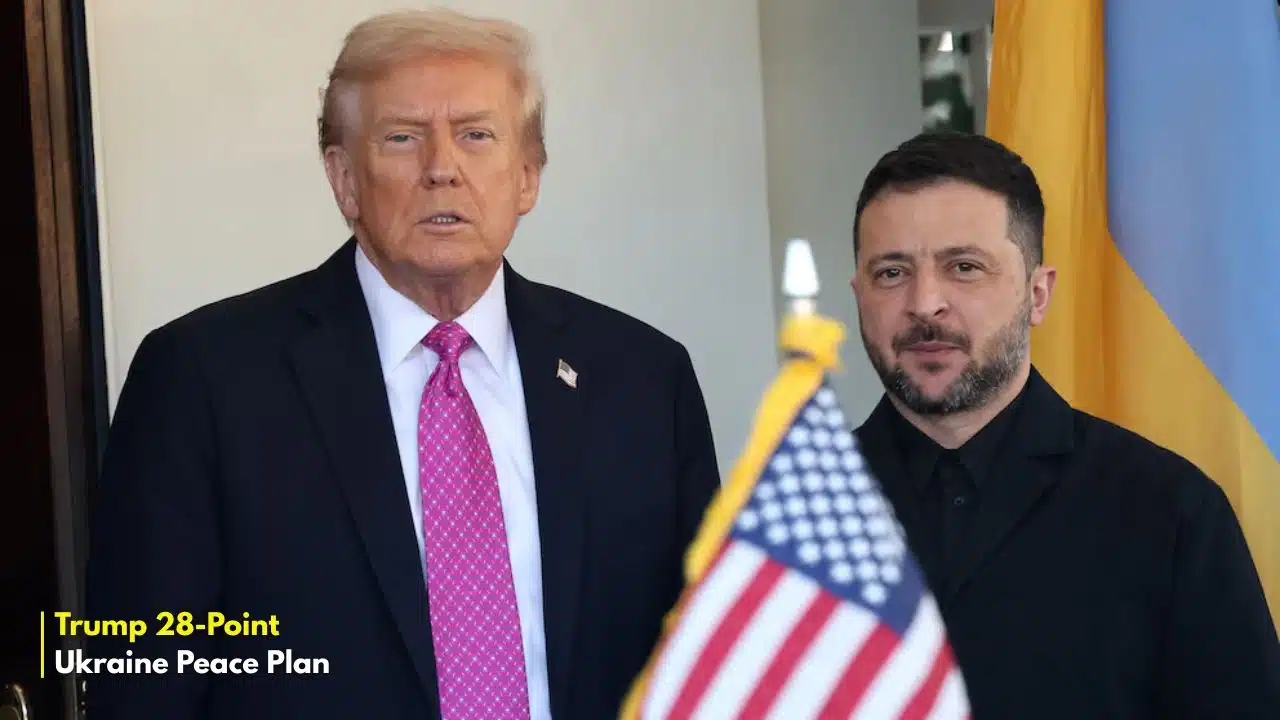
The silence surrounding President Donald Trump’s long-promised strategy to end the Russia-Ukraine war has shattered. A detailed, controversial 28-point peace plan, reportedly drafted by transition advisors and special envoys, has been leaked to key diplomatic circles, sparking a political earthquake from Kyiv to Brussels.
The proposal, obtained in draft form by multiple news agencies this morning, outlines a stark trade-off: territorial concessions and military neutrality for Ukraine in exchange for immediate security guarantees and a massive reconstruction fund. As President Volodymyr Zelensky prepares to meet President Trump in the coming days, the plan represents the most significant—and potentially explosive—diplomatic intervention since the full-scale invasion began in 2022.
Quick Take: The ‘28-Point’ Leak at a Glance
- Territory: Freezes the front lines; Crimea and Donbas recognized as “de facto” Russian territory.
- NATO: Ukraine constitutionally barred from NATO membership; Alliance agrees not to expand.
- Military Cap: Ukrainian Armed Forces limited to 600,000 personnel (down from approx. 850,000).
- Economics: Russia reintegrated into the global economy (G8 invitation) if it adheres to non-aggression.
- Enforcement: “Snap-back” sanctions and US military response if Russia violates the new lines.
The Core Proposal: Freezing the Map
At the heart of the 28-point plan is a pragmatic, albeit painful, acceptance of the current military reality. According to the leaked text, the proposal calls for an immediate ceasefire along the current line of contact.
Unlike previous Western proposals which demanded a Russian withdrawal to 2022 borders, this plan effectively cements Russian control over occupied territories.
- The 800-Mile DMZ: A demilitarized zone (DMZ) will be established along the front line. Russian forces are prohibited from entering this zone, but Ukraine must withdraw heavy weaponry from its perimeter.
- Status of Donbas & Crimea: The draft explicitly states that “Crimea, Lugansk, and Donetsk will be recognized as de facto Russian.” While the US stops short of de jure (legal) recognition, the distinction offers Vladimir Putin the domestic victory he requires.
“This is not a surrender, but a recognition of reality,” stated a source close to the Trump transition team, speaking on condition of anonymity. “We are stopping the killing. The borders can be debated by diplomats for the next fifty years, but the artillery stops today.”
Territorial Control & Proposals
| Region | Current Status (Nov 2025) | Trump Plan Proposal | Zelensky’s Position |
| Crimea | Russian Occupied (since 2014) | Recognized as De Facto Russian | Non-Negotiable Ukrainian Territory |
| Donbas | ~80% Russian Controlled | Recognized as De Facto Russian | Return to 1991 Borders |
| Zaporizhzhia | Partially Occupied | Frozen at Line of Contact | Demands Full Russian Withdrawal |
| Kherson | Partially Occupied | Frozen at Line of Contact | Demands Full Russian Withdrawal |
The Military Constraints: No NATO, Limited Army
Perhaps the most difficult pill for Kyiv to swallow is the dismantling of its Euro-Atlantic aspirations. Points 7 through 10 of the plan directly address Moscow’s primary casus belli: NATO expansion.
The plan demands that Ukraine “enshrine in its constitution that it will not join NATO.” In a reciprocal move, the Alliance would amend its statutes to block Ukraine’s future admission. This effectively neutralizes Ukraine, turning it into a buffer state between the Russian Federation and the West.
Furthermore, the plan limits the Ukrainian Armed Forces to 600,000 personnel.
- Context: Ukraine’s active military personnel surged to over 850,000 during the peak of the 2024-2025 attrition battles. A reduction to 600,000 would require significant demobilization.
- Security Guarantee: To offset the loss of NATO protection, the plan offers a unilateral US Security Guarantee. The language suggests that if Russia invades again, the US would trigger “decisive coordinated military response” and “snap-back” all lifted sanctions. However, no American troops will be stationed on Ukrainian soil; instead, European fighter jets would be garrisoned in neighboring Poland to enforce the skies.
Economic Carrots: Buying Russia’s Compliance
The 28-point plan diverges sharply from the Biden administration’s policy of economic isolation. It proposes a pathway for Russia’s rehabilitation into the global economy, arguing that a desperate, isolated Russia is more dangerous than a commercially integrated one.
- Sanctions Relief: Sanctions will be lifted “in stages” based on Russian compliance with the ceasefire.
- G8 Return: Russia would be invited to rejoin the G8 (formerly G7), restoring its status as a great power.
- Energy Cooperation: The US and Russia would enter a “long-term economic cooperation agreement” regarding energy and Arctic resources.
For Ukraine, the economic incentive is a “Powerful Global Reconstruction Package.” This includes a Ukraine Development Fund backed by the World Bank and US investors, targeting high-tech industries, AI data centers, and gas infrastructure modernization. The message to Kyiv is clear: Trade land for prosperity.
Reactions: “Dignified Peace” or “Capitulation”?
The leak has triggered a firestorm of diplomatic activity.
In Kyiv:
President Zelensky’s office initially dismissed the draft as “absurd,” with officials calling it a “provocation” designed to test Ukraine’s resolve. However, publicly, Zelensky has maintained a careful tone, stating he expects to discuss a “dignified peace” with Trump shortly.
“Peace cannot be capitulation,” Zelensky told reporters after meeting with a Pentagon delegation. “We will not trade our sovereignty for a ceasefire that Russia will break in six months.”
In Brussels:
The European Union is in a state of high alarm. EU Foreign Policy Chief Kaja Kallas emphasized that “peace plans cannot work if Europeans and Ukrainians do not agree.” There is a palpable fear that Washington is negotiating over the heads of European leaders, potentially leaving the EU to foot the bill for reconstruction while the US pivots away.
- French Response: Foreign Minister Jean-Noël Barrot reiterated that freezing the conflict on Putin’s terms would only invite future aggression against NATO’s eastern flank.
In Moscow:
Kremlin reactions have been cautiously optimistic. While Putin has publicly demanded even more—including the full withdrawal of Ukrainian troops from all annexed regions—Russian insiders view the “28 points” as a workable basis for negotiations, largely because it achieves their strategic goal of blocking Ukraine’s NATO membership.
The Grim Context: Why Now?
The timing of this proposal is driven by the brutal reality of the war’s trajectory in late 2025.
- Stalemate and Attrition: Despite billions in aid, the front lines have barely moved in 12 months, but the human cost has skyrocketed.
- Casualty Surge: According to the UN Human Rights Monitoring Mission in Ukraine (HRMMU), civilian casualties in the first ten months of 2025 were 27% higher than in 2024.
- Manpower Crisis: Both sides are bleeding. Russian casualties are estimated at over 1.16 million (killed and wounded) since 2022. Ukraine faces a severe shortage of infantry, with forced mobilizations causing domestic social friction.
The Human Cost (Estimated Nov 2025)
| Metric | Russia (Est.) | Ukraine (Est.) | Source |
| Total Casualties | ~1,163,000 | Confidential (High) | Ministry of Finance (UA) / Western Intel |
| Civilian Deaths (2025) | N/A | ~12,000+ (Jan-Oct) | UN HRMMU |
| Displaced Persons | N/A | ~250,000 (Donetsk 2025) | UN Refugee Agency |
Conclusion: A “Take It or Leave It” Moment
The “28-Point Plan” bears the hallmarks of Donald Trump’s deal-making style: transactional, unsentimental, and focused on immediate de-escalation rather than ideological victory.
For Zelensky, the choice is existential. Rejecting the plan risks the total cessation of American military aid, leaving Ukraine to fight a war of attrition it cannot win alone. Accepting it means signing away 20% of his country and rewriting the constitution under foreign pressure.
As the White House prepares for the upcoming summit, the world watches to see if this blueprint will indeed silence the guns of Europe—or if it will merely pause the conflict for a bloodier next chapter.































