Ever catch yourself staring up at the Moon and thinking, “I wish I owned a piece of that?” You’re not alone.
Back in 1980, a guy named Dennis Hope actually went ahead and claimed it. He walked into a government office, filed some paperwork, and started selling lunar land like it was beachfront property in Florida. Over the years, his company has brought in over $12 million, and he’s sold land to everyone from Hollywood A-listers to former U.S. presidents.
Dennis Hope is the man who made a fortune from selling the moon.
In this post, I’m going to walk you through how he pulled it off, why millions of people went along with it, and what space law experts really think about his wild venture. You might be surprised at how a simple loophole turned into a multimillion-dollar business.
Key Takeaways
- Dennis Hope claimed ownership of the Moon in 1980 by exploiting what he saw as a loophole in the 1967 Outer Space Treaty, which bans nations but not individuals from claiming celestial bodies.
- His company, Lunar Embassy, has sold over 611 million acres on the Moon and 325 million acres on Mars, reaching customers in more than 190 countries worldwide.
- Buyers include Tom Cruise, Nicole Kidman, and three former U.S. presidents, plus around 1,800 corporations like Hilton and Marriott.
- Legal experts and space law scholars say Hope’s claims violate international law, as the Outer Space Treaty applies to all entities, not just governments.
- According to estimates from 2024 and 2025, Dennis Hope’s personal net worth sits at approximately $10 million, though his business has generated over $12 million in total sales since 1980.
Who is Dennis Hope and What is His Claim to the Moon?
Back in 1980, Dennis Hope was unemployed, going through a divorce, and living in San Francisco. He was staring at a pretty tough situation.
Then one night, he looked up at the moon and had a wild thought: “There’s a lot of property up there.”
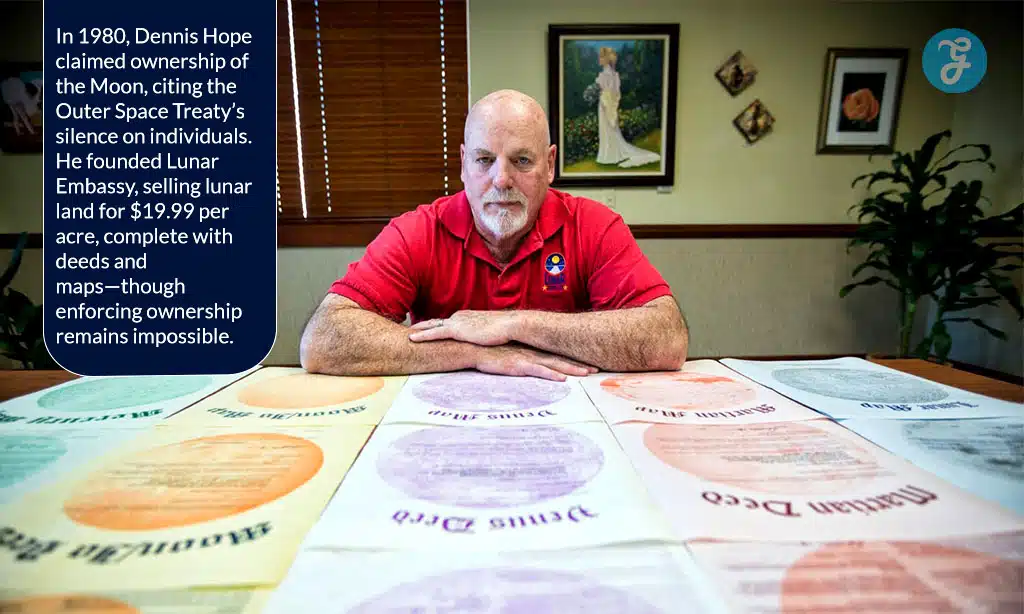
Hope dug into the 1967 Outer Space Treaty and noticed something interesting. Article II says no nation can claim sovereignty over the Moon or other celestial bodies. But it doesn’t say anything about individuals. He figured that was his opening. So he walked into a San Francisco county office and filed a declaration of ownership for the Moon and eight other celestial bodies. He even mailed letters to the United Nations, the U.S. government, and the Soviet Union, letting them know what he was doing. No one wrote back.
According to a 2024 report, Hope’s interpretation hinges on the idea that the treaty “addresses only nations, not individuals.” Whether that holds water is another story, but it gave him the confidence to start his business. He launched Lunar Embassy and began selling one-acre plots of the Moon for around $19.99 each. By 1995, he was making enough money to quit his day job and focus full-time on lunar real estate.
Hope’s pitch is simple: when you buy land from him, you get a deed with your name on it, a map showing your plot’s location, and a copy of the “Lunar Constitution.” He even promises buyers the right to exclude unauthorized visitors from their property, though how you’d enforce that from 238,000 miles away is anyone’s guess. Some areas, like the Apollo landing sites and the polar regions with frozen water, are designated as “celestial reserves” and aren’t for sale.
The Birth of Lunar Real Estate
The whole lunar real estate craze started in 1980, but Hope didn’t just wake up one day with this idea fully formed. He was broke, frustrated, and looking for a way out.
According to interviews he’s given over the years, the concept came to him during a cross-country drive in the late 1970s. By the time he got back to San Francisco, he’d decided to look into whether anyone actually owned the Moon.
How did lunar real estate start in the 1980s?
In 1980, Hope filed his claim and got the ball rolling. At first, he’d sit in bars with a stack of deeds in his coat pocket. When someone asked what he did for a living, he’d say, “I sell the Moon.” Most people laughed, but some bought in. According to a 2024 article, Hope recalled, “I’d sit in bars, with a batch of deeds in my coat. I’d get talking to someone, and when they asked what I did, I’d say, ‘I sell the moon.'”
By the mid-1990s, he’d trademarked the name “Lunar Embassy” and built a website called MoonShop. This was right when the internet was taking off, and suddenly Hope could reach customers all over the world. He wasn’t just selling to bar patrons anymore. He was selling to celebrities, corporations, and anyone curious enough to buy a novelty gift. The prices were low enough that it felt like a fun gamble: a single acre for $19.99, or a “continent-sized” plot of 5.3 million acres for $13.3 million.
What loophole in international law did Dennis Hope use?
The loophole Hope relied on is in Article II of the 1967 Outer Space Treaty. As of May 2025, 117 countries are parties to this treaty, including all major spacefaring nations. The treaty states that “outer space is not subject to national appropriation by claim of sovereignty, by means of use or occupation, or by any other means.” The key word here is “national.” Hope argues that because the treaty only mentions nations, it doesn’t stop private individuals from staking a claim.
Space law experts like Tanja Masson-Zwaan, president of the International Institute of Space Law, and Frans von der Dunk strongly disagree. They point out that Article VI of the Outer Space Treaty makes it clear that countries are responsible for “national space activities whether carried out by governmental or non-governmental entities.” In other words, the treaty covers both governments and private citizens.
Henry Hertzfeld from George Washington University has noted that the problem isn’t just the treaty language. It’s also that there’s no enforcement mechanism. Fraud cases against Hope have been filed in Germany and Sweden, but they fizzled out because no court felt it had jurisdiction over lunar property. China outright banned Lunar Embassy sales, calling them “ludicrous” profiteering. But in most countries, Hope’s business continues unchallenged, not because it’s legal, but because no one has the tools to stop him.
The Business of Selling the Moon
Once Hope had his claim filed, he needed to turn it into a real business. That meant creating a brand, setting prices, and figuring out how to market something as absurd as lunar real estate. And somehow, it worked.
How was Lunar Embassy created?
Lunar Embassy was born out of necessity. After Hope filed his claim in 1980, he realized people weren’t going to take him seriously unless he looked like a legitimate operation. So he trademarked the name “Lunar Embassy” and started printing official-looking deeds. By 1995, he’d launched MoonShop, an online storefront where customers could browse different celestial properties and place orders.
Each purchase comes with a personalized deed, a lunar map showing the buyer’s plot, and a copy of the Lunar Constitution. According to Hope’s website, the company has been featured on TV in over 180 countries on around 80 different channels, including CNN, NBC, and the BBC. That kind of media attention gave the business a legitimacy it probably didn’t deserve, but it helped Hope reach a massive audience.
In 2004, Hope took things a step further by founding the “Galactic Government,” a democratic republic that represents all lunar landowners. It has its own constitution, which was ratified by 173,562 people that same year. There’s even a unit of currency called the “Delta,” which Hope claims is backed by the Moon’s helium reserves, valued at $6 quadrillion.
How many acres have been sold worldwide?
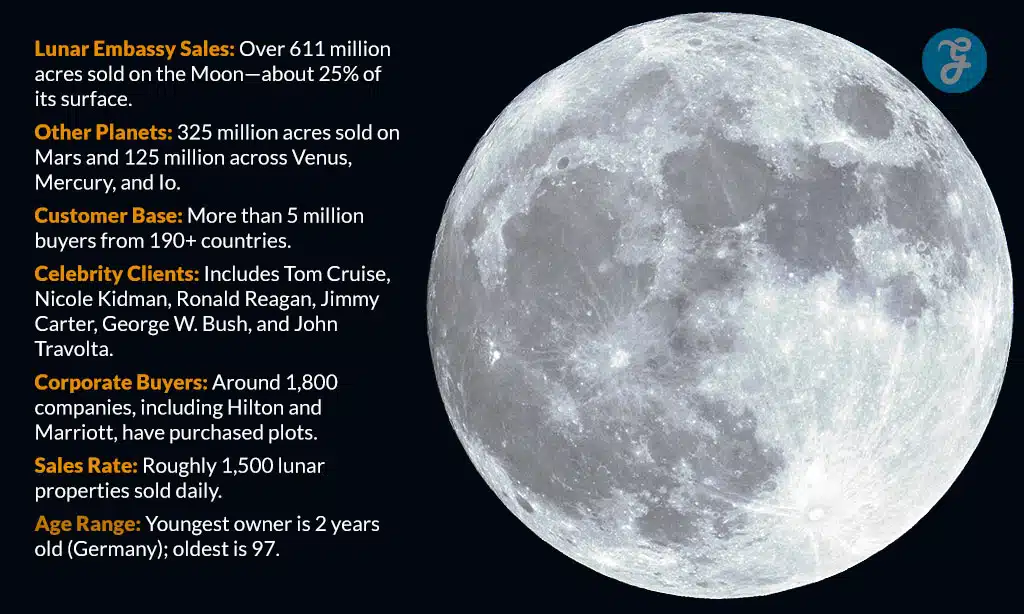
The numbers are staggering. According to a 2024 report, Lunar Embassy has sold over 611 million acres on the Moon alone. That’s enough land to cover roughly a quarter of the lunar surface. But Hope didn’t stop there. He’s also sold 325 million acres on Mars and 125 million acres combined on Venus, Mercury, and Io, one of Jupiter’s moons.
| Celestial Body | Acres Sold | Famous Buyers | Notable Companies |
|---|---|---|---|
| Moon | 611 million | Tom Cruise, Nicole Kidman, Ronald Reagan, Jimmy Carter, George W. Bush | Hilton, Marriott |
| Mars | 325 million | John Travolta | – |
| Venus | Part of 125 million (with Io & Mercury) | – | – |
| Io (Jupiter’s moon) | Part of 125 million (with Venus & Mercury) | – | – |
| Mercury | Part of 125 million (with Venus & Io) | – | – |
Hope claims to have over five million customers worldwide. Among them are 675 celebrities and three former U.S. presidents. According to a National Geographic article, around 1,800 major corporations have also bought land, including hotel chains like Hilton and Marriott, presumably eyeing future space tourism opportunities. Hope says his company moves about 1,500 lunar properties every single day.
The youngest lunar landowner is a two-year-old from Germany, and the oldest is 97. People from over 190 countries have purchased plots. Some buy them as gag gifts, others as novelty collectibles, and a few seem to genuinely believe they’re making a smart investment.
Why Did Dennis Hope Expand Claims to Mars, Venus, and Other Celestial Bodies?
After seeing how well Moon sales were going, Hope decided to think bigger. Why stop at one celestial body when you could claim them all?
He expanded his portfolio to include Mars, Venus, Mercury, Io, and even Pluto. The logic was simple: if people wanted a piece of the Moon, they might also want land on Mars, especially with all the buzz around space exploration and potential colonization. Elon Musk’s SpaceX has been talking about Mars missions for years, and that’s only fueled interest in Martian real estate.
According to a 2024 report, Hope has sold 325 million acres on Mars alone. For those with deeper pockets or bigger imaginations, he’s even selling entire planets. You can buy Pluto for $250,000 if you want your own dwarf planet. Hope also introduced extraterrestrial domain names like .mars and .moon, adding another layer to his space commerce empire.
In 2004, Hope announced the creation of the Galactic Government to represent all these new landowners. He introduced “Delta,” a currency supposedly backed by helium resources from the Moon, which he values at $6 quadrillion. Whether any of this has real-world value is highly debatable, but it certainly makes for a compelling story.
Controversies and Legal Challenges
Not everyone thinks Hope’s lunar land sales are harmless fun. Legal scholars, space law experts, and even some governments have serious problems with what he’s doing.
What disputes exist over the legality of lunar property sales?
- Legal experts like Tanja Masson-Zwaan and Frans von der Dunk argue that the 1967 Outer Space Treaty blocks all claims to celestial bodies, not just government claims. Article VI makes countries responsible for private space activities, which means the treaty applies to individuals too.
- Fraud cases have been filed against Hope in Germany and Sweden, but both cases fell apart due to weak enforcement and jurisdictional issues. No court wanted to touch the question of who owns the Moon.
- China banned Lunar Embassy sales outright, calling them profiteering and nonsense. Chinese authorities have made it clear that these deeds are worthless under their law.
- Henry Hertzfeld from George Washington University has pointed out that enforcement is nearly impossible. Most courts see these claims as unenforceable because no government recognizes them.
- The Jurgen family in Germany has claimed Moon ownership since 1756, based on a supposed gift from Prussian King Frederick the Great. Their claim predates Hope’s by more than 200 years, but like Hope’s, it has no legal standing.
- Hope sent letters to the United Nations and the Soviet Union in 1980, informing them of his claim. He never got a response, which he interprets as tacit approval. Legal experts call that wishful thinking.
What criticisms come from legal and scientific communities?
The backlash from the legal and scientific communities has been sharp. Tanja Masson-Zwaan, president of the International Institute of Space Law, has said bluntly, “What Lunar Embassy is doing does not give people buying pieces of paper the right to ownership of the moon.” She argues that the Outer Space Treaty is clear: no one can own celestial bodies, period.
Frans von der Dunk, another leading space law scholar, has made similar points. He notes that Article VI of the treaty makes governments responsible for the actions of their private citizens in space. That means Hope’s claim isn’t just questionable; it’s actively in violation of international law, even if no government has bothered to prosecute him.
According to a 2021 National Geographic report, “The moon is unclaimable under the 1967 Outer Space Treaty, which has so far been ratified by 100 UN member countries, including the United States.”
Fact-checkers and watchdog groups have also weighed in, labeling Hope’s operation as misleading at best and a scam at worst. They warn consumers that these deeds have zero real-world value and won’t be recognized by any court or government. Some regulatory agencies have urged people to think twice before buying lunar land, especially if they’re treating it as a serious investment.
Despite all this criticism, Hope has continued to operate for more than 40 years. He’s faced legal challenges, media skepticism, and outright bans in some countries, but his business keeps going. The lack of enforcement mechanisms means that even though experts say his claims are bogus, there’s no one with the authority or will to shut him down.
The Man Who Made A Fortune From Selling The Moon
Love him or hate him, Dennis Hope has left a mark on the way we think about space property rights. He’s forced legal scholars to grapple with questions they’d rather ignore and inspired a whole industry of lunar novelty businesses.
According to estimates from 2025, Hope’s net worth is around $10 million, and his company has generated over $12 million in total sales since 1980. He claims to be the richest man in the solar system if you count his “ownership” of the Moon, Mars, and other celestial bodies. Whether that’s true depends on who you ask.
Hope has sold land to over 675 celebrities, three former U.S. presidents, and around 1,800 major corporations. Companies like Hilton and Marriott have reportedly secured plots, possibly with an eye toward future space tourism. Hope has also established 23 “celestial reserves,” covering areas like the Apollo landing sites and the polar regions where water ice is found. In 2011, he turned down a $50 million offer for land at the Moon’s north pole, saying he wanted to keep prices affordable for future settlers.
His business got a major boost after the 2012 documentary “Lunarcy!” aired across the U.S., leading to a 30 percent jump in sales. After more than 40 years in the game, Hope has become a pop culture icon, whether people take him seriously or not. He’s sparked renewed interest in lunar exploration and raised questions about commercial space ventures that are more relevant now than ever.
With companies like SpaceX and Blue Origin pushing for commercial space exploration, and the commercial space industry projected to surpass $1 trillion by 2040, the questions Hope raised decades ago are becoming urgent. As of January 2025, 50 nations have signed the Artemis Accords, which outline a framework for peaceful space exploration and address property rights in space. The debate over who can claim what in space is far from over, and Hope’s story is part of that ongoing conversation.
Final Words
Some people sell real estate on Main Street. Dennis Hope aimed for the stars.
His Moon ownership story sits at the intersection of creative entrepreneurship and legal gray areas. He found what he believed was a loophole in the 1967 Outer Space Treaty and turned it into a multimillion-dollar business. Whether you see him as a visionary or a con artist, there’s no denying he’s made people think about space property rights in a whole new way.
His name is now tied to the concept of celestial property forever, and his story raises questions that are becoming more important as commercial space exploration takes off.
FAQs
1. Who is Dennis Hope and how did he sell the Moon?
Dennis Hope is an American entrepreneur who in 1980 filed a claim of ownership for the Moon, citing a perceived loophole in the 1967 Outer Space Treaty. He then established the Lunar Embassy, a business that has since sold millions of acres of lunar property to customers worldwide.
2. Is buying land on the Moon actually legal?
No, these deeds are not recognized by any government and have no legal standing, as the 1967 Outer Space Treaty forbids nations from claiming celestial bodies. Hope argued the treaty did not apply to individuals, but legal experts agree the claims are unenforceable, making the deeds novelty items.
3. How much money did Dennis Hope make from selling Moon property?
He has reportedly earned over $11 million from his venture, selling plots for as low as $20 per acre to millions of customers. His buyers include numerous celebrities like Tom Cruise and John Travolta, and even former U.S. Presidents Ronald Reagan and Jimmy Carter.
4. Can you actually visit or use the Moon land you buy from Dennis Hope?
No, the deeds are purely symbolic and do not grant you any right to visit, build on, or use the land you’ve purchased.