

Imagine a world where the odds are stacked entirely against you. You are living in a country under colonial rule. Scientific resources are scarce. Laboratories are poorly equipped. The global scientific community is dominated by the West. Most people would give up before they even started. But C. V. Raman was not like most people.
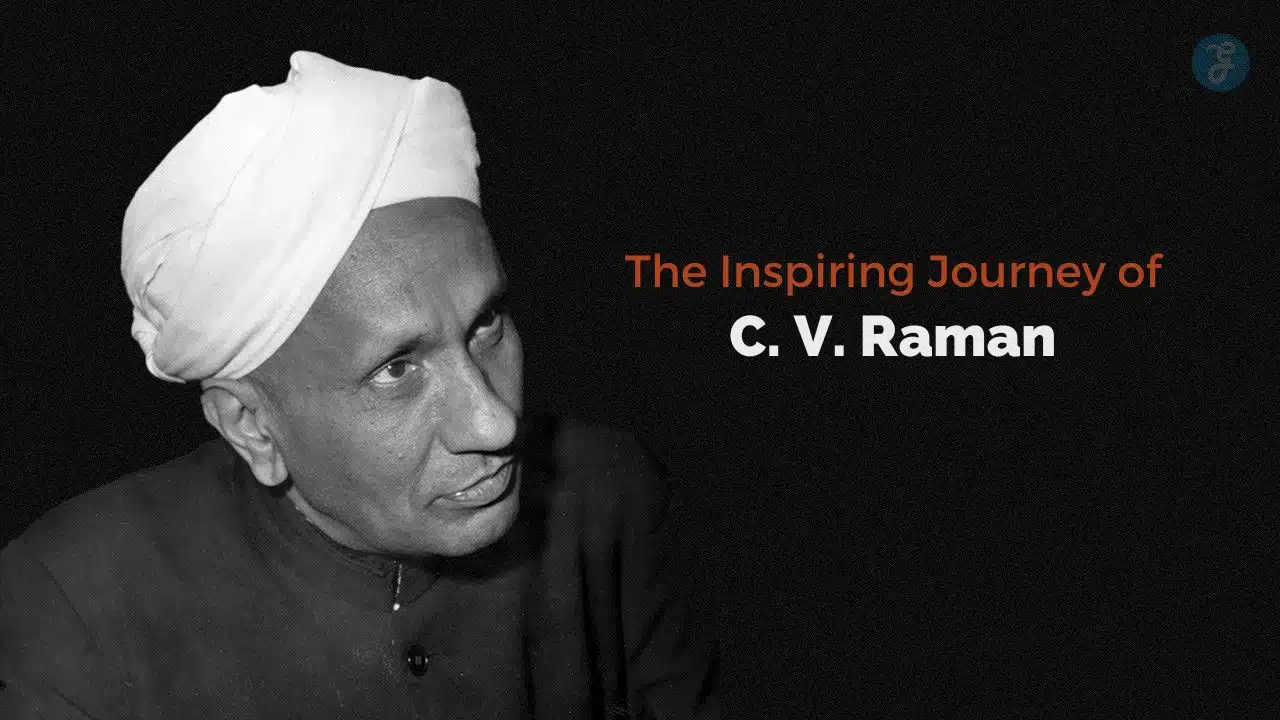
Sir Chandrasekhara Venkata Raman, better known as C. V. Raman, is a name that stands tall in the history of science. His journey was not just about discovering a physics phenomenon.
It was a story of relentless curiosity and an unshakeable belief in himself. He proved that great science does not come from expensive machines. It comes from the human mind.
From his early days as a child prodigy in Madras to the glittering halls of Stockholm, where he received the Nobel Prize, Raman’s life is a blueprint for anyone who dares to dream. Let us take a deep dive into the life of this extraordinary man who put India on the global scientific map.
The Boy Genius of Tiruchirappalli
Raman was born on November 7, 1888, in Tiruchirappalli in the Madras Presidency. It was clear from the very beginning that he was gifted. His father was a lecturer in mathematics and physics. This meant that young Raman grew up surrounded by books. While other children were playing games, he was absorbing complex academic concepts.
His academic progress was nothing short of rapid. He passed his matriculation examination at the age of 11. This is an age when most children are just finishing elementary school. Two years later, at the age of 13, he completed his intermediate examination with a scholarship.
He then moved to the Presidency College in Madras to pursue his degree. In 1904, he graduated with a Bachelor of Arts degree. He was only 16 years old. He did not just pass. He topped the entire university and won a gold medal in physics.
Most students at that age are unsure of what they want to do with their lives. Raman was already conducting high-level research. At the age of 18, he became the first student from Presidency College to publish a scientific paper in the Philosophical Magazine in London. This was a prestigious journal, and having a paper accepted there was a massive achievement for an Indian student in the early 1900s.
The Civil Servant Who Lived a Double Life
Despite his obvious brilliance, a career in science was not a practical option in British India. Research jobs were few and far between. The pay was low. His teachers recognized his talent and encouraged him to go to England for further studies. However, a British civil surgeon ruled that Raman’s health was too weak to withstand the harsh English climate.
Raman had to stay in India. He followed the standard path for bright young men of his time. He sat for the Financial Civil Service examination. To no one’s surprise, he topped the exam.
In 1907, at the age of 19, he joined the government as an Assistant Accountant General in Calcutta. He had a high-ranking job, a high salary, and a secure future. For most people, this would be the definition of success. For Raman, it was just a way to pay the bills.
His heart was not in accounting. It was in physics.
One day, while riding a tram in Calcutta, he saw a sign for the Indian Association for the Cultivation of Science (IACS). He immediately went inside. He met the secretary and asked if he could conduct research there in his spare time.
This marked the beginning of his famous double life. He would work at his government office from morning until late afternoon. Then he would rush to the IACS laboratory. He would work late into the night, conducting experiments on acoustics and optics. He even went there on weekends and holidays.
This went on for ten years. It is a testament to his incredible dedication that he managed to produce world-class research while working a full-time bureaucratic job.
The Voyage That Changed History
The turning point in his life came in 1921. Raman made his first trip to Europe to attend a conference. The trip was successful, but the real breakthrough happened on his way back home.
Raman was traveling aboard the ship S.S. Narkunda. As he stood on the deck, he looked out at the vast Mediterranean Sea. He was mesmerized by its deep, brilliant blue color.
At that time, the accepted scientific explanation came from Lord Rayleigh. Rayleigh believed that the sea was blue simply because it was reflecting the color of the blue sky.
Raman was a man who questioned everything. He did not just accept Rayleigh’s theory. He pulled a small Nicol prism from his pocket. He used it to observe the water and block out the reflection of the sky. He saw that the water remained blue.
He realized immediately that the water molecules themselves were scattering the sunlight. He hypothesized that the blue color was intrinsic to the water. This simple moment of curiosity on a ship’s deck sparked a line of inquiry that would consume him for the next seven years.
The Discovery of the Raman Effect
After returning to India, Raman eventually resigned from his civil service job. He accepted a position as a professor at the University of Calcutta. He took a massive pay cut, but he was finally free to do what he loved full-time.
He and his students, including the brilliant K. S. Krishnan, began a series of rigorous experiments on light scattering. They wanted to understand exactly what happened when light passed through different liquids.
What is the Raman Effect?
The Raman Effect is a phenomenon where light changes its color when it passes through a transparent material. Imagine throwing a tennis ball at a wall. Usually, it bounces back at the same speed. This is how light normally behaves.
However, in the Raman Effect, it is as if the tennis ball hits the wall and comes back slightly faster or slower. This happens because the light particles exchange energy with the molecules they hit. This energy change creates a color shift, which acts like a unique fingerprint for that material.
They discovered something extraordinary. When a beam of light hits a molecule, most of the light bounces off with the same energy. However, a very tiny fraction of the light changes its energy. This change in energy causes a change in color.
Raman explained that the photons (particles of light) were exchanging energy with the molecules. If the photon gave energy to the molecule, the light’s color would shift towards red. If it had energy, it would shift toward blue.
This phenomenon was unique to every substance. It acted like a fingerprint. By analyzing this scattered light, scientists could identify exactly what kind of molecules were in a sample.
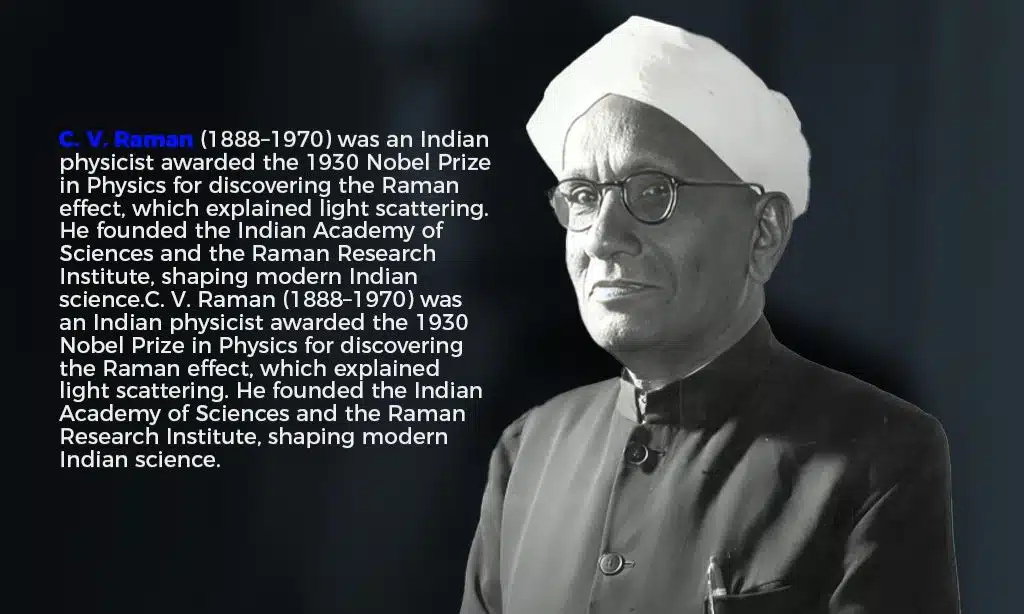
On February 28, 1928, Raman and Krishnan confirmed the discovery. They called it “modified scattering,” but the world soon came to know it as the “Raman Effect.”
The discovery was groundbreaking. It provided the first solid proof of the quantum nature of light. It opened up entirely new fields of study in chemistry and physics.
Confidence and the Nobel Prize
Raman knew he had made a history-changing discovery. He was incredibly confident. In fact, his confidence is legendary.
He was confident he deserved the prize and was vocal about his expectations. He knew his work was worthy of the highest honor in science. By 1930, he was so sure he would win that he did something unprecedented.
The Nobel Prize winners are usually announced in November. In July of 1930, months before the announcement, Raman booked two steamship tickets to Stockholm. He booked one for himself and one for his wife. He did not wait for the official letter. He wanted to make sure he had a seat on the ship so he could attend the ceremony in December.
His intuition was correct. In November 1930, the Nobel Committee announced that C. V. Raman was the winner of the Nobel Prize in Physics.
He became the first Asian and the first non-white person to receive a Nobel Prize in the sciences. It was a monumental moment for India. A man working in a colonial laboratory with simple equipment had beaten the best-funded institutions in the world.
Building Institutions for the Future
Winning the Nobel Prize was not the end of Raman’s career. It was just the beginning of his second act. He wanted to ensure that future generations of Indian scientists would not have to struggle for resources the way he did.
In 1933, he became the first Indian director of the Indian Institute of Science (IISc) in Bangalore. He later founded the Indian Academy of Sciences.
After retiring from the IISc, he established his own institute in 1948. It was called the Raman Research Institute (RRI). He poured his personal savings and his Nobel Prize money into this project. He aimed to establish an environment conducive to unrestricted research.
He loved nature, so he filled the RRI campus with gardens, trees, and flowers. He believed that a beautiful environment fostered beautiful thoughts. He remained active in research until his final days. He often said that the true wealth of a nation lies in the intellectual capability of its people.
Why C. V. Raman Matters Today?
Sir C. V. Raman passed away on November 21, 1970. However, his legacy is more vibrant than ever.
Every year on February 28, India celebrates National Science Day. This day commemorates the discovery of the Raman Effect. It serves as a reminder to students across the country that science is not about rote memorization. It is about questioning the world around you.
The Raman Effect is now used in technology all over the world. It is used in airport security scanners to detect explosives. It is used in museums to analyze pigments in old paintings without damaging them. It is used in medicine to detect cancer cells.
Raman’s life teaches us that limitations are often just in our heads. He did world-class research in a colonial era with simple equipment. He did not wait for permission or funding to chase his curiosity. He saw the blue sea and asked, “Why?” That simple question unlocked secrets of the universe that we are still using today.
Frequently Asked Questions or FAQs
Here are the most frequently asked questions people have about C. V. Raman.
Why is National Science Day celebrated on February 28?
National Science Day is celebrated in India on February 28 to mark the specific date in 1928 when C. V. Raman discovered the Raman Effect. The Government of India chose this date to honor his massive contribution to science.
The day is used to inspire students to pursue careers in research and innovation. It reminds everyone that significant scientific breakthroughs can happen anywhere if there is dedication and curiosity.
Is it true that C. V. Raman booked his Nobel Prize tickets early?
Yes, this is a famous and true story that highlights his confidence. In 1930, C. V. Raman booked steamship tickets to Stockholm in July. This was several months before the Nobel Prize winners were officially announced in November.
He was so certain of the importance of his work that he made travel arrangements for himself and his wife well in advance to ensure they would be present at the ceremony.
What inspired C. V. Raman to discover the Raman Effect?
The inspiration came during a sea voyage to Europe in 1921. While standing on the deck of the ship, Raman was fascinated by the deep blue color of the Mediterranean Sea. He questioned the prevailing scientific theory that the sea was blue simply because it reflected the sky.
He used a pocket prism to observe the water and realized the water molecules were scattering light themselves. This observation led him to conduct years of experiments on light scattering.
Was C. V. Raman the first Indian to win a Nobel Prize?
C. V. Raman was the first Indian to win the Nobel Prize in the sciences, specifically physics, in 1930. He was also the first Asian and non-white person to receive a Nobel Prize in any scientific field. However, he was not the first Indian to win a Nobel Prize in any category. Rabindranath Tagore had previously won the Nobel Prize in Literature in 1913.































