Tesla, Inc. (TSLA) has officially crossed a new threshold in the global race for autonomous driving supremacy. The electric vehicle giant, led by CEO Elon Musk, has successfully completed what it claims is the world’s first fully driverless car delivery, marking a critical step forward in Tesla’s long-promised self-driving future.
Model Y Drives Itself with No One Inside
In a first-of-its-kind operation, a Tesla Model Y drove itself from the company’s Gigafactory in Austin, Texas, to a customer’s home located approximately 15 miles away, completing the journey in around 30 minutes. What makes this event groundbreaking is the complete absence of any human presence—neither inside the vehicle nor operating it remotely.
The entire journey was captured on video, which Tesla later released to the public in two parts: an initial three-minute teaser, followed by the full 30-minute footage filmed from the back seat of the car. The video showcases the Model Y effortlessly managing complex driving tasks such as merging onto highways, navigating intersections, stopping at red lights, making smooth left and right turns, obeying speed limits, and finally parking itself safely beneath the customer’s apartment complex.
The delivery reportedly occurred without any external guidance or intervention, and according to Tesla, not even remote operators were involved in steering or monitoring the car during its route—an industry first on public roads in real-world conditions.
Major Leap Amid Previous Concerns and Early Setbacks
This milestone arrives just over a week after Tesla launched its robotaxi pilot program in Austin on June 22, 2025. The pilot, which involves using Tesla’s Full Self-Driving (FSD) software in Model Y vehicles, is currently running in a geofenced area of the city and includes human safety monitors sitting in the front seat.
However, early feedback from the program has been mixed, if not alarming. In user-recorded videos from these initial rides, the Tesla robotaxis have been seen making erratic driving decisions, such as:
-
Abrupt and unnecessary braking
-
Driving into oncoming traffic lanes
-
Failing to yield properly at intersections
-
Dropping off passengers in unsafe locations
-
Running over a curb
-
Drifting between lanes unexpectedly
These incidents raised regulatory concerns, and the U.S. National Highway Traffic Safety Administration (NHTSA) has since opened an inquiry into Tesla’s robotaxi operations, citing safety and reliability issues in real-world conditions. The agency stated that it is actively gathering information from Tesla to evaluate whether these autonomous features meet federal safety standards.
Despite the rocky start, Tesla appears to be pushing full steam ahead with its ambitious autonomous vision. According to sources and past public comments, Musk has envisioned a future where millions of autonomous robotaxis operate on roads worldwide, serving both logistics and ride-hailing purposes.
The Historic Delivery: Details of the Drive
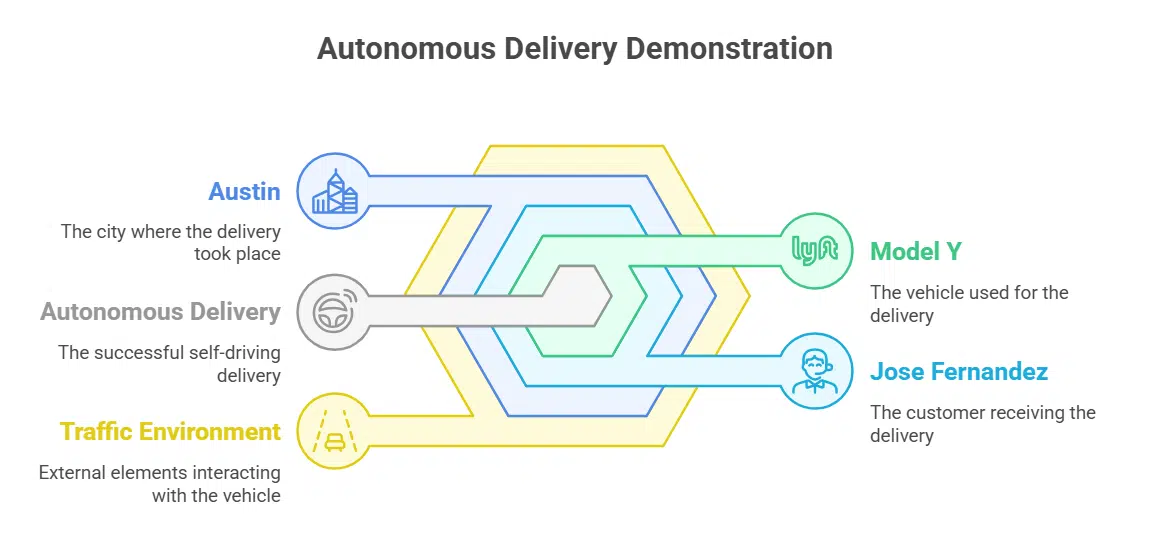
The customer chosen for the delivery was Jose Fernandez, a resident of Austin. The Model Y drove entirely by itself from Tesla’s manufacturing facility to Fernandez’s home, obeying all traffic regulations and interacting appropriately with surrounding vehicles, traffic lights, pedestrians, and road signs.
The video released by Tesla reveals several key highlights from the journey:
-
The car accelerates smoothly onto the highway using on-ramp lanes.
-
It navigates complex intersections with traffic signals and multiple turn lanes.
-
It makes well-judged lane changes on busy roads and highways.
-
It slows down appropriately for traffic lights, construction zones, and pedestrians.
-
It turns into residential roads and ultimately finds and parks in a designated space beneath the recipient’s building.
This single delivery could signal Tesla’s growing confidence in its camera-based Full Self-Driving (FSD) platform, which uniquely does not use LiDAR, radar, or high-definition maps—technologies commonly adopted by competitors like Waymo and Cruise.
Tesla’s Vision: AI-Powered Driving Without Human Supervision
Tesla’s autonomy strategy is distinct in its reliance on vision-based AI and real-time decision-making rather than pre-programmed routes or sensors like LiDAR. Tesla believes this approach is not only scalable but also closer to how human beings perceive and react to the road.
According to the company, this system is being trained using a massive fleet of Teslas collecting real-world driving data. The Model Y used in the autonomous delivery relied exclusively on Tesla’s neural networks and AI-based inference engine, running on the onboard computer to evaluate surroundings and make driving decisions.
Tesla has also been advancing its AI training using its in-house Dojo supercomputer, aimed at dramatically speeding up model improvements and enabling more complex driving scenarios.
TSLA’s Current Stock Status and Analyst Outlook
Despite the recent technological achievement, Tesla’s stock performance remains under pressure. The company currently holds a Zacks Rank #5 (Strong Sell). Analysts have expressed concerns regarding slowing electric vehicle (EV) demand, particularly in North America and Europe, which has impacted Tesla’s near-term revenue outlook.
Meanwhile, other auto sector players are being recognized for strong financial performance. According to Zacks Investment Research, the following companies currently have a Zacks Rank #1 (Strong Buy):
-
Strattec Security Corporation (STRT): Projected to see a 3.49% increase in revenue and 8.11% earnings growth in fiscal 2025. EPS estimates have improved significantly in the last 60 days.
-
Allison Transmission Holdings (ALSN): Expected to grow earnings by 6.26% in 2025, with notable improvements in analyst estimates.
-
Ferrari N.V. (RACE): On track for 13.56% sales growth and 7.97% earnings growth in 2025. Estimates have been raised in the past week alone.
This reflects investor appetite for companies with strong fundamentals and growth prospects in contrast to Tesla’s current volatility, despite its tech milestones.
Musk’s Roadmap: Robotaxis and Humanoid Robots
CEO Elon Musk has made clear that autonomous vehicles and AI-powered robots represent the future of Tesla. With global EV sales softening and competition increasing, Musk sees autonomy as the next frontier of profitability and innovation.
Earlier this month, Musk teased that Tesla would reveal its long-promised robotaxi model on August 8, 2025. He envisions these vehicles operating in fleets that generate passive income for owners and offer cost-effective rides for users.
In addition to self-driving vehicles, Musk is also focusing on scaling up Tesla’s Optimus humanoid robot project, with applications ranging from warehouse automation to household assistance. These robots are currently in early testing phases at Tesla facilities.
A Bold Step with Many Miles to Go
Tesla’s successful driverless delivery of a Model Y in Austin is an undeniable milestone. It pushes the boundaries of what’s currently being done in public road autonomy and showcases the company’s commitment to making full self-driving a reality.
However, the achievement must be viewed alongside persistent safety concerns, regulatory scrutiny, and the mixed results from Tesla’s early robotaxi tests. While the technology is rapidly evolving, broader deployment and public trust will require sustained improvements and transparency.
Tesla is no stranger to controversy or ambition—but if this driverless delivery is a sign of things to come, the company could be inching closer to transforming the global mobility landscape. Yet for now, the road to widespread autonomy still demands caution, oversight, and rigorous validation.