Hey there, are you curious about the latest tech wonders but feeling a bit lost in the fast-moving world of innovation? It’s tough to keep up with all the new startups and game-changing ideas popping up, especially in a place like Germany, buzzing with deep tech startups.
Guess what? Germany is a hot spot for tech in 2025, with cities like Berlin and Munich leading the charge as major hubs for artificial intelligence and space technology. This blog will break it all down for you, shining a light on 15 amazing deep tech startups shaking things up.
We’ll show you who they are, why they matter, and what’s next for tech in Germany. Stick around to find out more!
Key Takeaways
- Germany’s deep tech scene in 2025 is booming, with record funding in the DACH region, including Helsing’s $600 million Series C round, reaching a $12 billion valuation.
- Key sectors like AI, defense, and space tech are growing fast, with ISA Aerospace securing $150 million and earning unicorn status for low-Earth orbit solutions.
- Berlin hosts over 60% of Germany’s unicorns, while Munich excels in B2B SaaS and fintech, with Scalable Capital raising $155 million in Series E.
- Healthtech and biotech shine with ITM SE getting $262.5 million for cancer treatments and Tubulis Therapeutics raising $90.5 million for therapies.
- Startups like Impossible Cloud, valued at $470 million, are redefining cloud storage, showing Germany’s strength in deep tech innovation.
Overview of Germany’s Deep Tech Ecosystem in 2025
Hey, wanna know what’s cooking in Germany’s tech scene for 2025? It’s buzzing with fresh ideas, big bucks, and bold moves that are shaking things up!
Growth in funding and innovation
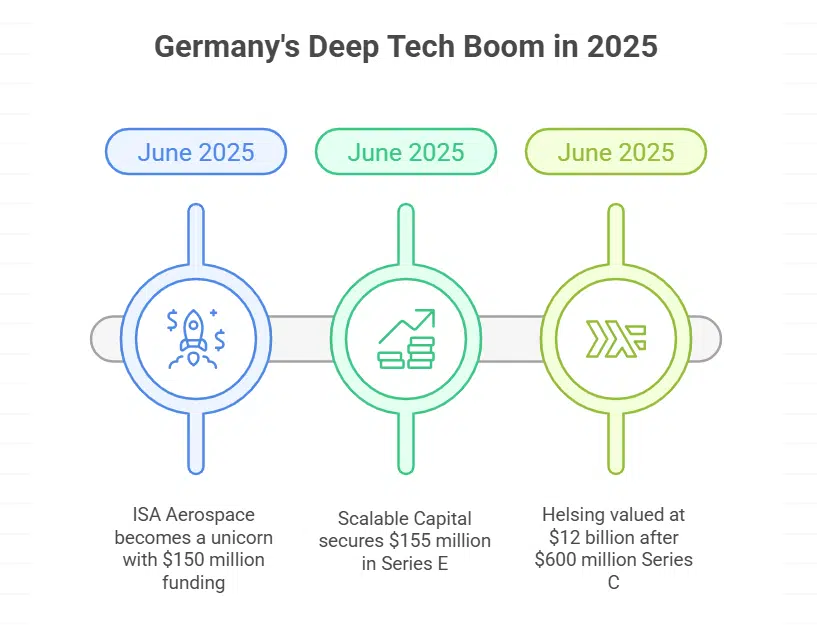
Check out the boom in Germany’s deep tech scene for 2025. Funding has hit record highs, especially in the DACH region, covering Germany, Austria, and Switzerland. Startups in deep tech, defense tech, and sovereign infrastructure are raking in huge investments.
Just look at Helsing, now valued at a stunning $12 billion after a $600 million Series C round in Berlin and Munich. That’s a big deal, showing how fast things are moving.
On top of that, June 2025 marked a major leap for the DACH ecosystem. ISA Aerospace in Munich grabbed $150 million in a convertible round, earning unicorn status. Berlin hosts over 60% of Germany’s unicorns, while Munich shines in B2B SaaS and fintech with Scalable Capital securing $155 million in a Series E.
This surge in startup funding trends, backed by venture capital funds, proves Germany’s spot as a hotbed for innovation and growth in AI, machine learning, and space technology.
Key sectors driving deep tech advancements
Dive right into the heart of Germany’s deep tech scene, and you’ll see some thrilling sectors leading the charge. Defense tech, with players like Helsing, is booming as AI transforms battlefield strategies.
Then there’s dual-use AI, where innovations from ISA Aerospace are pushing boundaries in space with low-Earth orbit solutions. These areas aren’t just growing; they’re reshaping how we think about security and exploration.
Healthtech is another hot spot, with Luma Care shining bright in phototherapy advancements. Biopharma isn’t far behind, as ITM SE drives cancer treatment breakthroughs. Don’t overlook cloud infrastructure either; Impossible Cloud is redefining storage with decentralized systems.
Add in fusion energy efforts by Proxima Fusion and space tech from Okapi Orbit, and you’ve got a powerhouse mix of ideas. These fields, fueled by AI and machine learning algorithms, are setting the stage for a future full of surprises.
Criteria for Selecting the Top 15 Startups
Hey there, want to know how we picked the top 15 deep tech startups in Germany? Stick with me, and I’ll spill the details on what made these innovators stand out!
Impact on industry
Deep tech startups in Germany are shaking up industries with bold ideas. Take HELSING, for instance, with its AI changing the game in defense tech. Then there’s ISAR Aerospace, pushing boundaries in space technology with low-Earth orbit solutions.
These companies, along with unicorns like Luma Care, are making waves across sectors. Their work ties directly to the DACH region’s record investment levels, driving innovation in defense and sovereign infrastructure.
Look at the numbers, folks; a 35% surge in DACH startup funding shows the impact. Major hubs like Berlin and Munich are breeding grounds for high-value ventures. This growth isn’t just talk, it’s fueling decacorns and transforming industries like biotech and cloud solutions.
Venture capital funds are pouring money into these game-changers, proving Germany’s deep tech scene is a force to reckon with.
Funding milestones
Check out the jaw-dropping funding wins for Germany’s deep tech startups. HELSING, a leader in AI for defense, bagged a massive $600 million in their Series C round, hitting a valuation of $12 billion.
Meanwhile, ISA AEROSPACE nabbed $150 million in a convertible round, soaring to unicorn status in the space technology race.
Over at LUMA CARE, their FDA-approved phototherapy tech pushed them to unicorn heights too. ITM SE secured $262.5 million in non-dilutive financing for cutting-edge radiopharmaceuticals to fight cancer.
Then there’s Proxima Fusion, pulling in €130 million to build a stellarator power plant, while SCALABLE CAPITAL raised $155 million in Series E for AI-driven portfolio management and ETF investing.
These startup funding trends show venture capital funds are betting big on innovation!
Technological breakthroughs
Let’s talk about some incredible advances in tech from Germany’s deep tech startups. These companies are breaking barriers with innovative ideas in AI, space technology, and healthcare.
Take HELSING, for example; their AI for defense is revolutionary, securing them an impressive $600 million in Series C funding, driving their valuation to a remarkable $12 billion.
That’s a significant achievement, everyone!
Now, imagine this: ISA Aerospace is soaring with $150 million in startup funding for commercial space tech. They’re developing solutions for low-Earth orbit launches, competing with major players like SpaceX rockets.
On another note, ITM SE is revolutionizing cancer care with radiopharma innovations, supported by a substantial €262.5 million in non-dilutive financing. These advancements aren’t just impressive; they’re transforming industries on a wide scale.
Top 15 Game-Changing Deep Tech Startups in Germany
Hey there, wanna hear about some mind-blowing companies shaking things up in Germany? Stick with me to uncover a few amazing deep tech innovators pushing the limits with artificial intelligence and space tech!
Helsing: AI for defense and real-time battlefield software
Check this out, folks, Helsing is making waves from their bases in Berlin and Munich with some serious tech! This deep tech startup focuses on AI for defense, crafting real-time battlefield software that’s changing the game.
With a hefty $600 million from their Series C funding, they’ve hit a staggering $12 billion valuation. That’s no small feat, right?
Dig into this, their work ties directly into geopolitical strategies, putting AI at the forefront of modern defense. They’re building tools that help make split-second decisions on the battlefield, powered by cutting-edge artificial intelligence.
It’s like having a super-smart sidekick for military ops, and investors are clearly all in on this vision.
ISA Aerospace: Low-Earth orbit launch solutions
ISA Aerospace, based in Munich, is making waves in the private space race. This startup focuses on low-Earth orbit launch solutions with its Spectrum rocket program. They’ve already snagged a whopping $150 million in a convertible funding round.
Talk about reaching for the stars! That huge cash boost helped them hit unicorn status, proving they’re a big player in space technology.
Heck, their work with reusable spacecraft could cut costs and shrink the carbon footprint of launches. They’re not just blasting off; they’re building a future where space is more accessible.
With giants like Arianespace in the game, ISA Aerospace stands out in the newspace scene. Their drive mirrors the bold moves of innovators like Elon Musk’s ventures. Stick around to see how they reshape the skies!
Luma Care: FDA-approved phototherapy health tech
Luma Care, based in Berlin, has taken the health tech world by storm. This startup hit unicorn status with its cutting-edge phototherapy tech. Their FDA-approved device, the LC-122M, is a versatile photodynamic therapy lamp.
It’s changing lives by treating skin conditions with light-based solutions. Imagine a gadget that heals while you relax, pretty neat, right?
Now, let’s chat about their impact on the industry. Luma Care stands tall among deep tech startups in Germany. Their innovation aligns with growing trends in phototherapeutic advances.
With FDA approval, they’ve set a high bar for health tech. Got skin issues? This team might just light up your path to recovery.
ITM SE: Radiopharma innovations and cancer treatments
ITM SE, based in Munich, is making waves in the medical field with its radiopharma innovations. This company focuses on creating new cancer treatments that can save lives. With a massive $262.5 million in non-dilutive financing, they’re expanding their reach fast.
Their goal? To bring cutting-edge therapies to patients who need them most.
Their work on scaling Actinium-225 isotope production is a game-changer for cancer care. ITM SE is also pushing hard for FDA approval of ITM-11, a promising therapy for tough cancers.
Imagine a future where such treatments are common, thanks to deep tech startups like this. Their efforts in research and development are lighting the path for better health solutions across Germany and beyond.
Impossible Cloud: Decentralized cloud infrastructure
Impossible Cloud, based in Hamburg, is shaking up the tech world with its decentralized cloud infrastructure. This startup is changing how data gets stored and accessed, moving away from traditional, centralized systems.
With a whopping $470 million valuation, they’ve caught the eye of big players in the industry. Their focus on decentralized cloud services offers a fresh way to handle data, making it more secure and flexible.
This company isn’t just riding the wave; they’ve raised strategic investment to push their vision forward. By tapping into trends like those seen with Amazon Web Services, Impossible Cloud is carving out a bold space in deep tech startups.
Their work could redefine how businesses manage data in 2025 and beyond. Hey, imagine a world where your info isn’t locked in one giant server farm, pretty neat, right?
German Bionic: Industrial exoskeleton robotics
German Bionic is creating a significant impact in robotics with their innovative industrial exoskeletons. Envision workers lifting heavy loads effortlessly, thanks to wearable technology that enhances strength and reduces fatigue.
This startup, based in Germany, has secured an impressive $20 million to introduce their equipment into factories and warehouses. Their mission? Supporting people in demanding jobs to stay safe and work more efficiently.
Explore their purpose, and you’ll understand why they’re exceptional among deep tech startups. They’re dedicated to integrating robotics with genuine human requirements, particularly for industrial tasks.
Envision a future where back injuries decrease, and productivity rises—that’s the aim fueling their advancements. With startup funding trends supporting them, German Bionic is poised to transform how we approach challenging labor.
KEWAZO: Automated robotics for construction
KEWAZO is shaking up the construction world with automated robotics. Based in Germany, this deep tech startup focuses on making job sites safer and faster. They’ve built robots that handle tough tasks like scaffolding, cutting down on manual labor.
Imagine a machine doing the heavy lifting while workers stay out of harm’s way, pretty neat, right?
Their tech isn’t just cool; it’s backed by serious cash. KEWAZO raised a solid $12.8 million to push their robotics further. This funding shows big trust in their vision for construction.
With automation trends on the rise, their solutions fit right into the future of building. Hey, who wouldn’t want a robot buddy on the job site?
Synapticon: Motion control technologies for robotics
Synapticon is making waves in the robotics world with their cutting-edge motion control tech. Based in Germany, they’ve raised a solid $20.5 million to boost their work. Their systems help robots move with precision, almost like a dancer hitting every step flawlessly.
This is huge for industries craving automation, from factories to warehouses.
Now, imagine robots working smoother than ever, thanks to Synapticon’s smart solutions. Their focus on AI and learning technologies pushes boundaries in how machines operate. It’s like giving robots a brain to think and act fast.
Stick with us to see how this deep tech startup shapes the future of robotics!
Waku Robotics: Autonomous robotics for logistics
Waku Robotics stands out as a top player in Germany’s deep tech sector. This innovative startup focuses on autonomous robotics for logistics, making warehouses and supply chains smarter.
Imagine a world where robots zip around, sorting packages faster than you can say “express delivery.” Based in a fast-moving tech landscape in 2025, they’re riding the wave of cutting-edge solutions.
Plus, with support from the Federal Minister for Startups, their path to growth looks bright.
Venture capital investments in robotics are booming across Germany, and Waku Robotics is reaping the benefits. Their work aligns with efforts by Germany’s Digital Minister to boost conditions for tech startups.
Picture robots handling heavy loads while humans sip coffee, all thanks to this company. With logistics becoming a hot field, their autonomous systems are changing the game for businesses big and small.
Tubulis Therapeutics: Biotech cancer therapies
Tubulis Therapeutics is making waves in the biotech world with their focus on cancer therapies. Based in Germany, this deep tech startup has raised a whopping $90.5 million to fight cancer.
Their work targets new ways to attack tumors with precision. It’s like finding the right key to a tricky lock, and they’re getting closer every day.
Man, think of the impact this could have on so many lives. With that kind of startup funding, Tubulis is speeding up research to bring hope to patients. Their biotech solutions aim to outsmart cancer, step by step.
Stick with us to see how they grow in this exciting field of health innovation.
Cytena: Bioprinting and cell handling for research
Cytena stands out as a trailblazer in the biotech world. This German deep tech startup focuses on bioprinting and cell handling solutions for research. They’ve raised a solid $4.6 million to push their cutting-edge ideas forward.
Their tech helps scientists work with cells in precise, game-changing ways. Imagine building tiny structures with living cells, almost like crafting a puzzle at the microscopic level.
That’s the kind of magic Cytena brings to labs.
Their innovations are fueling progress in medical studies and beyond. By blending biotech with smart tools, they’re helping researchers solve big problems. Think of it as giving science a superpower, especially in areas like drug testing.
With startups like Cytena, Germany’s deep tech scene keeps shining bright. Their work ties right into green technologies and advanced research trends, paving the way for new discoveries.
Understand AI: AI-powered data annotation and solutions
Check out Understand AI, a transformative force in AI-powered data annotation. This startup focuses on making data work smarter for autonomous driving tech. They’ve raised an impressive $2.8 million to support their mission, and it’s yielding significant results.
Their solutions help cars “see” and respond better on the road. How impressive is that?
Explore further, and you’ll notice why they shine in the deep tech startups arena. With cutting-edge tools and a talent for AI, they’re addressing difficult data challenges directly.
Their work connects to larger trends like machine learning ops, or MLOps, driving innovation in automation. Stay tuned to see how they’re influencing the future!
JoS Quantum: Quantum OS for secure finance applications
JoS Quantum stands out in the deep tech world with its cutting-edge quantum operating systems. This German startup focuses on secure finance applications, a game-changer for the industry.
Imagine locking your money in a vault no hacker can crack; that’s the kind of safety they’re building. Their tech uses quantum principles to shield financial data, making breaches nearly impossible.
Dig into their mission, and you’ll see why finance giants are taking notice. JoS Quantum is crafting tools to protect transactions in an age of rising cyber threats. With quantum technology at their core, they’re setting a new standard for security.
It’s like giving Wall Street an ironclad shield, and honestly, who wouldn’t want that?
Synapze: Privacy-first TinyAI automation for finance
Synapze stands out in the deep tech arena with its focus on privacy-first TinyAI automation for finance. This German startup crafts small, mighty AI tools that protect sensitive data while boosting efficiency in financial operations.
Imagine having a super-smart assistant that keeps your secrets safe, like a vault no one can crack. Their tech tackles complex tasks, from crunching numbers to spotting trends, all without risking user privacy.
Dig into their approach, and you’ll see why it’s a game-changer for startups and big firms alike. Synapze uses TinyAI to cut down on heavy computing needs, making solutions fast and light on resources.
With rising concerns over data leaks, their privacy focus hits the mark in a world hungry for secure innovation. It’s like building a fortress around your financial data, keeping the bad guys out while letting you work smarter.
Scantinel: Lidar sensor technology for autonomous vehicles
Scantinel stands out in the deep tech startups scene with its cutting-edge LiDAR tech for autonomous vehicles. This German company has raised a hefty $19.2 million to push its innovations forward.
Their sensors act like super-sharp eyes, helping self-driving cars spot obstacles and move safely. Imagine a car dodging a stray bike on a busy street, all thanks to Scantinel’s wizardry!
What’s cool is how this fits into the bigger AI and tech wave, much like trends seen with giants such as Nvidia. Their work is a game-changer for the future of transport. Stick around, because Scantinel is driving us straight into a sci-fi world, one sensor at a time.
Emerging Trends in Germany’s Deep Tech Sector

Hey, have you noticed how fast artificial intelligence is shaping up defense tech in Germany? Stick around to catch more exciting shifts in this space!
Rise of AI in defense and automation
AI is making waves in defense and automation across Germany, and it’s no surprise given today’s geopolitical strategies. Investor interest in sovereign and dual-use technologies is skyrocketing, pushing startups like Helsing to the forefront.
They’re building real-time battlefield software that could change how wars are fought. Think of it as a chess game, but with drones and data calling the shots.
On the flip side, automation is getting a massive boost from AI too. It’s like giving robots a brain to handle tough tasks in factories or logistics. With geopolitical tensions on the rise, the focus on AI in defense isn’t just cool, it’s critical.
Startups are racing to create tools that keep nations safe while making industries smarter. Stick around, because this tech storm is just getting started.
Growth in robotics for industrial applications
Man, robotics in industrial settings is taking off like a rocket in Germany! Companies are jumping on this tech to boost efficiency and cut down on grunt work. Think about heavy lifting or tricky tasks on construction sites; robots are stepping in big time.
German Bionic, for instance, raised a whopping $20 million to build exoskeletons that help workers lift heavy loads without breaking a sweat. It’s like having a superhero suit on the job!
Now, let’s chat about another player, KEWAZO, which nabbed $12.8 million to push robotics in construction. Their machines automate tough jobs, saving time and keeping workers safe.
This trend isn’t just cool; it’s changing how industries operate. With start-ups like these getting major startup funding from VC funds, the future of industrial robotics looks brighter than a summer day.
Stick around to see how far this tech can go!
Advancements in decentralized cloud solutions
Hey there, let’s chat about a cool trend in tech. Decentralized cloud solutions are shaking things up in Germany, and they’re a big deal. Unlike old-school cloud systems tied to one giant server, these spread data across many spots.
It’s like sharing a secret among friends instead of shouting it in a crowded room. This setup boosts security and cuts down on crashes.
Now, check out Impossible Cloud, based in Hamburg. They’re rocking a $470 million valuation in this space. Their focus on decentralized cloud tech makes storing stuff safer and more flexible.
It’s a game-changer for businesses needing reliable data options. Plus, with startups like this pushing limits, Germany’s deep tech scene is buzzing with fresh ideas.
Breakthroughs in quantum and biotech fields
Quantum tech is making waves in Germany, and it’s a game-changer for secure systems. Startups like JoS Quantum are building tools for safe finance apps, using quantum operating systems to lock down data.
It’s like putting your money in a vault that no one can crack. Meanwhile, Proxima Fusion grabbed a whopping 130 million euros to craft a stellarator power plant. That’s a big step toward clean, endless energy.
On the biotech side, innovation is saving lives with fresh ideas. Tubulis Therapeutics raised 90.5 million bucks to fight cancer with new therapies. Their work targets tumors in ways old meds can’t touch.
It’s like giving doctors a sharper tool to cut out the bad stuff. Germany’s deep tech startups in biotech are pushing hard to solve big health puzzles.
The Role of Venture Capital in Scaling Deep Tech Startups
Hey, wanna know how deep tech startups in Germany are soaring to new heights? Venture capital is the wind beneath their wings, pumping big bucks into bold ideas to help them grow fast!
Major VC funds supporting deep tech in Germany
Big players are pouring cash into Germany’s deep tech startups. Funds like Project A, with a hefty $325 million Fund V, are leading the charge. They’re hunting for bold ideas in artificial intelligence and beyond.
Then there’s Picus Capital, dropping $250 million on early-stage ventures. It’s a goldmine for fresh innovators.
On another note, BGF is swinging a massive $500 million tech growth fund, while Main Capital brings $520 million to boost B2B SaaS firms. Don’t sleep on GreenTech Growth Fund either; they’ve got $160 million for sustainable scaleups.
With powerhouses like these, plus support from business angels, startup funding trends are soaring. It’s like watching a rocket blast off!
Record-breaking funding rounds in 2025
Funding for deep tech startups in Germany reached incredible heights in 2025, and it’s a significant achievement. Imagine money flowing in like a river after a storm. Helsing, based in Berlin and Munich, secured a remarkable $600 million in their Series C round, boosting their valuation to an astonishing $12 billion.
That’s the kind of investment that captures attention in the AI and defense sector.
Over in Munich, ISA Aerospace excelled with a $150 million convertible round, achieving unicorn status quicker than you might expect for “space technology.” At the same time, Scalable Capital, also from Munich, pulled in $155 million in a Series E for fintech.
And don’t overlook Hamburg’s Impossible Cloud, reaching a $470 million valuation with their decentralized cloud tech. These startup funding trends highlight Germany as the key destination for daring, transformative innovations.
Germany’s Contribution to the European Deep Tech Landscape
Hey, wanna know how Germany’s shaping the tech future in Europe? Stick around, and let’s chat about their big role in pushing cool innovations across the continent!
Deep tech’s role in Europe’s sovereignty goals
Deep tech startups are key players in boosting Europe’s independence. They drive innovation in areas like AI and space technology, helping the European Union stand strong on its own.
The EU’s “Choose Europe” Scale-Up Strategy, part of its startup push, works to align laws across member states in a 28th regime setup. This makes it easier for companies to grow and compete globally, cutting reliance on foreign tech.
On top of that, funding for sovereign and dual-use technologies is soaring. Deep tech firms, such as those tied to defense or critical infrastructure, are getting major support to protect Europe’s interests.
It’s like building a sturdy shield; these startups help guard the region’s future. With this focus, Europe is carving its own path in the global tech race.
Cross-border collaborations and partnerships
Let’s chat about how Germany is teaming up with neighbors for big wins in deep tech. Cross-border partnerships, especially in the DACH region with Germany, Austria, and Switzerland, are sparking fresh ideas and faster growth.
Just think of it as a tech potluck, where each country brings something special to the table. These ties are helping startups share skills, funds, and markets with ease.
Switzerland, for instance, is making waves with its €100 billion DeepTech Vision for public-private R&D teamwork. This bold plan is pushing firms in the region, including German deep tech startups, to join forces on game-changing projects.
It’s like a buddy system for innovation, building stronger networks across borders. With tools like LinkedIn connecting talent and ideas, plus trends in AI and space technology gaining steam, the DACH area is becoming a powerhouse for progress.
Challenges Faced by Deep Tech Startups in Germany
Hey, running a deep tech startup in Germany isn’t a walk in the park, ya know? Dig into the gritty hurdles these innovators face, and you’ll see why their journey’s such a wild ride!
Regulatory hurdles
Diving straight into the mess, regulatory hurdles pose a real challenge for deep tech startups in Germany. The rules can feel like a maze, slowing down innovation in areas like AI and biotech.
Take the EU AI Act, set to kick in during Q3 2025, with fines looming by 2026. This law aims to keep things safe, but it adds layers of red tape for companies trying to launch new ideas fast.
On top of that, getting approvals for cutting-edge tech, such as space technology with firms like ISAR Aerospace, often takes ages. Startups must jump through endless hoops to meet strict standards.
It’s like running a race with weights on your ankles. These barriers can stall progress, making it tough to compete on a global stage.
Talent acquisition and retention
Finding top talent for deep tech startups in Germany is a real uphill battle. These companies need sharp minds to push boundaries in fields like AI and space technology. Yet, skilled workers are hard to come by.
The EU’s “Blue Carpet” initiative helps by drawing global talent to the region. It’s a game-changer, opening doors for experts worldwide to join the fight for innovation.
Holding onto that talent, though, is another tough nut to crack. Startups often lose great people to bigger firms with deeper pockets. Offering cool projects and a sense of purpose can help.
Think of it like keeping a star player on your team; you’ve got to give them reasons to stay. With tools like smart hiring platforms and trends in startup funding, German firms are stepping up their game to build solid crews for the future.
Scaling from innovation to commercialization
Turning a bright idea into a market hit is no easy task for deep tech startups in Germany. Many struggle to shift from lab experiments to selling products. The “Lab2Unicorn” initiative helps bridge this gap, pushing research into real-world use.
It’s like turning a rough sketch into a masterpiece, but with tech and funding.
This jump often needs huge support, and the EU’s “Choose Europe” Scale-Up Strategy plays a big role. It aims to keep startups in the EU, stopping them from moving abroad for better deals.
Think of it as planting a seed and making sure it grows in your own backyard. With programs like these, plus growing startup funding trends, German innovators in AI and space technology have a shot at making it big.
Future Outlook for Deep Tech Startups in Germany
Hey, wanna know where Germany’s deep tech scene is headed after 2025? Stick around to catch the exciting scoop on funding surges and hot sectors like artificial intelligence and space tech!
Expected growth in funding and innovation
Germany’s deep tech scene is buzzing with promise in 2025. Experts see a bright path ahead for startup funding trends, especially after the E4 Business Climate Index climbed for six straight months by June 2025.
More cash is flowing into bold ideas, giving startups the fuel to grow fast. Think of it as planting seeds in fertile soil, ready to sprout big.
This positive outlook means more innovation is on the horizon. Investors are jumping in, eager to back game-changers in AI and space tech, like ventures similar to ISAR Aerospace. It’s a thrilling time, folks, as Germany’s startups gear up to tackle giant challenges with fresh solutions.
Key sectors to watch beyond 2025
Let’s zoom in on the hot zones for deep tech beyond 2025. Healthtech and biopharma, with players like Luma Care and ITM SE, are blazing trails in medical breakthroughs. Think cutting-edge treatments and game-changing therapies that could save lives.
Then, there’s fintech and wealthtech, where Scalable Capital is shaking up how we handle money with smart, digital solutions.
Hop over to fusion energy, and you’ve got Proxima Fusion and Okapi Orbit pushing the limits of clean power. These fields aren’t just growing; they’re set to explode with fresh ideas.
Keep an eye on space technology too, as companies like ISAR Aerospace aim for the stars with bold missions. These sectors are the future, and Germany’s deep tech startups are right at the heart of it.
Takeaways
Hey there, what an exciting journey through Germany’s deep tech scene in 2025! We’ve explored 15 incredible startups, from Helsing’s AI for defense to Tubulis Therapeutics’ cancer breakthroughs, showing how innovation drives change.
These companies demonstrate that cutting-edge ideas in AI, robotics, and biotech can address real challenges with straightforward, impactful solutions. So, which startup catches your eye, and how might their technology influence your life? Stay engaged with this field; explore local tech hubs or news for more insights, and remain motivated to witness how Germany’s daring advances contribute to global progress!
FAQs on Tech Startups In Germany
1. What are some hot deep tech startups in Germany for 2025?
Hey, let me tell you, Germany’s got some real brainy outfits cooking up big ideas. Think of companies like Isar Aerospace, blasting off with space technology that could rival a sci-fi flick. They’re just one of the 15 game-changers shaking up the scene with mind-blowing innovations.
2. How does AI play a role in these German startups?
Well, artificial intelligence, or AI, is the secret sauce for many of these deep tech startups. Firms like Mistral AI are diving deep into smart tech, crafting solutions that think almost like humans.
3. Are there cool space projects among these German innovators?
You bet, space is the new frontier for some of these folks. Isar Aerospace is leading the charge, working on projects as wild as the Dragon Capsule, aiming to push boundaries way beyond our blue sky. It’s like watching a space race unfold right in Europe’s backyard.
4. What’s the deal with startup funding trends in Germany for 2025?
Listen up, funding is the lifeblood of these deep tech startups, and the trends are hotter than a summer grill. Big players, think investment firms like Charles Schwab or private equity groups, are pouring cash into sectors from AI to cryptocurrencies. Even giants like McKinsey are eyeing these ventures, alongside everyday tools like ETFs and other investment products.
5. Are there surprising names in Germany’s deep tech world?
Oh, absolutely, some names might catch you off guard, like Neko Health popping up with health tech wizardry. Then you’ve got influences from OpenAI’s groundbreaking work inspiring local innovators, almost like Spotify did for music streaming. It’s a mixed bag of brilliance, proving Germany’s not just about cars and beer anymore.