Choosing where to study is a massive decision. You want a degree that opens doors, but you also want an adventure that feels safe and welcoming. If you are looking for world-class education without the dizzying price tag of the US or UK, you are on the right track. Here is a fun fact: More international students are picking Singapore and South Korea than ever before, and it is not just for the food (though the food is incredible). These two countries are climbing the global rankings faster than almost anywhere else.
In this guide, I will walk you through exactly why Study In Asia is trending, break down the costs in real dollars, and share a few “insider” tips on visas and daily life that most brochures miss. Grab a coffee, and let’s figure out which destination is your perfect match.
Why Asia is a Top Study Destination
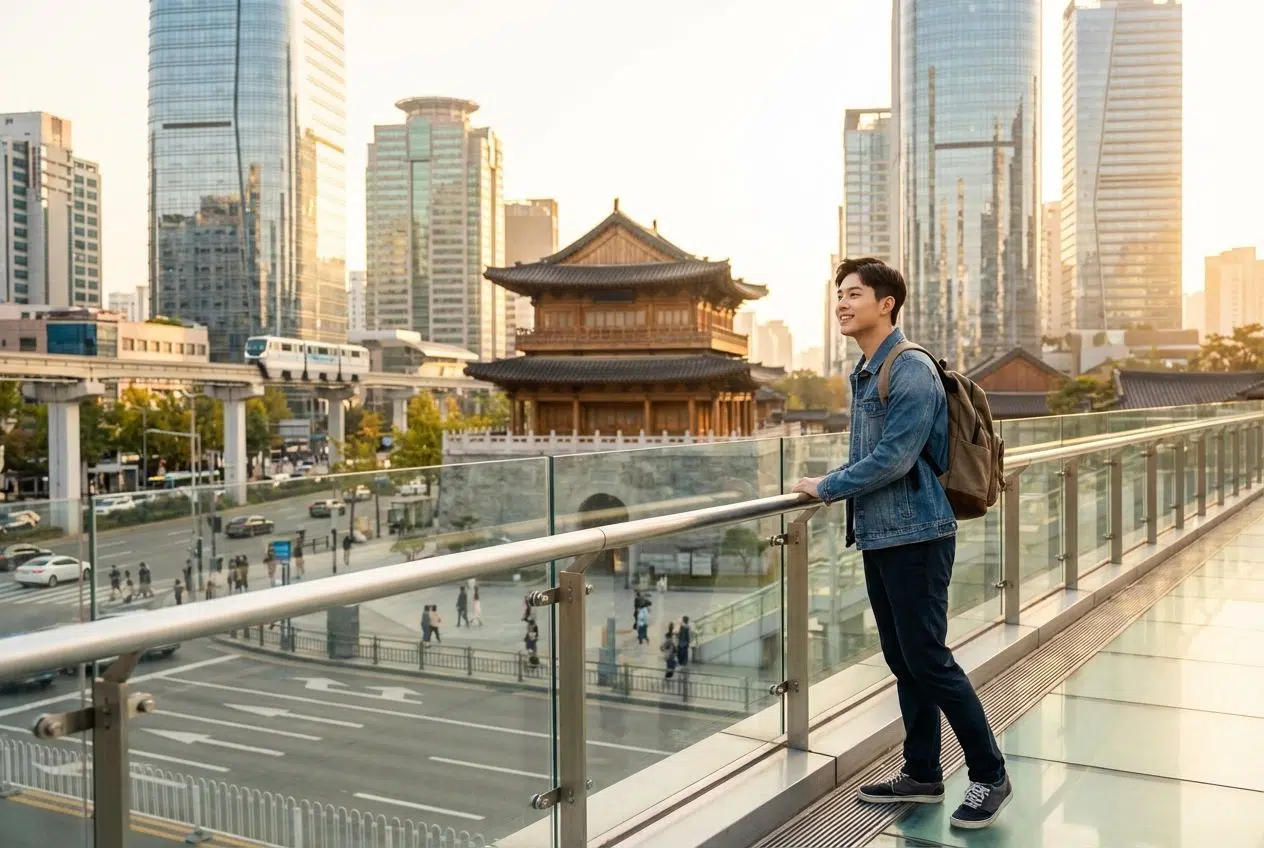
Asia offers an experience you simply cannot find in the West. It is a place where 600-year-old palaces sit next to futuristic skyscrapers, and where your student budget stretches much further than you might expect.
Growth of world-class universities
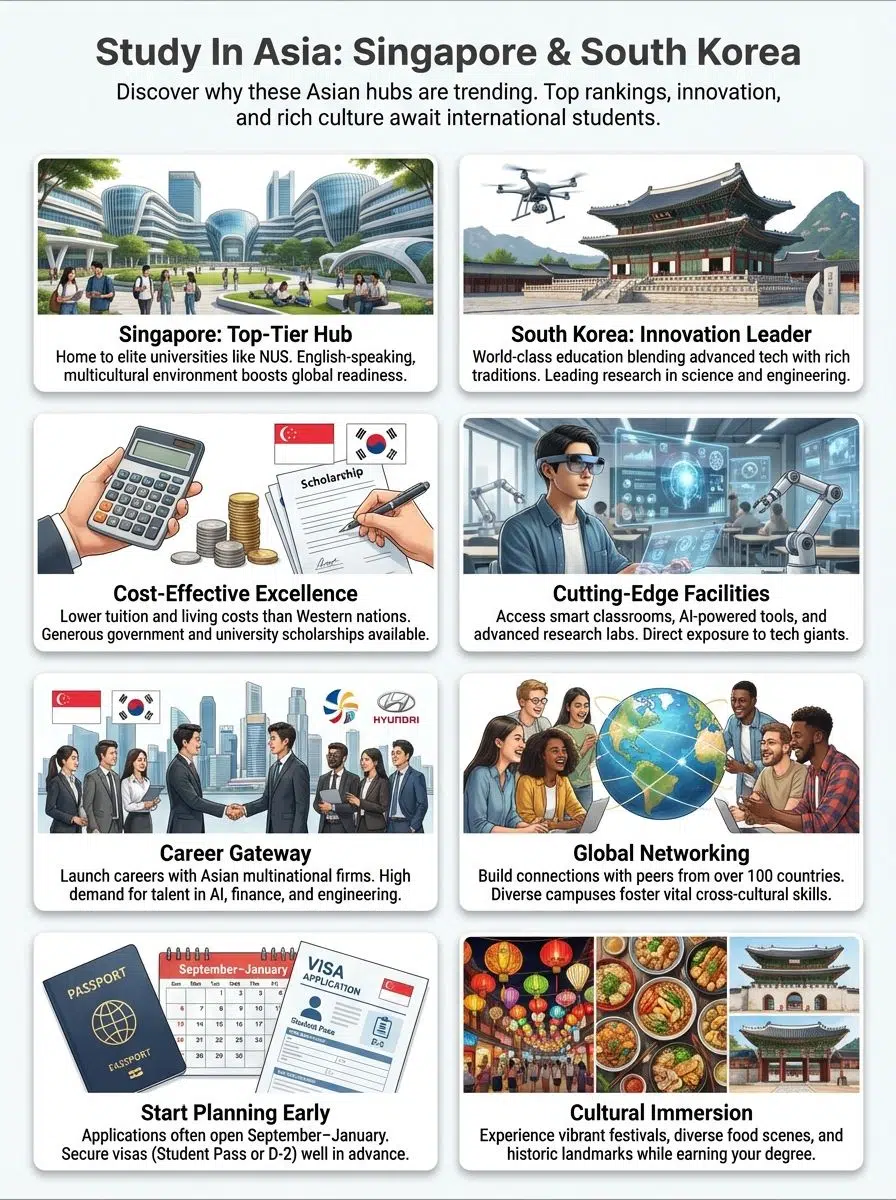
If you think you need to stay in the West for a top-tier degree, think again. Singapore and South Korea are now home to some of the most prestigious institutions on the planet.
According to the QS World University Rankings for 2026, the National University of Singapore (NUS) is ranked an impressive #8 globally. That puts it ahead of many Ivy League schools. South Korea is right up there, too, with Seoul National University (SNU) securing the #31 spot in the 2025 rankings.
These aren’t just numbers. They mean you get access to research facilities and professors who are leading global conversations in tech, business, and engineering.
Blend of tradition and modernity
One minute you are coding in a state-of-the-art AI lab, and the next you are walking through a quiet temple. This mix is what makes daily life here so electrifying.
In Seoul, you can visit the Gyeongbokgung Palace wearing a traditional Hanbok and get in for free, then head to the Gangnam district for a taste of modern city life. In Singapore, the futuristic Gardens by the Bay are just a short train ride from the historic shophouses of Chinatown.
This environment teaches you adaptability. You learn to navigate different cultures and histories side-by-side, a soft skill that global employers love.
Affordable education and living costs
Let’s talk money. In the US, tuition at a private university can easily top $40,000 or $50,000 a year. In Asia, you get a world-class education for a fraction of that price.
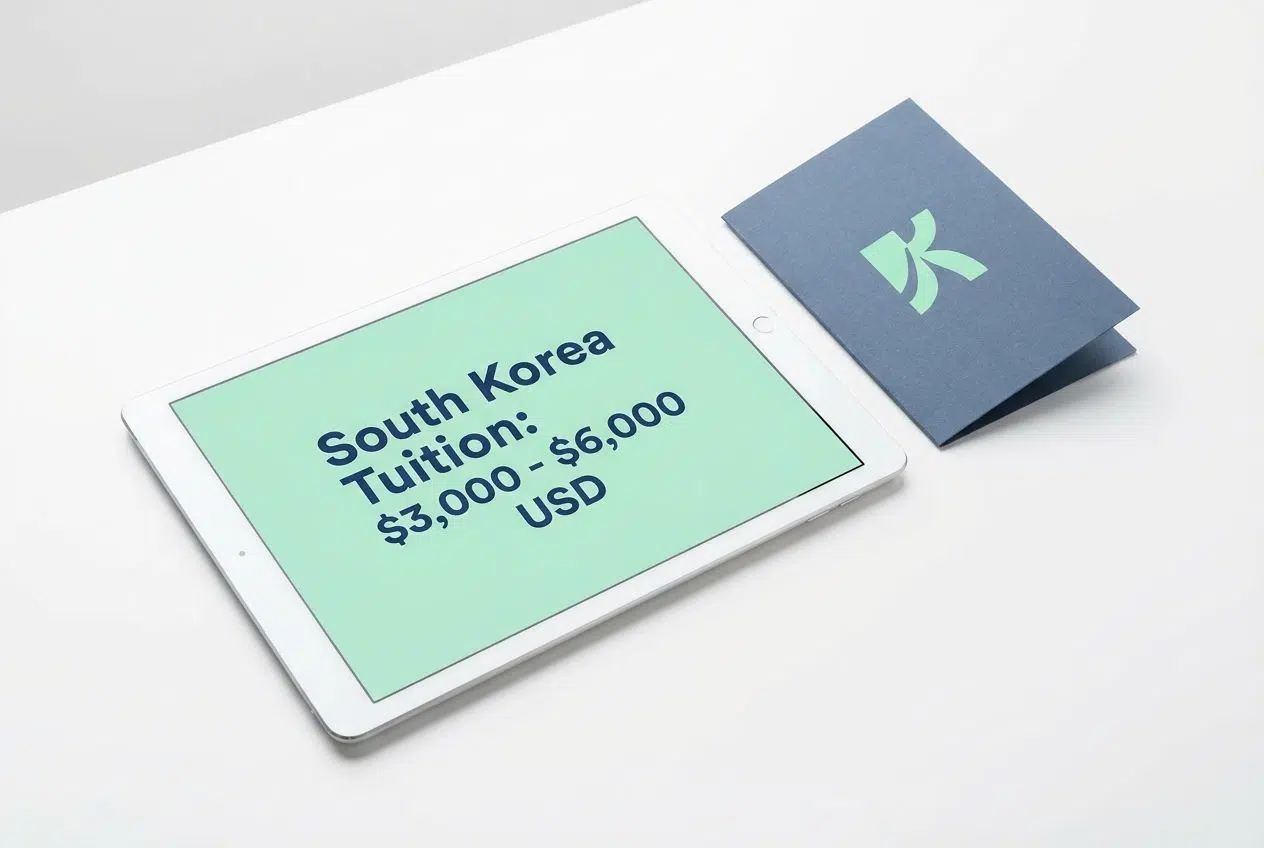
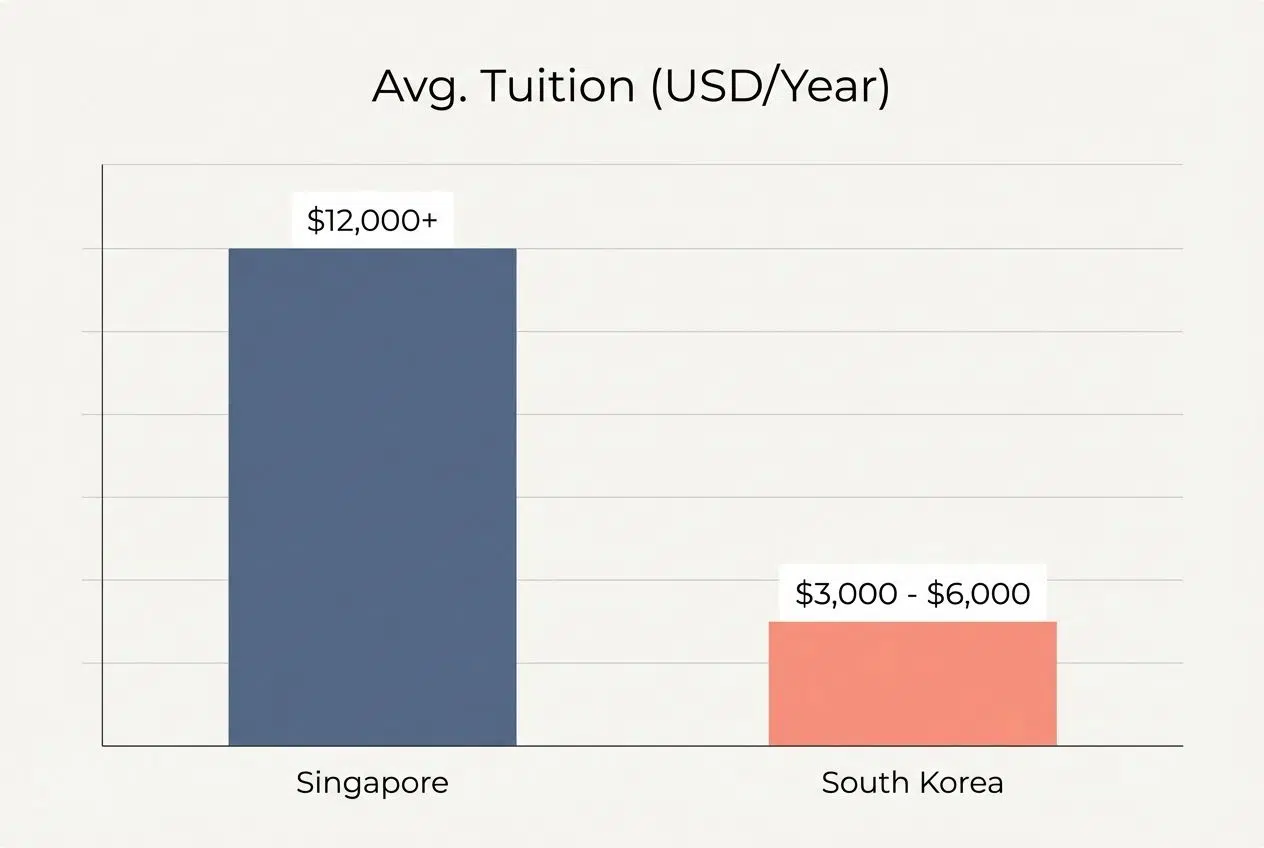
- South Korea: Undergraduate tuition at a top public university like SNU is often between $3,000 and $6,000 USD per year.
- Singapore: While slightly more expensive, the government offers a Tuition Grant Scheme that can subsidize nearly half your fees in exchange for a work commitment after graduation.
Living costs are manageable too. A delicious meal at a Singaporean hawker center can cost as little as $3 to $5 USD, while a hearty stew in Seoul will run you about $7 USD. Your wallet will thank you.
Why Singapore is a Leading Choice
Singapore is often called a “soft landing” for international students. It is English-speaking, incredibly safe, and efficient. If you want a smooth transition into Asian culture, this is the place.
Top-ranked universities and institutions
We already mentioned NUS, but Nanyang Technological University (NTU) is another giant, consistently ranking in the global top 30. These schools are famous for their engineering, business, and computer science programs.
The education style here is rigorous but rewarding. You will be pushed to think critically and innovate. Plus, degrees from these institutions are recognized by employers worldwide, from London to New York.
“Learning never exhausts the mind.” – Leonardo da Vinci
Multicultural environment
Singapore is a true melting pot. Walking across campus, you will hear a mix of English, Mandarin, Malay, and Tamil. This diversity is baked into the national identity.
You might celebrate Deepavali (the Festival of Lights) one month and the Chinese New Year the next. For foodies, this is paradise. You can grab Indian roti prata for breakfast and Hainanese chicken rice for lunch at famous spots like the Maxwell Food Centre.
Because English is the main language of instruction and daily business, you won’t face a language barrier. This makes it incredibly easy to make friends and network from day one.
Excellence in technology and innovation
Singapore calls itself a “Smart Nation,” and they mean it. The government pours money into tech, and you see it everywhere.
Universities are packed with labs for robotics, AI, and green energy. In fact, many students get the chance to intern with tech giants like Google, Dyson, and Grab, which all have major regional HQs here.
If you are studying STEM (Science, Technology, Engineering, and Math), Singapore is basically a giant playground for your career.
Why South Korea is Gaining Popularity
South Korea is dynamic, fast-paced, and culturally rich. Thanks to the “Korean Wave” (Hallyu), it has become a magnet for students who want to be at the center of global pop culture and innovation.
High-quality education system
Korean universities are known for their intensity and excellence. The “SKY” universities, Seoul National University, Korea University, and Yonsei University, are the Ivy League of Korea.
The government is actively recruiting international students with a goal to host 300,000 by 2027. This means more courses are being taught in English, and support systems for foreign students are better than ever.
Professors here expect hard work, but they also foster a strong sense of teamwork. You will likely spend late nights in the library with your study group, building bonds that last a lifetime.
Rich cultural experiences
Life outside the classroom in Korea is never boring. Student neighborhoods like Hongdae and Sinchon are buzzing 24/7 with buskers, cafes, and affordable shopping.
You can spend your weekends hiking the mountains that surround Seoul, visiting traditional hanok villages, or singing your heart out at a noraebang (karaoke room). The public transport system is arguably the best in the world, making it easy to explore every corner of the country.
Global recognition of Korean universities
A degree from a Korean university is a badge of honor. As Korean companies like Samsung, Hyundai, and LG continue to dominate global markets, the value of a Korean education rises with them.
Employers know that graduates from these schools are disciplined, resilient, and ready to work in fast-paced environments. Plus, being able to speak even a little Korean is a huge asset in today’s global business world.
Key Benefits of Studying in Singapore and South Korea
Beyond the classroom, studying in these two countries gives you practical advantages that can fast-track your career.
Access to advanced facilities and resources
Both nations treat education as a national priority, and the facilities prove it. You will find libraries that look like spaceships and campus Wi-Fi that is blazing fast.
- Singapore: Universities often have “incubation hubs” for student startups, providing funding and mentorship to turn your ideas into real businesses.
- South Korea: Campuses are famous for their 24-hour study cafes and high-tech PC rooms (PC Bangs) where students unwind or work on group projects.
You are not just reading about technology; you are using it every single day.
Networking opportunities with global students
Your classmates will be your future business partners. In Singapore, you might sit next to someone from Indonesia, France, and India in the same lecture hall.
In South Korea, the international student community is tight-knit. Universities often run “buddy programs” that pair you with a local Korean student to help you adjust. These connections are gold when you start looking for jobs after graduation.
Gateway to career opportunities in Asia
This is where things get really exciting. Both countries are desperate for global talent.
South Korea recently updated its visa rules in late 2025. The D-10 Job Seeker Visa now allows qualified graduates to stay for up to 3 years to look for work, with relaxed rules for internships. This is a game-changer for building a career there.
In Singapore, the Tuition Grant Scheme usually comes with a 3-year bond to work for a Singapore-based entity. While some see this as a restriction, it is actually a guaranteed ticket into the local job market, pushing you to land a role in a global business hub right out of school.
Tips for Preparing to Study in Singapore and South Korea
A little preparation goes a long way. Here is how to get ready for your move.
Understand the application process
Deadlines are strict, so start early. For South Korea, a helpful resource is the Study in Korea website run by the government.
Most applications will require:
- Official academic transcripts.
- Proof of finances (bank statements).
- Language test scores (TOEFL/IELTS for English programs, TOPIK for Korean programs).
- A personal statement explaining why you want to study there.
Pro-Tip: In South Korea, the academic year starts in March, not September. Make sure you adjust your timeline accordingly.
Research scholarships and financial aid
Free money is out there if you know where to look.
In South Korea, the Global Korea Scholarship (GKS) is the holy grail. It covers your airfare, full tuition, a monthly stipend, and even a year of Korean language training. It is competitive, but worth it.
In Singapore, besides the Tuition Grant, look for university-specific awards like the ASEAN Undergraduate Scholarship (if applicable) or merit-based entrance scholarships offered directly by NUS and NTU.
Learn about the culture and language
Even if your classes are in English, learning the local language unlocks the city.
For Korea: Download Naver Maps or KakaoMap before you go. Google Maps does not work well in South Korea. Also, get KakaoTalk; it is the messaging app everyone uses.
For Singapore: You don’t need a translation app, but learning “Singlish” phrases like “can or not?” (Is this possible?) Or “dabao” (takeaway food) will endear you to the locals instantly.
How to Choose the Right Destination
Still on the fence, choosing the right destination? Let’s break it down side-by-side to see which lifestyle fits you best.
| Feature | Singapore | South Korea (Seoul) |
|---|---|---|
| Language | English is the main language. | Korean is essential for daily life. |
| Climate | Hot and humid year-round (Tropical). | Four distinct seasons with cold winters. |
| Avg. Tuition (USD/Year) | $12,000 – $20,000+ (Subsidized). | $3,000 – $6,000 (Public Universities). |
| Avg. Rent (USD/Month) | $600 – $1,100 (Shared/Hostel). | $350 – $500 (Goshiwon/Shared). |
| Part-Time Work | Max 16 hours/week (Term time). | Max 25 hours/week (Term time). |
Assess your academic and career goals
If you want a career in finance, logistics, or international business, Singapore is the regional HQ for those industries. It is professional, polished, and English-speaking.
If you are interested in robotics, manufacturing, design, or media, South Korea is the place to be. You will gain a unique edge by mastering a difficult language and understanding a complex market.
Consider cultural compatibility and personal preferences
Do you hate winter? Singapore is your best bet. Do you love fashion and nightlife? Seoul is unbeatable. Be honest with yourself about the lifestyle you want, because you will be living it 24/7.
Tips for Prospective Students in Asia
Ready to take the leap? Here are three final steps to ensure you land on your feet.
Research Universities and Degree Programs
Don’t just look at the university name; look at the specific department. KAIST is legendary for engineering, while Hongik University in Seoul is famous for arts and design.
Check the curriculum to see how many classes are actually in English. Some “English track” programs still have electives taught in Korean, so read the fine print.
Prepare for Visa and Admission Requirements
Paperwork can be slow, so be patient.
- Singapore: You will need a Student Pass. The process is fully online via the ICA (Immigration & Checkpoints Authority) and is generally very efficient.
- South Korea: You will apply for a D-2 Visa. You will need to show a bank statement with a specific minimum balance (often around $20,000 USD) to prove you can support yourself.
Make sure your passport has at least six months of validity left. It sounds obvious, but it is the number one reason for rejected applications.
Learn about Local Languages and Cultural Norms
Respect goes a long way. In Korea, always use two hands when receiving something from a professor or elder. In Singapore, never chew gum (it is famously banned) and always return your tray at the hawker center.
These small gestures show that you are making an effort, and locals will appreciate it immensely.
Final Words
Studying in Singapore or South Korea is more than just a degree; it is a front-row seat to the future. You will get a top-tier education, build a global network, and grow in ways you cannot even imagine right now.
The application steps are clear, the scholarships are generous, and the adventure is waiting. I once took a chance on a semester abroad, and it completely changed my career path. I know it can do the same for you.
So, check those deadlines, polish that personal statement, and get ready to pack your bags. Your study in Asia adventure starts now!