

Streameast, the most notorious sports piracy network in the world, has been shut down following a coordinated year-long investigation led by the Alliance for Creativity and Entertainment (ACE). The platform had become the leading hub for unauthorized sports streaming, drawing over 1.6 billion visits per year. Through its network of at least 80 domains, Streameast provided free access to pirated broadcasts of high-value sporting events ranging from Premier League and Champions League football matches to NFL, NBA, MLB, NHL games, as well as Formula 1 races, boxing, mixed martial arts, and other pay-per-view competitions.
The operation represents one of the most significant global enforcement actions against live sports piracy, a problem that costs leagues, broadcasters, and advertisers billions of dollars each year.
The Investigation and Raid in Egypt
The investigation culminated in a sting operation on August 24, carried out in cooperation with Egyptian law enforcement in Sheikh Zayed City, part of the Greater Cairo area. Two individuals alleged to be behind Streameast’s operations were arrested on suspicion of copyright infringement and running a large-scale piracy business.
During the raid, authorities confiscated laptops, smartphones, credit cards, cash, and cryptocurrency wallets. Investigators also uncovered evidence linking Streameast to a shell company in the United Arab Emirates that had been used to launder illegal advertising revenue. According to findings reported by multiple outlets, the operation generated more than $6 million over the last 15 years, with parts of the money allegedly invested in real estate in Egypt.
The arrests marked a turning point in ACE’s campaign against digital piracy, which often struggles with jurisdictional challenges and operators hiding behind layers of anonymity.
How Streameast Operated
Streameast thrived because it exploited a simple model: high-demand live sports, combined with easy-to-access streaming links and a revenue stream built on digital advertising. By setting up dozens of mirror sites and redirect domains, Streameast avoided permanent shutdowns for years. Reports indicate that the network used as many as 400 domains over its lifetime, frequently migrating to new addresses to stay ahead of authorities.
Unlike small piracy sites, Streameast achieved global reach. It consistently ranked among the top illegal sports streaming platforms worldwide, with heavy user traffic originating from the United States, United Kingdom, Canada, Germany, and the Philippines. For millions of users, it became the go-to site to watch high-profile matches without paying subscription fees.
This popularity came at a significant cost to the sports industry. Leagues such as the Premier League, UEFA, NFL, NBA, and MLB invest billions in broadcast rights. Piracy undermines these contracts, impacts team revenues, and ultimately threatens the ecosystem that funds players, staff, and youth programs.
The Role of ACE and Global Entertainment Giants
The Alliance for Creativity and Entertainment is a coalition of more than 50 major media and sports stakeholders, including Disney, Netflix, HBO, Fox, Sony Pictures, Amazon, Paramount+, DAZN, and Sky. Its mission is to disrupt and dismantle piracy networks that exploit digital platforms.
In this case, ACE not only traced Streameast’s digital infrastructure but also built cooperation with Egyptian authorities to ensure that arrests were made and assets were seized. The organization hailed the takedown as one of the most important in recent years because Streameast had grown into the dominant brand in the illegal streaming market.
The action also demonstrated the importance of cross-border enforcement. Piracy operations often span multiple countries, with servers in one jurisdiction, administrators in another, and financial channels in yet another. By connecting the dots between Egypt and the UAE, ACE was able to expose the financial backbone of Streameast’s operations.
Aftermath: What Happens to Streameast Users?
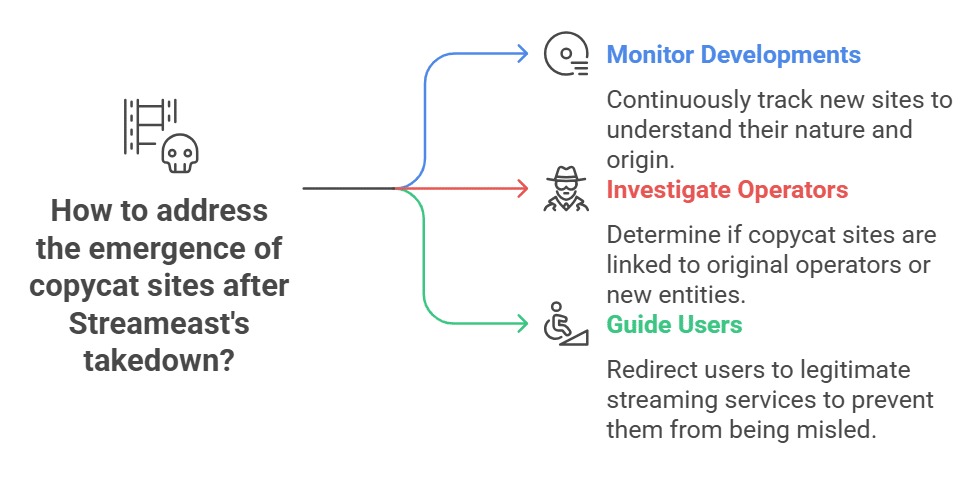
Following the takedown, all known Streameast domains were redirected to ACE’s “Watch Legally” webpage, which provides links to official streaming services. The move serves a dual purpose: cutting off traffic to illegal sites while guiding users toward legitimate, safe, and high-quality platforms.
However, piracy experts warn that copycat sites are already attempting to fill the void. These imitation platforms often emerge quickly after a major shutdown, sometimes using the same branding to trick users. ACE has confirmed that it is monitoring these developments and investigating whether they are linked to the original Streameast operators or opportunistic newcomers.
Wider Impact on Sports Piracy
The closure of Streameast is significant not just because of its scale but also because it signals renewed momentum in the global fight against piracy. Sports piracy has been especially difficult to control because demand peaks during live events, where users are more willing to take risks to avoid subscription costs.
Platforms like Streameast also pose security risks to users. Illegal streaming sites are notorious for spreading malware, phishing attempts, and fraudulent ads. The enforcement action therefore benefits not only sports leagues and broadcasters but also everyday fans who may otherwise be exposed to harmful content online.
Industry Reactions
The takedown has been widely welcomed across the entertainment and sports industries. ACE leaders described it as a landmark action in protecting sports rights holders. Executives from sports broadcasters such as DAZN emphasized that the move safeguards both the financial health of leagues and the viewing experience of fans.
For sports organizations, the case also reinforces the importance of international cooperation. The involvement of Egyptian authorities, combined with investigative leads from the U.S. and support from the global ACE coalition, shows that piracy operations can no longer assume impunity by hiding across jurisdictions.
The Challenge Ahead
While Streameast’s closure is a milestone, it is not the end of the piracy problem. The persistence of copycat sites and the availability of illicit IPTV services show how adaptable piracy networks can be. Enforcement groups like ACE and Europol stress that continuous monitoring, public awareness, and legal alternatives are essential in preventing piracy from regaining momentum.
The battle against piracy is also evolving with technology. Operators increasingly use encrypted servers, decentralized hosting, and cryptocurrency payments to mask their activities. Law enforcement agencies are now focusing not only on site takedowns but also on disrupting financial pipelines, which may prove more effective in the long run.
The information is collected from ESPN and Yahoo.