Have you ever stared at an empty supply closet and wondered if you should just buy the cheapest option right now? It is a common dilemma. Most businesses waste thousands of dollars simply because they do not understand the difference between strategic sourcing vs Tactical Purchasing
It happens every single day.
This article breaks down both approaches in simple terms, so you can pick the right one for your specific situation. Read on to find out which method saves you the most money in the long run.
What is Tactical Purchasing?
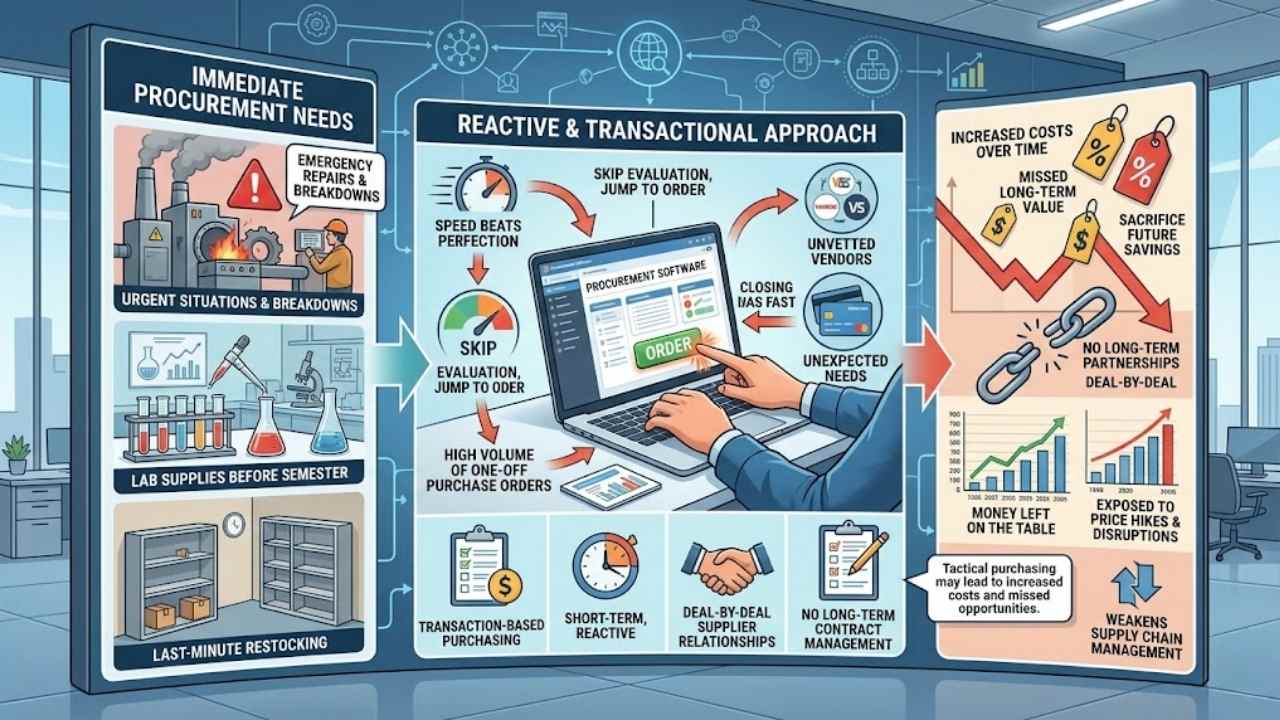
Tactical purchasing focuses on meeting your immediate buying needs right now. Your team handles orders, processes transactions, and gets products in the door fast without much planning ahead.
Definition and characteristics (Tactical Purchasing)
Tactical purchasing is a short-term, reactive approach to buying goods and services. Your company uses this method to meet immediate procurement needs right now. You focus on quick transactions rather than long-term planning.
Speed matters most in tactical purchasing because you need supplies fast. Lab supplies before a semester starts, emergency equipment repairs, or last-minute inventory restocking all fall into this category. The stakes are incredibly high for these quick fixes. A recent report from Supply Chain Dive shows the average cost of a supply chain disruption is $1.5 million per day. When a machine breaks, you cannot afford to wait.
Your procurement team acts fast to solve urgent problems. They skip the lengthy evaluation process and jump straight to ordering. Tools like Order.co specialize in this area, allowing teams to place quick, compliant orders across thousands of vendors in minutes. This method works best when time is short and you cannot wait for a slower process.
Transactional buying defines the core of tactical purchasing. You prioritize immediate cost savings and operational efficiency over future value creation. Your sourcing strategy focuses on the next purchase, not the next five years. Procurement software and vendor relationships help speed up these quick buys. You make reactive decisions based on what you need today.
Your company does not build long-term supplier partnerships through tactical purchasing. Instead, you work with suppliers on a deal-by-deal basis. This approach lets you grab the best price available right now. However, tactical purchasing may lead to increased costs over time because you miss chances to negotiate better contracts. You sacrifice future savings for present speed.
Focus on immediate procurement needs (Tactical Purchasing)
Immediate procurement needs drive tactical purchasing decisions every single day. Your company faces urgent situations that demand fast action. A lab needs supplies before the semester starts. An office runs out of paper. A factory requires emergency parts to keep machines running.
Tactical purchasing handles these situations with speed and efficiency. You react to what happens right now, not what might happen later. The U.S. Bureau of Labor Statistics recently projected a 19% growth rate for logisticians through 2033. This massive demand shows just how many professionals are needed to manage these fast-paced, daily supply chain demands.
This approach prioritizes getting the job done fast over finding the best long-term deal. Your procurement team focuses on transaction-based purchasing, which means completing one purchase at a time without thinking about future contracts or supplier relationships. The goal is simple, just solve the problem today.
Speed beats perfection when your business needs something right now.
Speed comes with a price, though. Tactical purchasing may lead to increased costs and missed opportunities for long-term value, even though it gets you what you need fast. You might pay more per unit because you buy in small quantities. A 2025 survey from ElectroIQ found that 94% of companies reported a negative revenue impact due to supply chain disruptions. When you buy reactively, you are far more exposed to these costly delays.
You skip the market research that could reveal cheaper suppliers. Your team spends time on repetitive orders instead of planning ahead. Inventory management becomes harder when you buy only what you need today. Supply chain disruptions hit harder because you have no backup suppliers waiting in the wings. Procurement decisions made in a rush can lock you into bad contracts. Yet for emergency situations, this reactive approach works perfectly. You cannot wait weeks to negotiate better pricing when your production line stops. Tactical sourcing lets you move quickly, handle immediate needs, and keep operations running smoothly.
Reactive and transaction-based approach (Tactical Purchasing)
Tactical purchasing operates as a reactive machine that springs into action only when a need arises. Your team spots an urgent requirement, and you buy what you need right now. This approach treats each purchase as a separate transaction rather than part of a larger supply chain management strategy. You focus on getting the item in hand quickly, not on building relationships with suppliers or planning ahead.
Emergency procurement situations call for this specific method. Lab supplies before a semester starts, rush orders for office equipment, or last-minute inventory restocking all fit this mold. Your finance team approves the purchase, and the transaction closes. Speed matters most here, so you skip the lengthy evaluation processes that strategic sourcing demands.
If your team relies heavily on reactive purchasing, you will likely notice a few common patterns:
- A high volume of one-off purchase orders sent to unvetted vendors.
- Frequent use of company credit cards for unexpected, immediate needs.
- Limited contract management, meaning you rarely lock in favorable rates.
- Constant scrambling to replace out-of-stock items at the last minute.
This transaction-focused style prioritizes immediate cost savings and operational efficiency in the short term. You grab the best price available today without worrying about total cost of ownership or long-term supplier collaboration. The purchase order gets placed, delivered, and filed away. Contract management stays minimal since you are not building multi-year agreements. This speed comes with a hidden price tag.
For example, modern platforms like Procurify help automate these reactive approvals. Their pricing for small U.S. businesses starts around $1,000 per month, which is a great investment for controlling fast spend. However, even with great software, you may miss opportunities for volume discounts that come from consolidated spending. Your organization could face increased costs down the road because you are not analyzing spend patterns or leveraging supplier relationships. A 2026 QIMA survey revealed that 79% of supply chains expect rising costs to be a major disruption. Buying reactively leaves you completely exposed to these price hikes. Tactical purchasing works well for genuine emergencies, but relying on it too heavily leaves money on the table and weakens your supply chain management efforts.
What is Strategic Sourcing?
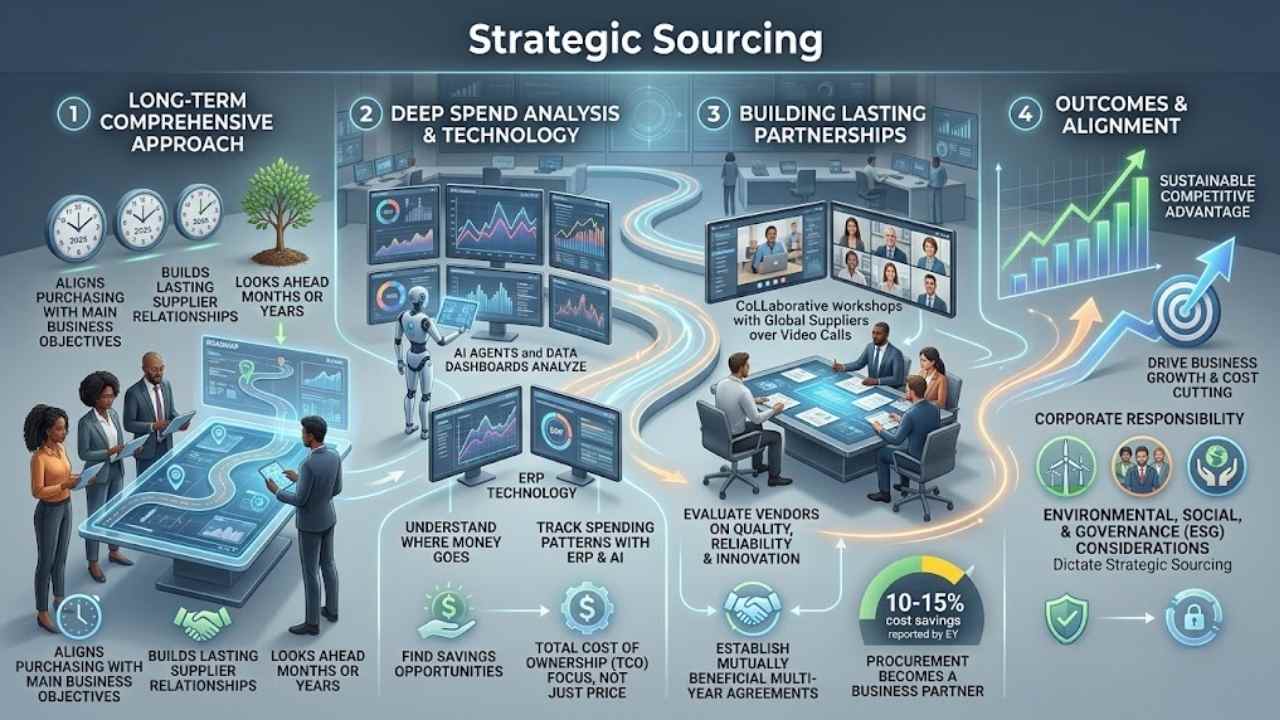
Strategic sourcing means companies think ahead and build strong supplier partnerships that support their business goals. This method uses spend analysis, supplier evaluation, and cross-functional teams to cut costs over time while managing risks and boosting value.
Definition and characteristics (Strategic Sourcing)
Strategic sourcing takes a long-term, comprehensive approach to buying goods and services. Companies use this method to align their purchasing decisions with their main business objectives. Rather than just grabbing the cheapest option today, teams look ahead months or years. They build lasting relationships with suppliers who can deliver real value over time.
This approach focuses on total cost of ownership, not just the price tag on an invoice. Organizations that practice strategic sourcing conduct deep spend analysis to understand where their money goes. They evaluate suppliers based on quality, reliability, and innovation, not just low prices. The business community recognizes this shift. In a 2025 survey by Stripe, 65% of large companies cited strategic leadership as a crucial procurement capability.
Cross-functional teams work together to make sourcing choices that support company goals. A successful strategic approach usually involves:
- Deep analysis of historical spend data to find savings.
- Evaluating vendor quality and sustainability records.
- Building multi-year contract terms that protect your budget.
- Tracking spending patterns using ERP technology and AI agents.
Tools and enterprise platforms such as GEP help enterprise teams manage these complex global networks. Strategic sourcing guides your complete supplier selection and establishes long-term contracts that benefit both the company and its partners. This method creates a strong base for business development and improved risk management across the entire supply chain.
Long-term, proactive strategy
Strategic sourcing works like planting seeds for a forest instead of picking fruit from today’s tree. You look ahead, map out your needs, and build relationships with suppliers who can grow with your company. This approach takes time to set up, but it pays off big. You establish multi-year supplier agreements that lock in better prices, improve quality, and reduce waste.
Your team stops reacting to emergencies and starts planning ahead. You align sourcing decisions with your broad business strategy, not just fill today’s orders. Research from EY confirms that implementing strategic category management can deliver 10% to 15% in direct cost savings. Long-term value creation delivers better results than quick fixes every time in sourcing.
A proactive approach means you study the market, understand supplier capabilities, and negotiate contracts that work for years, not days. Your company cuts costs through total cost of ownership (TCO) analysis, which looks at the real price of goods over time. You avoid the trap of picking the cheapest option today that becomes expensive tomorrow.
Advanced software is making this easier than ever. Pricing AI tools and modern platforms connect you with better supplier networks and deep market intelligence. ChatP2P solutions are also emerging to help buyers and suppliers communicate directly and securely. This strategy guides supplier selection and builds trust with partners who understand your vision. Your procurement team becomes a business partner, not just an order-taker, helping your company win in the long run.
Aligning sourcing with broader business objectives
Your sourcing decisions should match what your company wants to achieve. Think of it like this. If your business goal is to cut costs, then your sourcing plan needs to support that goal. If you want to grow into new markets, your sourcing should help you get there. This is where long-term strategy comes in.
You pick suppliers who fit your company’s future plans, not just today’s needs. Your procurement team works with other departments to understand what matters most. Finance cares about cost management. Operations cares about delivery speed. Sales cares about product quality. When everyone rows in the same direction, sourcing becomes a tool that drives real business results.
A major part of this alignment involves corporate responsibility. A 2025 KPMG survey found that 66% of procurement leaders believe Environmental, Social, and Governance (ESG) demands will heavily dictate strategic sourcing decisions over the next few years. Sourcing with purpose means you build multi-year supplier agreements that support your company’s path forward. You do not just buy lab supplies before a semester starts and call it a day.
Instead, you establish relationships with suppliers who can grow with you. To build resilience, a recent supplier survey showed that 71% of leaders are intentionally increasing their spend with U.S.-based small suppliers. These long-term contracts give you stability and better pricing over time. Your company gains an advantage because suppliers invest in your success too. They learn your needs, improve their service, and help you avoid problems before they happen. This approach transforms sourcing from a simple transaction into a partnership that creates lasting value for your entire organization.
Key Differences Between Tactical Purchasing and Strategic Sourcing
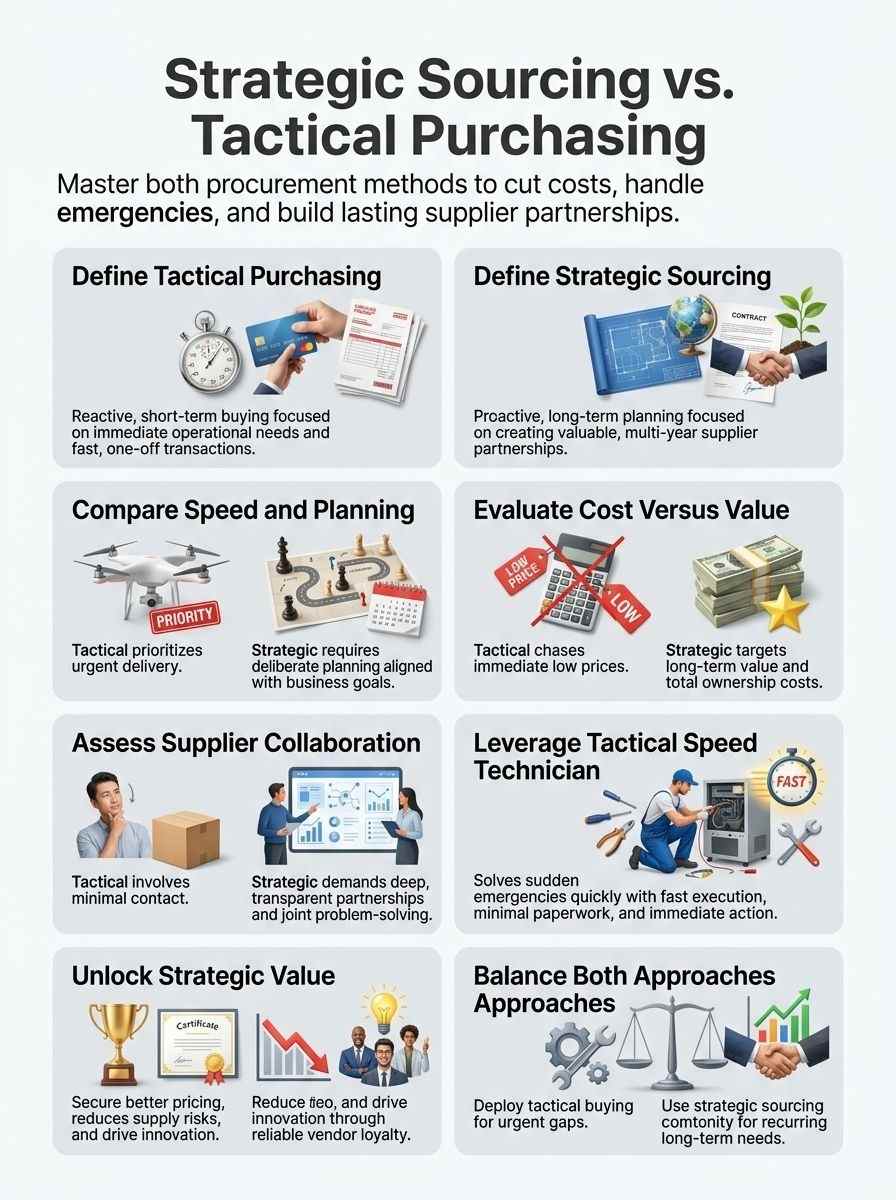
Tactical purchasing reacts to today’s needs, while strategic sourcing builds tomorrow’s advantage, so read on to see which approach fits your business best.
Timing and focus (Key Differences)
When you need supplies fast, timing and focus separate these two purchasing approaches like night and day. One method moves quick, while the other plays the long game.
| Aspect | Tactical Purchasing | Strategic Sourcing |
|---|---|---|
| Time Horizon | Short-term, reactive focus on immediate procurement needs | Long-term, proactive strategy spanning multiple years |
| Decision Speed | Rapid purchasing to address urgent requirements quickly | Deliberate planning aligned with broader business objectives |
| Approach Type | Transaction-focused and responsive to sudden demands | Holistic view of entire procurement process |
| Primary Goal | Meet immediate operational needs and emergency situations | Create long-term value and establish lasting supplier relationships |
| Real-World Example | Ordering lab supplies before a semester starts due to urgent necessity | Securing multi-year supplier agreements that support company growth |
| Flexibility | Highly adaptable to changing, sudden requirements | Structured around predictable business cycles and goals |
| Cost Focus | Prioritizes immediate cost savings and quick solutions | Focuses on value creation rather than just immediate cost reductions |
| Supplier Selection | Based on availability and quick turnaround capability | Guides complete supplier selection through careful evaluation |
Speed matters when your team needs supplies yesterday. Tactical purchasing handles this by moving fast, prioritizing immediate availability above everything else. You place an order, it arrives, problem solved. Strategic sourcing uses a different approach. It builds relationships with suppliers over time, negotiates better terms, and locks in favorable pricing for the long haul.
Your company plans ahead, identifies key suppliers, and structures deals that last years. According to The Hackett Group, utilizing modern digital tools can cut your strategic sourcing cycle time by roughly 30%. This makes the planning phase much faster than it used to be.
For example, consider an academic institution facing an urgent need. E&I Cooperative Services notes that tactical procurement ensures basic lab supplies arrive right before a semester starts. Compare that to strategic sourcing, which secures multi-year agreements with EdTech software providers to guarantee long-term technical support. Both serve different purposes in your business. Emergency procurement situations call for tactical speed. Major purchasing decisions call for strategic thinking. Your company probably uses both methods, each in its proper place.
Business goals and objectives (Key Differences)
When comparing tactical purchasing and strategic sourcing, their business goals point in completely different directions. One focuses on today, the other on tomorrow.
| Tactical Purchasing | Strategic Sourcing |
|---|---|
| Immediate Cost Savings Tactical purchasing prioritizes short-term cost reductions right now. Your team finds the cheapest supplier available for this purchase. You save money today, but may pay more later. |
Long-Term Value Creation Strategic sourcing focuses on value over many years, not just this month. Your company builds relationships with suppliers who deliver quality consistently. You invest time upfront to save money and improve quality down the road. |
| Operational Efficiency Tactical purchasing handles immediate procurement needs fast. Lab supplies arrive before your semester starts. Emergency orders get processed without delay. Speed matters more than planning. |
Broader Business Alignment Strategic sourcing aligns sourcing decisions with primary company goals. Your procurement supports your company’s mission and vision. Multi-year supplier agreements reflect your long-term direction. Every purchase serves a larger purpose. |
| Transaction-Based Approach Tactical purchasing treats each purchase separately. One order has no connection to the next. Your team repeats the same buying process over and over. Each deal stands alone. |
Holistic Strategy Strategic sourcing takes a complete view of your entire procurement process. Your company guides the supplier selection across departments. Long-term contracts with suppliers create consistency. Everything connects to your bigger picture. |
| Reactive Purchasing Goals Tactical purchasing responds to what happens right now. A broken machine needs parts today. You react instead of prepare. Goals shift based on current problems. |
Proactive Sourcing Goals Strategic sourcing anticipates future needs and plans ahead. Your team identifies suppliers before problems occur. You build relationships before you need them. Goals stay steady and purposeful. |
These two approaches serve different purposes in your business. Tactical purchasing handles urgent situations effectively. Strategic sourcing builds your competitive advantage over time. Your company likely needs both, but for different reasons.
To put this into perspective, a 2026 report by Ivalua highlights that 74% of Chief Procurement Officers list cost savings as their absolute primary objective. To achieve that goal, they must manage their “tail spend.” Tail spend refers to small, unmanaged purchases that can make up 20% of a company’s budget but involve 80% of its suppliers. Tactical purchasing creates this messy tail spend, while strategic sourcing cleans it up.
Level of supplier collaboration (Key Differences)
Tactical purchasing and strategic sourcing take opposite paths regarding how closely you work with suppliers.
| Aspect | Tactical Purchasing | Strategic Sourcing |
|---|---|---|
| Supplier Relationship | Minimal engagement with suppliers. You contact them, place an order, and move on. Relationships stay surface-level and transactional. | Deep partnerships develop over time. You build real connections with suppliers. Trust and communication flow in both directions. |
| Communication Style | One-off conversations focused on getting what you need fast. Suppliers hear from you mainly through purchase orders. Dialogue stops after the transaction closes. | Ongoing conversations about goals, challenges, and opportunities. You share business plans with suppliers. They provide input on improvements and innovations. |
| Contract Terms | Short-term agreements or spot purchases. Contracts focus on immediate needs only. You lock in prices for quick transactions. | Long-term contracts establish stability. Multi-year agreements give suppliers certainty. Both sides commit to sustained growth together. |
| Collaboration Level | Minimal teamwork between your company and suppliers. You dictate requirements, and suppliers fill them. Little room for joint problem-solving exists. | True collaboration shapes sourcing decisions. Suppliers work as extensions of your team. Together you solve problems and create value. |
| Information Sharing | Limited data exchange occurs. You share specs and deadlines only. Suppliers lack visibility into your broader operations. | Transparent information flows freely. Suppliers understand your strategic direction. You discuss forecasts, market trends, and future plans. |
| Flexibility and Adaptation | Limited flexibility since relationships are short-term. Changes require renegotiating with new suppliers. Switching vendors happens frequently based on price. | High flexibility emerges from strong partnerships. Suppliers adapt to your changing needs quickly. Both parties adjust terms based on market shifts. |
| Real-World Example | Your school needs lab supplies before the semester starts. You call several vendors, compare prices, and order from the cheapest option. Once delivered, the relationship ends. | Your company secures a multi-year supplier agreement with a lab equipment provider. You meet quarterly to discuss needs. The supplier proactively suggests cost-saving solutions. |
Tactical purchasing handles immediate purchases and emergency situations well. You call a supplier, get what you need, and keep moving. Strategic sourcing guides supplier selection instead. It establishes long-term contracts and builds real partnerships.
In fact, supply chain diversification requires this high level of collaboration. A 2026 QIMA global sourcing survey found that 43% of supply chains shifted their sourcing locations recently, with U.S. firms leading the charge. You cannot successfully move manufacturing to a new country without deep, strategic collaboration. Your suppliers become allies in achieving business goals, not just vendors filling orders.
Cost versus value considerations (Key Differences)
Tactical purchasing focuses on immediate cost savings and operational efficiency in the short term. You grab what you need right now at the lowest price possible. This approach works great when you need lab supplies before a semester starts or when an emergency pops up. The issue is that chasing the cheapest option today can actually cost you more money down the road. You might miss out on better deals, quality improvements, or supplier relationships that could save you thousands later. It is like buying the cheapest car part to fix your vehicle today, only to have it break again next month.
Strategic sourcing takes a different path by focusing on long-term value creation rather than just immediate cost reductions. This method guides your complete supplier selection and establishes long-term contracts with suppliers who understand your business. You invest time upfront to find partners who deliver quality, reliability, and innovation over several years.
The real money savings come from building these relationships, negotiating better terms, and reducing waste over time. Gartner research published recently by Aavenir shows that organizations implementing cognitive, strategic procurement capabilities report 8% to 12% reductions in their total cost of ownership. Strategic sourcing asks the bigger question about what a decision will cost in year two and year three. That future-focused thinking transforms how you spend your budget.
Pros and Cons of Tactical Purchasing
Tactical purchasing gets you what you need right now, fast and straightforward. But this quick-fix method comes with real trade-offs that can hurt your wallet and your business down the road.
Advantages of tactical purchasing
Tactical purchasing helps your company move fast when urgent needs pop up. This approach lets you grab supplies and handle emergency situations without waiting around. A 2025 Achilles report noted that geopolitical disruption alerts rose by 167%, making the ability to buy fast from backup sources highly valuable.
- Speed matters most when you need lab supplies before a semester starts, and tactical purchasing delivers results in days, not months.
- Your team can respond to sudden market changes or unexpected equipment failures without getting stuck in lengthy approval processes.
- Immediate cost savings appear in your budget right away, since you purchase only what you need right now without extra inventory sitting on shelves.
- Operational efficiency improves because your staff focuses on getting the job done rather than planning months ahead for every small purchase.
- Emergency procurement situations get handled quickly, keeping your business running smoothly when surprises happen.
- Short-term spending stays flexible, allowing you to adjust purchases based on what actually happens instead of guesses made long ago.
- Rapid purchasing means your team can take advantage of flash sales or limited-time offers that pop up unexpectedly.
- Transaction-based buying works great for one-off purchases where you do not need ongoing supplier relationships or complex negotiations.
- Your procurement staff spends less time on paperwork for simple, straightforward purchases that do not require deep analysis.
- Quick decision-making keeps projects moving forward, especially when delays could hurt your company’s bottom line or customer satisfaction.
- Minimal supplier involvement requirements mean you can work with different vendors for different purchases without building long-term contracts.
- Reactive purchasing handles those sudden urgent moments that every business faces from time to time.
When software needs change overnight, a quick tactical purchase can save the day. For example, smaller software subscriptions can often bypass the estimated $50,000 redline threshold that usually triggers a long legal review. This allows your team to get back to work immediately.
Limitations of tactical purchasing
Tactical sourcing works fast for urgent needs, but it comes with real drawbacks. Short-term thinking can cost you money and opportunities down the road. According to Achilles, natural hazard-related disruptions rose by 27% in 2025. If you rely only on spot-buying, a sudden flood or storm will leave you completely stranded without a contracted backup supplier.
- Increased costs pile up over time because you skip the negotiation process that comes with long-term contracts, forcing you to pay higher prices for each purchase.
- Missed opportunities for value creation happen when you focus only on immediate cost savings instead of building relationships that could lower expenses later.
- Supplier relationships stay shallow and transactional, preventing you from developing partnerships that offer better service, quality, and pricing over multiple years.
- Inventory management suffers when you make rushed purchases without planning ahead, leading to overstocking or running out of critical materials.
- Quality control takes a back seat because you prioritize speed over careful supplier vetting, potentially bringing in subpar products that hurt your operations.
- Emergency procurement situations drain your resources and create stress on your team when you constantly scramble to handle urgent requirements.
- Lack of strategic alignment means your purchasing decisions do not support your company’s bigger goals, leaving money on the table.
- Supplier diversity programs get neglected since you are too busy handling immediate needs to build a varied supplier base.
- Risk management gaps appear because you do not assess suppliers thoroughly or establish contingency plans for supply chain disruptions.
- Data collection and analysis fall short when you process transactions quickly without capturing insights that could improve future purchasing decisions.
- Competitive disadvantage grows as competitors lock in better rates through strategic sourcing while you pay premium prices for rush orders.
- Scalability challenges emerge when your business grows and you realize your reactive approach cannot handle increased volume efficiently.
Another major limitation is the vulnerability to inflation. A 2025 survey of University of California suppliers revealed that 60% foresee long-term price escalation. If you only use tactical purchasing, you will pay those inflated premium prices every single time you place a new order.
Pros and Cons of Strategic Sourcing
Strategic sourcing brings real advantages to companies that commit to it. You will face some real obstacles along the way, though.
Benefits of strategic sourcing
Companies that pick strategic sourcing gain real advantages over their competition. Long-term value creation beats short-term thinking every single time. A U.S. Government Accountability Office review found that leaders who strategically manage 90% of their procurement achieve 10% or more in annual savings.
- Your business builds stronger relationships with suppliers through multi-year contracts and consistent partnerships that grow over time.
- Cost reductions happen naturally when you work with suppliers for years, since both sides learn each other’s needs and find smarter ways to work together.
- Long-term contracts secure better pricing and terms because suppliers feel confident about future business with your company.
- You reduce supply chain disruptions by having reliable suppliers who know your operations well.
- Quality improves across all your purchases since suppliers invest in serving you better when they know you will stay with them.
- Your procurement team spends less time searching for new vendors and more time on actual strategy and planning.
- Risk management becomes easier when you understand your suppliers’ capabilities and have backup plans in place.
- Vendor performance stays high because suppliers know you measure results and expect consistent excellence.
- Innovation happens more often when suppliers feel like true partners and share new ideas with your team.
- Alignment with broader business objectives happens naturally since sourcing decisions support your company’s core goals and mission.
- Emergency procurement situations get handled faster because you already have trusted suppliers ready to help.
- Your company saves money on transaction costs and administrative work by using fewer suppliers over longer periods.
- Sustainability goals become achievable when you partner with suppliers who share your values and commit to improvement.
- Negotiation power grows stronger as you consolidate purchases with key suppliers and show them your loyalty.
- Data collection improves dramatically, giving you insights into spending patterns and supplier performance that lead to better decisions.
Also, the technology driving these benefits is getting smarter. Research by HFS indicates that AI-driven strategic sourcing already delivers roughly 20% in direct cost savings, proving the massive financial upside of this approach.
Challenges of strategic sourcing
Strategic sourcing demands significant time and resources from your team. Organizations must invest heavily in planning, analysis, and supplier relationship management to make this approach work.
- Time investment creates real pressure on procurement teams, since strategic sourcing requires months or even years to develop solid supplier partnerships and contracts, unlike tactical purchasing that handles urgent needs quickly.
- Building supplier relationships takes patience and effort, as your team must communicate regularly with vendors, negotiate terms, and establish trust before seeing any real benefits from the arrangement.
- Initial costs spike upward during the strategic sourcing process, because your organization pays for market research, supplier evaluation, and contract development before gaining any long-term savings.
- Data analysis becomes complex and demanding, requiring your procurement staff to gather information about supplier performance, market trends, and pricing patterns across multiple sources and time periods.
- Supplier selection mistakes carry heavy consequences, since a poor choice in a multi-year contract locks your organization into an unfavorable agreement that is difficult to change without significant costs.
- Internal alignment challenges emerge when different departments want different things from suppliers, forcing procurement professionals to balance competing needs and business objectives across the entire company.
- Market changes can make your strategic plans outdated, as economic shifts, new technologies, or industry disruptions may render your carefully crafted supplier agreements less valuable than anticipated.
- Supplier dependency grows stronger over time, leaving your organization vulnerable if a key vendor faces financial trouble, operational problems, or sudden service failures that disrupt your supply chain.
- Flexibility decreases substantially with long-term contracts, making it harder for your team to respond quickly to unexpected opportunities or shift to better suppliers when circumstances change.
- Measuring success takes longer than tactical purchasing, since strategic sourcing focuses on long-term value creation rather than immediate cost reductions, making it difficult to prove ROI in the short term.
Software costs also factor into these challenges. For example, middle-market plans for popular tools like Procurify can cost around $2,000 per month. While the return on investment is strong, your finance team must be prepared for that upfront cost to properly manage long-term contracts.
Choosing the Right Approach for Your Business
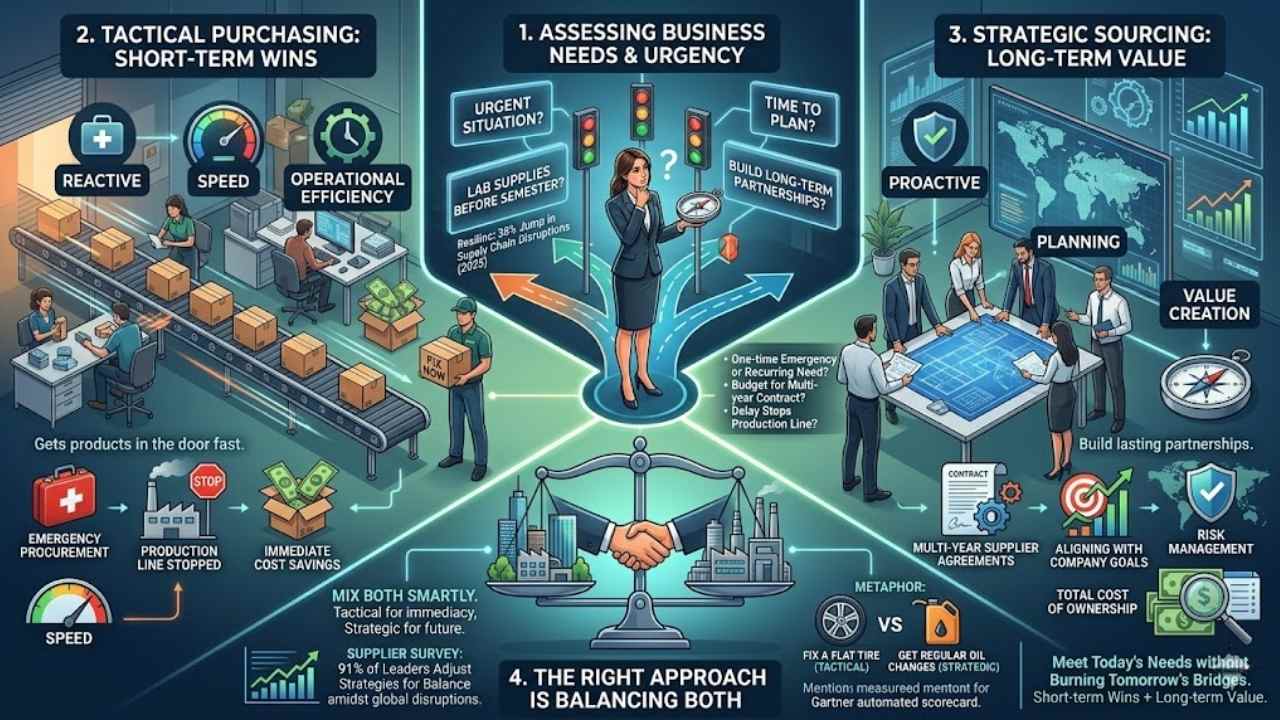
Your business needs shape which method works best for you. You pick tactical purchasing when you face urgent supply gaps, tight deadlines, or sudden market shifts that demand quick action.
Assessing business needs and urgency
Your first step is figuring out what your company actually needs right now. Does an urgent situation demand immediate action, like ordering lab supplies before a semester starts? Or can you take time to build a long-term plan with suppliers? Ask yourself tough questions about deadlines, budget constraints, and operational demands.
The landscape is more unpredictable than ever. Resilinc data showed a 38% jump in supply chain disruption notifications in 2025 alone. Tactical purchasing works well for emergency procurement situations where speed matters most. Strategic sourcing fits better when you have time to think ahead and align sourcing decisions with company goals.
To figure out which path to take, ask your team these simple questions:
- Is this a one-time emergency or a recurring daily need?
- Do we have the budget to invest in a multi-year contract right now?
- Will a delay in this purchase stop our production line?
The difference between these two approaches comes down to one simple fact. You must decide how much time you have and what matters more between getting something fast or getting the best deal over years.
Understanding your business situation helps you pick the right tool for the job. Some purchases need to happen today, while others can wait months or even years. If a lab needs supplies before the semester starts, tactical sourcing gets the job done fast. If you are aiming to secure multi-year supplier agreements that reduce costs and boost value over time, strategic sourcing makes sense. Evaluate whether you are facing a one-time emergency or a recurring need that shows up regularly. Companies that master both approaches know when to move quickly and when to slow down and plan carefully. This balance between short-term wins and long-term value creation separates good procurement from great procurement.
Balancing short-term and long-term goals
Most companies face a real tension. They need cash today, but they also need strength tomorrow. Tactical purchasing handles the urgent stuff, like ordering lab supplies before a semester starts or grabbing emergency materials when production lines stop. This approach saves money right now and keeps operations moving. Strategic sourcing locks in multi-year supplier agreements that build value over time.
The trick is not choosing one over the other, but mixing both approaches smartly. A smart business uses tactical purchasing for immediate needs while laying groundwork with strategic sourcing for the future. Current data from Supplier surveys indicates that 91% of leaders have recently adjusted their small-business sourcing strategies to strike this exact balance amidst global disruptions.
It is similar to maintaining a car. You fix a flat tire today because you need to drive, but you also get regular oil changes to keep the engine running strong for years. Tactical sourcing prioritizes immediate cost savings and operational efficiency in the short term. Strategic sourcing focuses on long-term value creation rather than just immediate cost reductions.
Companies that master both methods see better results. They handle urgent requirements quickly through tactical methods, yet they guide the broader supplier selection through strategic partnerships. Many teams use tools like the Gartner automated supplier scorecard to measure this precise balance. This balance means you spend less money now without sacrificing the stable, reliable supplier relationships that protect your business down the road. The goal is simple. You must meet today’s needs without burning bridges with tomorrow’s opportunities.
Final Thoughts
You now understand the real difference between buying things fast and planning ahead for your company’s future. Tactical purchasing handles your urgent needs right now. Strategic sourcing builds lasting partnerships that save money over years.
Your business needs both approaches working together, not fighting each other. Short-term buying fixes immediate problems, but long-term sourcing creates real value and stronger supplier relationships.
Start by looking at what your company actually needs this week, this month, and this year. Pick the right tool for each job, and watch your purchasing become smarter and more profitable. Start building your sourcing strategy today.