Elon Musk’s satellite internet company Starlink Satellite Communications has entered into a formal partnership with the Unique Identification Authority of India (UIDAI) to introduce a seamless and secure onboarding process for Indian customers. The collaboration allows Starlink to use Aadhaar-based e-KYC verification to sign up new subscribers in compliance with India’s regulatory standards.
The announcement was made by the Ministry of Electronics and Information Technology (MeitY) on August 20, confirming that Starlink will integrate Aadhaar’s authentication tools into its customer registration systems. According to officials, the objective is to ensure that people across India — including those living in remote and underserved regions — can access high-speed internet without facing the lengthy paperwork or documentation hurdles that usually slow down onboarding.
The integration of Aadhaar authentication represents one of the most significant steps Starlink has taken since receiving government approval to operate in India earlier this month. The Department of Telecommunications recently granted Starlink a Unified License, which permits the company to roll out satellite internet services across the country.
What the Starlink–UIDAI Collaboration Means
Under this new arrangement, Starlink has been designated as both a Sub-Authentication User Agency (Sub-AUA) and a Sub-eKYC User Agency (Sub-eKYC UA). These roles formally authorize the company to use Aadhaar infrastructure for digital identity verification.
The Aadhaar e-KYC process will allow customers to validate their identity online through biometric or OTP-based authentication. The process is entirely voluntary, meaning customers can choose whether to authenticate with Aadhaar. Those who opt in will benefit from a fast, paperless, and regulation-compliant onboarding experience that ensures complete transparency and accountability.
The government emphasized that Aadhaar has become a trusted foundation for digital service delivery in India. By partnering with Starlink, Aadhaar is now extending its influence into the satellite broadband sector, which is expected to play a crucial role in bridging India’s digital divide.
How Aadhaar Strengthens Starlink’s Rollout
The use of Aadhaar not only simplifies onboarding but also ensures that Starlink’s operations align with India’s strong emphasis on regulatory compliance, data security, and customer protection.
By leveraging Aadhaar authentication, Starlink can onboard users in real time without requiring physical document submission or manual checks. This speeds up the customer journey, reduces administrative burden, and minimizes the risk of fraud. It also highlights India’s ability to scale digital identity solutions for global technology providers, demonstrating the robustness of its digital ecosystem.
For Starlink, this move ensures smoother adoption across Indian households, businesses, educational institutions, and government offices that are eager to access reliable high-speed satellite internet. The company is positioning itself as a game-changer in regions where terrestrial broadband services remain unavailable or unreliable.
Starlink’s Place in India’s Satellite Internet Market
The timing of this announcement is significant. Alongside Starlink, other major players are preparing to enter India’s satellite communications sector. Bharti Airtel-backed Eutelsat OneWeb and Jio Satellite Communications (JioSpaceFiber in partnership with SES) are both working on their own satellite internet offerings, though spectrum allocation remains pending.
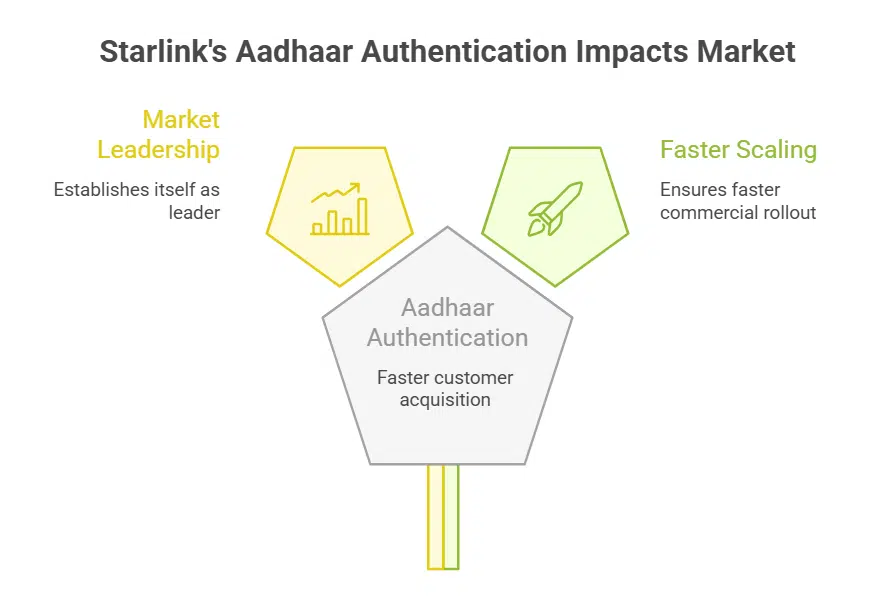
Starlink’s use of Aadhaar authentication gives it an edge in customer acquisition, ensuring faster scaling once commercial rollout begins. Industry experts believe that with a combination of global satellite technology and India’s digital infrastructure, Starlink could quickly establish itself as a leader in the Indian satcom market.
Government’s Push for Digital Infrastructure
This partnership also underscores the Indian government’s broader vision to integrate Aadhaar into multiple sectors beyond banking, telecom, and public services. Aadhaar is already the world’s largest biometric digital identity system, covering over 1.38 billion people. Its reliability, scalability, and proven track record make it an attractive tool for global companies entering India.
The Ministry of Electronics and IT highlighted that Starlink’s adoption of Aadhaar demonstrates the confidence international technology providers have in India’s digital frameworks. It also reflects how Aadhaar can be leveraged to bring innovation to service delivery while maintaining transparency and accountability.
Next Steps for Starlink in India
With its Unified License in hand and UIDAI partnership secured, Starlink is preparing to expand rapidly across India. The company aims to deliver speeds up to 200 Mbps to households and enterprises, with particular emphasis on rural and underserved regions.
Starlink’s entry into the Indian market could potentially serve millions of users. By working with Aadhaar, it will be able to onboard customers at scale in a way that is both secure and efficient.
The company has also indicated interest in collaborating with existing telecom providers such as Airtel and Jio to extend its reach further. While competitors are still awaiting key regulatory approvals, Starlink’s proactive approach could help it capture early market share.