

In a high-profile announcement at the White House, former U.S. President Donald Trump officially launched the ambitious Stargate project, a massive AI infrastructure program valued at $500 billion. This historic initiative is being hailed as one of the largest private technology investments in U.S. history. Trump highlighted the project as a cornerstone for America’s leadership in artificial intelligence, positioning it as a bold answer to the global AI race.
The initiative is not solely political—it brings together some of the biggest names in global technology and finance. The project represents a joint collaboration between OpenAI, SoftBank, and Oracle, with each partner taking on a defined role in operations, financing, and strategy.
The Role of OpenAI, SoftBank, and Oracle
- SoftBank, led by Chairman Masayoshi Son, is overseeing financing and long-term strategic planning. Son described the initiative as the dawn of a new “golden age of technology,” underscoring his vision to merge AI with massive infrastructure development.
- OpenAI, led by CEO Sam Altman, will lease and operate the facilities, bringing its expertise in generative AI and large-scale model training.
- Oracle provides cloud infrastructure expertise, with reports indicating a $300 billion, five-year compute deal to integrate the data centers into Oracle’s cloud ecosystem.
Together, the three giants aim to establish a nationwide backbone for AI infrastructure—comparable in scale to the early buildout of the U.S. electrical grid or interstate highway system.
Abilene, Texas: The First Stargate Hub
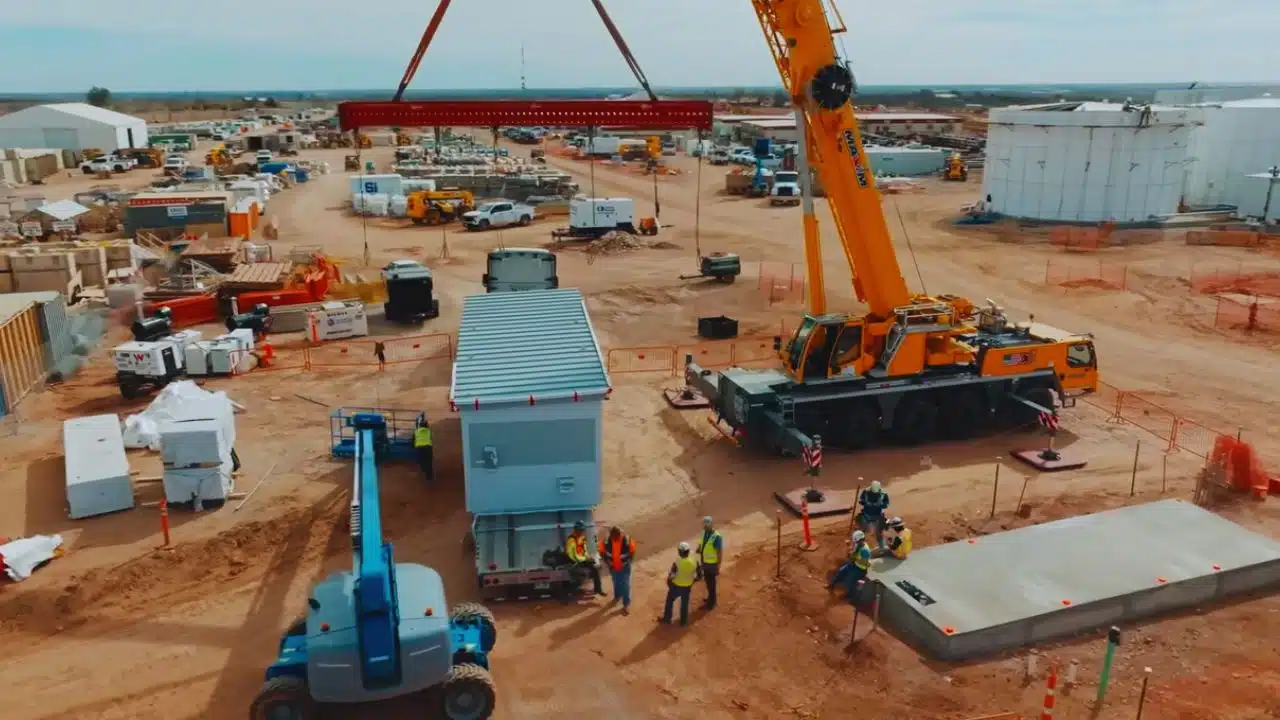
The project’s first operational data center is located in Abilene, Texas. This site is designed to become a critical hub for AI training and deployment, featuring:
- Eight H-shaped data buildings, with one already operational and another nearing completion.
- Tens of thousands of Nvidia GB200 GPUs, making it one of the most powerful AI training clusters in the world.
- A power draw of up to 900 megawatts (MW), supported by a mix of natural gas and renewable sources.
- A closed-loop water cooling system to reduce strain on West Texas’s scarce water supply.
Sam Altman personally toured the site during the launch announcement, emphasizing that Abilene is only the beginning of the broader Stargate rollout.
Five Additional Sites Across the U.S.
The Stargate consortium confirmed plans for five additional large-scale data center complexes. The chosen regions highlight a mix of strategic and logistical advantages, such as access to power grids, land availability, and state-level incentives. The new sites include:
- Two additional hubs in Texas – Shackelford County and Milam County.
- Doña Ana County, New Mexico – chosen for its proximity to major energy corridors.
- Lordstown, Ohio – a former industrial hub now repositioning as a tech corridor.
- An undisclosed Midwestern state – location details remain confidential for competitive and regulatory reasons.
Each site is expected to replicate the Abilene model, scaling to hundreds of megawatts of computing power. With these expansions plus an additional 600 MW upgrade at Abilene, Stargate’s total early capacity is projected at 5.5 GW, with the ultimate goal of reaching 10 GW nationwide by 2029.
Early Challenges and Conflicts
The Stargate project has not been without obstacles. In July 2024, the Wall Street Journal reported disagreements between SoftBank and OpenAI over site usage and data center locations. At that time, industry insiders speculated the project was being scaled back due to funding disputes.
Funding was indeed a major concern. With an astronomical $500 billion target, the project required innovative financing strategies. Recent reports suggest:
- Debt financing and chip-leasing models are being explored by OpenAI.
- Nvidia pledged up to $100 billion in chip supply commitments.
- Oracle may issue bonds to cover infrastructure spending.
These measures suggest the consortium is adapting financial strategies to keep the project on track.
Energy, Sustainability, and Environmental Questions
The Abilene site’s 900 MW energy requirement raised concerns about sustainability. To address environmental risks:
- Developers installed closed-loop cooling to minimize water waste.
- The project is integrating renewables alongside fossil fuel power, attempting to balance grid reliability with emissions reductions.
- Community groups have raised concerns about light pollution, habitat disruption, and the relatively low number of permanent jobs the facilities may create once construction ends.
Despite this, supporters argue the project represents a long-term investment in America’s AI economy and will create indirect benefits across energy, logistics, and cloud services.
Why Stargate Matters in the Global AI Race
The scale of Stargate is not just about hardware—it is about geopolitical positioning. Nations like China are also investing billions in AI supercomputing, and analysts see Stargate as a direct response to maintain U.S. leadership.
Key reasons it matters:
- AI compute power is a global bottleneck—large language models and generative AI systems require vast clusters of GPUs to operate.
- By 2029, Stargate could create one of the largest AI supercomputing networks on Earth, rivaling national initiatives in China and the EU.
- The project symbolizes a public-private model, where government support combines with private capital to accelerate AI growth.
Outlook and Next Steps
With the Abilene facility operational and five more sites under construction, Project Stargate is shifting into execution mode. Analysts say the next five years will determine whether it becomes a transformative success or stalls under financial and environmental pressure.
To succeed, the project must:
- Secure sustained financing across its $500 billion buildout.
- Balance energy consumption with environmental sustainability.
- Ensure demand for compute power keeps pace with capacity.
- Build public trust by addressing community and regulatory concerns.
If these hurdles are overcome, Stargate could mark a turning point in global AI development, reshaping how intelligence, data, and computing power are distributed worldwide.
The Information is Collected from MSN and CNBC.































