


South Korea’s President Lee Jae-Myung has outlined a new approach toward North Korea’s nuclear weapons program. Instead of demanding the immediate dismantling of the North’s arsenal, he is advocating for an interim deal in which Pyongyang agrees to freeze its production of nuclear weapons. The strategy reflects his belief that the situation requires practical steps to prevent further escalation, even if they fall short of the long-term goal of denuclearization.
Lee explained that North Korea is believed to be producing 15 to 20 nuclear weapons each year, steadily expanding its stockpile. Since 2022, North Korea has formally declared itself a nuclear weapons state in its constitution and vowed it would never give up its arsenal. In this environment, Lee sees a freeze as an immediate measure to slow the growth of the North’s nuclear capacity, buying time for diplomacy and reducing the risk of conflict.
Denuclearization vs. Realistic Goals
The South Korean president has acknowledged the difficulty of pursuing full denuclearization in the short term. Previous administrations, both in Seoul and Washington, pushed for the elimination of North Korea’s nuclear weapons. However, repeated negotiations failed. In 2019, talks between Donald Trump and Kim Jong Un collapsed in Hanoi after the U.S. demanded complete dismantling of nuclear facilities in exchange for sanctions relief.
Lee’s proposal aims to reframe the diplomatic agenda. Instead of focusing on an outcome that appears unattainable, he suggests concentrating on more achievable goals—such as halting additional production of nuclear warheads and missiles. He sees this as a phased strategy that could lead to gradual progress, while keeping the long-term objective of denuclearization alive.
The Possibility of Renewed Trump–Kim Talks
Lee has repeatedly emphasized that the most realistic path toward renewed dialogue lies in Donald Trump’s potential return to direct negotiations with Kim Jong Un. During Trump’s first term, the two leaders met multiple times, including at historic summits in Singapore and Hanoi, and even briefly at the Korean Demilitarized Zone. Although those talks ended without lasting agreements, they established a level of personal rapport between Trump and Kim.
North Korea has signaled interest in restarting talks, but only if Washington abandons its insistence on total denuclearization. For Pyongyang, recognition as a nuclear power is non-negotiable, but a freeze could serve as middle ground. Lee considers this a window of opportunity for diplomacy, which he hopes can be leveraged to stabilize the Korean Peninsula and reduce international tensions.
Balancing Global Alliances and Regional Realities
Lee’s diplomatic posture comes at a time of shifting geopolitical alignments in Northeast Asia. In recent months, China, Russia, and North Korea have strengthened their ties, as shown during a high-profile military parade in Beijing where Kim Jong Un stood alongside Xi Jinping and Vladimir Putin. Unlike in earlier periods, China refrained from pressing North Korea on denuclearization during the event.
For South Korea, this trilateral cooperation is troubling. The alignment of Beijing, Moscow, and Pyongyang threatens to marginalize Seoul’s influence in regional security affairs. In response, Lee has signaled that South Korea will continue to work closely with its allies—the United States and Japan—to safeguard its national security. However, he remains careful not to completely alienate China, given its role as South Korea’s largest trading partner.
South Korea’s Role at the United Nations
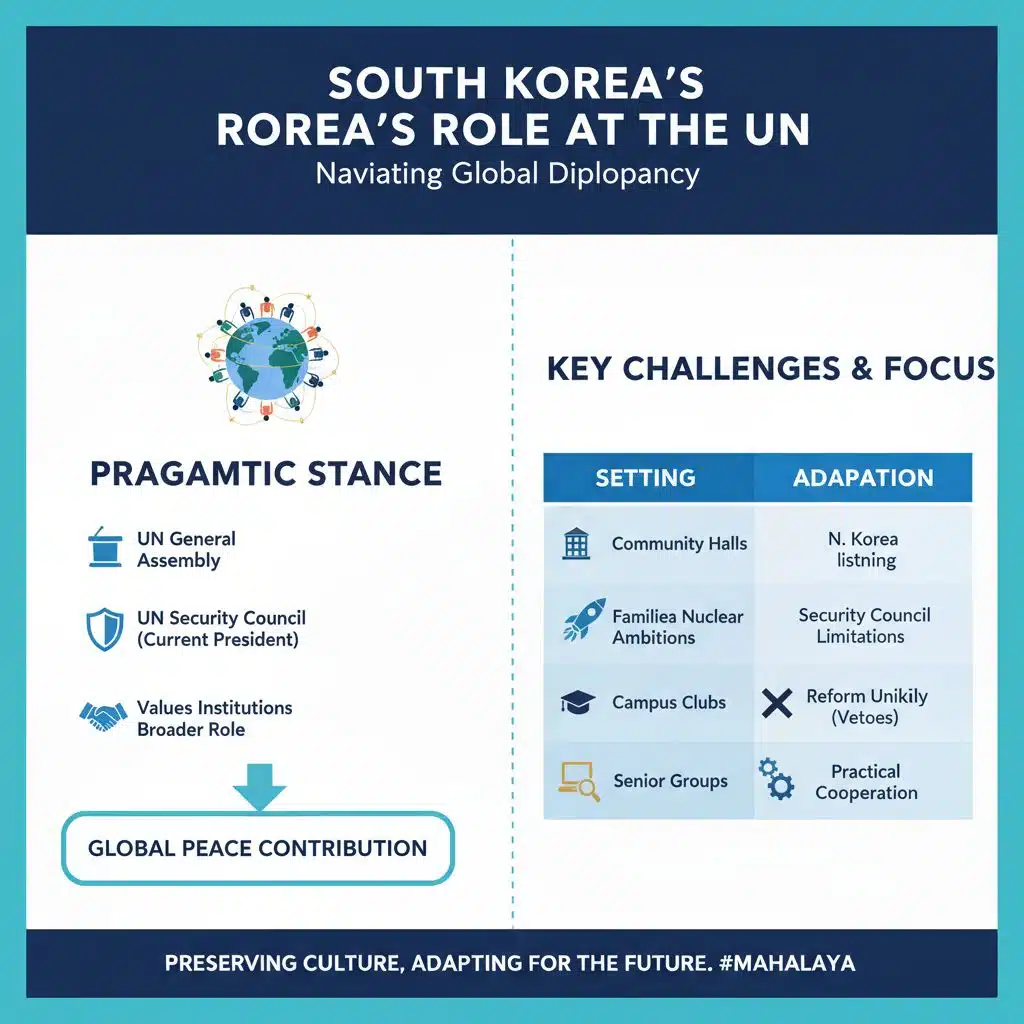
Lee’s comments came just before his trip to the United Nations General Assembly in New York, where South Korea currently holds the rotating presidency of the UN Security Council. While critics have argued that the Security Council has failed to check North Korea’s nuclear ambitions due to repeated vetoes by China and Russia, Lee has taken a pragmatic stance. He acknowledges the limitations of the UN but still values the institution’s broader role in maintaining international peace.
Reform of the Security Council, in his view, is unlikely, given the entrenched positions of its permanent members. Instead, Lee favors practical cooperation where possible and emphasizes South Korea’s responsibility to contribute to global peace despite institutional shortcomings.
Relations with China, Russia, and the U.S.
South Korea’s position between China and Russia on one side, and the U.S. on the other, creates a constant balancing act. Lee has described his country as being located at the intersection of competing global camps. He insists that South Korea must avoid becoming overly dependent on any one power while still strengthening its alliance with Washington.
Russia’s growing military partnership with North Korea—sending food, oil, and financial resources in exchange for weapons and troops during the Ukraine war—has created fresh complications. Lee has condemned Russia’s invasion of Ukraine, but he has also made it clear that South Korea cannot afford to cut off dialogue with Moscow entirely. For him, pragmatism and coexistence remain the guiding principles.
Trade Tensions with the United States
Despite reaffirming South Korea’s alliance with Washington, Lee has not shied away from expressing concern over the economic frictions caused by U.S. trade policies. The Trump administration’s trade war has imposed tariffs that South Korea has been trying to negotiate down. Although Lee secured a reduction of some tariffs to 15%, further trade agreements have stalled.
Tensions escalated recently when hundreds of South Korean workers, involved in constructing a car battery factory in Georgia, were detained by U.S. immigration officials. The incident sparked outrage in Seoul and raised questions about the reliability of America as a business partner. Lee’s administration secured their release, but he admitted the episode would make Korean companies more hesitant to invest in the U.S. Nevertheless, he expressed determination to turn the crisis into an opportunity to strengthen bilateral ties.
Domestic Challenges and North Korea Policy Shifts
At home, Lee governs a deeply polarized nation still recovering from the political turmoil that followed the impeachment of former president Yoon Suk Yeol. Yoon had attempted to impose martial law, citing alleged infiltration of South Korean institutions by pro-North Korean sympathizers. His removal left the country divided, and Lee is now working to restore stability.
As part of his outreach to Pyongyang, Lee has halted the practice of transmitting radio broadcasts across the border into North Korea. These broadcasts, while offering rare outside information to the isolated North Korean population, were considered deeply provocative by Kim Jong Un’s regime. Human rights groups criticized Lee’s decision, arguing it reduced communication with ordinary North Koreans. Lee, however, maintains that the broadcasts had limited impact and that stopping them was a necessary step toward restoring trust.
So far, North Korea has dismissed Lee’s goodwill gestures and issued statements ridiculing his initiatives. Despite the hostile response, Lee remains committed to his pragmatic approach.
Lee Jae-Myung’s strategy reflects a broader shift in South Korean foreign policy: away from maximalist goals that have repeatedly failed and toward realistic, incremental progress. He sees freezing nuclear production as a way to prevent further escalation, reduce the immediate threat, and lay the foundation for future diplomacy.
While critics argue that such a deal might legitimize North Korea’s nuclear status, supporters believe it could stabilize the situation and prevent a dangerous arms buildup. The success of this approach will depend heavily on whether Donald Trump and Kim Jong Un can revive negotiations, and whether Washington is willing to soften its stance.
For now, Lee is positioning South Korea as a careful mediator, balancing between global powers, protecting national interests, and seeking peace on the Korean Peninsula.































