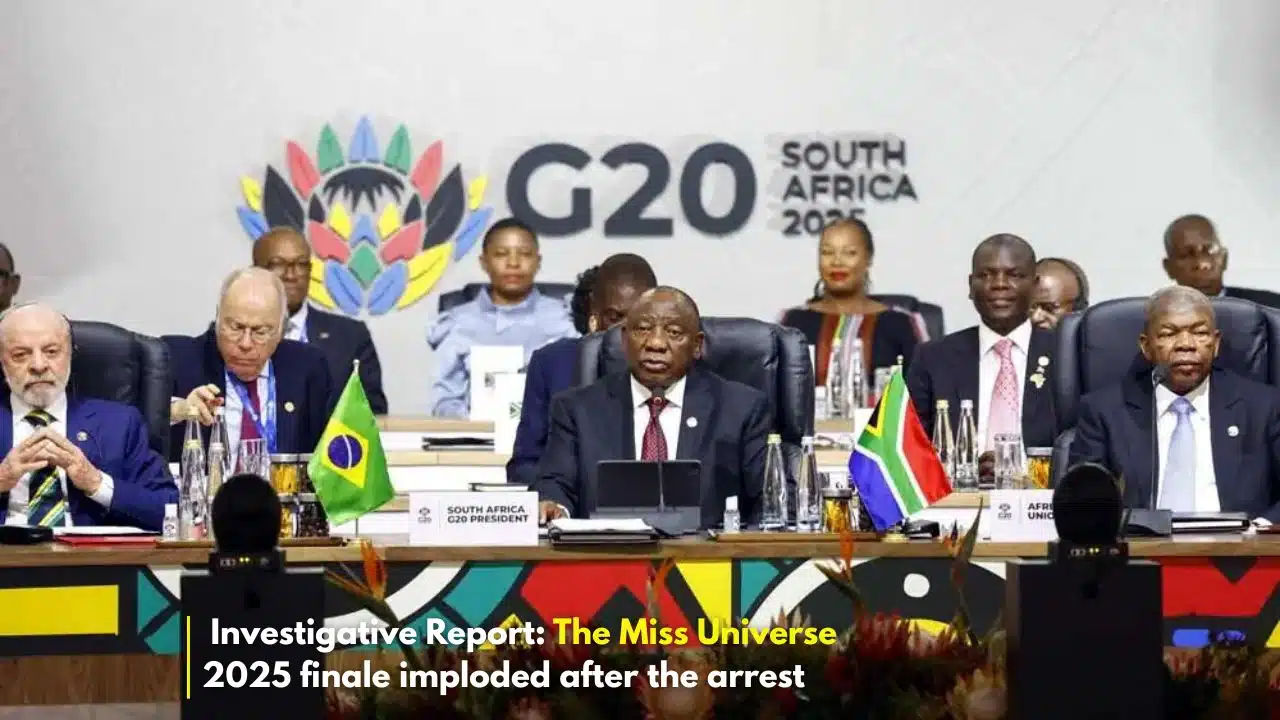
The post-1945 international order fractured visibly on Sunday morning inside the cavernous NASREC Expo Centre. In a move without precedent in the two-decade history of the G20, the “Johannesburg Declaration” was adopted not by consensus of all members, but by the determined will of nineteen nations and the African Union, leaving the United States Chair empty and its delegation absent.
The summit, hosted by South Africa under the theme “Solidarity, Equality, Sustainability,” was intended to bridge the widening gap between the Global North and South. Instead, it formalized the schism. The adoption of the declaration—which calls for $5.9 trillion in climate finance and demands fundamental reform of the UN Security Council—signals the effective birth of a “G19” order, where the developing world, backed by China and a pragmatic Europe, moves forward without Washington.
Key Facts: The Johannesburg Rift
-
The Break: For the first time, a G20 Leaders’ Declaration was finalized without US signature. The White House ordered a total boycott of the final plenary.
-
The Money: The text formally recognizes a financing gap of $5.8–5.9 trillion needed by developing nations pre-2030 to meet climate goals—a demand the US rejected as “economic surrender.“
-
The Pretext: The Trump administration cited “unfair wealth transfers” and allegations regarding South African domestic policy as reasons for the snub.
-
The Winners: The African Union (in its first summit as a permanent member) and China, which successfully positioned itself as the champion of the “Global Majority.“
-
The Losers: The Rand (ZAR) fell 4% against the dollar in early trading on fears of US trade retaliation against the AGOA pact.
The “Empty Chair” Crisis
The drama began unfolding late Friday when US negotiators, operating under direct instructions from Washington, ceased engagement with the Sherpa track (the diplomatic drafting process). Sources inside the negotiation room described a “toxic” atmosphere, with American officials characterizing the draft text’s focus on historical climate responsibility as a direct attack on the US economy.
By Saturday morning, as President Cyril Ramaphosa prepared to open the summit, the US seat remained conspicuously vacant. The White House Press Secretary issued a statement from Washington calling the proceedings “a theater of anti-Americanism” and citing disputed claims regarding the treatment of minority groups in South Africa as a secondary justification for the withdrawal.
“We will not legitimize a document that demands American taxpayers subsidize their economic competitors while our values are insulted,” a senior US State Department official told reporters on background.
Faced with a choice between a failed summit (no declaration) or breaking the consensus rule, President Ramaphosa took a gamble. Invoking the African philosophy of Ubuntu (“I am because we are”), he pushed for adoption among the remaining members.
Deep Dive: The Declaration’s “Trillion-Dollar” Shift
The Johannesburg Declaration is being hailed by development economists as the most progressive document in G20 history, primarily because it abandons the “billions” framework of the past decade.
1. Climate Finance Reality Check Previous summits struggled to meet a $100 billion annual pledge. The 2025 text obliterates this ceiling, explicitly noting that “Developing countries require an estimated $5.8–5.9 trillion for the pre-2030 period to implement their Nationally Determined Contributions (NDCs).”
-
Why this matters: It shifts the conversation from “aid” to “obligation,” framing climate finance as a debt owed by industrializers to the industrialized.
2. The “Global Alliance Against Hunger” Building on Brazil’s 2024 initiative, the declaration operationalizes the “Global Alliance against Hunger and Poverty,” with concrete pledges from the EU and China to fund agricultural technology transfers to Africa.
3. UN Security Council Reform Reflecting the African Union’s new clout, paragraph 42 of the declaration calls for “urgent and transformative reform” of the UNSC, specifically demanding permanent seats for Africa. This language was stronger than any previous G20 text, which usually offered only vague platitudes about “modernization.“
4. Digital Public Infrastructure (DPI) The group endorsed an “AI for Africa” initiative, pledging to democratize access to computational power to prevent a “digital apartheid” where the Global South provides data while the North hoards the algorithms.
Geopolitical Chess: The Realignment
The absence of the United States created a vacuum that other powers were eager to fill.
China’s Quiet Victory Premier Li Qiang, representing President Xi Jinping, used the platform to contrast Beijing’s “reliability” with Washington’s volatility. By signing the declaration without drama, China cemented its image as the primary partner for the Global South. “China stands ready to work with the G20 to implement the Johannesburg vision, regardless of shifting winds elsewhere,” Li stated .
The European Dilemma The European Union, represented by Commission President Ursula von der Leyen, found itself in an agonizing position. While politically aligned with the US on Ukraine, Europe’s economic interests in Africa and commitment to climate multilateralism forced a break with Washington. To mitigate the damage, the EU announced a €16.2 billion investment package for South Africa on the sidelines, a move analysts see as “apology money” for the US walkout.
Russia’s Free Pass With the US absent, the usual fierce debates over language condemning the war in Ukraine were notably muted. The final text noted “human suffering” in Ukraine and Gaza but avoided naming aggressors—a formulation that allowed Russia to sign on easily, handing Moscow a diplomatic win.
Economic Fallout: Markets React to the Schism
The diplomatic rupture has immediate economic costs. The South African Rand (ZAR) displayed extreme volatility, dropping to R19.45 against the dollar.
The AGOA Threat Market jitters are driven by fears that the Trump administration will retaliate by revoking South Africa’s access to the African Growth and Opportunity Act (AGOA), which allows duty-free exports to the US.
-
Sector at Risk: The South African automotive and citrus industries are heavily exposed.
-
Investor Sentiment: “The risk premium on South African assets just spiked. The market is pricing in a trade war,” noted Dawie Roodt, Chief Economist at the Efficient Group (Paraphrased).
Crypto and Gold Rally Conversely, the breakdown of G20 coordination sent investors flocking to non-sovereign assets. Gold hit a record high of $3,100/oz, and Bitcoin surged, driven by the narrative that the US dollar-based global order is fraying.
Expert Analysis: The End of “Global Governance”?
Is the G20 dead? Not exactly, but it has mutated.
Dr. Elizabeth Sidiropoulos, SA Institute of International Affairs: “We are witnessing the end of the G7’s ability to dictate the global agenda. The G20 has not failed; it has just shed its Western containment field. Johannesburg is the moment the ‘Global Majority’—the BRICS+ and the African Union—took the steering wheel. The US boycotted the bus, but the bus left the station anyway.
John Kirton, G20 Research Group: “A G20 without the US is functionally a G19. It can issue statements, but it cannot enforce financial stability rules or global tax reforms without the participation of the world’s largest economy. We are entering a dangerous period of fragmented globalization.
What to Watch Next
-
The “G19” Implementation: Can the EU and China actually mobilize the trillions promised for climate finance without US private capital?
-
US Retaliation: Watch for executive orders from the White House next week targeting “unfriendly” G20 signatories with tariffs.
-
The 2026 Presidency: The G20 presidency is scheduled to return to the US in 2026. Given the Johannesburg boycott, there is serious speculation that the US may decline to host, or that the BRICS nations might boycott a US-hosted summit in a tit-for-tat escalation.
Conclusion
The Johannesburg Summit will be remembered not for what was signed, but for who wasn’t there to sign it. By walking away, the United States may have intended to delegitimize the proceedings. Instead, it arguably accelerated the very multipolarity it seeks to arrest. The “Johannesburg Declaration” is now international record—a roadmap for a world that is learning to operate, for better or worse, without American consensus.