We often talk about how technology has changed our phones, our homes, and our workplaces, but the most radical transformation is currently happening in our driveways. The era of the “dumb” machine is ending. The automotive industry is currently navigating its most significant shift since the assembly line, moving away from horsepower and hardware toward code and connectivity. At the center of this revolution is the Software-Defined Vehicle.
Just a few years ago, a car was a static product; the day you bought it was the best it would ever be. Today, that logic has flipped. Modern vehicles are being designed to improve over time, evolving through invisible digital updates while you sleep. But what exactly does this mean for the average driver, and are we ready to treat our cars less like machines and more like mobile devices?
Key Takeaways
-
Definition: SDVs decouple hardware from software, allowing the car to improve after purchase.
-
Analogy: The shift mirrors the transition from dumb phones to smartphones (App Stores, OTA updates).
-
Business Model: The industry is pivoting from hardware sales to software subscriptions (Functions on Demand).
-
Architecture: Complex wiring (Domain) is being replaced by centralized computing (Zonal).
-
Risks: Cybersecurity and data privacy are the primary hurdles to mass adoption.
What is a “Software-Defined Vehicle” (SDV)?
A Software-Defined Vehicle (SDV) is a vehicle whose features, functions, and value are primarily enabled and managed by software rather than mechanical hardware.
In traditional automotive engineering, if you wanted a car with better braking or a new entertainment system, you had to buy a new model. The hardware and software were tightly coupled and unchangeable. In an SDV, the hardware (chassis, wheels, electric motor) is “decoupled” from the software. This separation allows manufacturers to continuously alter how the car drives, interacts, and feels without ever touching a bolt or wire.
The Technical Shift: From Messy Wires to a Central Brain
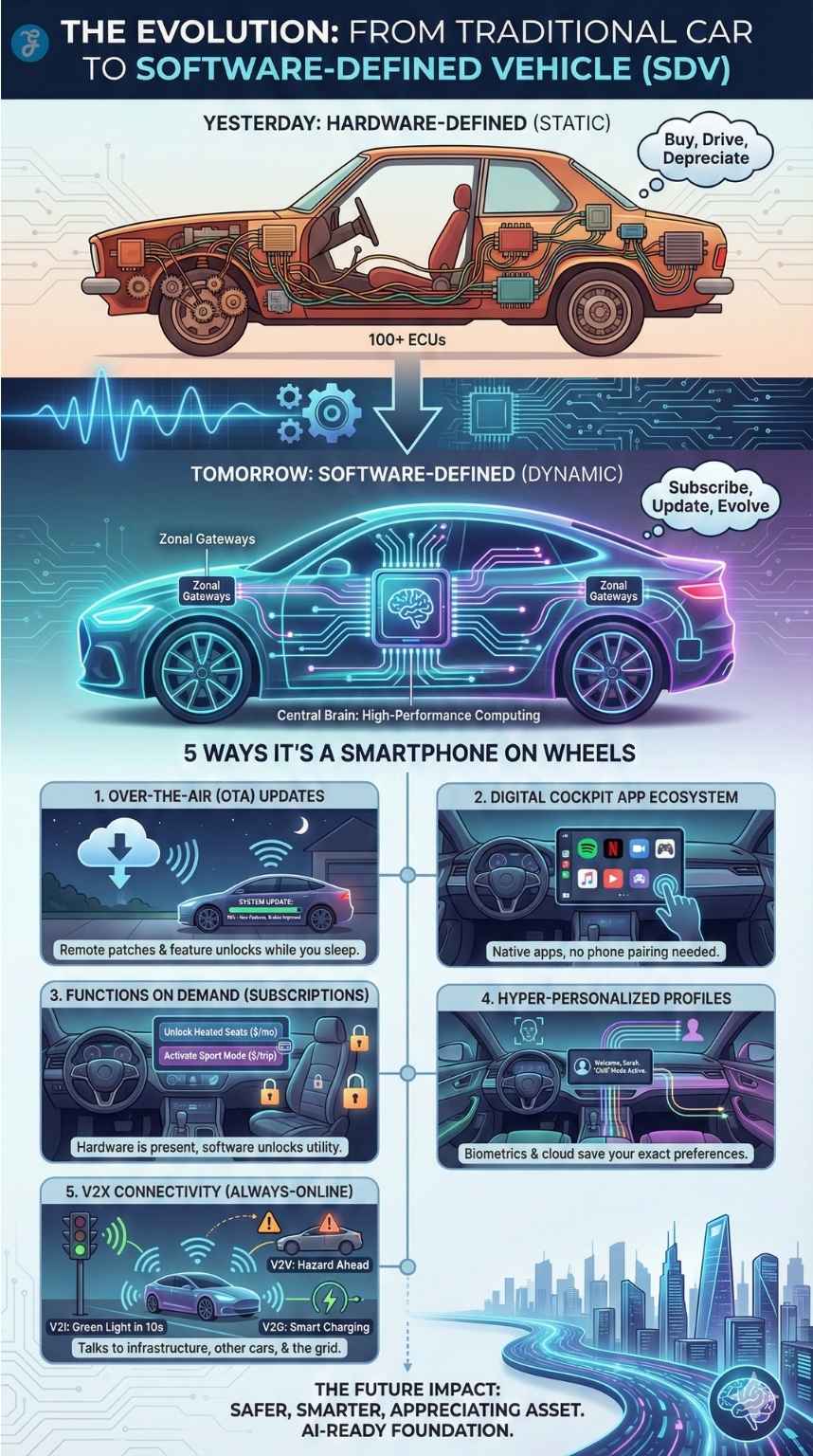
To understand the magnitude of this change, we have to look under the hood—figuratively speaking. Traditional cars rely on Domain Architecture, a complex web of up to 100 distinct “Electronic Control Units” (ECUs). There is a separate chip for the windows, another for the engine, and another for the airbags. They barely talk to each other.
SDVs utilize Zonal Architecture. This replaces those 100+ confused chips with a few powerful High-Performance Computing (HPC) units—essentially, a central brain. This “Server on Wheels” approach allows for centralized control, easier updates, and massive data processing.
| Feature | Traditional Vehicle | Software-Defined Vehicle (SDV) |
| Primary Value | Mechanical (Engine, Handling) | Digital (User Experience, Autonomy) |
| Architecture | Distributed (100+ separate ECUs) | Centralized (High-Performance Computing) |
| Updates | Impossible or Dealer-only | Frequent Over-the-Air (OTA) Updates |
| Lifecycle | Depreciates immediately | Can appreciate in utility over time |
| Connectivity | Limited (Bluetooth/GPS) | Always-on (5G, Cloud, V2X) |
5 Ways Your Car is Becoming a Smartphone on Wheels
The comparison isn’t just a buzzword; the parallels between the evolution of mobile phones and automobiles are strikingly exact. Just as the “dumb phone” became a platform for apps and services, the car is undergoing the same metamorphosis. Here are the five key ways this is happening right now.
1. Over-the-Air (OTA) Updates: The “Living” Product
The most defining characteristic of a smartphone is that it updates itself. SDVs have adopted this capability, known as Over-the-Air (OTA) updates.
In the past, a recall for a software glitch meant a frustrating trip to the dealership, lost time, and paperwork. With SDVs, manufacturers can push patches remotely. But it goes beyond just fixing bugs. OTA updates can now deeply alter the vehicle’s mechanical behavior. Tesla famously improved the braking distance of the Model 3 by wirelessly tweaking the ABS software. Other manufacturers have used OTA to unlock extra battery range during natural disasters or increase horsepower for a weekend track day.
Types of OTA Updates:
-
SOTA (Software Over-the-Air): Updates to the infotainment, maps, and apps.
-
FOTA (Firmware Over-the-Air): Critical updates to the ECUs controlling steering, battery management, and suspension.
2. App Stores & The “Digital Cockpit”
We are witnessing the death of the proprietary, clunky car navigation system. The dashboard is becoming a canvas for third-party developers, effectively turning the car into a new screen for the “App Economy.”
Leading automakers are integrating native operating systems like Android Automotive OS, which allows drivers to download apps directly to the car without pairing a phone. You can now join a Zoom conference call (audio-only while driving), watch Netflix while charging an EV, or play video games using the steering wheel as a controller. The car is no longer just a mode of transport; it is a developer platform.
3. Functions on Demand: The Subscription Model
This is perhaps the most controversial shift. As cars become software-defined, the business model moves from “Ownership” to “Usership.” This concept, often called Functions on Demand (FoD), allows manufacturers to hardware-lock features that can be unlocked via a digital subscription.
Imagine buying a luxury car that has heated seats, advanced laser headlights, and full autonomous driving hardware physically installed, but they don’t work until you subscribe to the “Winter Package” or “Pro Driver Package.”
| Feature | How it works in an SDV |
| Performance | Subscribe to “Sport Mode” for faster acceleration for a weekend trip. |
| Comfort | Pay a monthly fee for heated steering wheels during winter, cancel in summer. |
| Autonomy | Rent “Full Self-Driving” capability only for long road trips. |
While this offers flexibility, it has sparked intense debate among consumers who feel that if they bought the hardware, they should own the capability.
4. Hyper-Personalization: The “Single User Identity”
Smartphones are incredibly personal devices; you wouldn’t hand yours to a stranger without locking it. SDVs are adopting this same “User Profile” logic.
Through the use of biometrics (facial recognition or fingerprint scanners) and cloud connectivity, the vehicle recognizes the driver the moment they open the door. It then downloads their personal profile from the cloud. In seconds, the seat adjusts, the mirrors tilt, the ambient lighting changes to their favorite color, and their Spotify playlist queues up.
Crucially, this profile is portable. If you rent a car from the same brand in a different city, your profile travels with you. You log in, and the rental car instantly “becomes” your car.
5. Connectivity (V2X): The Always-Online Device
A smartphone is useless without a network connection. Similarly, an SDV relies on constant communication with the outside world. This is known as Vehicle-to-Everything (V2X) communication.
The car acts as an Internet of Things (IoT) device, constantly exchanging data with:
-
V2I (Vehicle-to-Infrastructure): Talking to traffic lights to know when they will turn green.
-
V2V (Vehicle-to-Vehicle): Warn other cars of black ice or accidents ahead.
-
V2G (Vehicle-to-Grid): Smart charging when electricity rates are low and selling power back to the grid during peak hours.
The “OS Wars”: Who Will Control Your Dashboard?
Just as computers have Windows vs. Mac and phones have Android vs. iOS, the automotive world is currently fighting a battle for the “soul” of the dashboard. There are three distinct approaches currently dominating the market, and the car you buy dictates which digital ecosystem you live in.
1. The “Walled Garden” (Tesla & Rivian)
Some manufacturers build their entire software stack from scratch.
-
Pros: Seamless integration. The software controls everything perfectly because it was built for that specific car.
-
Cons: No Apple CarPlay or Android Auto. You are forced to use their navigation and music interfaces, whether you like them or not.
2. The “Tech Giant” Integration (Google Built-In)
Automakers like Volvo, Polestar, Ford, and GM are giving up and handing the keys to Silicon Valley. They use Android Automotive OS as the native operating system.
-
Pros: You get Google Maps, Google Assistant, and the Play Store built directly into the car. It feels exactly like an Android tablet.
-
Cons: Car manufacturers lose control over the user data and the “look and feel” of the experience.
3. The “Phone Projection” Reliance (Apple CarPlay & Android Auto)
For many drivers, the car’s native software is irrelevant because they instantly plug in their phone.
-
The Shift: Apple’s “Next Generation CarPlay” aims to take over every screen in the car, including the speedometer and climate controls. However, some carmakers (like GM) are now blocking CarPlay in their new EVs to force users to use the car’s built-in software (and subscription services).
The Benefits: Why Are We Doing This?
The shift to software-defined architectures is expensive and complex, but the benefits for both manufacturers and consumers are transformative.
-
Predictive Maintenance: Instead of waiting for a part to fail, the software monitors the “health” of the vehicle in real-time. It can alert the driver (and the service center) weeks in advance that a specific component is showing signs of wear, preventing breakdowns.
-
Enhanced Safety: Safety protocols can be updated instantly. If a new threat is identified on icy roads, the traction control algorithm can be updated globally across millions of cars in hours.
-
Resale Value Protection: Traditionally, old cars lack the features of new cars. SDVs can remain “current” for longer, as software updates add features that keep the vehicle competitive in the used market.
Generative AI: Your New Co-Pilot
The Software-Defined Vehicle is the perfect host for the latest boom in Artificial Intelligence: Large Language Models (LLMs).
Until now, voice commands in cars were frustratingly rigid. If you didn’t say the exact phrase “Set temperature to 70 degrees,” the car wouldn’t understand. SDVs are integrating Generative AI (like ChatGPT-powered assistants) to create a natural conversation.
-
Contextual Understanding: You can say, “I’m cold, and I want some coffee,” and the AI will raise the cabin temperature and find the nearest Starbucks automatically.
-
Vehicle Knowledge: Instead of digging through a physical owner’s manual, you can ask the car, “What does that yellow light on my dashboard mean?” and the AI will explain the issue and book a service appointment if needed.
How SDVs Change Car Insurance (Usage-Based Insurance)
The Software-Defined Vehicle is killing the traditional insurance model of “pay a flat rate based on your age and zip code.” Because SDVs are always connected and packed with sensors, they know exactly how you drive.
This has given rise to Telematics-Based Insurance (or UBI – Usage-Based Insurance).
-
Real-Time Data: The car shares data on your braking harshness, cornering speed, and time of day driven directly with the insurance provider.
-
The Reward: Safe drivers can see premiums drop by 30-40% because they are proving their safety with data, not demographics.
-
The Risk: Conversely, aggressive driving habits are instantly recorded, potentially raising rates or voiding warranty claims if the data shows “track-like” driving behaviors on public roads.
The Challenges: It’s Not All Smooth Driving
Despite the glossy promise of a smarter future, the road to the Software-Defined Vehicle is paved with significant hurdles.
Cybersecurity and Hacking
If your phone gets hacked, you might lose your credit card info. If your car gets hacked, you could lose control of your brakes at 70 mph. Automotive Cybersecurity is now a critical safety discipline. As cars become more connected, the “attack surface” for hackers grows. Manufacturers must implement military-grade encryption to prevent malicious actors from accessing the vehicle’s Controller Area Network (CAN bus).
Data Privacy
SDVs generate terabytes of data daily—from your location history to your driving style and even camera footage of your surroundings. The question of “Who owns this data?” remains a legal grey area. Insurance companies are eager to access this data to adjust premiums based on real-time driving behavior, a trend that privacy advocates worry could become invasive.
Subscription Fatigue
Consumers are already overwhelmed by subscriptions for streaming services and software. Bringing this model to the driveway—where people are used to one-time payments—risks alienating buyers. There is a fine line between “flexibility” and “renting the hardware you already bought.”
The Future of the Automotive Industry
The Software-Defined Vehicle is the foundation for the next massive leap: Autonomous Driving. You cannot have a self-driving car without the centralized computing and rapid decision-making capabilities of an SDV architecture.
We are moving toward a future where the “brand” of a car will be defined by its operating system rather than its engine. Just as we have “Apple families” and “Android families,” we may soon see households loyal to specific automotive software ecosystems. The car is no longer just a machine that moves us; it is a digital companion that learns, adapts, and evolves.
Frequently Asked Questions (FAQ)
1. Can my older car become a Software-Defined Vehicle?
Generally, no. True SDVs require a specific hardware architecture (Zonal Architecture) and high-performance computing chips installed at the factory. While some older cars can receive basic infotainment updates, they lack the “central brain” required for deep system changes.
2. Do I have to pay for updates?
It depends. Most safety and security updates (bug fixes) are free. However, “feature” updates—like adding self-parking capabilities, faster acceleration, or premium navigation maps—are increasingly becoming paid upgrades or monthly subscriptions.
3. Is it safe to drive while the car is updating?
No. Most deep system updates (FOTA) require the car to be stationary and parked. The vehicle will usually lock the doors and disable driving functions for 20–45 minutes while the update installs, similar to how your phone cannot be used during an OS update.
4. What happens if the software crashes while driving?
Automotive software is built on “Real-Time Operating Systems” (RTOS), which are far more robust than your PC’s Windows or macOS. Critical systems like brakes and steering have redundant backups and are isolated from non-critical systems (like music) to ensure that even if your screen freezes, your brakes will still work.
5. Will software-defined cars be more expensive?
Initially, yes. The high-performance computers and advanced sensors increase upfront costs. However, manufacturers argue that the “Total Cost of Ownership” may decrease because predictive maintenance will prevent costly mechanical failures, and the car’s value will depreciate more slowly.
Final Thought: From Horsepower to Computing Power
The Software-Defined Vehicle is not just an upgrade; it is a fundamental reimagining of personal transportation. We are leaving behind the era where a car’s value was defined solely by pistons and gears. Instead, we are entering a future where code is the new engine, and connectivity is the new fuel.
While challenges like data privacy and subscription fatigue remain, the benefits of a vehicle that learns, adapts, and improves over time are undeniable. As the lines between our digital lives and our driving experiences blur, the car is finally catching up to the rest of our technology. The only question remains: are we ready to trade the feeling of permanent ownership for the flexibility of digital usership? The road ahead is digital, and the update is already downloading.