Do you ever feel like good grades and technical know-how aren’t enough to land your dream job or keep up at work? You are not the only one. Many professionals get stuck in interviews or struggle with teamwork, even when they know their field inside and out. Companies today want workers who can communicate clearly, solve problems fast, bounce back from setbacks, and lead others. These qualities are called soft skills, and the soft skills training market for them is exploding.
In fact, jobs that need strong communication and emotional intelligence are growing faster than those that do not. If you find it difficult to speak up in meetings or adjust to change quickly, don’t worry, these are skills you can build.
I’m going to walk you through why this training matters more than ever and how new tech is making it easier (and frankly, more fun) to learn.
Understanding Soft Skills Training
Soft skills shape how we work and connect with others. They are the engine behind growing careers and building stronger teams, one interaction at a time.
Definition and Importance of Soft Skills
Soft skills are the personal traits that determine how well you interact with others. Think of them as the “people skills” that complement your technical ability. They include communication, teamwork, emotional intelligence, adaptability, and critical thinking. While hard skills help you get the interview, these skills help you get and keep the job.
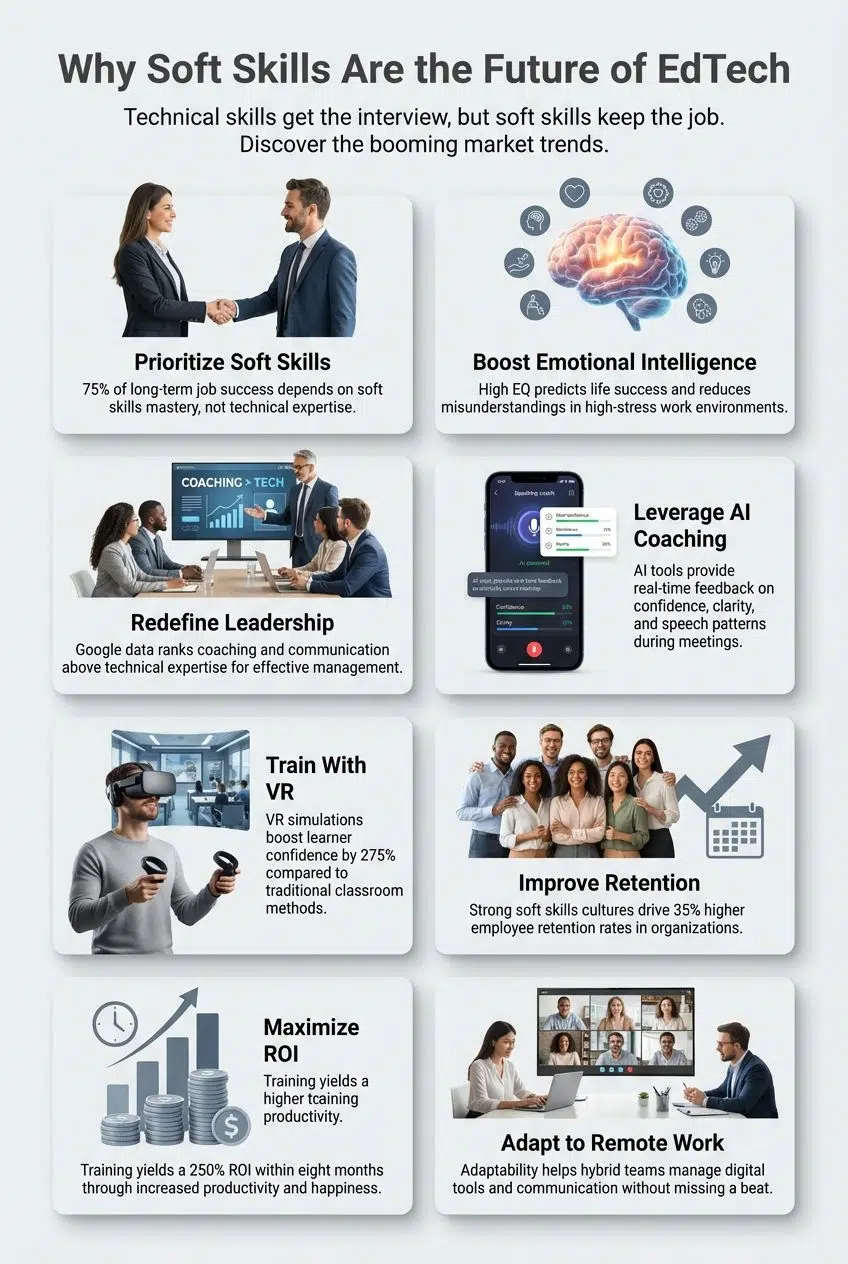
Communication skills allow you to explain complex ideas simply. Teamwork helps groups finish big projects faster. Employers across the United States look for these qualities because they make workplaces friendlier and more productive. In fact, a landmark study by the Stanford Research Institute International found that 75% of long-term job success depends on soft skills mastery, while only 25% comes from technical skills.
A strong set of soft skills helps workers keep up during digital shifts or job changes. For example, being adaptable helped millions switch to remote work after 2020. The World Economic Forum notes that companies now rate problem-solving and self-management as top priorities for workforce training.
Soft skills support leadership too; good leaders stay calm under stress and listen before acting.
Emotional intelligence is the best predictor of success in life.
Examples of Key Soft Skills in Demand
Companies are actively hunting for people who can collaborate effectively. Here are the specific skills needed more than ever in 2026:
- Communication Skills: These help you share ideas clearly, whether you are on a Zoom call or writing a Slack message. Good communication avoids confusion, saves time, and builds trust.
- Emotional Intelligence (EQ): This helps you understand your own feelings and the feelings of others. High EQ leads to better teamwork and fewer misunderstandings in high-stress environments.
- Leadership: This isn’t just for managers. It is about guiding teams toward goals. A good leader supports coworkers, handles change well, and brings out the best in others.
- Teamwork: This means working together to finish tasks faster. Sharing ideas with a group often produces stronger results than working alone, especially in tools like Microsoft Teams or Asana.
- Critical Thinking: This lets you spot problems quickly and find smart solutions. Employers value workers who think ahead and make wise choices under pressure.
- Adaptability: This shows you can handle new tools, changing jobs, or remote work setups without missing a beat. With AI changing workflows daily, adaptability is now a top career survival skill.
- Resilience: This helps people bounce back from setbacks. Companies see it as vital during tough economic times or big organizational changes.
- Conflict Resolution: This stops small arguments from growing bigger by helping people listen calmly and reach agreements that suit all sides.
- Time Management: This helps you finish your work on time without feeling rushed. It is crucial for meeting deadlines in fast-paced environments where you juggle multiple projects.
- Creativity: This sparks new ideas for products or better ways to do things, often setting one business apart from its rivals.
These skills shape how we interact every day while boosting job performance across industries, from healthcare to tech giants like Google and Amazon, and even retail leaders like Walmart.
Why Soft Skills Are Crucial in Today’s Workforce
Soft skills often tip the scales between a good worker and a great one. Managers see these skills as keys that open doors to better teams, smoother deals, and happier workplaces.
Growing Need for Emotional Intelligence
Emotional intelligence helps people understand their own feelings and the feelings of others. According to LinkedIn’s 2024 Global Talent Trends report, 92% of talent professionals say strong soft skills are just as important, or more important than hard skills. Workplaces need people who can handle stress, adapt quickly, and talk with respect to all sorts of coworkers.
Teams work better when members show empathy. Leaders also use emotional intelligence for smart decisions and to build trust. With workplaces going remote or hybrid, knowing how to read virtual cues has become a top skill. Emotional intelligence does not just help at work; it makes life easier in many situations, whether talking with friends or solving problems under pressure.
Adapting to Globalization and Diverse Workforces
Teams now stretch across continents and cultures. Your Monday morning meeting might include colleagues from New York, London, and Singapore. Skills like adaptability, clear communication, and empathy help workers connect with colleagues from different backgrounds.

These soft skills are key as companies hire talent worldwide. With digital changes speeding up, more jobs demand teamwork with global partners. Training programs boost workforce development by focusing on respect and self-awareness in daily tasks. This helps teams build trust fast and solve problems together, no matter where they sit on the map.
Culture is the widening of the mind and of the spirit, said Jawaharlal Nehru.
Enhancing Leadership and Collaboration
Strong leadership encourages trust and brings people together. Good leaders know how to listen, share clear goals, and help each person shine. Soft skills training helps workers grow these talents fast.
Google proved this with their famous Project Oxygen study. They analyzed their best managers and found that technical expertise ranked last among the top eight qualities. The number one quality? Being a good coach and communicator. This data changed how the tech giant hires and promotes, prioritizing empathy over coding ability for leaders.
Working well with others matters more than ever. Companies with high trust levels and good collaboration are far more likely to perform well financially. Leaders who show empathy earn respect from their workforce faster, keeping projects moving forward without drama slowing things down. In short, investing in soft skills makes both workers and managers ready for any challenge.
The Role of EdTech in Revolutionizing Soft Skills Training
Technology brings soft skills training to life, making it personal and engaging. Learners get hands-on experiences that stick with them long after the lesson ends.
Personalized Learning through AI and Analytics
AI tracks how each person learns best. It spots your weak points using analytics, then gives you different lessons to help fill those gaps. For example, AI-powered communication coaches like Poised can listen to your speech in real-time meetings and give you private feedback on your confidence, clarity, and filler words.
These tools adjust instantly. You get feedback right away on skills like emotional intelligence or leadership. Busy workers save time because no one has to repeat what they already know. Managers see growth through easy-to-read charts, making workforce training smarter for everyone.
Gamification and Interactive Learning Modules
Simple games and quizzes turn digital learning into a fun challenge rather than a boring task. Points, badges, and leaderboards push learners to improve skills like communication and critical thinking.
- Microlearning: Apps break long lessons into 5-minute chunks you can do on your phone.
- Instant Feedback: Students practice teamwork in modules and see how their choices change the outcome immediately.
- Safe Failure: You can mess up a negotiation in a game without losing a real client.
Virtual rewards make training feel more like playing a game than sitting in class. Modules adapt to each user’s pace so everyone can grow at their own speed. Interactive learning gives people confidence as they practice emotional intelligence in safe spaces before facing real groups at work.
Virtual Reality (VR) for Realistic Simulations
Virtual Reality places learners inside a lifelike scene. Users wear headsets and take part in digital classrooms or meetings. This makes skills like communication and adaptability feel urgent and real.
Companies use this technology for serious training. For instance, Walmart partnered with VR firm Strivr to train over a million associates. They used VR headsets to simulate the chaos of Black Friday sales, allowing employees to practice managing crowds and stress without the actual risk. The result was a massive boost in employee confidence and retention.
Another leader in this space, Bodyswaps, allows users to practice difficult conversations with virtual avatars and then watch themselves back from the other person’s perspective. This builds empathy faster than any textbook could. VR keeps learning active, no dull lectures, just jump right in and learn by doing.
Key Market Trends Driving the Growth of Soft Skills Training
Fresh trends are shaping how people learn soft skills. Stay tuned to see what is changing—some of it might surprise you.
Rise in Remote and Hybrid Work Environments
More jobs now allow people to work from home or split time between the office and home. This shift happened fast. People use video calls, chats, and emails more than ever. Communication skills matter even more in these settings because you cannot rely on body language as much.
It is easy for misunderstandings to pop up without strong emotional intelligence. Teamwork looks different when everyone sits in a separate place. Workers need adaptability to handle changes in tools and meetings. Leaders must keep teams connected, support well-being, and solve problems quickly across screens.
Emphasis on Employee Well-Being and Retention
Happy workers stay longer and work better. Companies now focus on emotional intelligence and stress management to boost employee well-being. Digital learning tools offer quick lessons in empathy and resilience.
Organizations with strong soft skills cultures report 35% higher employee retention rates. Firms use microlearning modules for daily skill-building and support mental health through interactive platforms. This type of professional development does not just fill a skills gap; it makes staff feel valued every day. Better workplace culture grows as people connect through improved interpersonal skills.
Demand for Lifelong Learning and Upskilling
People now change jobs more than ever. Skills can become outdated quickly. Digital transformation keeps moving the finish line, forcing everyone to learn new things again and again. Even top companies like Google or Microsoft expect regular upskilling from their teams.
Online learning makes this easier. Platforms like Udemy Business and LinkedIn Learning offer thousands of short courses in leadership and adaptability available at any hour. This trend means professional development is no longer just a one-time event; it follows workers through every stage of life.
Market Insights and Growth Projections
Soft skills training now grabs attention as more companies invest in digital learning. New data points to strong growth ahead, so smart players are paying close attention.
Largest and Fastest-Growing Skill Categories
People want to know which soft skills are rising fastest. Here is a snapshot of the current landscape based on 2024-2025 market data.
| Skill Category | Growth Trend | Why in Demand | Key Insight |
|---|---|---|---|
| Communication Skills | High & Stable | Hybrid workplaces need clear messaging to avoid costly errors. | Consistently ranked in the top 3 most requested skills by employers on LinkedIn. |
| Emotional Intelligence | Fastest Growing | Employees juggle more stress and diverse teams. | Searches for “emotional intelligence courses” have doubled since 2020. |
| Adaptability & Resilience | Rapid Climb | Change is constant; new tech keeps coming. | Demand grew by 26% year-over-year according to recent global skills reports. |
| Collaboration & Teamwork | Consistent Growth | Cross-cultural teams make teamwork harder but more vital. | 64% of organizations list this as a top priority for new hires. |
| Leadership & Influence | Steady Rise | Baby boomers are retiring; Gen Z needs to lead sooner. | Leadership microlearning demand is up 19% as companies train young managers. |
| Problem Solving | Fast Track | Automation handles routine; humans must solve the complex stuff. | The World Economic Forum lists this as a critical skill for the next 5 years. |
Regional Market Highlights
Soft skills training is gaining steam across different regions. Let’s look at where the action is heating up.
Expansion in North America and European Markets
North America and Europe lead the way in soft skills training. Companies across the United States, Canada, Germany, and the United Kingdom use digital platforms extensively for workforce development. In the U.S. alone, the soft skills training market was valued at roughly $24.1 billion in 2025.
Big names like LinkedIn Learning and Coursera focus heavily on communication skills, emotional intelligence, and leadership here. The shift to hybrid work in these regions put digital learning tools front and center. Government programs boost professional development, too. In 2024, over 70% of large European firms reported staff using online microlearning for critical thinking.
Growing Interest in the Asia-Pacific Region
Many companies in the Asia-Pacific region now see the value of soft skills. China, India, and Japan are jumping on digital learning for workforce training. Major cities like Singapore, Tokyo, and Sydney push for more online courses that teach leadership development.
Initiatives like Singapore’s SkillsFuture encourage professional development using EdTech platforms. Young people want career readiness classes to help them land jobs at global firms. Experts say this region will see massive spending growth by 2027 as demand rises for emotional intelligence and teamwork training.
Benefits of Soft Skills Training for Individuals and Organizations
Soft skills training lifts people and teams, sparking better results at work. Curious about the real impact on careers? Here is what the data says.
Improved Job Performance and Career Growth
People with strong communication skills or emotional intelligence stand out. They solve problems faster, share ideas clearly, and adapt to changes better. In digital learning programs, people can practice leadership and teamwork every day, which builds confidence for real-world situations.
Employees who focus on professional development get noticed. Skills like critical thinking help them win promotions. A study by MIT Sloan proved this with hard numbers: they found that soft skills training in factories yielded a 250% Return on Investment (ROI) within just eight months. Productivity went up, and workers were happier.
Better Team Dynamics and Productivity
Good teamwork grows with strong communication skills. People share ideas more openly, spot problems faster, and find better answers as a group. Team members start to trust each other more, which helps them handle tough days with less stress.
92% of talent professionals see soft skills as just as important or more than technical skills.
Training in adaptability leads to smoother projects and fewer mistakes. Staff who build resilience are quick to adjust plans when changes pop up. As workers learn new digital learning methods, they get better at working together from anywhere, keeping everyone productive and connected.
Challenges and Opportunities in the Sector
While soft skills training faces bumps and hurdles, the road ahead shines with big wins and fresh ideas.
Overcoming Barriers to Adoption
Soft skills training sounds simple, but bringing it into daily work can hit a few bumps.
- Measurement Difficulties: Companies often struggle to measure “better communication,” making leaders hesitant to invest. However, new tools like xAPI are helping track these behaviors better.
- Budget Constraints: About 37% of small and medium enterprises cite cost as the main barrier to implementing these programs.
- Old-School Methods: Boring lectures do not work. Interactive EdTech solutions like VR are needed, but can be expensive to start.
- Fear of Vulnerability: Employees can feel shy about admitting they need help with teamwork or adaptability.
- Time: Workers often say they have no time for learning. This is why microlearning (5-minute lessons) is becoming the standard solution.
Breaking down these walls paves the way for more benefits, especially as demand grows in hybrid workspaces.
The Future Prospects of Soft Skills Training
Fresh training methods are popping up everywhere. New chances keep springing to help people learn these skills faster and smarter.
Innovating Training Delivery Methods
Teachers now use AI and digital learning to help people grow. Some companies use microlearning, which breaks lessons into small chunks you can finish in minutes. Virtual reality brings real-life work situations into your home or office, letting you practice emotional intelligence without risk.
Gamification makes training fun by turning tasks into friendly competitions. Apps on your phone let you learn anytime, anywhere, on the bus or while waiting for coffee. Short videos show ways to solve problems fast, while quizzes check what you remember right away.
Exploring New Market Opportunities
Soft skills training has started reaching fresh groups. Companies in retail, healthcare, and tech now want better communication and teamwork for their staff. EdTech platforms spot this shift; they are making more microlearning options and digital courses for professional development.
Organizations across Latin America and Africa show strong interest in workforce training to close the skills gap. The push for remote work brings new needs for emotional intelligence and creative leadership, no matter the country. Soft skill tools blend easily with online learning apps, making room for faster growth worldwide.
Final Words
Soft skills training is quickly changing how we get ready for jobs, thanks to new tech, online lessons, and smart tools. People want better communication, emotional intelligence, teamwork, and problem-solving skills at work now more than ever.
These methods are practical because they use short digital lessons anyone can start right away, saving time while making a big impact. Learning these key skills helps people grow in their careers and lets companies build stronger teams with higher job happiness.
For those who want to keep learning or find what is next in their job journeys, websites like Coursera or LinkedIn Learning have loads of courses ready to go. Growth depends on being flexible, so stretch your mind a little each day, and you will be amazed by how far you can go!