You know the feeling: you spend years building an audience on a platform, only for an algorithm change to wipe out your engagement overnight. Or maybe you’ve noticed how “free” apps seem to know a little too much about your offline conversations. It’s not just you—trust is collapsing. A 2024 Pew Research Center study highlighted that 77% of Americans have little to no trust in social media executives to responsibly manage their data.
That skepticism has given rise to SocialFi (Social Finance). It’s not just a buzzword; it’s a structural shift. By combining social networking with the financial backbone of blockchain, SocialFi promises to fix the broken “user-as-product” model.
Instead of a CEO in Silicon Valley owning your profile, you own it. Instead of waiting for a monthly ad-revenue check that might never come, you get paid instantly via smart contracts.
We’re going to look at the hard data behind this shift, the specific platforms like Farcaster and Lens Protocol that are leading the charge, and the real obstacles standing in the way of mass adoption.
What is SocialFi?
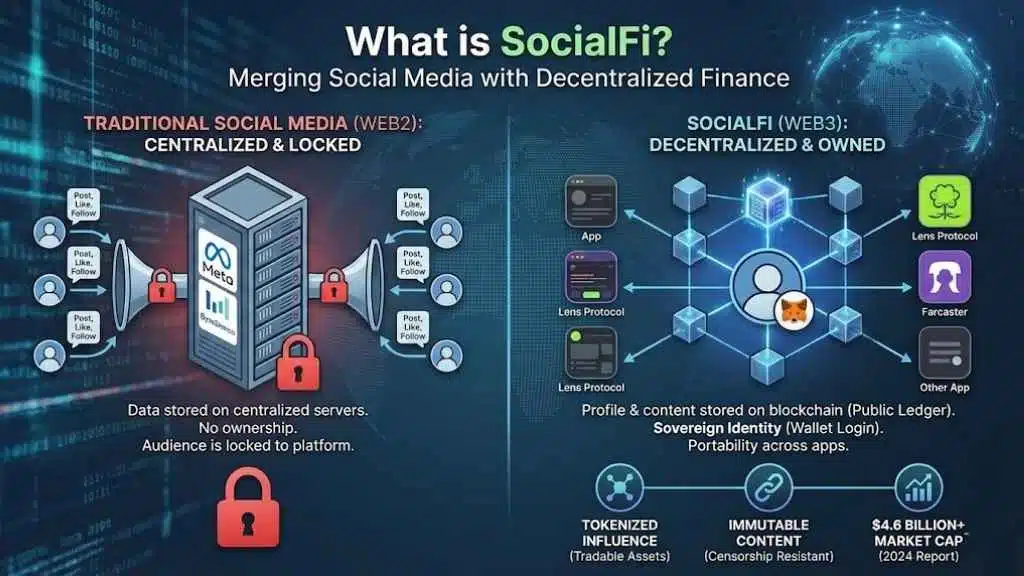
SocialFi uses blockchain to fundamentally restructure how social networks operate. It merges the social interactions you’re used to—liking, following, posting—with decentralized finance (DeFi) principles.
Definition and key principles
At its core, SocialFi turns your digital footprint into an asset you own. On traditional platforms (Web2), your data is stored on centralized servers owned by Meta or ByteDance. In SocialFi, your profile and content are stored on a blockchain.
This difference is technical, but the result is practical: Portability.
If you build a following on a platform like Lens Protocol, you can take that entire audience to a different app built on the same network. You aren’t locked into one interface. The key principles driving this sector include:
- Sovereign Identity: You log in with a crypto wallet, not an email owned by a provider.
- Tokenized Influence: Your “clout” can be measured and traded as a digital asset.
- Immutable Content: Posts are recorded on a public ledger, making censorship significantly harder.
The money is following this logic. A 2024 report by KuCoin noted that the market capitalization for SocialFi sector coins had already exceeded $4.6 billion. This isn’t a niche experiment anymore; it’s a growing economy.
The integration happens through “Smart Contracts”—self-executing code that runs on the blockchain. These contracts handle the logic that central servers used to manage.
When you “like” a post on a SocialFi platform, you aren’t just clicking a button; you might be signing a micro-transaction that tips the creator a fraction of a cent. This is often built on high-speed blockchains like Base or Polygon to keep costs near zero.
This integration solves the “platform risk” problem. On X (formerly Twitter), the company can shadowban you or remove your monetization at will. In a SocialFi ecosystem, the rules are hard-coded. As long as you follow the transparent logic of the smart contract, no human moderator can arbitrarily cut off your income.
The Problems with Traditional Social Media
The current social media model is facing a crisis of authority. Users are realizing that “free” access comes with a steep hidden cost: their privacy and their autonomy.
Privacy concerns and data misuse
We are currently living through an era of what the FTC’s 2024 report described as “vast surveillance.” Traditional platforms collect thousands of data points—from your location history to how long you hover over an ad—to build a profile they can sell.
This centralization creates massive “honeypots” for hackers. In 2024 alone, data breaches exposed billions of records globally. When one company holds the keys to 3 billion users, a single breach is catastrophic.
SocialFi projects approach this differently by using technologies like Zero-Knowledge Proofs (ZK-proofs). This allows a network to verify you are a real person without you ever having to reveal your actual identity or personal data to the app developers.
Centralized control and lack of transparency
The dangers of centralization aren’t theoretical—they are operational. A prime example occurred in June 2023, when Reddit suddenly changed its API pricing.
This decision effectively killed popular third-party apps like Apollo and forced users to use the official, ad-heavy app. The community revolted, but they had no power. Data analysis of the protest showed that roughly 27% of protesting users stopped posting entirely, yet the company pushed the changes through anyway.
In a centralized model, you are a tenant, not an owner. The landlord can change the locks whenever they want. SocialFi removes the landlord. Governance tokens often allow the community to vote on platform fees and feature updates, ensuring the network serves the users, not just the shareholders.
Monetization challenges for creators
The “Creator Economy” is booming—Goldman Sachs projects it will reach $480 billion by 2027—but the wealth is heavily concentrated at the top.
On platforms like Spotify or YouTube, intermediaries take a massive cut. You might need millions of views to earn a minimum wage. In contrast, Web3 models allow for direct “peer-to-peer” payment.
Comparison of payout models:
| Feature | Traditional Social (Web2) | SocialFi (Web3) |
| Revenue Share | Platform takes 30-100% | Platform takes 0-5% |
| Payment Speed | Net-30 or Net-60 days | Instant (seconds) |
| Ownership | Platform owns the audience | Creator owns the audience |
How Blockchain Can Transform Social Media
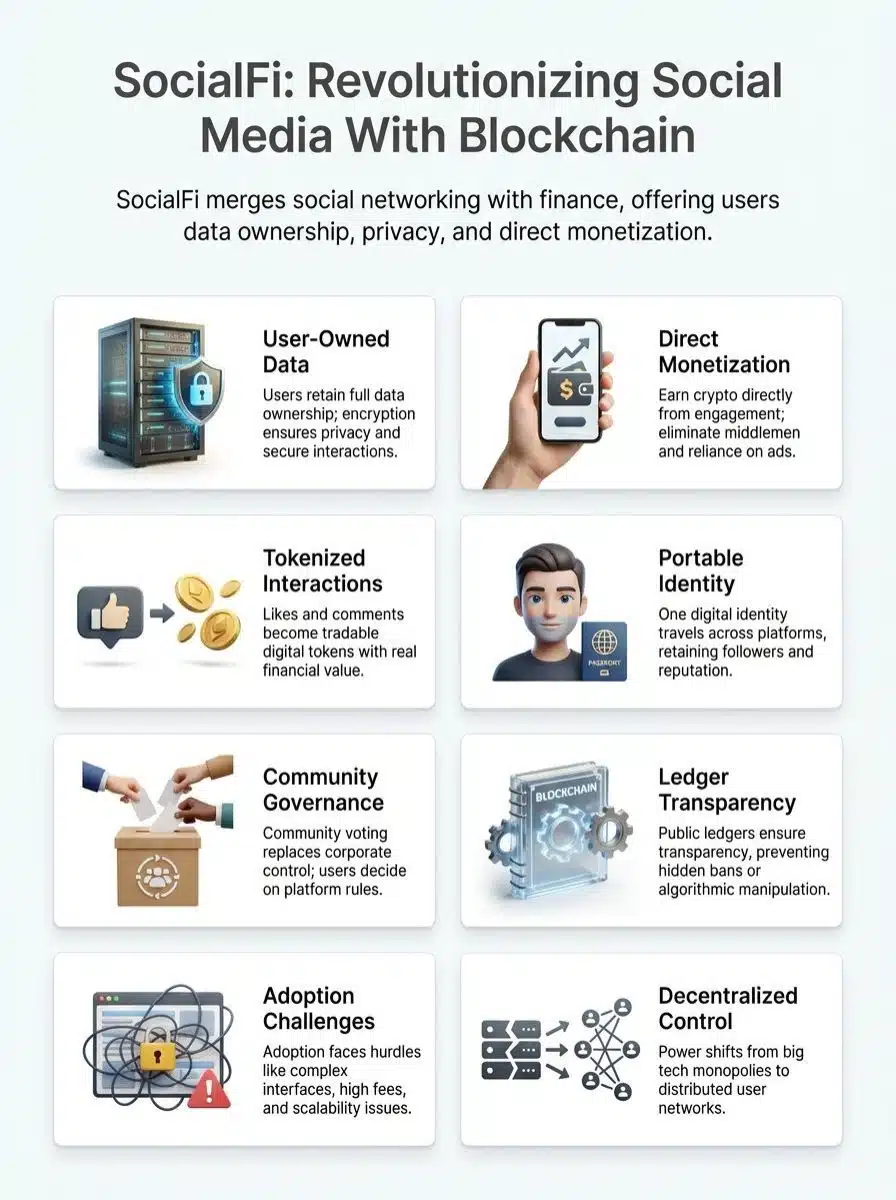
Blockchain isn’t just a database; it’s a trust machine. By replacing corporate terms of service with open-source code, we can rebuild social networks from the ground up.
Decentralization and user control
Decentralization shifts power from the “Boardroom” to the “Community.” In a network like Farcaster, the software is run by a distributed network of “Hubs.” Anyone can run a Hub.
This means if one interface shuts down or bans you, your data still exists on the network. You can simply log in through a different app and find all your followers and posts waiting for you. It turns social media into a public utility, similar to email. You don’t lose your emails just because you switch from Outlook to Gmail; SocialFi brings that same freedom to your social graph.
Enhanced privacy and data security
Security in SocialFi is cryptographic, not just policy-based. Instead of trusting a company promise that “we value your privacy,” you trust the math.
Many newer platforms are adopting end-to-end encrypted messaging by default. Since your identity is linked to a cryptographic wallet (like a string of random characters) rather than your government name or phone number, you maintain a layer of pseudonymity that is impossible on Facebook or LinkedIn.
Transparent monetization models
Transparency is the antidote to the “black box” algorithms that frustrate creators. On the blockchain, every transaction is visible.
If a creator sells a digital membership or a piece of content as an NFT (Non-Fungible Token), the revenue split is visible on-chain. There are no hidden fees. Furthermore, smart contracts can enforce royalties automatically. If a fan resells your digital artwork or exclusive post to someone else, you can automatically receive 10% of that secondary sale—forever.
Key Features of SocialFi Platforms
If you download a SocialFi app today, it might look like Twitter or Instagram, but the engine under the hood offers features that traditional apps simply cannot match.
SocialFi turns engagement into value. A great example of this is the “Frames” feature on Farcaster. Frames turn a static social media post into an interactive app. You can mint an NFT, play a game, or buy a product directly inside the feed without ever leaving the app.
Other platforms allow you to buy “Keys” or shares of a creator. If that creator grows in popularity, the value of your access key rises. This aligns the incentives of the creator and the fan—when the creator wins, the early supporters win financially too.
Portable digital identities
This is the “Holy Grail” of the new social web. Protocols like ENS (Ethereum Name Service) or Lens Handles give you a universal username.
Imagine if your Twitter handle, YouTube subscribers, and Instagram photos were all attached to a single “backpack” that you carried with you. If a new, better photo app launches tomorrow, you can connect your backpack, and boom—your photos and followers are already there. This forces apps to compete on features and user experience, rather than locking you in with your own data.
Reward systems for user engagement
In the Web2 world, you work for the platform for free by creating content. In Web3, you get paid.
- Tips: Users can tip small amounts of cryptocurrency (like the DEGEN token) for good comments.
- Earn-to-Post: Some networks distribute governance tokens based on your weekly engagement activity.
- Curator Rewards: If you share someone else’s post and it goes viral, the protocol can split the rewards between the original author and you (the curator).
Challenges Facing SocialFi Adoption
Despite the innovation, SocialFi hasn’t killed Facebook yet. There are significant hurdles that make it difficult for the average person to switch.
User experience issues
Let’s be honest: crypto apps can be clunky. Managing private keys, paying “gas fees” (transaction costs), and signing legitimate-looking transactions that drain your wallet are real risks.
The industry is racing to fix this with a tech standard called Account Abstraction (ERC-4337). This allows users to create accounts with familiar features like “reset password” or “social login” (using Google/Apple IDs), hiding the complex crypto mechanics in the background. Until this is the standard, the learning curve remains steep.
High entry barriers for non-crypto users
The “cold start” problem is real. A 2023 survey indicated that over 55% of internet users are still uncomfortable handling cryptocurrency. Asking someone to download a browser extension like MetaMask just to like a photo is a non-starter for mass adoption.
Successful SocialFi apps will likely need to hide the blockchain elements entirely, presenting a “Web2.5” experience where users don’t even realize they are using crypto until they try to cash out their earnings.
Scalability concerns
Blockchains are slow compared to centralized servers. Visa processes 65,000 transactions per second; Ethereum processes about 15-30. If millions of users try to post at once, the network clogs up and fees skyrocket.
“The costs on Polygon don’t scale to mainstream usage for social transactions.” — Stani Kulechov, Founder of Lens Protocol.
To solve this, major projects are migrating to “Layer 2” solutions. For instance, Lens Protocol announced the development of the “Lens Network” using ZK-sync technology to handle the massive volume of data required for a global social network without charging users $5 to post a status update.
The Future Potential of SocialFi

We are in the early innings. The infrastructure is being laid for a digital society that values ownership over access.
Supporting creators like professionals
SocialFi is professionalizing the “middle class” of creators. You no longer need 100,000 followers to make a living; you might only need 1,000 “true fans” who hold your creator tokens or subscribe via smart contract.
This shifts the economy from an “Attention Economy” (getting the most views for ads) to a “Value Economy” (providing the most value to specific users).
Building trust through transparency
Trust will move from brand names to code. In the future, we won’t ask “Do I trust this company to not sell my data?” We will check the open-source code to verify “Does this app have the ability to sell my data?” When the answer is “No,” we build a foundation for genuine digital safety.
Enabling new economic models
We will likely see the rise of “Community-Owned Networks.” Imagine a version of Uber or Airbnb built on SocialFi rails, where the drivers and hosts own the network and vote on the fees.
With projections of the creator economy hitting nearly half a trillion dollars by 2027, SocialFi provides the financial plumbing to ensure that money ends up in the pockets of the people creating the value.
Final Thoughts
SocialFi isn’t just about adding crypto payments to Twitter; it’s about fixing the fundamental power imbalance of the web. By leveraging decentralization, Account Abstraction, and portable identities, we can build networks that serve us, rather than farm us for data.
The technology is maturing fast, with platforms like Farcaster and Lens Protocol already proving that a user-owned internet is possible. Are you ready to own your digital life, or are you content with renting it? The next time you scroll, ask yourself who really benefits from your time—it might be time to claim your share.