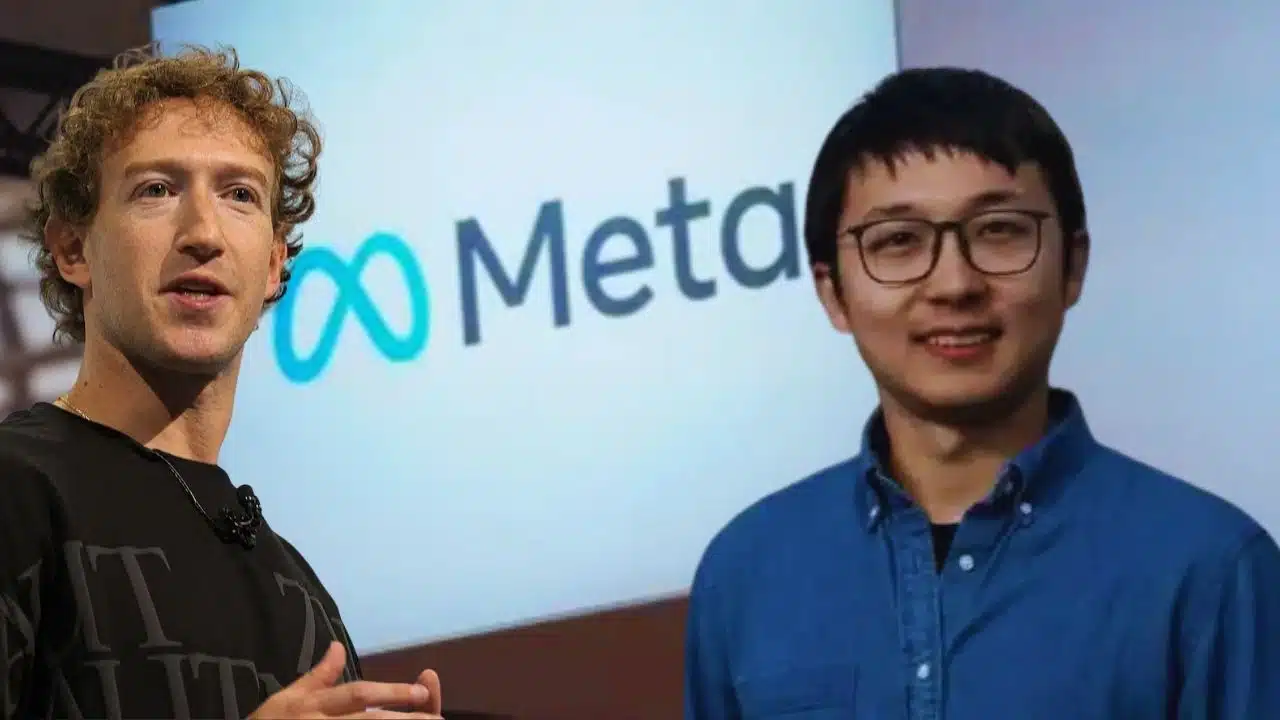
Meta CEO Mark Zuckerberg has officially named Shengjia Zhao—the co-creator of OpenAI’s ChatGPT and a key figure in developing GPT-4—as the Chief Scientist of Meta Superintelligence Labs.
Marking another major move in the company’s aggressive artificial intelligence (AI) expansion. Zhao will directly report to Zuckerberg and Alexandr Wang, the former CEO of Scale AI, who recently joined Meta as Chief AI Officer after Meta acquired his company for $14 billion.
This announcement comes amid Meta’s multi-billion-dollar effort to attract top AI talent and develop frontier AI models to compete with rivals like OpenAI, Google DeepMind, and Anthropic.
Shengjia Zhao’s AI Legacy: From OpenAI to Meta
Zhao played a pivotal role at OpenAI, helping co-create some of the most advanced large language models, including:
- ChatGPT
- GPT-4
- GPT-4.1, Mini models, and o3
He also led research on synthetic data generation, which is considered essential for training robust AI systems. Zhao’s innovative work on scaling laws and model efficiency has drawn significant attention in the AI research community.
In a social media post, Zuckerberg highlighted Zhao’s contributions:
“Shengjia has already pioneered several breakthroughs, including a new scaling paradigm, and distinguished himself as a leader in the field. I’m looking forward to working closely with him to advance his scientific vision. The next few years are going to be very exciting!”
A Formal Role After Months of Quiet Contribution
Although Shengjia Zhao’s name appeared in an internal Meta memo in June as a new hire, his official leadership role was only confirmed recently. Zuckerberg revealed that Zhao had been working behind the scenes since the inception of Meta Superintelligence Labs and is now stepping into a formal leadership position.
“Now that our recruiting is going well and our team is coming together, we have decided to formalize his leadership role,” Zuckerberg explained.
Meta Superintelligence Labs: The AI Dream Team
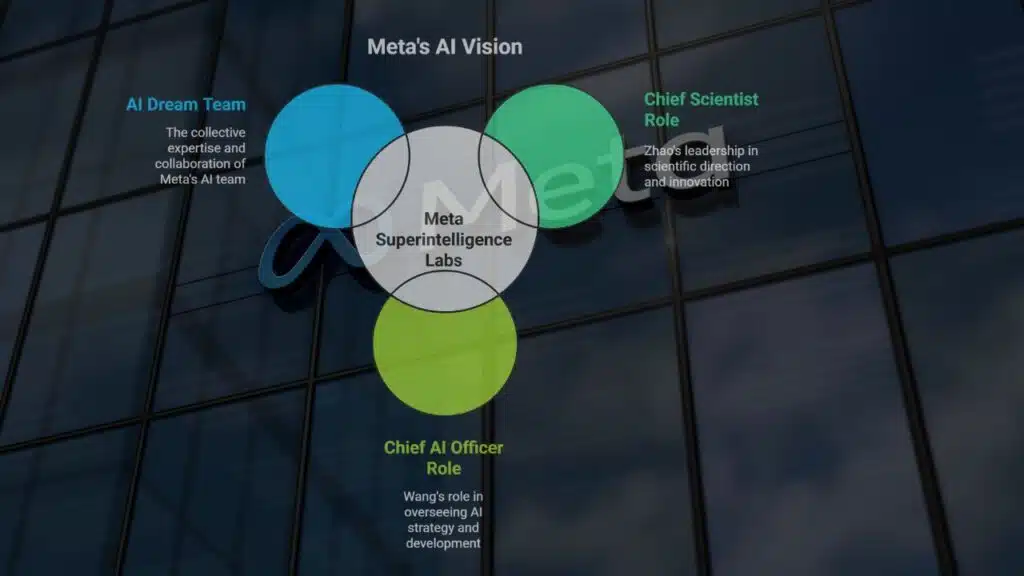
Meta Superintelligence Labs is Meta’s newly formed division focused on developing general-purpose AI systems that could rival the capabilities of OpenAI’s GPT models and Google’s Gemini. With Zhao as Chief Scientist and Alexandr Wang as Chief AI Officer, Meta is assembling what many analysts call an AI dream team.
Wang posted on X (formerly Twitter):
“We are excited to announce that @shengjia_zhao will be the Chief Scientist of Meta Superintelligence Labs! Shengjia is a brilliant scientist who most recently pioneered a new scaling paradigm in his research. He will lead our scientific direction for our team.”
Meta’s Massive Investment in AI Talent and Infrastructure
Meta has gone on a major spending spree to poach top AI minds from rivals like Google DeepMind, OpenAI, Apple, and Anthropic. The company is not just hiring aggressively—it is building the infrastructure to support its AI ambitions.
- Meta acquired Scale AI for $14 billion, bringing Alexandr Wang onboard.
- It has pledged to invest hundreds of billions of dollars to build advanced AI data centers across the United States.
- The tech giant is also stockpiling NVIDIA H100 chips, a crucial component for training large-scale AI models, according to a report from The Information.
These efforts are part of Zuckerberg’s long-term vision to lead in the race for Artificial General Intelligence (AGI)—a form of AI that can outperform humans at most economically valuable tasks.
Meta vs OpenAI and Google: A New Frontier in AI Wars
The appointment of Shengjia Zhao is not just a personnel move—it’s a strategic signal. Meta wants to compete head-on with OpenAI (backed by Microsoft) and Google DeepMind in building next-gen AI systems.
By hiring one of the core minds behind ChatGPT and GPT-4, Meta gains a competitive edge in understanding what it takes to build, scale, and deploy large foundation models that are safe, efficient, and commercially viable.
With billions in investment and top-tier talent on board, Meta’s ambitions in superintelligence are no longer speculative—they’re actively unfolding.
The Information is Collected from Business Insider and CNBC.