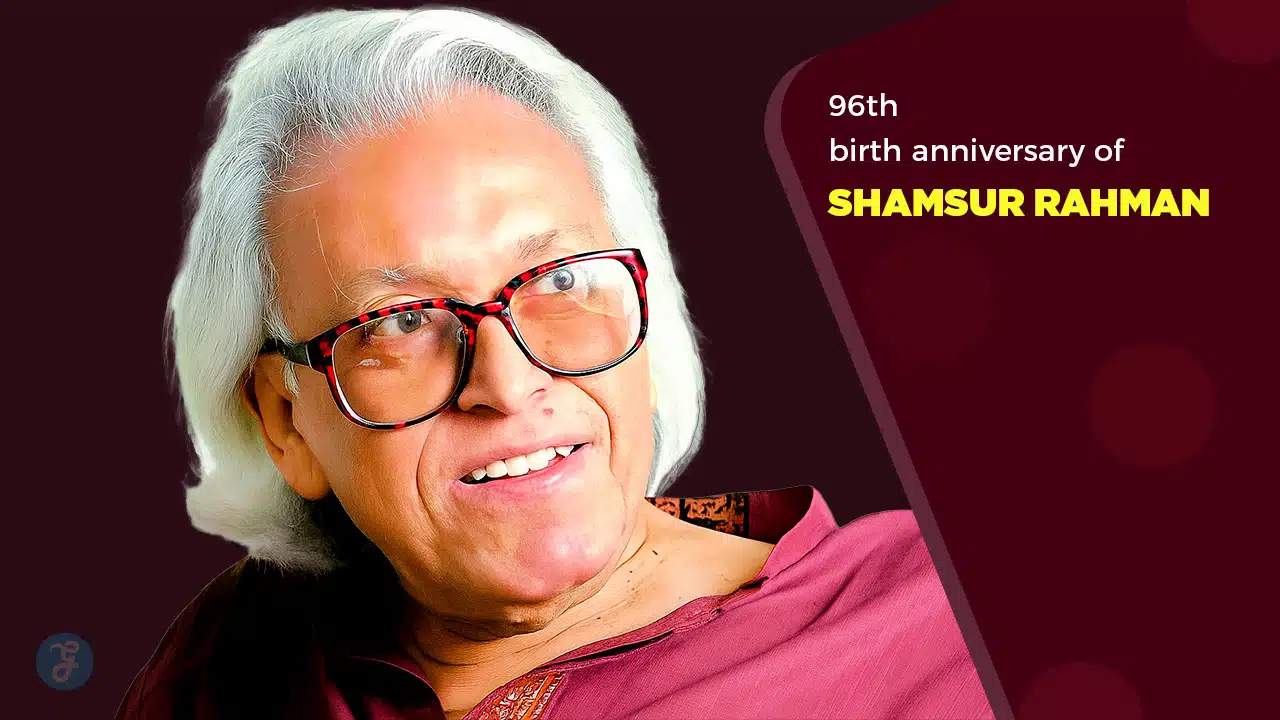
You know how some poets feel like they belong to a specific time, while others seem to capture the very soul of a nation? When you explore Shamsur Rahman and his poetry, you find an artist firmly in that second category.
Today is his 96th birth anniversary. He was incredibly prolific, producing over sixty books of poetry in his lifetime. But it’s not the sheer volume that makes him a giant of Bengali literature.
It’s how he used his words to chronicle the birth and struggles of Bangladesh, making his work an essential part of the nation’s history.
This blog will walk you through Shamsur Rahman’s journey, from his earliest inspirations to his role as a national voice. We’ll look at the core themes that defined his work and see why his words on freedom, justice, and humanity still resonate so powerfully today.
Key Takeaways
- Shamsur Rahman, born in 1929, wrote over sixty books of poetry and is widely regarded as the unofficial poet laureate of Bangladesh.
- His early work was influenced by literary giants like Rabindranath Tagore and Jibanananda Das, but he soon developed a unique urban voice while studying at Dhaka University.
- His poetry became a powerful chronicle of Bangladesh’s history, directly addressing the 1969 mass uprising and the 1971 Liberation War in famous works like “Asader Shirt,” “Swadhinota Tumi,” and the collection “Bondi Shibir Theke.”
- Beyond poetry, Rahman was a respected journalist and the editor of the national newspaper Dainik Bangla, a post he resigned from in 1987 to protest the autocratic government of President Hussain Muhammad Ershad.
- Using clear and direct language, his poems champion liberal humanism, democracy, and empathy for ordinary people, standing firmly against religious extremism and political oppression.
Shamsur Rahman’s Journey as a Poet
Shamsur Rahman’s path to becoming a poet began with a deep love for literature discovered while he was a student of English at Dhaka University. His voice matured over the years, shaped by the rich culture of Bengal and the foundational work of earlier poets like Rabindranath Tagore and Jibanananda Das.
What early influences shaped Shamsur Rahman’s poetry?
Born on October 23, 1929, in Dhaka, Shamsur Rahman grew up as the third of thirteen children. This upbringing in a large family in the Narshingdi district gave him an early, intimate understanding of people and community. After completing his matriculation at Pogos High School in 1945, a pivotal moment occurred when he read Rabindranath Tagore’s collection of short stories, *Golpoguchchho*. He later said this book transported him to an extraordinary world and profoundly changed him.
His time at Dhaka College further expanded his horizons. It was there that he immersed himself in Bengali literature and formed new friendships that broadened his perspective. These formative years were crucial, setting the stage for his emergence as one of the most significant voices in Bengali poetry. His very first poem, “Unish Unoponchash,” was published in 1949 in the journal *Sonar Bangla*, marking his official entry into the literary world.
How did Shamsur Rahman’s poetic style evolve over time?
When Shamsur Rahman started writing at Dhaka University, his early poems echoed the romantic style of masters like Rabindranath Tagore and Kazi Nazrul Islam. However, his voice quickly began to change. With the publication of *Roudra Karotite* in 1963 and *Bidhvasta Nilima* (The Shattered Blue) in 1967, his poetry became sharper and more grounded in reality.
His style evolved to directly reflect the turbulent political landscape of what was then East Pakistan. This shift cemented his reputation as a distinctly “urban poet,” a writer whose work captured the pulse of city life in Dhaka. His poems started to mirror the growing unrest, including the mass uprising of 1969 and the subsequent Bangladesh Liberation War in 1971.
Over time, his writing carried increasingly powerful social messages. His 1972 collection, *Bondi Shibir Theke* (From the Prison Camp), showed deep empathy for the freedom fighters and ordinary citizens caught in the conflict. His influence grew, and his work was even published in West Bengal’s prestigious *Kavita* journal. Today, the U.S. Library of Congress holds fifty of his titles, a testament to how his uniquely Bengali voice reached audiences across the world.
What are the main themes in Shamsur Rahman’s poetry?
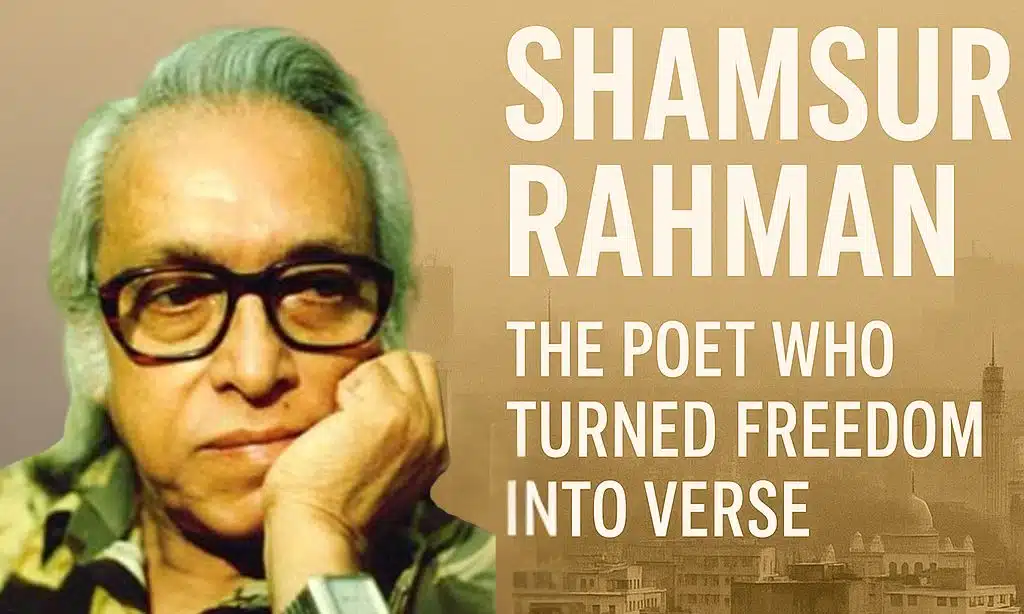
Shamsur Rahman’s poems are filled with powerful themes of hope, love, and the relentless pursuit of freedom. His words paint vivid pictures of everyday life in Dhaka, the nation’s epic struggles for identity, and the enduring dream of a “Sonar Bangla” (Golden Bengal).
How does Shamsur Rahman express patriotism and political struggles?
He used his poetry as a direct response to political injustice. Works like “Barnamala, Amar Duhkhini Barnamala” (Alphabet, My Sorrowful Alphabet) and “February 1969” became anthems of protest and national pride. During the 1971 Bangladesh Liberation War, he wrote “Swadhinota Tumi” (Freedom, You) and “Tomake Paoar Jonyo, Hey Swadhinata” (To Attain You, O Freedom), which offered courage to a nation at war.
His pen was just as sharp in the face of domestic tyranny. From 1987 to 1990, his poetry confronted the autocratic rule of President Hussain Muhammad Ershad. After Ershad’s fall in 1990, he released “Ganatantrer Pokkhe Kobita” (Poems for Democracy). By using simple, accessible language, he ensured his messages of freedom and resistance reached everyone, making him a true voice of Bangladesh’s democratic dreams.
In what ways does Shamsur Rahman show humanism and empathy for common people?
Shamsur Rahman consistently wrote about the lives and struggles of ordinary people. He focused on the experiences of workers, students, and the poor, giving a powerful voice to the powerless in Bengali society. His poems often served as a strong critique of violence, terrorism, and religious sectarianism.
One of his most famous poems, “Asader Shirt” (Asad’s Shirt), is a moving tribute to Amanullah Asaduzzaman, a student activist killed during the 1969 mass uprising. The poem transforms a simple piece of clothing into a symbol of sacrifice and revolution. By honoring individuals like Asad, Rahman aligned himself with the people, not the powerful.
His focus on liberal humanism set him apart from many of his contemporaries. You can see this profound empathy in works like “Buk Tar Bangladesher Hridoy” (His Chest is the Heart of Bangladesh), where he captures the spirit of the nation through the courage of its people.
What are the key works of Shamsur Rahman?
Shamsur Rahman authored many iconic works that defined an era of Bengali literature and inspired generations. His poems became particularly resonant during the Bangladesh Liberation War, leaving a lasting mark on the cultural identity of the nation.
What is the significance of “Prothom Gaan Dwityo Mrittyur Agey”?
Published in 1960, *Prothom Gaan Dwityo Mrittyur Agey* (First Song Before the Second Death) was Shamsur Rahman’s debut poetry collection. The book was an immediate critical success, winning the prestigious Adamjee Literary Award in 1962. The poems in this collection show the early influence of Rabindranath Tagore and the English literature he studied at Dhaka University.
This work marked a new direction for modern Bengali poetry. It introduced themes of romanticism, a yearning for freedom, and a deep love for Bangladesh. More importantly, it laid the groundwork for the themes of rebellion, humanism, and empathy that would define his later, more politically charged works.
What themes are explored in “Buk Tar Bangladesher Hridoy”?
Sacrifice and courage are the central themes of “Buk Tar Bangladesher Hridoy” (His Chest is the Heart of Bangladesh). Shamsur Rahman wrote this powerful poem in honor of Nur Hossain, a young pro-democracy activist. On November 10, 1987, Hossain was killed during a mass protest against the autocratic rule of President Hussain Muhammad Ershad.
Nur Hossain had painted slogans on his chest and back that read, “Let autocracy be doomed, Let democracy be freed.” Rahman’s poem immortalized this act, turning Hossain into an enduring symbol of the fight for democracy in Bangladesh. The poem uses simple yet profound language to capture both the pain of the sacrifice and the hope it inspired. It remains a vital piece of Bengali literature, commemorating the courage of ordinary people in the face of tyranny.
What messages are conveyed in “Bandishibir Theke”?
*Bandishibir Theke* (From the Prison Camp), published in 1972, captures the pain and hope of the Bangladeshi people during the Liberation War. Written while Rahman himself felt like a captive in his own land, the poems give voice to prisoners, families, and all those suffering under oppression. The collection is a raw and honest depiction of life during wartime.
The poems explore themes of:
- The psychological toll of confinement and fear.
- The resilience and courage of the freedom fighters.
- The profound sense of loss and suffering.
- The unwavering dream of a free and independent “Sonar Bangla.”
This collection stands as a tribute to those who fought for Bangladesh’s independence. It serves as a powerful reminder of the importance of human rights and justice, solidifying Rahman’s role as the poetic conscience of his nation.
What were Shamsur Rahman’s contributions beyond poetry?
Beyond his immense poetic legacy, Shamsur Rahman played a significant role in shaping public discourse through his work in journalism. He was also a steadfast advocate for secularism and free thought, using his platform to stand against religious extremism in Bangladesh.
What was his role in journalism and editorial work?
Shamsur Rahman had a long and distinguished career in journalism, working for publications like the *Morning News* and Radio Pakistan in his early years. His most significant role was as the editor of the national newspaper, *Dainik Bangla*, starting in 1977. He also served as the editor of the popular weekly magazine, *Weekly Bichitra*.
His journalistic career was marked by a commitment to integrity. In 1987, he made a courageous stand by resigning from his position as Chief Editor of *Dainik Bangla*. This resignation was a direct protest against the autocratic government of President Ershad, which was attempting to control the press. His bold action reinforced his reputation as a voice for freedom of speech and inspired many across the country.
How did he advocate against religious fundamentalism?
Shamsur Rahman was a vocal defender of secular and liberal values. He consistently used his poetry and his public platform to speak out against religious intolerance and extremism. His poetry collection *Samprodaikotar Biruddhe Kobita* (Poems Against Communalism) is a direct call for unity and religious harmony.
A shy person by nature, he became an outspoken public intellectual in the 1990s, defending liberal humanism against rising fundamentalism. This advocacy made him a target. In January 1999, he survived an assassination attempt by the militant group Harkat-ul-Jihad-al-Islami. His unwavering stance, praised by fellow writers like Humayun Azad, cemented his legacy as a champion of free thought in Bangladesh.
Takeaways
Shamsur Rahman and his poetry remain a vital force in Bengali literature. His words beautifully capture a deep love for Bangladesh, a profound empathy for its people, and an unyielding commitment to freedom. His journey, from his student days at Dhaka University to his influential years at Dainik Bangla, reflects the journey of his nation.
His legacy is not just in his more than sixty books of poems but in the enduring spirit of hope and resilience they inspire.
Through his clear, powerful lines, he continues to guide new generations of writers and readers who dream of a more just and humane world.
FAQs on Shamsur Rahman and His Poetry
1. Who was Shamsur Rahman and what made him a key figure in Bengali literature?
Shamsur Rahman (1929-2006), often called the unofficial poet laureate of Bangladesh, became a central figure by capturing the nation’s struggles and aspirations in his work. His poetry is celebrated for its urban perspective, liberal humanism, and powerful reflections on the Bangladesh Liberation War.
2. How did Shamsur Rahman’s education influence his poetry?
He attended Pogos High School and Dhaka College before studying English literature at Dhaka University, which exposed him to global literary movements. This education enabled him to blend Western modernist techniques with the specific cultural and political realities of Bengal, creating a unique poetic voice.
3. What are some famous works by Shamsur Rahman that reflect major events in Bangladesh’s history?
Poems like “Asader Shirt” turned a protester’s bloody shirt from the 1969 mass uprising into a national symbol of resistance. His 1972 collection, “Bondi Shibir Theke” (From the Prison Camp), contains powerful verses written during the Liberation War, including the iconic “Tomake Pawar Jonno, Hey Swadhinota” (To Attain You, O Freedom).
4. Which awards did he receive for his contributions to Bengali poetry?
Rahman’s extensive contributions were recognized with Bangladesh’s highest honors, including the Bangla Academy Award in 1969 and the Ekushey Padak in 1977.
5. Did other writers or poets influence or connect with Shamsur Rahman’s journey?
He was deeply influenced by earlier Bengali masters like Rabindranath Tagore and Kazi Nazrul Islam but forged his own modern path. He was also an active participant in a vibrant literary circle that included contemporaries like Syed Manzoorul Islam and Abu Zafar Obaidullah, who engaged with and critiqued his work.
6. Where can readers find translations or studies about his poetry today?
A significant collection of his work is available in “Selected Poems of Shamsur Rahman,” translated by the acclaimed poet and academic Kaiser Haq. These translations provide English-speaking audiences access to the depth and power of his poetry, ensuring his legacy continues to be discovered by new generations.