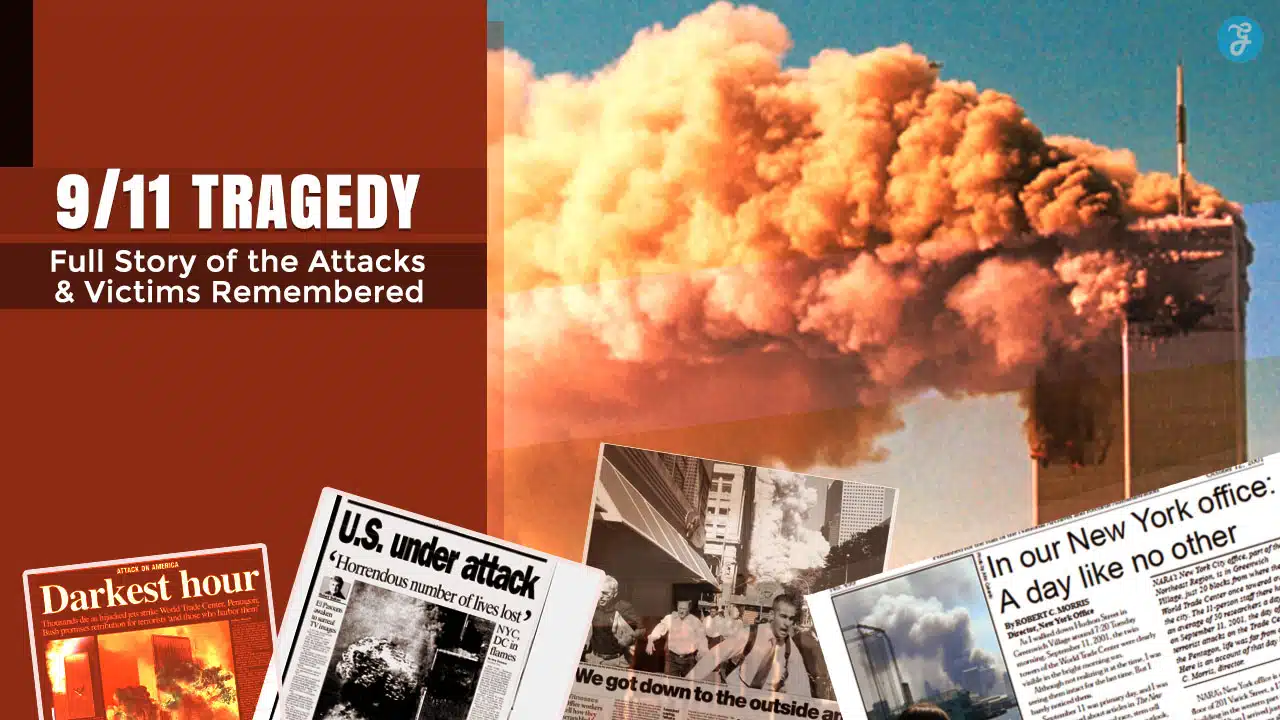
The attacks of September 11, 2001—commonly referred to as 9/11—remain one of the darkest and most defining events in modern history. Orchestrated by al-Qaeda, the coordinated hijackings and crashes of four commercial airliners caused unprecedented loss of life, destruction, and global consequences. Nearly a quarter of a century later, the effects are still visible in politics, security systems, health outcomes, and international relations.
The Morning of the Attacks
How the Day Unfolded
-
American Airlines Flight 11 left Boston at 7:59 AM bound for Los Angeles. At 8:46 AM, it was deliberately flown into the North Tower of the World Trade Center.
-
United Airlines Flight 175, also leaving Boston, struck the South Tower at 9:03 AM. Millions of people watched this impact live on television as news crews were already covering the North Tower fire.
-
American Airlines Flight 77 departed Washington Dulles International Airport at 8:20 AM. At 9:37 AM, it crashed into the Pentagon, killing passengers and military personnel inside the building.
-
United Airlines Flight 93 took off from Newark at 8:42 AM. Its hijackers intended to target a landmark in Washington, DC. However, at 10:03 AM, after passengers and crew resisted, the plane crashed in a field near Shanksville, Pennsylvania.
The sequence of attacks lasted less than two hours but changed the world forever.
The World Trade Center Attacks
Immediate Impact
The Twin Towers were symbols of global commerce, each standing 110 stories tall. The first strike tore a gaping hole into the upper floors of the North Tower, while the second impact ignited fuel explosions in the South Tower. Thousands of office workers, visitors, and first responders were trapped. Smoke and flames poured into the sky.
Collapse of the Towers
Structural engineers later confirmed that the heat from the jet fuel and fires weakened the steel framework. At 9:59 AM, the South Tower collapsed, followed by the North Tower at 10:28 AM. Manhattan was blanketed in smoke, ash, and debris. The destruction caused shockwaves not only in New York but across the world.
Rescue and Survival
When the planes hit, about 17,400 people were inside the towers. Most on floors below the impact zones escaped, but nearly everyone above the strike points in the North Tower perished. In the South Tower, 18 individuals managed to descend from above the impact area before the building collapsed—a remarkable story of survival.
The Attack on the Pentagon
At 9:37 AM, Flight 77 struck the western side of the Pentagon, the command hub of the U.S. Department of Defense. The crash destroyed a section of the building, killing 59 people aboard the plane and 125 military and civilian staff inside. Reconstruction efforts began immediately, and remarkably, staff reoccupied rebuilt offices by August 2002.
United Flight 93: The Heroic Resistance
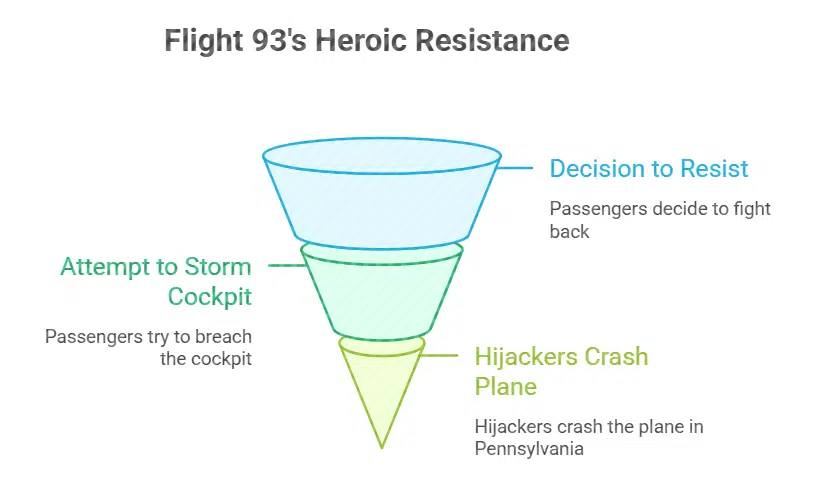
Flight 93’s passengers, upon learning about the other attacks through phone calls, decided to resist the hijackers. They attempted to storm the cockpit, forcing the hijackers to crash the plane in Pennsylvania instead of reaching Washington, DC. Their actions are widely credited with saving countless lives in the nation’s capital.
Casualties and Loss
-
Total fatalities: 2,977 victims (not including the 19 hijackers).
-
At the World Trade Center: 2,606 deaths.
-
At the Pentagon: 125 deaths.
-
On the four planes: 246 passengers and crew members.
-
First responders: 441 New York City emergency workers, including firefighters and police officers, lost their lives while trying to rescue others.
-
Youngest victim: Two-year-old Christine Lee Hanson.
-
Oldest victim: 82-year-old Robert Norton.
In addition to immediate deaths, thousands were injured. Over time, many survivors and rescue workers developed illnesses linked to exposure to toxic dust, smoke, and debris.
Who Were the Attackers
The perpetrators were 19 men linked to al-Qaeda, the militant Islamist network founded by Osama bin Laden.
-
15 were Saudi nationals,
-
two were from the United Arab Emirates,
-
one was Egyptian,
-
one was Lebanese.
The mastermind was Khalid Sheikh Mohammed, who designed the plan and coordinated logistics. The attack was meant to send a symbolic message of power and revenge against the United States.
U.S. Response to 9/11
Military Action
Less than a month later, the U.S. launched Operation Enduring Freedom, invading Afghanistan with support from international allies. The goal was to dismantle al-Qaeda and remove the Taliban regime that harbored them. The war became America’s longest conflict, lasting until U.S. troops withdrew in 2021.
Counterterrorism and Security Changes
-
Creation of the Department of Homeland Security and Transportation Security Administration (TSA).
-
Strict airport security protocols such as reinforced cockpit doors, advanced baggage screening, and bans on certain items in cabins.
-
Passage of the USA PATRIOT Act, expanding surveillance and law enforcement powers to monitor terrorist threats.
Political and Social Impact
Globally, 9/11 reshaped international relations, strengthened NATO’s role in counterterrorism, and prompted wars in Afghanistan and Iraq. It also led to debates on privacy, human rights, and the balance between freedom and security.
Khalid Sheikh Mohammed and Legal Proceedings
Capture and Detention
Khalid Sheikh Mohammed was captured in Pakistan in 2003. He spent three years in CIA custody before being transferred to Guantánamo Bay in 2006. During interrogations, he faced harsh methods including waterboarding, raising ongoing controversies about torture and due process.
Delayed Justice
For years, U.S. military courts at Guantánamo struggled to begin a full trial due to legal disputes about admissible evidence and human rights violations. Families of victims have expressed frustration at the slow pace.
Recent Developments
-
In 2024, plea agreements were proposed: Mohammed and two co-defendants would plead guilty in exchange for life sentences instead of the death penalty.
-
Days later, then-Defense Secretary Lloyd Austin canceled the deals, saying they were not in the national interest.
-
A military judge later ruled that the cancellation was invalid, but in July 2025, the U.S. Court of Appeals for the D.C. Circuit upheld the government’s right to block the plea deal.
-
As of now, no final trial or sentencing has been completed, leaving one of the most important legal cases in U.S. history unresolved.
Rebuilding and Remembering
Ground Zero
-
Clearing debris at the World Trade Center site took more than eight months.
-
Today, the 9/11 Memorial and Museum honor the victims. The reflecting pools occupy the footprints of the original towers, inscribed with names of the dead.
-
One World Trade Center (Freedom Tower), standing 1,776 feet tall, opened in 2014 as a symbol of resilience.
Pentagon
The Pentagon’s damaged section was rebuilt within a year, symbolizing the U.S. military’s determination to recover quickly.
Health and Environmental Effects
-
First responders and survivors: Many developed chronic lung conditions, cancers, and PTSD from exposure to toxic dust and psychological trauma.
-
Studies show that tens of thousands continue to receive treatment under the World Trade Center Health Program.
-
Generations of firefighters, police officers, and volunteers have spoken of ongoing health struggles, reinforcing the long shadow cast by the attacks.
Global Legacy of 9/11
-
9/11 changed air travel, diplomacy, military operations, and the way governments approach terrorism.
-
It influenced culture, media, literature, and public consciousness, becoming a defining moment of the 21st century.
-
International conflicts, including the wars in Afghanistan and Iraq, were directly tied to its aftermath.
-
For Americans, annual memorial ceremonies at Ground Zero, the Pentagon, and Shanksville ensure the victims are never forgotten.