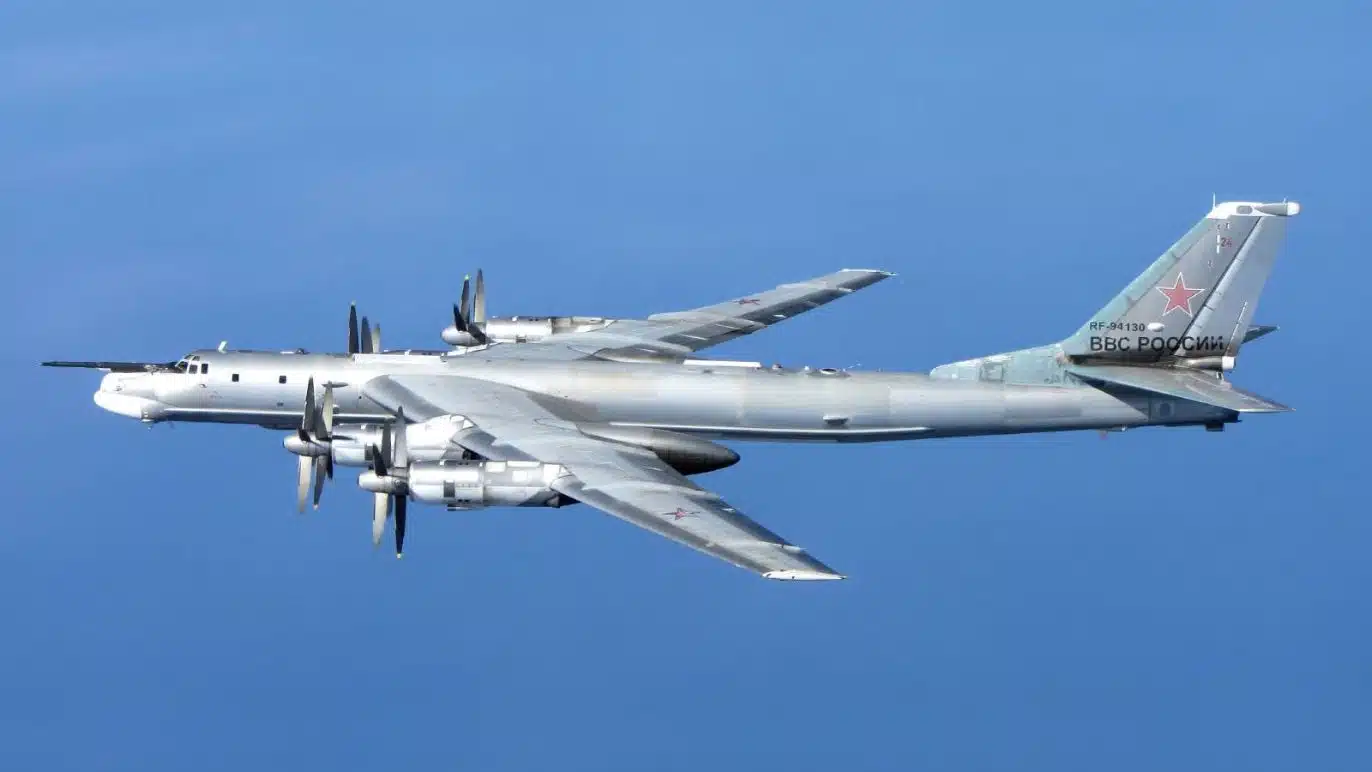
Russian and Chinese strategic bombers have conducted a rare, long-range joint patrol around Japan, prompting Tokyo to scramble fighter jets and lodge formal protests as already strained ties with Beijing come under fresh pressure. The mission underscores deepening military cooperation between Moscow and Beijing and raises new questions about how Japan, South Korea and the United States will respond to more frequent shows of force in the Western Pacific.
What Happened in the Skies Around Japan
Japanese defense officials said two Russian Tu-95 nuclear-capable strategic bombers flew from the Sea of Japan toward the East China Sea, where they rendezvoused with two Chinese H-6 bombers for what was described as a “long-distance joint flight” over the western Pacific. The aircraft formation passed through sensitive airspace near Japan’s southwestern island chain, leading the Japan Air Self-Defense Force (JASDF) to scramble fighter jets to monitor the patrol.
According to Japan’s Defense Ministry Joint Staff Office, the joint bomber group flew off the coast of Shikoku and in the vicinity of the Miyako Strait, a key international corridor between Okinawa’s main island and Miyako Island that connects the East China Sea and the Pacific. At various points in the mission, four Chinese J-16 fighter jets joined the bombers for a round-trip flight between Okinawa and Miyako, adding a tactical escort to what Tokyo views as a strategic signaling operation.
Aircraft Involved: Tu-95, H-6 and Fighter Escorts
The Russian contingent consisted of Tu-95 “Bear” bombers, long-range aircraft designed during the Cold War that remain central to Moscow’s strategic bomber fleet and can carry nuclear-capable cruise missiles. These bombers are used frequently in patrols near NATO airspace in Europe and the North Atlantic and now increasingly appear in joint missions with China in the Asia-Pacific.
The Chinese side deployed H-6 bombers, a long-range platform derived from the Soviet-era Tu-16 design but repeatedly modernized to carry cruise missiles and perform extended patrol missions over sea and land. The flight was further reinforced by Chinese J-16 multirole fighter jets, which flew alongside the bombers during parts of the sortie between Okinawa and Miyako, and by Russian Su-30 fighter jets and an A-50 airborne early warning and control aircraft in the Sea of Japan.
Key Aircraft at a Glance
| Aircraft type | Country | Role | Notable features |
|---|---|---|---|
| Tu-95 “Bear” | Russia | Strategic bomber | Nuclear-capable, long-range cruise missile platform. |
| H-6 bomber | China | Strategic bomber | Modernized variant with extended range and anti-ship capability. |
| J-16 | China | Multirole fighter | Escort, air-to-air and strike missions; joined bombers near Okinawa. |
| Su-30 | Russia | Fighter | Flown concurrently over Sea of Japan as part of wider activity. |
| A-50 | Russia | AEW&C | Airborne early warning, battle management support in the region. |
Japan’s Immediate Military Response
Japan scrambled JASDF fighter jets to shadow the bombers and their escorts, track flight paths, and verify that no violations of Japanese airspace occurred. Officials stressed that the aircraft remained over international waters and did not enter sovereign airspace, but their approach to key straits and island chains was deemed a serious security concern.
Japanese Defence Minister Shinjiro Koizumi said on X that the China‑Russia joint patrol was “clearly intended as a show of force” against Japan and posed a “grave concern” for national security. He added that JASDF pilots “rigorously executed air defense identification protocols,” indicating that Japan treated the mission as a high-priority air-defense event rather than a routine patrol.
Japan’s Defense Ministry also reported that, at the same time as the bomber patrol to the south and east, Russian Air Force assets including an A-50 early-warning aircraft and two Su-30 fighters conducted a separate sortie over the Sea of Japan to the north. This multi-axis pattern suggested a coordinated operation designed to test regional surveillance, response times, and command-and-control across multiple theaters around the Japanese archipelago.
South Korea Drawn In by ADIZ Incursion
The joint patrol did not only affect Japan. South Korea’s military said that seven Russian aircraft and two Chinese planes entered its air defense identification zone (ADIZ) during the exercise, prompting Seoul to scramble its own fighter jets. Although ADIZ boundaries are not sovereign airspace, incursions are closely watched because they can create ambiguity and force militaries to show readiness and resolve.
Seoul lodged a protest, calling the joint patrol “provocative” and demanding that such activities not be repeated without prior notice. For South Korea, the episode adds to a pattern of Chinese and Russian air activities near its ADIZ over recent years, intensifying worries about a two-front challenge in both the East China Sea and the Sea of Japan.
Beijing and Moscow: “Routine” and Under an Annual Plan
While Tokyo and Seoul portrayed the patrol as destabilizing, Beijing and Moscow framed it as a routine part of long-term military cooperation. China’s Defence Ministry said in a brief statement that the mission was the 10th joint strategic air patrol conducted by the Chinese and Russian militaries and was carried out “in relevant airspace over the East China Sea and the western Pacific” under an annual cooperation plan.
Chinese state-linked commentary argued that the operation complied with international law, occurred entirely in international airspace, and was not directed at any “third party,” a phrase Beijing often uses when addressing allied concerns from Japan, South Korea or the United States. Russian media, citing Moscow’s Defence Ministry, highlighted that the joint flight lasted around eight hours and presented it as a demonstration of the two countries’ capability to conduct coordinated, long-range missions in the Asia-Pacific.
Why the Miyako Strait and Okinawa Matter
The Miyako Strait—between Okinawa’s main island and Miyako Island—is a narrow but strategically vital corridor linking the East China Sea and the wider Pacific, frequently used by the Chinese People’s Liberation Army Navy (PLAN) and Air Force (PLAAF) for blue-water training. Japan views repeated transits through this strait by Chinese warships and aircraft as part of Beijing’s efforts to normalize operations in areas close to Japanese territory and push beyond the so‑called “first island chain.”
Recent Japanese reports noted that, days before the joint bomber patrol, Chinese carrier-based fighters operating from the aircraft carrier Liaoning had locked fire-control radars on JASDF F‑15J fighters near Okinawa, prompting a strong diplomatic protest from Tokyo. Against this backdrop, the combined Russia‑China flight through sensitive air corridors is seen in Tokyo as a further escalation in both frequency and complexity of military activities in Japan’s immediate neighborhood.
Tensions Over Taiwan and Japan’s New Security Posture
The timing of the patrol is widely connected to remarks by Japanese Prime Minister Sanae Takaichi, who said last month that Japan could respond to any Chinese military action against Taiwan that also threatened Japan’s security. Beijing condemned those comments, accusing Tokyo of “interfering in China’s internal affairs” and warning that linking Japan’s security directly to a Taiwan contingency risked destabilizing the region.
For Japan, Taiwan’s security is increasingly treated as integral to its own, especially given the geographic proximity of the Ryukyu island chain to the Taiwan Strait and the heavy concentration of U.S. forces in Okinawa. Analysts say the joint bomber patrol can be read as a combined signal from China and Russia that they reject Japan’s expanded security role and are willing to coordinate pressure on Tokyo if it aligns more closely with Washington and Taipei in a crisis.
Deepening China‑Russia Military Cooperation
China and Russia have significantly expanded their defense partnership in recent years, conducting joint naval drills, missile defense exercises and serial bomber patrols across East Asia. These activities are often framed by both capitals as counterweights to U.S.-led alliances, especially the U.S.–Japan security treaty and Washington’s growing cooperation with South Korea and Australia.
The latest mission marks at least the 10th joint strategic air patrol, illustrating that what began as occasional symbolic flights is now evolving into a recurring operational pattern. Beyond political signaling, repeated joint patrols help both air forces refine interoperability, communications and coordinated targeting procedures, all of which could be relevant in a crisis scenario in the Taiwan Strait or the wider Western Pacific.
Japan’s Domestic Debate on Defense and Deterrence
The patrol is likely to sharpen domestic debates in Japan about defense spending, strike capabilities and the interpretation of its pacifist constitution. Tokyo has already adopted a new national security strategy that calls for “counterstrike” capabilities—long-range missiles able to hit bases in an adversary’s territory—in response to North Korean missile tests and perceived threats from China.
Episodes such as the Russia‑China bomber sortie give political momentum to advocates of faster military modernization, including the deployment of long-range missiles in Japan’s southwest islands, expanded air and missile defenses, and closer integration with U.S. command structures. At the same time, critics warn that spiraling action–reaction cycles could draw Japan deeper into great‑power confrontation and make its territory a prime target in any regional war.
Reactions from the United States and Allied Exercises
While detailed U.S. statements are still emerging, Washington has long urged China and Russia to avoid what it calls “coercive and destabilizing” military behavior near U.S. allies. Shortly after the joint patrol, Japan and the United States conducted a joint air exercise, which Tokyo framed as a show of readiness in an increasingly severe security environment.
These drills, staged soon after the bomber mission, are part of a broader series of joint exercises that involve U.S. bombers, fighters and surveillance aircraft operating from bases in Japan and Guam. The timing reinforces a pattern whereby China‑Russia joint patrols near Japan are often followed by visible alliance activity, underscoring the region’s drift toward competitive signaling between rival blocs.
How This Fits into the Wider Regional Picture
The joint patrol comes amid a dense calendar of military activity in East Asia, including North Korean missile launches, Chinese maritime patrols around the disputed Senkaku/Diaoyu Islands, and U.S. freedom-of-navigation operations in the South China Sea. Experts say the cumulative effect is an environment where miscalculation risks rise, even if none of the actors seeks open conflict.
For South Korea and Taiwan, the flight underscores the challenge posed by an increasingly coordinated China‑Russia front in Northeast Asia. Seoul has to balance its economic ties with China and its security relationship with the United States, while Taipei will see the mission as further evidence that Beijing can call on Moscow’s support to stretch U.S. and allied resources across multiple theaters.
Legal and Normative Questions: International Airspace, ADIZ and Signaling
Both sides insist they are operating within international law, but their interpretations of risk and responsibility differ sharply. China and Russia say flights in international airspace are legitimate and that ADIZ lines are unilateral constructs with no basis in sovereignty, while Japan and South Korea argue that repeated close‑in patrols and radar lock-ons create unsafe conditions and heighten the chance of unintended clashes.
International law does not prohibit military aircraft from flying in international airspace, yet established practice emphasizes transparency and avoidance of unsafe intercepts to prevent incidents. The core dispute is less legal than political: whether such highly choreographed bomber patrols—especially by nuclear-capable platforms—should be viewed as normal exercises or as coercive pressure aimed at shaping the strategic choices of neighboring states.
Looking Ahead: Escalation Risks and Possible Off-Ramps
Analysts expect that China‑Russia joint air operations around Japan are likely to continue and potentially expand in scope, duration and the mix of assets involved. Future patrols could incorporate more advanced bombers, unmanned systems or more intensive electronic warfare activities, further complicating the picture for Japanese and South Korean air defenses.
Diplomatic options remain, including hotlines, pre‑notification mechanisms and regional confidence‑building measures, but political appetite for such steps is limited amid deep distrust between Beijing, Tokyo and Washington. For now, the episode over the Miyako Strait and the Sea of Japan serves as a stark illustration of how contested the skies of Northeast Asia have become—and how quickly a single patrol can reverberate across the region’s security architecture.