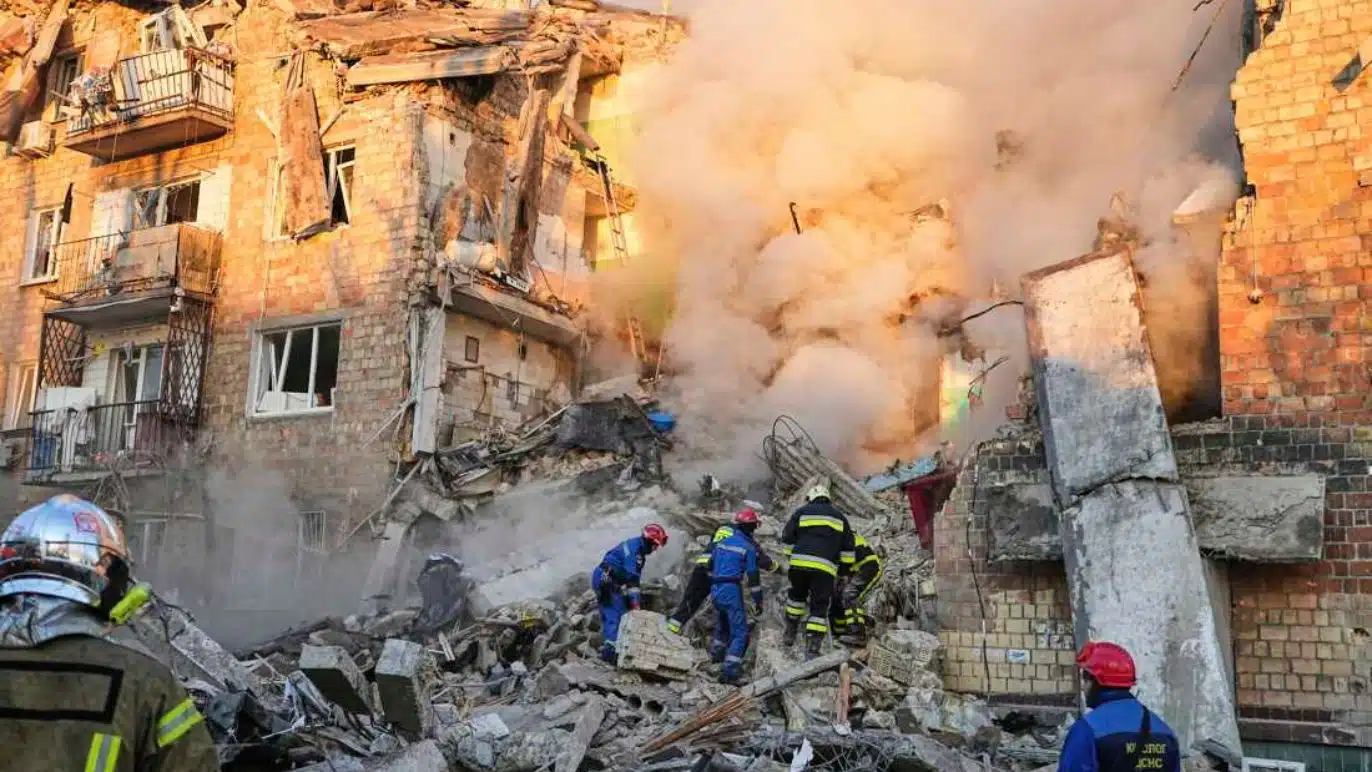
The Ukrainian Air Force described the attack as “one of the largest and most coordinated missile offensives” since the conflict began in 2022. The strike came barely 48 hours before Ukrainian President Volodymyr Zelenskyy’s planned meeting with U.S. President Donald Trump, increasing speculation that Moscow’s timing was deliberate — meant to weaken diplomatic momentum toward a potential ceasefire or new peace framework.
The Scale and Nature of the Attack
According to Ukraine’s military command, Russia launched more than 80 aerial threats, including hypersonic Kinzhal missiles, Iskander ballistic missiles, and Kalibr cruise missiles, backed by Iranian-made Shahed-136 drones. The full-scale offensive targeted not just Kyiv but key points in Kyiv Oblast, Chernihiv, Poltava, and Vinnytsia regions.
The Ukrainian Ministry of Defense confirmed that air defenses intercepted at least 65 projectiles, though several penetrated the city’s core, damaging power grids, communication hubs, and residential areas.
Table: Overview of Russian Attack on Kyiv (Dec 27, 2025)
| Category | Details |
|---|---|
| Date & Time | December 27, 2025, 3:00–5:00 AM local time |
| Attack Type | Missile & drone barrage |
| Weapons Used | Kinzhal, Iskander, Kalibr, Shahed-136 |
| Number of Missiles Fired | Approx. 80+ |
| Missiles Intercepted | 65 (estimated) |
| Primary Targets | Energy grids, defense facilities, civilian zones |
| Casualties | 16 injured (confirmed); 3 fatalities (reported) |
| Air Alerts | Active across 10 Ukrainian regions |
| Areas Most Affected | Kyiv city, Brovary, and northern suburbs |
Civilian Impact and Damage
The human impact of the latest attack was immediate and profound. Thousands of Kyiv residents spent the night in bomb shelters and subway stations, while rescuers worked through the morning to sift through damaged structures.
Emergency repair teams reported temporary power outages across several Kyiv districts, including Solomianskyi, Dnipro, and Holosiivskyi. Authorities also confirmed disruptions to water supply systems and partial loss of mobile connectivity, especially in eastern outskirts such as Brovary.
Table: Humanitarian and Infrastructure Impact
| Impact Area | Description |
|---|---|
| Civilian Casualties | 3 confirmed dead, 16 injured (including 2 children) |
| Power Supply | Outages in 6 districts; restoration expected within 24–36 hours |
| Water Services | Interrupted due to damage to main line in Dnipro district |
| Communications | Temporary cell network interruptions |
| Public Transport | Metro opened as shelter; restricted daytime services |
| Property Damage | 47 buildings damaged, 8 destroyed |
| Public Response | High resilience; organized volunteer-led evacuations |
Ukraine’s Air Defense, Tactics, and Rapid Response
Ukraine’s air defense systems, strengthened by Western support in recent months, played a pivotal role in averting a more catastrophic outcome. The Patriot missile systems supplied by the United States and IRIS-T and NASAMS systems from Europe were active throughout the attack.
The Air Force noted that advanced interception radar detected 95% of inbound threats, though the hypersonic Kinzhal’s velocity limited interception chances. Ukrainian troops tracked the projectile trajectories in real time using NATO satellite links and AI-assisted radar mapping — part of a newly integrated digital defense command deployed in mid-2025.
Table: Ukraine’s Air Defense Overview (Post-2025 Modernization)
| System Type | Country of Origin | Capabilities | Operational Efficiency (as reported) |
|---|---|---|---|
| Patriot PAC-3 | USA | Long-range; high-altitude interception | 85% success rate vs. ballistic missiles |
| NASAMS | Norway/USA | Short to mid-range defense | 90% intercept rate for drones/cruise missiles |
| IRIS-T SLM | Germany | Precision-guided interception; agile targeting | 93% success against Shahed drones |
| Gepard AA Guns | Switzerland | Anti-drone; short range | 96% rate vs. low-flying UAVs |
| Stinger/Manpads | USA | Portable air defense | Variable, terrain-dependent |
“Our defenses stood strong. The enemy launched one of its largest attacks to test our will and systems — they have failed to break either.”
Immediately after the assault, Ukraine’s Military Intelligence Directorate (HUR) identified at least three Russian airfields linked to the operation — in Kursk, Mozdok, and Tambov — prompting retaliatory drone strikes on those facilities later in the afternoon.
Global Condemnation and International Reaction
The assault on Kyiv drew sharp condemnation from global leaders, many of whom denounced Moscow’s timing and tactics as deliberately provocative.
U.S. Secretary of State Antony Blinken labeled the raid “an act of intimidation rather than strategy,” reiterating Washington’s support for Kyiv’s right to self-defense. Meanwhile, EU Commission President Ursula von der Leyen described the attack as “barbarism disguised as geopolitics.”
Table: International Political Responses
| Country/Entity | Leader/Official | Statement Summary | Follow-Up Action |
|---|---|---|---|
| United States | Antony Blinken | Condemned attack; reaffirmed defense aid | Approval of new Patriot missile batch |
| European Union | Ursula von der Leyen | Called it “terrorism against civilians” | Emergency EU Council briefing scheduled |
| France | Emmanuel Macron | “Russia’s peace is always written in blood.” | French military aid phase 5 announced |
| United Kingdom | David Lammy | Summoned Russian ambassador | Sending humanitarian assistance |
| NATO | Jens Stoltenberg | Urged Moscow to halt escalation | Convening defense consultative meeting |
| Germany | Friedrich Merz | Warned Putin of “grave isolation in Europe” | Doubling of IRIS-T shipments to Ukraine |
Diplomatic Timing: A Message Before Talks
Analysts view the timing of this mass strike as highly significant. The assault occurred just days before President Zelenskyy’s scheduled meeting with President Trump, marking what was expected to be the first major diplomatic contact between Ukrainian and U.S. leadership since early 2024.
Military analysts suspect Moscow’s intention was to project dominance and intimidate ahead of any negotiation outcomes. The Kremlin, however, officially framed the operation as “a necessary response to Ukrainian provocations in Russian border regions” — a claim Western intelligence largely dismissed.
Table: Diplomatic Timeline – Kyiv, Washington, Moscow (Dec 2025)
| Date | Event | Strategic Context |
|---|---|---|
| Dec 24, 2025 | Zelenskyy confirms meeting with Trump in Florida | Expected discussion on peace terms and aid renewal |
| Dec 25, 2025 | Russia expands missile production in Voronezh | Seen as prelude to escalation |
| Dec 26, 2025 | U.S. releases intelligence warning of pending strike | “Imminent aerial campaign” mentioned |
| Dec 27, 2025 | Russia launches assault on Kyiv | Seen as direct pre-meeting provocation |
| Dec 29, 2025 | Planned Trump-Zelenskyy talks | Agenda includes ceasefire viability |
“This attack wasn’t about territory — it was about psychology. Russia wanted to show strength, not win ground.”
Global Markets and Energy Repercussions
The missile strikes on Kyiv immediately rattled global energy and commodities markets. Oil prices rose by 2.8%, with Brent Crude reaching $92.5 per barrel, while European natural gas futures surged by 4% due to fears of infrastructure disruption in Western Ukraine.
Ukraine’s energy minister confirmed that while key power transmission lines sustained minor damage, the national grid remained intact due to ongoing Western-funded fortifications introduced earlier in the year.
Table: Economic and Energy Market Impact (as of Dec 27, 2025)
| Sector | Immediate Impact | Market Change (%) | Long-term Outlook |
|---|---|---|---|
| Global Oil | Rise in Brent crude price | +2.8% | Volatility likely into early 2026 |
| Natural Gas | Demand spike in Europe | +4.0% | Stabilization within two weeks expected |
| Grain Exports | Odessa shipments delayed 12 hours | -1.5% | Minor disruptions; resumed operations |
| Ukrainian Hryvnia | Slight depreciation | -0.9% | Stabilized by National Bank action |
| Stock Markets | Brief dip in European indices | -0.6% | Recovery anticipated by Jan 2026 |
Military Developments on the Ground
The Kyiv assault appears to be part of a wider Russian winter offensive. Satellite and intelligence reports indicate increased troop movements and missile deployments along the Belgorod, Kursk, and Bryansk regions. Ukrainian officials claim that Russia aims to intensify pressure on multiple fronts before any diplomatic progress in early 2026.
Ukrainian drone strikes inside Russia have likewise become more frequent in recent weeks, hitting fuel depots and radar installations. This asymmetric approach has strained Moscow’s air defense capacity, which remains spread thin across numerous strategic installations.
Table: Key Military Activity Surrounding the Kyiv Offensive
| Area | Activity | Ukrainian Response |
|---|---|---|
| Kursk & Belgorod | Russian troop buildup, missile launch platforms | Artillery targeting and drone surveillance |
| Donetsk Front | Ongoing skirmishes and artillery exchange | Defensive holds and rotation of units |
| Black Sea & Odesa | Missile activity detected | Naval anti-air drills activated |
| Western Ukraine | No direct hits reported | Air defense kept on alert; energy safeguards in place |
Civilian Resilience: Life Under Siege
Despite the gravity of the attack, Kyiv’s population has shown remarkable resilience. Many metro stations continue to serve dual purposes — as both transit hubs and emergency shelters. Residents have created community-led networks distributing medicines, blankets, and power banks during such emergencies.
Table: Civilian Preparedness Snapshot
| Category | Status | Public Sentiment |
|---|---|---|
| Emergency Shelter Use | >65,000 overnight stays | Calm and disciplined |
| Medical Assistance | Fully operational field hospitals | Moderate injury volume |
| Volunteer Networks | 400+ groups active citywide | High public participation |
| Government Morale Programs | Information & reassurance broadcasts | Positive civic response |
| Psychological Support | Hotline calls up 22% | Counseling available in shelters |
Conclusion: A Pivotal Moment in a Prolonged War
The December 27 attack on Kyiv marks a pivotal point in the conflict’s trajectory. It highlighted both Moscow’s determination to maintain pressure and Ukraine’s growing defensive sophistication.
As the world watches the upcoming Trump–Zelenskyy meeting, the symbolism of Kyiv enduring yet another heavy assault just days prior cannot be overlooked. Whether peace will follow remains uncertain — but what is clear is that Ukraine’s resistance, resilience, and reliance on international solidarity have never been stronger.
The coming weeks will determine whether diplomacy or destruction defines the next chapter of a war that continues to shape Europe’s security landscape.