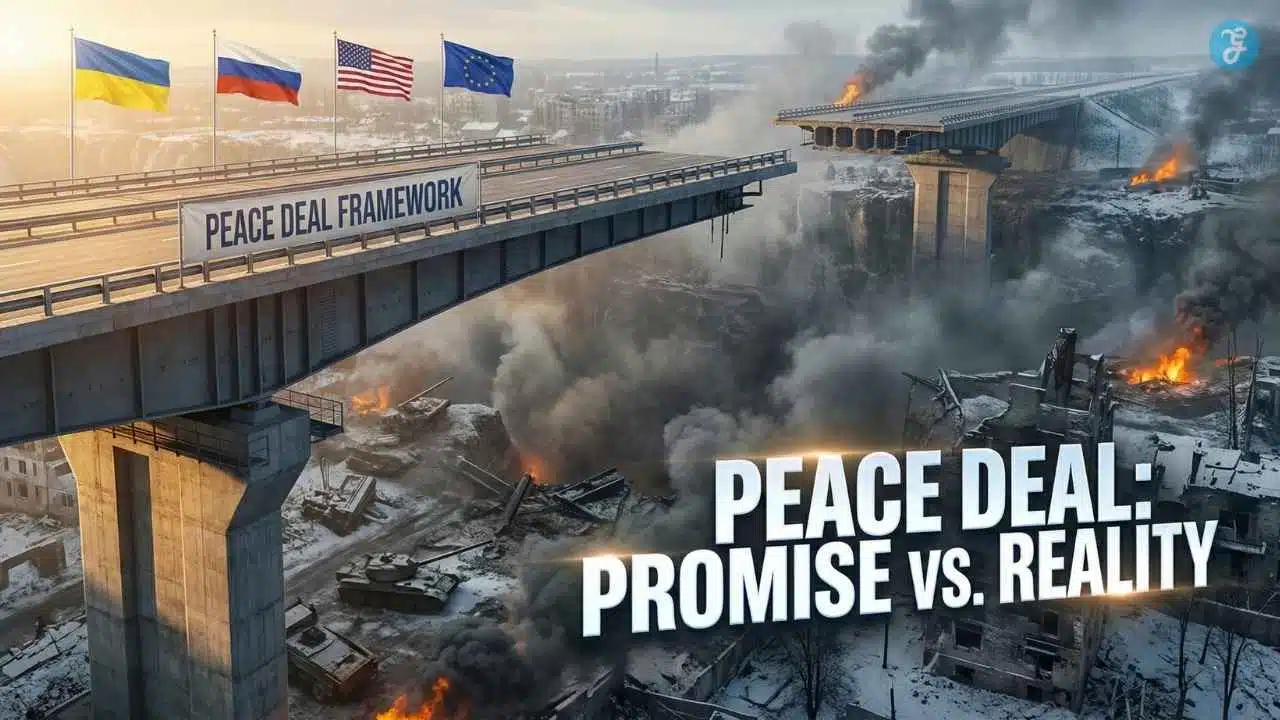
Trump and Zelenskyy met in Florida as a draft 20-point peace framework nears completion, but the Kremlin rejects a temporary ceasefire idea and disputes over Donbas, guarantees, and enforcement persist. Peace is not a headline. Peace is a system that survives mistrust.
As of December 29, 2025, the latest push for a Russia-Ukraine settlement is being shaped by U.S.-led diplomacy, with President Donald Trump publicly claiming the framework is very close and President Volodymyr Zelenskyy indicating progress on security terms. Yet Russia’s position, especially its rejection of a temporary ceasefire concept and its insistence on a “bold decision” by Ukraine on Donbas, signals that the road from “draft” to “reality” is still steep.
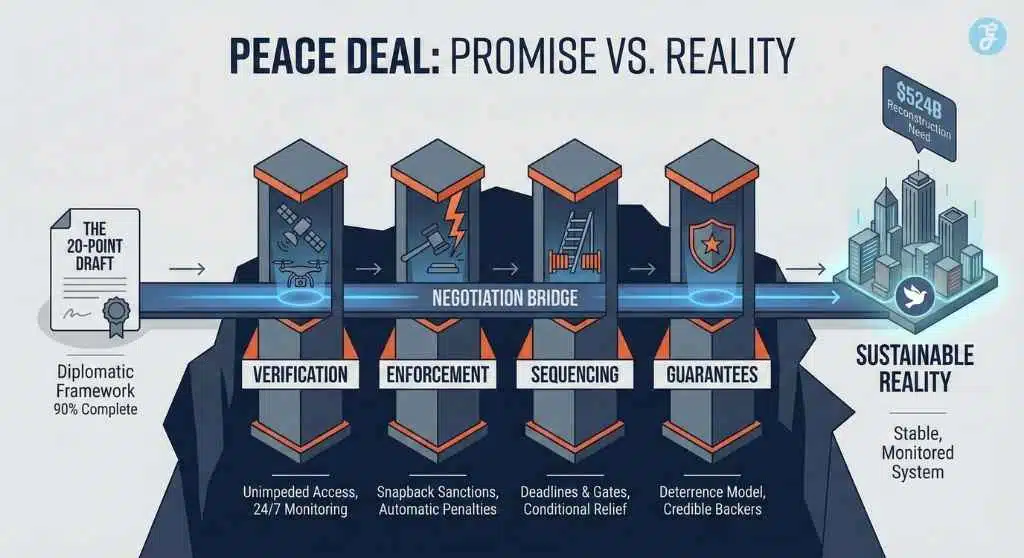
This editorial analysis focuses on one question (your focus keyword): Is the Russia-Ukraine peace deal just a promise, or can it become reality? It answers it by applying a practical test: verification, enforcement, sequencing, sanctions leverage, and civilian/economic impact.
Why “peace agreement” is a slippery phrase right now
In war diplomacy, the same word, “peace,” often describes very different outcomes. That ambiguity can be useful for politicians. It can also mislead the public.
Ceasefire vs armistice vs final settlement
A ceasefire is a halt in fighting. It can be partial (for example, a ban on long-range strikes), localized (around key infrastructure), or comprehensive (across the line of contact). Ceasefires can start quickly and fail quickly if rules are unclear.
An armistice is a more structured stop to active hostilities. It usually involves mapped lines, force separation, and monitoring, while postponing final questions about borders and recognition.
A final settlement resolves the end-state: sovereignty, territorial status, security guarantees, sanctions relief sequencing, reconstruction financing, dispute resolution, and humanitarian issues like prisoners and missing persons. It is the hardest form of “peace” and the least common, while both sides still believe time could improve their leverage.
What “peace” can mean in practical terms:
| Term used publicly | What it typically means | What must it include to last |
| Ceasefire | Pause in kinetic fighting | Clear prohibited actions + monitoring |
| Armistice | Structured stop to hostilities | Force separation + verification + incident rules |
| Peace agreement | It could be an armistice or a settlement | Sequencing + enforcement + credible guarantees |
| Final settlement | Political-legal end of war | Legitimacy + funding + deterrence architecture |
When “promise” is a tactic, not an outcome
In late-stage negotiations, “we’re close” can mean several things at once:
- A real narrowing of differences,
- A trial balloon to test public reaction,
- Leverage aimed at allies (“support this plan now”),
- Blame positioning (“we offered peace; they blocked it”).
A peace deal becomes real only when it includes commitments that are costly to violate—meaning monitoring access, penalties that trigger quickly, and a sequencing ladder that reduces “you go first” deadlocks.
Reader checklist: Separating PR from enforceable peace
- Are monitors named, resourced, and granted access in writing?
- Are violations defined (drones, missiles, sabotage, proxies)?
- Are penalties automatic and fast, not political and slow?
- Does the deal include sequencing with deadlines and verification gates?
Where the talks appear to stand as of late December 2025
Public reporting points to a draft framework that has narrowed some gaps but remains stuck on the most consequential disputes: territory (especially Donetsk/Donbas) and implementation, alongside continued debate over the Zaporizhzhia nuclear power plant arrangements.
The reported 20-point framework and what “nearly done” hides
Reuters published a point-by-point outline of a draft 20-point framework shared by Zelenskyy’s office, describing it as the basis for talks with Trump.
The outline includes:
- reaffirmation of Ukraine’s sovereignty,
- a non-aggression agreement,
- a monitoring mechanism (including space-based unmanned monitoring),
- robust security guarantees,
- Ukraine maintains an armed force of 800,000,
- an objective to mobilize $800 billion for recovery funds,
- a legally binding agreement monitored by a “Peace Council” chaired by Trump, with sanctions in case of violations, and a ceasefire taking effect once all parties agree.
This is the familiar trap of “95% done”: a lot can be agreed in principle, while the final items determine whether the war truly stops.
What the draft reportedly contains vs what remains unresolved:
| Area | What’s described in the draft | What’s still contested |
| Monitoring | Mechanism + tech-based monitoring concept | Access, authority, and penalties in practice |
| Security | “NATO-style” guarantees language | Who guarantees, what triggers, what response |
| Territory | Acknowledged as the most complex | Donetsk/Donbas lines, withdrawals, DMZ design |
| Nuclear plant | Joint operation concept discussed | Who controls, governance structure, and stakes |
Why Donbas and “enforcement” are the hard core
Donbas is a conflict within the conflict. It combines:
- Sovereignty and recognition,
- Population displacement and legitimacy,
- Military geography and logistics,
- The political survival of leaders on both sides.
Reuters’ reporting on the Kremlin position frames Donbas as the hinge: it says Ukraine must make a “bold decision” and notes Russian demands for Ukraine’s withdrawal from remaining areas of Donetsk under Ukrainian control.
Even if a ceasefire is signed, the agreement can fail if it leaves Donbas’ status ambiguous without enforceable boundaries and dispute mechanisms.
Territory language that stabilizes vs destabilizes:
| Draft language type | Why it stabilizes | Why it destabilizes |
| Mapped annexes + coordinates | Limits reinterpretation | Vague “current lines” without maps |
| Verification gates | Prevents stalling and blame games | Open-ended “future talks” with no dates |
| Material breach definition | Creates clear red lines | “Good faith” wording with no penalty |
The ceasefire problem: stopping violence vs freezing it
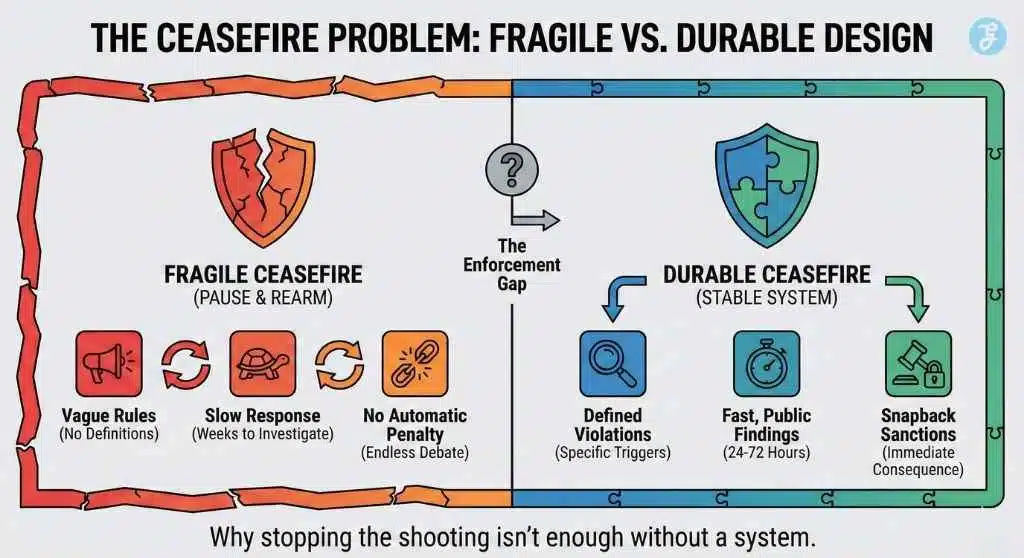
A ceasefire that reduces death today matters. But a ceasefire that permits rearmament and positional improvement without consequences often becomes a pause before the next phase.
In late December 2025, the Kremlin publicly opposed a European-Ukrainian proposal for a temporary ceasefire, warning it could prolong the conflict and risk renewed violence. This position matters because it signals a preference for a settlement that locks in Russia’s demands rather than a pause that might strengthen Ukraine.
A ceasefire must define more than “stop firing”:
| Ceasefire element | “Durable” design | “Fragile” design |
| Prohibited actions | Missiles, drones, sabotage, proxies | Only “artillery” and “shelling.” |
| Monitoring | Independent access + public reporting | Restricted access + politicized claims |
| Incident handling | 24–72h investigation window | Weeks of arguments and retaliation |
| Penalties | Automatic and fast | Negotiated after each violation |
The non-negotiables and red lines
Peace deals fail when they ignore what each side cannot accept politically.
Ukraine’s sovereignty, deterrence, and political survival
Ukraine’s core needs are shaped by a basic fear: a deal that pauses the war but leaves Ukraine exposed is not peace; it is a countdown.
In the draft framework described by Reuters, Ukraine’s sovereignty is reaffirmed, and the proposal calls for robust guarantees mirroring NATO’s Article 5-style commitments from the U.S., NATO, and European countries. Even if the final deal doesn’t match that language exactly, it shows what Ukraine seeks: deterrence that changes Moscow’s calculation.
Ukraine’s “must-haves” as design requirements:
| Requirement | What it means | What happens if missing |
| Sovereignty | Control of national institutions | Political fracture, weak compliance |
| Deterrence | Specific triggers + credible backers | “Paper peace,” high relapse risk |
| Economy | Reconstruction + trade routes | State capacity erodes |
| Legitimacy | The public can accept the terms | Spoilers, internal instability |
Russia’s demands, leverage, and regime incentives
Russia’s negotiating position is influenced by:
- Battlefield leverage
- Sanctions and economic constraints,
- Domestic narrative needs,
- Strategic goals (buffer zones, influence, limits on Ukraine).
Reuters reported the Kremlin’s view that temporary ceasefires can prolong the war and that Donbas remains central, while noting Russia controls about a fifth of Ukraine and seeks withdrawal from the remaining Donetsk areas controlled by Ukraine.
This raises the blunt question: Does Russia want peace, or does it benefit from prolonged conflict? The answer is conditional. It depends on whether a deal:
- Locks in enough of Russia’s goals to sell domestically, and
- Prevents renewed war in ways Russia is willing to accept.
Incentives that can push Moscow toward settlement vs prolonged war:
| Pressure toward settlement | Why it matters | Incentive to prolong conflict | Why it persists |
| Sanctions + isolation | Long-term growth and tech limits | Coalition fatigue bet | Time may weaken Ukraine’s support |
| War cost | Personnel, industry, legitimacy | Leverage via force | Gains may improve terms |
| Uncertainty | Risk of setbacks | Narrative utility | “War footing” consolidates power |
| Economic re-entry | Relief and investment | Strategic aim | Keep Ukraine constrained |
Why referendums, DMZs, and “land swaps” can become legitimacy traps
These tools appear often because they sound like a compromise. They can also collapse under real conditions.
- Referendums: who votes, how displaced people participate, and whether voting is free from coercion become a legitimacy minefield.
- Demilitarized zones (DMZs): A DMZ only works if it is patrolled and violations trigger consequences.
- Land swaps can reduce immediate violence but can also harden resentment and set precedents.
Compromise tools and the conditions they require:
| Tool | Needs to be credible | If not credible, it becomes |
| Referendum | Free conditions + displaced inclusion | Coercion narrative + instability |
| DMZ / buffer zone | Patrol + rules + penalties | Grey-zone conflict corridor |
| Land swap | Legal recognition + deterrence | Seed for future revenge war |
| Joint administration | Clear authority + security | Sabotage magnet |
The human and economic reality: what peace must pay for
Peace negotiations are not abstract. They happen under a human toll that shapes politics and urgency.
Civilian harm: UN-verified snapshot from late 2025
The UN’s “Protection of Civilians in Armed Conflict, November 2025” reports at least 226 civilians killed and 952 injured in November 2025, and 2,311 killed and 11,084 injured from January to November 2025, higher than the same period in 2024 and 2023.
The same UN update reports long-range strikes (missiles and loitering munitions) caused 51% of all civilian casualties in November 2025.
UN civilian casualty snapshot (Ukraine):
| Period | Killed | Injured | Key driver noted |
| Nov 2025 | 226 | 952 | Long-range strikes major share |
| Jan–Nov 2025 | 2,311 | 11,084 | Above 2024 and 2023 levels |
These numbers don’t “prove” one side’s intention in negotiations. They do explain why civilian protection clauses and enforcement are not optional.
Reconstruction: $524 billion over the next decade (baseline)
The World Bank-led Rapid Damage and Needs Assessment (RDNA4) estimates $524 billion in reconstruction and recovery needs over the next decade (as of damage through Dec 31, 2024).
This figure is central to “promise vs reality.” A ceasefire without financing credibility, governance safeguards, and investment de-risking can still fail—because instability and economic collapse become fuel for renewed conflict.
Reconstruction baseline (RDNA4):
| Metric | Estimate | What it means for peace |
| 10-year recovery & reconstruction | $524B | “Peace dividend” requires huge capacity |
| Scale vs economy | ~2.8× Ukraine’s 2024 nominal GDP estimate | Private capital needs protection |
What would make a deal real instead of performative
This is the section that separates “promise” from “reality.” The deal must survive the first violation, the first disinformation wave, and the first political shock.
Verification: what real monitoring looks like
Reuters’ outline of the draft framework describes a monitoring mechanism overseeing the line of contact, including space-based unmanned monitoring designed for early notification of violations and conflict resolution.
That’s directionally meaningful. But “monitoring” is not one thing. It must be designed in layers.
Verification layers that reduce collapse risk:
| Layer | Tool | What it detects | Common failure |
| Layer 1 | Satellites/drones | Movements, major strikes | Access to ground truth is missing |
| Layer 2 | Ground monitors | Local incidents, attribution | Restricted zones, intimidation |
| Layer 3 | Hotlines | Prevent escalation | Not used or politicized |
| Layer 4 | Public reporting | Builds shared facts | Selective releases, mistrust |
Enforcement: the Day 2 test
Enforcement answers one question: what happens when the agreement is violated?
The draft framework described by Reuters includes sanctions “in case of violations” under an implementation mechanism (Peace Council chaired by Trump). The critical detail is how violations are defined and how fast penalties trigger.
Enforcement tools and what they deter:
| Enforcement tool | Deterrence target | Works best when… |
| Automatic sanctions snapback | Major breaches | Triggers are objective and fast |
| Aid escalation clause | Renewed offensives | Partners pre-commit politically |
| Asset freezes expansion | Elite-driven escalation | Enforcement is coordinated |
| Demilitarized zone patrol | Local incursions | Patrol has a mandate + protection |
| Arbitration panel | Interpretation disputes | Time-limited and not a delaying tactic |
Model ceasefire annex: a step-by-step blueprint readers can judge
Below is a model ceasefire annex, a practical template showing what a serious ceasefire needs. It is not “the” plan. It is a reference so readers can evaluate any draft they see.
Annex A — Definitions and scope
A workable ceasefire begins with definitions. Otherwise, violations become language games.
Table: essential definitions
| Term | A definition that reduces ambiguity |
| Line of contact | Mapped coordinates + annexed map |
| Heavy weapons | Caliber and system list (artillery, MLRS, missiles) |
| Long-range strike | Missile, drone, air-launched weapons beyond X km |
| Sabotage | Attacks on infrastructure, command nodes, rail, and energy |
| Material breach | Threshold (e.g., civilian mass casualty event; major offensive) |
Annex B — Immediate cessation rules (Hour 0 to Hour 24)
A ceasefire that “starts later” often fails. The first day must be strict and measurable.
Step-by-step (Day 1):
- Hour 0: all parties confirm start time in writing and activate 24/7 hotlines.
- Hour 1–6: monitors confirm communications, register liaison officers, and publish initial procedural statement.
- Hour 6–24: ban on long-range strikes, heavy weapons fire across the line, and attacks on critical civilian infrastructure.
Day 1 prohibitions (minimum viable set):
| Prohibited action | Why it’s included |
| Missile/drone strikes | Largest escalation risk: civilian harm |
| Heavy artillery across the line | Triggers a rapid spiral |
| Attacks on energy/water | Humanitarian catastrophe risk |
| Offensive troop movement beyond X km | Prevents exploiting the pause |
Annex C — Force posture, buffers, and weapon restrictions (Day 2 to Day 30)
A ceasefire without force posture rules can become a regrouping phase.
Step-by-step (Day 2–30):
- Establish a buffer zone of defined depth (e.g., 10–20 km) where heavy weapons are prohibited.
- Define permitted patrol routes and “no-go” areas for combat units.
- Require baseline transparency: declared unit locations at a defined interval (e.g., every 72 hours) to monitors.
Buffer zone design options:
| Option | Benefit | Risk |
| Narrow buffer | Easier to implement | Less protection from misfire/escalation |
| Wider buffer | Stronger stability | Harder to verify and enforce |
| Heavy-weapons-only ban | Politically easier | Leaves infiltration risk |
| Full demilitarization | Strongest | Highest enforcement burden |
Annex D — Verification protocol and access guarantees
Verification must be operational, not rhetorical.
Step-by-step:
- Create a Joint Incident Center (JIC) with liaison teams from all parties and an independent chair.
- Set a 72-hour maximum for incident determinations, with interim findings published.
- Guarantee monitor access, safety, and movement; obstruction becomes a material breach.
Verification protocol readers can look for:
| Protocol element | What “serious” looks like |
| Evidence standard | Shared method: imagery + ground visit + logs |
| Access clause | “Unimpeded” access + safety guarantees |
| Timeline | 24h preliminary / 72h final finding |
| Public reporting | Weekly summaries + incident logs |
| Obstruction penalty | Automatic consequence for denial of access |
Annex E — Incident response and de-escalation
Most ceasefires break because small incidents become political theatre.
Step-by-step:
- Any incident triggers a hotline call within 60 minutes.
- Monitors deploy within 12 hours where feasible.
- Parties agree to a “no retaliation during investigation” rule.
Escalation controls:
| Control | Why it helps |
| No-retaliation window | Stops spiral logic |
| Rapid verification | Prevents propaganda dominance |
| Public interim updates | Reduces rumor-driven escalation |
Annex F — Humanitarian measures that build compliance
Humanitarian steps create political space for compromises.
Step-by-step:
- Begin All-for-All prisoner exchange planning (if agreed) with lists verified by a neutral mechanism.
- Establish missing persons and civilian detainee channels.
- Create repair corridors for water, heating, and hospitals.
Reuters’ draft outline includes a humanitarian committee and “All for All” prisoner exchange principle, plus return of civilian detainees/hostages, including children.
Humanitarian steps and why they matter:
| Step | Trust effect | Practical effect |
| POW exchanges | High | Reduces domestic pressure to escalate |
| Civilian returns | High | Reinforces legitimacy |
| Repair corridors | Medium–high | Keeps the state functioning |
Annex G — Sequencing ladder (if/then gates)
A ceasefire must connect to a roadmap, or it becomes a drift.
Example sequencing ladder:
| Gate | If verified… | Then… |
| Gate 1 | Ceasefire holds 14 days + access | Begin buffer implementation |
| Gate 2 | Heavy weapons withdrawn from the buffer | Start limited sanctions waivers |
| Gate 3 | 60 days stable + humanitarian steps | Expand reconstruction corridors |
| Gate 4 | Political talks milestones met | Broader economic measures adjust |
| Snapback | Material breach verified | Sanctions return automatically |
Annex H — Enforcement triggers and “snapback” design
Enforcement must not depend on endless diplomacy.
Sample material breach triggers:
| Trigger type | Examples |
| Civilian mass casualty | Major strike in an urban center |
| Offensive maneuver | Cross-buffer armored push |
| Monitor obstruction | Denial of access repeatedly |
| Infrastructure sabotage | Energy/water system attack |
Sanctions sequencing: a sector map readers can understand
Sanctions are leverage. Relief is bargaining currency. But relief that arrives too early can remove the pressure needed to keep compliance.
What EU economic sanctions cover
The EU Council’s sanctions extension states the measures cover a broad spectrum including restrictions in trade, finance, energy, technology and dual-use goods, industry, transport, and luxury goods, plus bans on seaborne import/transfer of crude oil and certain petroleum products, removal of several Russian banks from SWIFT, suspension of broadcasting activities/licenses for several Kremlin-backed media outlets, and anti-circumvention measures.
That list matters because it shows why “lift sanctions” is not a one-switch.
Sanctions sector map table: what exists, what could be phased, what risks it creates
Sanctions “sector map” (EU measures highlighted):
| Sector | Measures described by the EU Council | Why is it’s leverage | What phased relief could look like | Key risk |
| Trade | Broad trade restrictions | Limits revenue + inputs | Limited humanitarian/repair waivers | Dual-use leakage |
| Finance | Financial restrictions | Raises the cost of war | Partial banking channels for supervised trade | Evasion networks expand |
| SWIFT | Several banks excluded | Cuts payment routes | Time-limited channels tied to compliance gates | Hard to snap back quickly |
| Energy | Energy restrictions + oil import ban (seaborne crude, products) | Major revenue pressure | Narrow exceptions tied to verified ceasefire durability | Funds for war capacity |
| Technology & dual-use | Tech + dual-use limits | Constrains weapons supply chains | Relief is usually last, highly conditional | Military reconstitution |
| Industry | Industrial sector restrictions | Slows production capacity | Limited parts for civilian rebuilding are under monitoring | Diversion to the war industry |
| Transport | Transport restrictions | Limits logistics + trade | Conditional corridor arrangements | Smuggling and sanctions-busting |
| Luxury goods | Luxury restrictions | Elite pressure symbol | Early “confidence” gesture relief | Purely symbolic, low compliance value |
| Media | Broadcast/license suspensions | Reduces state disinfo reach | Rarely relaxed early | Propaganda intensifies |
How sanctions sequencing can support compliance (instead of wrecking it)
A credible sanctions roadmap has three features:
- phased relief (not front-loaded),
- verification gates (tied to observable compliance),
- snapback (automatic reimposition for material breach).
Reader checklist: “good” sanctions sequencing
- Is relief tied to verified steps (withdrawals, access, stability period)?
- Is snapback automatic and defined?
- Are multiple actors aligned (U.S., EU, key partners), not just one?
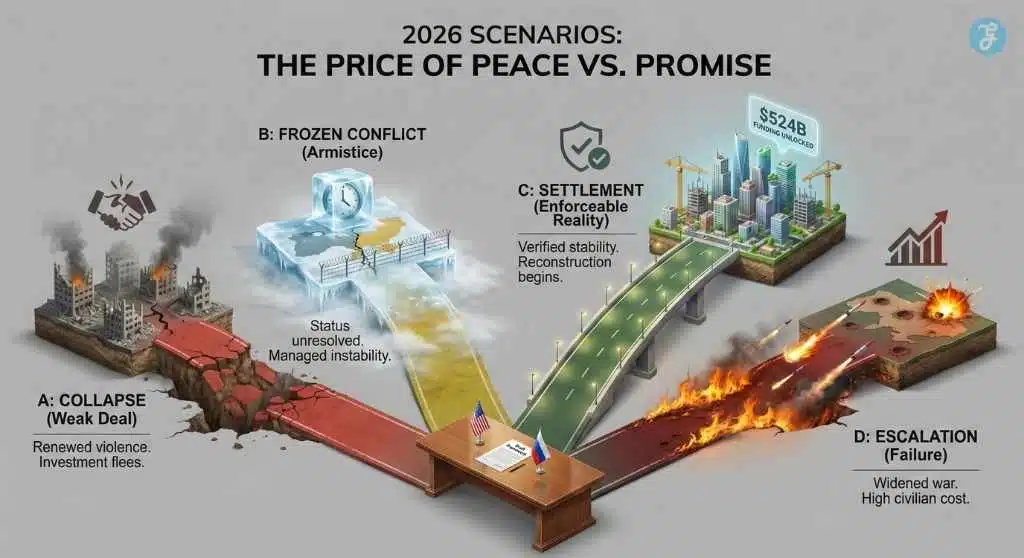
Four plausible scenarios for 2026—and their civilian/economic impacts
These scenarios are not predictions. They are structured pathways that help readers understand what “promise vs reality” looks like on the ground.
Scenario A — A limited ceasefire that collapses
This is the “photo-op ceasefire.” It begins with optimistic statements but lacks enforcement and fast verification.
Civilian and economic impact: Scenario A
| Area | Likely impact | Why |
| Civilian harm | Brief dip, then rebound | Violations escalate without penalties |
| Infrastructure | Continued damage risk | No credible protection clauses |
| Economy | Uncertainty remains high | Investors stay out |
| Reconstruction | Small-scale emergency repairs | Funding is risk-averse without stability |
| Sanctions | Relief stalls; pressure stays | Compliance can’t be verified reliably |
| Political stability | Blame cycle intensifies | Each side claims betrayal |
This outcome is common when negotiators announce “progress” before finalizing enforcement language.
Scenario B — A frozen conflict armistice (stable-ish, unresolved)
This scenario reduces large-scale fighting and locks in a line of control, but postpones final territorial status.
Civilian and economic impact: Scenario B
| Area | Likely impact | Why |
| Civilian harm | Lower than 2025 peaks, not zero | Grey-zone violence persists |
| Displacement | Partial returns, many remain stuck | Status unresolved discourages return |
| Energy/services | Gradual stabilization in safe areas | Repair access improves |
| Economy | Slow recovery with high risk premium | War risk persists in market pricing |
| Reconstruction | Regional rebuilding expands | Donors focus on “safe corridors.” |
| Sanctions | Limited adjustments possible | Major relief tied to settlement |
This is often sold as peace. Strategically, it is managed instability.
Scenario C — A comprehensive settlement (rare, but possible)
This scenario requires verification access, enforcement triggers, credible deterrence, and a realistic political pathway.
Civilian and economic impact: Scenario C
| Area | Likely impact | Why |
| Civilian harm | Sustained major reduction | Violations carry costs quickly |
| Infrastructure | Protection clauses reduce catastrophic damage | Incentives align to avoid breach |
| Economy | Risk premium drops; investment begins | Predictability improves |
| Reconstruction | Large-scale plans become feasible | Funding unlocks with governance gates |
| Sanctions | Phased easing tied to compliance | Leverage converts into a compliance tool |
| Politics | Hard debates continue, but stabilize | Deal has legitimacy mechanisms |
This is the only scenario that meaningfully addresses the scale of recovery need—measured at $524B over a decade.
Scenario D — Escalation or widened war aims
In this scenario, negotiations either fail or become a cover for intensified operations.
Civilian and economic impact: Scenario D
| Area | Likely impact | Why |
| Civilian harm | High and rising | Long-range strikes continue; escalation |
| Infrastructure | Severe damage risk | Energy/water/housing become targets |
| Economy | Deep uncertainty; capital flight | War risk spikes |
| Reconstruction | Stalls or reverses | Donors shift to emergency mode |
| Sanctions | Tighten and expand | Political pressure rises |
| Regional/global | Higher market volatility | Energy, supply chains, security risk |
UN reporting shows civilian casualties remained high through late 2025, with long-range strikes driving a major share in November. In an escalation scenario, that risk profile worsens.
Editorialge editorial stance
Neutral analysis does not mean moral equivalence. It means you evaluate proposals based on what makes agreements hold.
From what is publicly reported as of Dec 29, 2025:
- There is a draft framework and public claims of being “very close,” with Zelenskyy describing progress on security terms.
- The Kremlin publicly opposed a temporary ceasefire concept and emphasized Donbas as central, implying Moscow does not want a pause that could strengthen Ukraine.
- The EU has extended economic sanctions until July 31, 2026, covering wide sectors and including oil import bans, SWIFT exclusions, and anti-circumvention measures—suggesting relief will likely be phased and conditional.
- Civilian harm remains high in UN tracking, raising the urgency for enforceable protections.
So, is the Russia-Ukraine peace deal just a promise—or can it become reality? It can become reality only if the final text contains the architecture that peace requires: verification with access, enforcement with speed, sequencing with incentives, and sanctions snapback that actually triggers.
Without that, it is a promise—maybe sincere, maybe strategic—but structurally fragile.
Final Thoughts: What reality will demand next
If you want to judge the next draft like a reader who refuses to be played by headlines, use this list.
10 watch-items that decide “promise vs reality.”
- Independent monitors: named, funded, protected, and granted access.
- Defined violations: drones, missiles, sabotage, proxy actions all included.
- Fast incident timelines: 24–72 hours for findings, not weeks.
- Material breach thresholds: clear triggers that can’t be argued endlessly.
- Automatic penalties: snapback sanctions and other consequences.
- Sequencing ladder: “if/then” gates tied to verification.
- Security guarantees: who commits, what triggers, what response.
- Donbas mechanism: clear and legitimate pathway, not coercion-prone theatre.
- Energy/civilian infrastructure protections: verifiable bans and consequences.
- Reconstruction governance: anti-corruption safeguards and de-risking to mobilize capital at scale.
A durable peace deal is not the one that sounds best at a press conference. It’s the one that still holds when the first shell lands, the first drone appears, or the first politician tries to walk away.
Frequently Asked Questions
1) What’s the difference between a ceasefire and a peace agreement?
A ceasefire pauses fighting. A peace agreement sets enforceable terms—monitoring, penalties, sequencing, and guarantees—designed to stop the war from restarting.
2) Why is Donbas central to the negotiations?
Because it is the core dispute where sovereignty, recognition, and military control collide. Public reporting shows it remains the hardest unresolved issue.
3) What kind of security guarantee would actually deter renewed war?
A guarantee with named guarantors, defined triggers, and credible response options. Draft language reported by Reuters suggests “Article 5-like” mirroring is being discussed.
4) Would sanctions be lifted immediately under a deal?
A durable framework usually provides relief and includes a snapback. The EU extended economic sanctions until July 31, 2026, indicating leverage remains central.
5) Could a “frozen conflict” be sold as peace?
Politically, yes, but it is closer to a long armistice. It can reduce deaths while leaving the dispute unresolved and capable of flaring again.
6) What would make any agreement collapse quickly?
Vague rules, weak monitoring, slow incident investigations, no automatic penalties, unclear sequencing, and security guarantees that don’t change the attacker’s calculus.