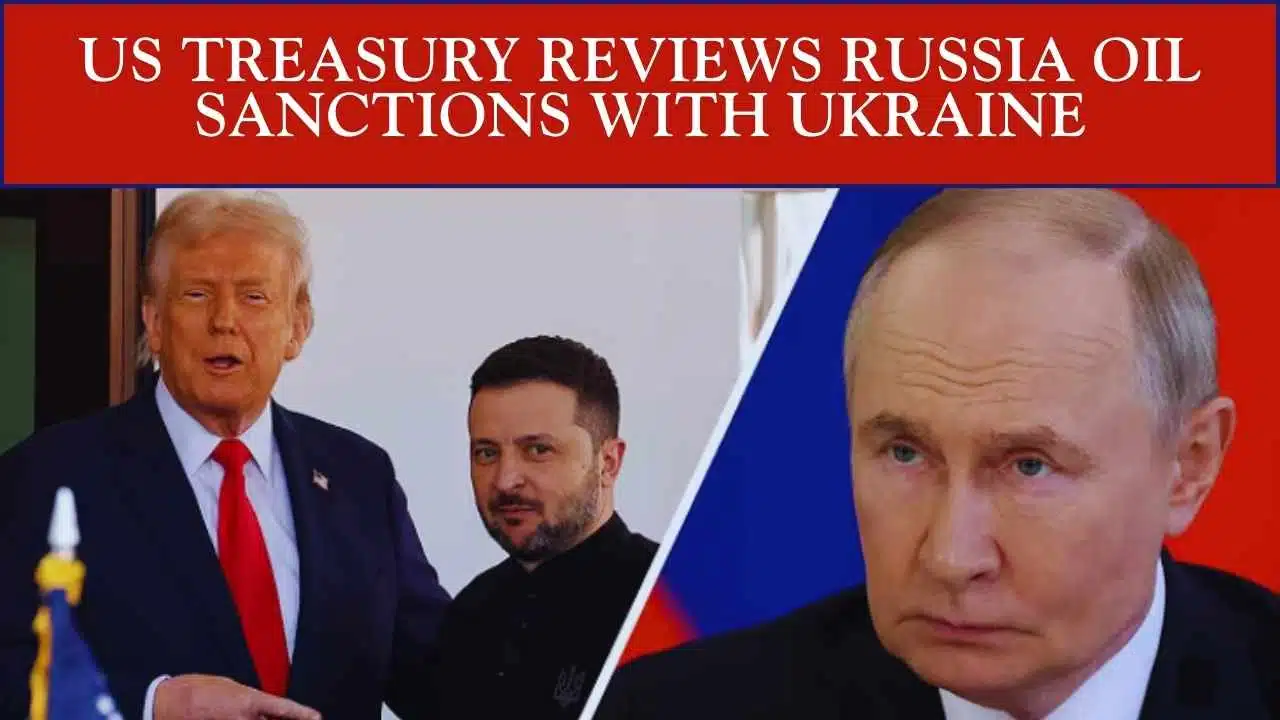
US Treasury Secretary Scott Bessent held a virtual meeting on December 9 with Ukrainian First Deputy Prime Minister—and Minister of Economy—Yulia Svyrydenko. The discussion centered on refining Washington’s sanctions strategy against key Russian oil producers while strengthening US commitments to Ukraine’s long-term reconstruction. This comes amid the Trump administration’s active diplomatic push to bring Moscow and Kyiv to the negotiating table for a sustainable peace, as outlined in recent State Department briefings.
Their talks highlighted ongoing sanctions targeting Rosneft and Lukoil, two of Russia’s largest oil majors. Together, these companies control production capacity equivalent to more than 5% of global oil output—around 5.5 million barrels per day in 2025, according to the International Energy Agency’s latest Oil Market Report. The meeting also touched on collaborative efforts to bolster Ukraine’s anti-corruption measures and the operational rollout of the newly launched US-Ukraine Reconstruction Investment Fund, signaling a multifaceted approach to support Kyiv amid its protracted conflict with Russia.
Sanctions Deliver a Major Budget Blow to Moscow
The sanctions in question, first announced by Bessent on October 22 and fully enforced starting November 21, are proving highly effective in curbing Russia’s war economy. Official data from Russia’s Federal Tax Service reveals that oil and gas revenues tumbled 34% year-over-year in November, dropping to just 530.9 billion rubles (about $5.2 billion at current exchange rates). This sharp decline stems from a combination of slumping global crude prices—Brent crude averaged under $70 per barrel in late November, per EIA data—and widening discounts on Russia’s flagship Urals crude blend, which traded at $15-20 below Brent amid shipping constraints and buyer caution.
These measures represent the first direct Treasury sanctions on Russian energy firms under President Trump’s second term, escalating pressure far beyond the more targeted actions of prior administrations. Since Russia’s full-scale invasion of Ukraine in February 2022, Western sanctions have already forced Moscow to pivot its oil exports eastward, with India and China absorbing over 80% of seaborne crude flows (Kpler data). But the latest round has prompted immediate market reactions Treasury officials confirmed that nearly a dozen major purchasers—primarily state-owned refiners in India and China—have signaled plans to halt or sharply reduce December imports. Reuters, citing tanker tracking from Kpler and Vortexa, projects Russian crude shipments to India could fall by 30-40% through January 2026, potentially costing Moscow billions more in lost revenue.
The broader ripple effects are already visible. Russia’s sovereign wealth fund, the National Welfare Fund, has dipped below critical thresholds, limiting its ability to subsidize domestic fuel prices or fund military spending, as noted in a November 28 Bloomberg analysis. Independent economists, including those at the Carnegie Endowment for International Peace, estimate these sanctions could shave 1-2% off Russia’s GDP growth in 2026 if sustained. Treasury is prepared to take further action if necessary to support President Trump’s effort to end yet another war,” Bessent declared during the October announcement, according to the official Treasury press release—a statement that underscores the administration’s dual-track strategy of economic leverage and peace diplomacy.
Reconstruction Partnership Takes Shape with New Momentum
Shifting focus to Ukraine’s future, Svyrydenko and Bessent delved into the progress of the US-Ukraine Reconstruction Investment Fund, a landmark initiative launched in late 2025. The fund has secured Alvarez & Marsal—a globally respected consulting firm with expertise in post-conflict economies and infrastructure—as its primary investment advisor. This appointment, announced just weeks ago, will guide due diligence and project selection. Starting with $150 million in seed capital—$75 million each from the US via USAID contributions and Ukraine’s state budget—the fund targets high-potential sectors like critical minerals extraction (Ukraine holds Europe’s largest lithium reserves, per USGS data), energy grid modernization to replace war-damaged infrastructure, and large-scale reconstruction of housing, roads, and ports.
Bessent praised Svyrydenko’s hands-on leadership in kickstarting the fund, emphasizing that Ukraine’s domestic reforms are non-negotiable for unlocking further Western investment. This virtual summit coincided perfectly with Ukraine’s unveiling of its comprehensive Anti-Corruption Strategy for 2026-2030 at a high-profile forum in Kyiv on the same day. Hosted by the National Anti-Corruption Bureau of Ukraine (NABU), the event drew representatives from the US, EU, World Bank, and IMF, who reiterated that robust transparency mechanisms—such as digital procurement platforms and independent audits—are essential for mobilizing the estimated $500 billion needed for full reconstruction, according to World Bank assessments.
Ukraine has made tangible strides here NABU reported a 25% increase in high-level corruption convictions in 2025, while the country’s score on Transparency International’s Corruption Perceptions Index improved slightly to 36/100. International partners view these steps as pivotal not just for rebuilding but also for advancing Ukraine’s EU accession bid, with Brussels tying candidacy progress to verifiable governance reforms. As Svyrydenko noted in her forum remarks (quoted on Ukraine’s government website), “Anti-corruption is the foundation of our recovery—it’s how we turn resilience into prosperity.” The Treasury-Ukraine talks thus paint a picture of coordinated support sanctions to weaken Russia’s aggression, paired with investment vehicles to empower Ukraine’s postwar revival.