

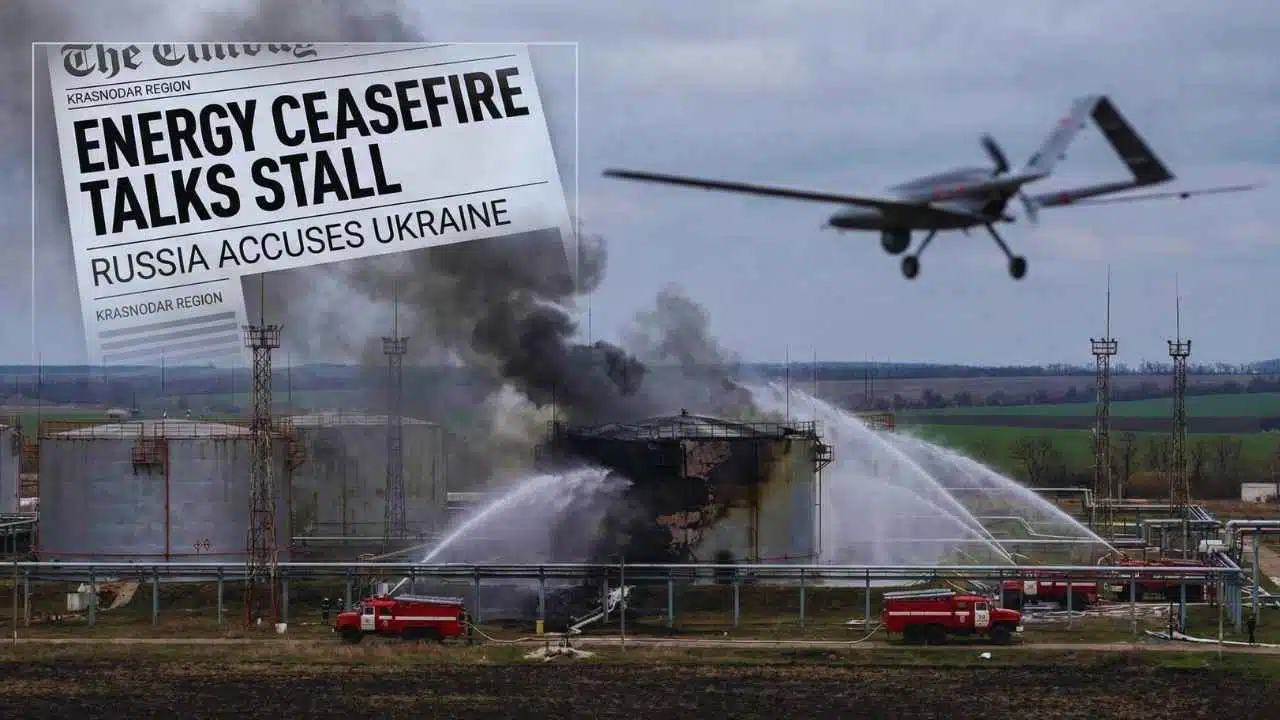
Russia accuses Ukraine of sabotaging energy ceasefire efforts after drones hit an oil facility in Russia’s Krasnodar region, as U.S.-backed talks push a 30-day pause on strikes against energy infrastructure.
What triggered the latest accusation, and what each side says?
Russia says a drone strike hit an oil storage-related facility near Kavkazskaya in Krasnodar Krai, igniting a fire and forcing emergency response measures. Russian officials described the attack as a deliberate provocation timed to undercut a newly discussed 30-day halt on strikes against energy infrastructure.
Russian statements framed the incident as evidence that Ukraine is not serious about limited de-escalation steps, even if broader ceasefire terms remain unresolved. Moscow’s message is aimed at both domestic audiences and foreign mediators: it wants the narrative to be that Russia is prepared to comply with a narrow energy pause, but Ukraine is not.
Ukraine has rejected the claim that it is “sabotaging” peace efforts. Ukrainian officials have signaled support for a limited framework that would protect energy assets, but they argue that any pause must be mutual, clearly defined, and observable in practice. Kyiv’s position is that an “energy ceasefire” cannot exist on paper while attacks and damage continue on the ground.
This dispute matters because it highlights the central weakness of partial ceasefires in an active war: a single disputed incident can become a political weapon and a pretext for retaliation. Even if both sides are willing to explore a narrow deal, they may still interpret “energy targets” differently—or use ambiguity to claim compliance.
Russia’s allegation also fits a broader pattern in the conflict: both sides often compete to convince international partners that the other is acting in bad faith. That competition intensifies whenever high-level diplomacy appears to create momentum, because credibility can shape future military aid, sanctions policy, and negotiating leverage.
What the proposed “energy ceasefire” is meant to cover?
The energy-focused pause being discussed is narrower than a full ceasefire. The basic idea is to reduce or stop strikes that disable power generation, transmission, and other energy-related systems that civilians depend on for heat, water, medical care, communications, and transportation.
In U.S. readouts and related diplomatic messaging, the energy pause has been presented as a first step—an early, practical measure that could be broadened later. In this approach, negotiators try to lock in an achievable commitment (don’t hit power systems) before tackling the harder political questions (territory, security guarantees, sanctions, and accountability).
However, an “energy ceasefire” quickly runs into definitional problems:
- Does it cover only electricity infrastructure, or also oil and gas assets?
- Is a fuel depot “energy” or “military logistics,” or both?
- If a site supports both civilian supply chains and military operations, can it be excluded?
Those questions are not academic. In modern war, fuel depots, pumping stations, and refineries can be dual-use—supporting civilian economies while also enabling military transport and armored operations. That overlap creates incentives for each side to interpret the rules in a way that protects its own options.
Below is a simplified view of what is commonly argued to fall inside or outside an energy-strike pause, and where disputes typically occur:
| Category | Examples | Why it’s contested |
| Electricity generation | Thermal plants, hydro plants, grid-connected renewables | Clear civilian impact, but also supports industry and military bases |
| Transmission & distribution | High-voltage substations, transformers, major grid nodes | Often targeted because disabling them causes broad outages |
| Oil & fuel storage | Oil depots, product tanks, regional fuel hubs | Can be framed as civilian energy supply or military logistics |
| Oil & gas processing | Gas plants, refineries, condensate facilities | Economic impact is large; “energy” vs “war funding” arguments clash |
| Cross-border pipelines | Transit pipelines, pumping stations | Damage can affect multiple countries and contracts, raising political stakes |
A credible energy pause usually requires a shared list of protected asset types, mapped locations, a start time, and a process for handling alleged violations. Without those, the agreement becomes vulnerable to immediate breakdown—especially after any large fire, explosion, or outage.
Why energy infrastructure is central to this war?
Energy has been a strategic pressure point since the full-scale invasion began in 2022. Both Russia and Ukraine have incentives to target energy-related systems, but for different reasons.
For Russia, strikes that degrade Ukraine’s power system can reduce industrial output, weaken logistics, and create humanitarian stress that pressures political leaders. Winter makes this especially severe. When electricity fails, heating systems can collapse, water pumping can stop, hospitals rely on backup power, and rail transport can slow.
For Ukraine, long-range drone campaigns against Russian oil and fuel infrastructure are often framed as a way to reduce the resources that support Russia’s war effort. Even when economic effects are hard to measure in real time, repeated disruptions can increase costs, complicate logistics, and force Russia to spend more on air defense and repairs.
International assessments have emphasized how extensive the damage is and why protection of energy systems is treated as urgent:
- Large reconstruction and recovery estimates have highlighted energy assets as a major damage category.
- Energy-focused analyses have described repeated waves of strikes, large capacity losses, and the vulnerability of substations and thermal generation.
- Humanitarian monitoring organizations have warned that further grid damage can have severe consequences for civilians during cold seasons.
This context helps explain why diplomats often choose “energy” as a first target set for de-escalation. If you can reduce grid attacks, you reduce immediate civilian suffering, stabilize essential services, and potentially create space for wider talks.
At the same time, the same context makes compliance hard. If one side believes the other is gaining a battlefield or economic edge by continuing strikes—especially against dual-use targets—political support for restraint can evaporate quickly.
Timeline: how the ceasefire push and the sabotage claim collided?
The controversy escalated because the alleged Krasnodar strike came as public messaging suggested movement toward an energy pause and related technical talks.
| Date (2025) | Development | Why it mattered |
| March 18–19 | Leader-level discussions and public readouts indicated support for a 30-day pause on strikes against energy infrastructure | Created expectation of immediate restraint |
| March 19 | Reports and official statements described a drone strike and fire at/near Kavkazskaya in Russia’s Krasnodar region | Sparked Russia’s “sabotage” accusation |
| Late March | Technical-level talks in Saudi Arabia were described as focusing on implementation steps and possible expansion (including Black Sea-related measures) | Attempted to turn political intent into workable rules |
| Following weeks/months | Both sides continued to trade accusations around infrastructure strikes | Demonstrated fragility without verification mechanisms |
The key issue is not only what happened at one oil facility. It is that the timing of the incident allowed it to become a test case for whether an “energy ceasefire” can survive first contact with battlefield reality.
Russia’s narrative is that Ukraine broke faith first, proving the pause is meaningless. Ukraine’s narrative is that Russia continued attacks and that Russia uses ceasefire language to gain political advantage while maintaining pressure.
Even when diplomacy appears to create agreement in principle, it can take time to define “protected targets,” implement communication channels, and establish procedures for alleged violations. That gap—between announcement and enforceable practice—is where disputed strikes can derail progress.
The verification problem: why partial ceasefires break down so fast?
A narrow ceasefire can work only if there is a shared understanding of rules and a credible way to evaluate violations. In this war, verification is difficult for several reasons:
- Access limitations: Many strike sites are in contested areas or deep behind front lines. Independent investigators may not be able to visit quickly—or at all.
- Attribution challenges: Drones can be launched from long distances, routes can be indirect, and debris may not always yield clear proof of origin.
- Dual-use targets: Fuel hubs, pumping stations, and certain industrial sites can be described as either “civilian energy” or “military logistics,” depending on political needs.
- Information warfare: Both sides have incentives to release selective evidence, emphasize certain incidents, and frame events to influence partners and public opinion.
A workable framework typically needs at least five elements:
- Precise definitions of energy infrastructure (what counts, what doesn’t).
- A start time and time zone, plus clarity on whether there is a “grace period.”
- A protected list or categories, potentially including mapped coordinates.
- A reporting channel for alleged violations, with deadlines for evidence.
- A consequence ladder—what happens after a violation (warnings, inspections, retaliation limits, repair corridors).
Without these details, a partial ceasefire is vulnerable to what happens in practice: a fire breaks out, a depot is hit, a substation fails, and each side claims the other violated first. The ceasefire becomes more about messaging than restraint.
This is also why energy pauses are sometimes paired with discussion of maritime measures and other confidence-building steps. The logic is that if technical talks can produce tangible results—like safer shipping or predictable rules—trust might increase enough to widen the ceasefire. But if the first step collapses under accusation, the ladder to broader agreements becomes harder to climb.
What happens next: scenarios and implications for the war and diplomacy?
The immediate future depends on whether mediators can narrow the gap between political intent and operational reality.
One scenario is that the energy pause survives in a limited form: strikes continue but are reduced against the most sensitive grid nodes, or both sides quietly avoid certain targets without publicly admitting it. That can happen when leaders want the benefits of restraint but fear domestic criticism for appearing “soft.”
Another scenario is that the pause collapses fully, with each side using the other’s alleged violation to justify renewed or expanded targeting. In that case, infrastructure strikes may intensify—especially ahead of winter or during major battlefield offensives.
A third scenario is partial compliance with carve-outs. For example, electricity substations might be treated as “off limits,” while oil depots are treated as legitimate military-adjacent targets. This kind of carve-out can reduce some humanitarian harm but also creates constant argument over classification.
What to watch in coming weeks:
- Whether diplomatic channels publish clearer definitions of protected targets.
- Whether there are reports of fewer strikes on high-voltage substations and major generation sites.
- Whether either side publicly accepts third-party monitoring or structured reporting procedures.
- Whether “energy ceasefire” discussions broaden to Black Sea shipping or prisoner exchanges, which can indicate confidence-building.
For civilians, the stakes are immediate. Energy infrastructure damage can translate into blackouts, heating failures, and disruption to hospitals and essential services. For diplomacy, the stakes are structural: if negotiators cannot protect the grid, it becomes harder to persuade publics that any broader ceasefire will hold.
For the war’s trajectory, targeting decisions shape resource allocation. Every strike forces the defender to choose between protecting cities, the frontline, and infrastructure. Even a modest reduction in infrastructure attacks can free up repair crews, stabilize economic activity, and reduce humanitarian strain—factors that influence endurance on both sides.































