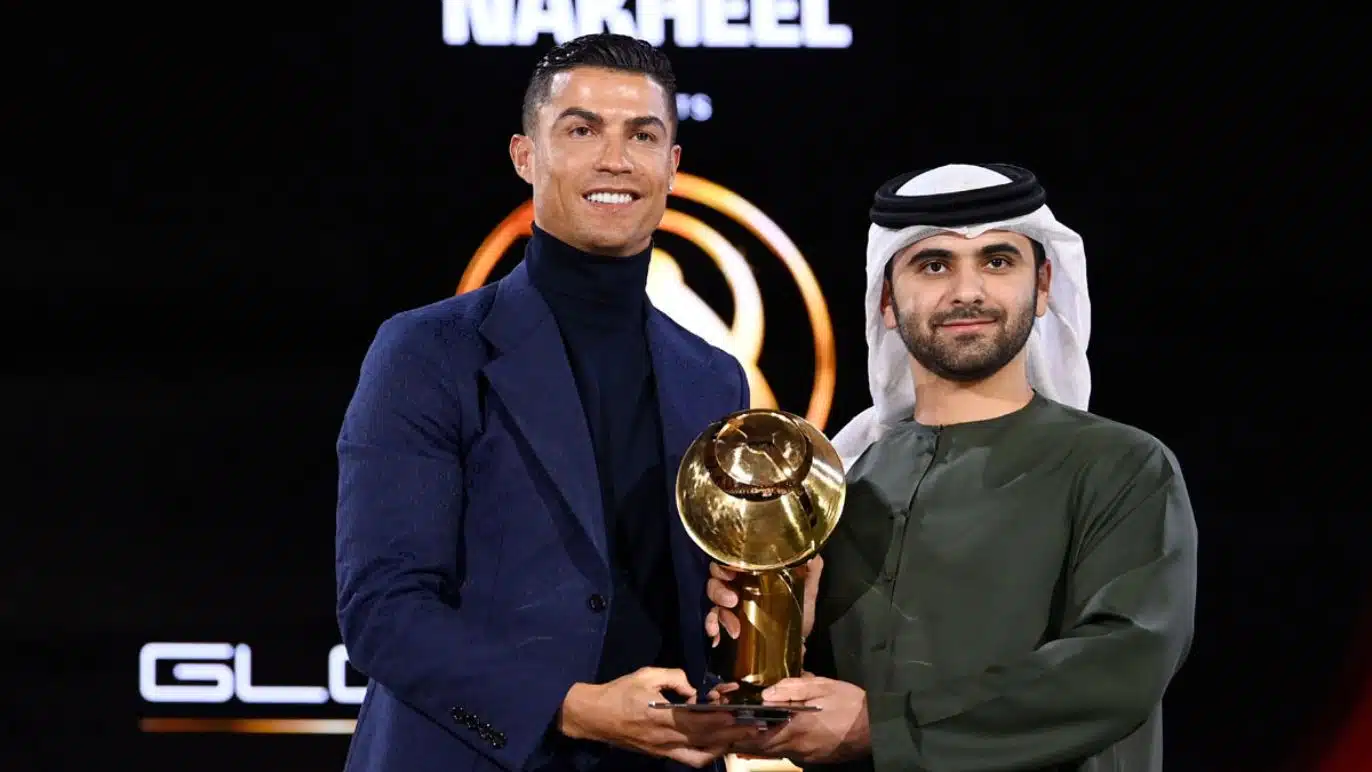
Cristiano Ronaldo has been crowned Best Middle East Player for 2025, securing the accolade for a record third consecutive time at the Globe Soccer Awards in Dubai and underlining his enduring dominance in the region well into his 40s. The Al-Nassr superstar’s latest honour adds another chapter to an already historic career and further strengthens his status as the face of Middle Eastern football on the global stage.
Ronaldo’s Historic “Three‑in‑a‑Row” Milestone
Cristiano Ronaldo received the Best Middle East Player 2025 award at the Globe Soccer Awards gala held in Dubai on December 28, 2025, in front of a star-studded audience of footballers, club executives and global sports figures. The recognition marks his third successive win in the category, following previous triumphs in 2023 and 2024 since his move to Saudi Arabia’s Al-Nassr.
The award is part of a relatively new Globe Soccer segment dedicated to players plying their trade in Middle Eastern leagues, where Ronaldo has quickly established himself as the benchmark for excellence. By winning it three times in a row, he has effectively set an early records standard that future stars in the region will be judged against.
Star‑Studded Night in Dubai
The 2025 Globe Soccer Awards ceremony took place at a high-profile gala in Dubai, a city that has become synonymous with elite football gatherings and end‑of‑year celebrations. Held at a luxury venue and broadcast worldwide, the event brought together top names from football and other sports, reinforcing its status as one of the most influential dates on the global sporting calendar.
Alongside Ronaldo’s recognition, the evening also celebrated other winners, including tennis legend Novak Djokovic, who received a Globe Sports Award as a cross‑sport tribute to global excellence. In football, several European stars and clubs were honoured in different categories, illustrating how the awards now bridge multiple continents and competitions while increasingly spotlighting the Middle Eastern game.
Ronaldo’s Reaction: “I Still Motivate Myself to Carry On”
In his on‑stage remarks after receiving the trophy, Ronaldo stressed that his hunger for goals and trophies remains undiminished, despite his age and the length of his career. “I still motivate myself to carry on, it doesn’t matter where I play, to score goals and keep going,” he said, pointing to an inner drive that has sustained him across Portugal, England, Spain, Italy and now Saudi Arabia.
Ronaldo also reiterated a personal ambition that has grabbed global headlines: his determination to chase the extraordinary landmark of 1,000 career goals. “I want to win more trophies and reach a number, and I will reach that number,” he noted, a clear reference to that four‑figure target and a message that he is far from considering retirement.
Social Media Message: “Special Way to End the Year”
Soon after the ceremony, Ronaldo shared a celebratory post on Instagram featuring a photo of himself holding the Best Middle East Player trophy. In his caption, he described the award as a “special moment to end the year on,” and thanked fans while vowing to maintain the same passion, commitment and hunger that have characterised his career.
The social media post quickly went viral among his hundreds of millions of followers, generating a wave of congratulations from supporters, fellow professionals and public figures across the globe. The reaction highlighted once again how Ronaldo’s influence stretches far beyond the pitch, where his image and words routinely shape football narratives worldwide.
Dominance in the Saudi Pro League
Since joining Al‑Nassr in early 2023, Ronaldo has been the central figure in the Saudi Pro League’s footballing and commercial rise. His goal record in the region, including multiple seasons with 35 or more goals across competitions, has made him the go‑to star for both domestic fans and international audiences tuning in to the league.
In the 2025 calendar year alone, Ronaldo scored around 40 goals for club and country, maintaining an elite scoring pace that is remarkable for a player aged 40. These numbers underpin the rationale for his selection as Best Middle East Player and reinforce the idea that he remains one of the world’s most reliable finishers despite leaving European football.
The Numbers Behind the Award
Ronaldo has now compiled three consecutive calendar years in the Middle East featuring prolific scoring and decisive performances. In 2023 he broke the record for goals in a single Saudi league season, then followed up with another explosive campaign in 2024 and kept his output high through 2025.
Across these years, his scoring patterns have included hat‑tricks, critical late winners and multi‑goal performances in high‑profile league and cup fixtures for Al‑Nassr. This consistency, rather than just isolated moments, is what award organisers and voters have repeatedly highlighted when justifying his selection as the region’s standout player.
Rivals Beaten to the Prize
The Best Middle East Player category typically features some of the biggest names to have joined clubs in the Gulf region in recent seasons. Among those competing with Ronaldo for recognition have been stars such as Karim Benzema, Riyad Mahrez and regional hero Salem Al‑Dawsari, all of whom boast strong resumes and sizable fan bases.
That Ronaldo has emerged as the winner three years in a row underlines the perceived gap between his overall impact and that of his rivals. Even as these players have delivered notable performances for their respective teams, Ronaldo’s combination of goals, leadership and visibility has kept him firmly at the top of the regional hierarchy.
Why This Award Matters for Ronaldo
For Ronaldo, the Best Middle East Player honour is more than a personal trophy; it is also validation of his decision to move to Saudi Arabia at a stage when many assumed his peak years were behind him. By turning the Saudi Pro League into a stage for record‑breaking seasons, he has managed to extend his legacy into a new footballing frontier.
The award also supports his argument that football’s centre of gravity is shifting, and that top‑level performance and prestige are no longer confined to Europe’s traditional powerhouse leagues. In that sense, every new recognition he earns in the Middle East feeds into a broader narrative about the globalisation of elite football.
Impact on Middle Eastern Football
Ronaldo’s presence in the region has dramatically elevated the international profile of Middle Eastern club football. Matches involving Al‑Nassr routinely attract global broadcasting interest, with highlights and clips from his goals widely shared on digital platforms and sports networks.
His move helped trigger a wave of high‑profile transfers to Saudi clubs, encouraging other top players and coaches to consider the Middle East as a viable destination both competitively and financially. The result has been an accelerated rise in the perceived quality and importance of the region’s football scene, which awards like Globe Soccer’s Best Middle East Player category seek to reflect.
Globe Soccer Awards’ Growing Role
The Globe Soccer Awards, held annually in Dubai since 2010, have carved out an increasingly influential space in football’s awards ecosystem. By combining global categories with region‑specific honours such as Best Middle East Player, the event recognises both established and emerging football markets.
For the Middle East, the ceremony functions as a showcase of the region’s football development and ambitions, especially as Gulf states invest heavily in clubs, infrastructure and international partnerships. Ronaldo’s repeated wins therefore resonate not only as personal accolades but also as markers of the region’s successful recruitment of elite talent.
Ronaldo at 40: Defying Football’s Age Curve
At 40 years old, Ronaldo continues to deliver performances more commonly associated with players five to ten years younger. Maintaining peak physical condition through rigorous training, nutrition and recovery routines, he has preserved his explosiveness, aerial ability and finishing sharpness.
This longevity has become part of his legend, with each new season serving as further proof that his career is stretching far beyond the conventional lifespan of a top‑level forward. For younger players in the Middle East and beyond, his example offers a visible template of how discipline and professionalism can prolong time at the top of the game.
Chasing 1,000 Goals: Ambition Without Limits
Ronaldo’s stated target of reaching 1,000 career goals has been widely debated among pundits and supporters, but the player himself has made it clear he is “confident” he can get there. This ambition injects additional intrigue into every season he plays, especially as he remains a primary scoring outlet for Al‑Nassr and still features for Portugal.
The Best Middle East Player 2025 award offers fresh evidence that he is not content merely to wind down his career; instead, he is actively pursuing new heights and numerical milestones. For fans, each goal and trophy from this point onwards carries an extra historical layer, as the football world watches to see how far his statistics can ultimately climb.
Leadership On and Off the Pitch
Beyond the goals and trophies, Ronaldo’s influence at Al‑Nassr and in the region is also felt in his leadership role within the squad and the broader football community. Younger teammates often speak of his professionalism, training intensity and game preparation as standards they aim to emulate.
Off the field, his interactions with fans, public appearances and charitable activities help cement a positive image for both the club and the Saudi league more broadly. Winning the Best Middle East Player award three times in a row reinforces this leadership dimension, portraying him as not just a star signing but a cornerstone figure for the region’s football project.
A Signal to Future Stars
Ronaldo’s sustained success and recognition in the Middle East send a powerful message to other players considering moves outside Europe’s traditional elite leagues. The combination of competitive football, high‑profile awards and global visibility shows that careers can flourish in new markets without sacrificing prestige.
As Gulf clubs continue to invest, Ronaldo’s story may serve as a blueprint for future stars looking to leave their mark on a growing football frontier. The Best Middle East Player award, repeatedly landing in his hands, becomes a symbol of both individual excellence and the opportunities now available in the region.
What Comes Next for Ronaldo
With another major honour added to his collection, attention now turns to what Ronaldo can achieve in the coming seasons for Al‑Nassr and Portugal. Key questions revolve around how long he plans to keep playing, whether he can maintain his scoring rate and how close he can move towards the 1,000‑goal mark he has publicly embraced.
For the Middle East, his continued presence guarantees sustained international focus on the region’s leagues, fixtures and development plans. As long as he remains active, every match he plays will be framed not just as a domestic contest but as another episode in one of football’s most extraordinary late‑career chapters.
Cristiano Ronaldo’s third straight Best Middle East Player award thus stands as both a personal milestone and a milestone for the region, encapsulating how one player’s drive for greatness has intertwined with the ambitions of an emerging football powerhouse.