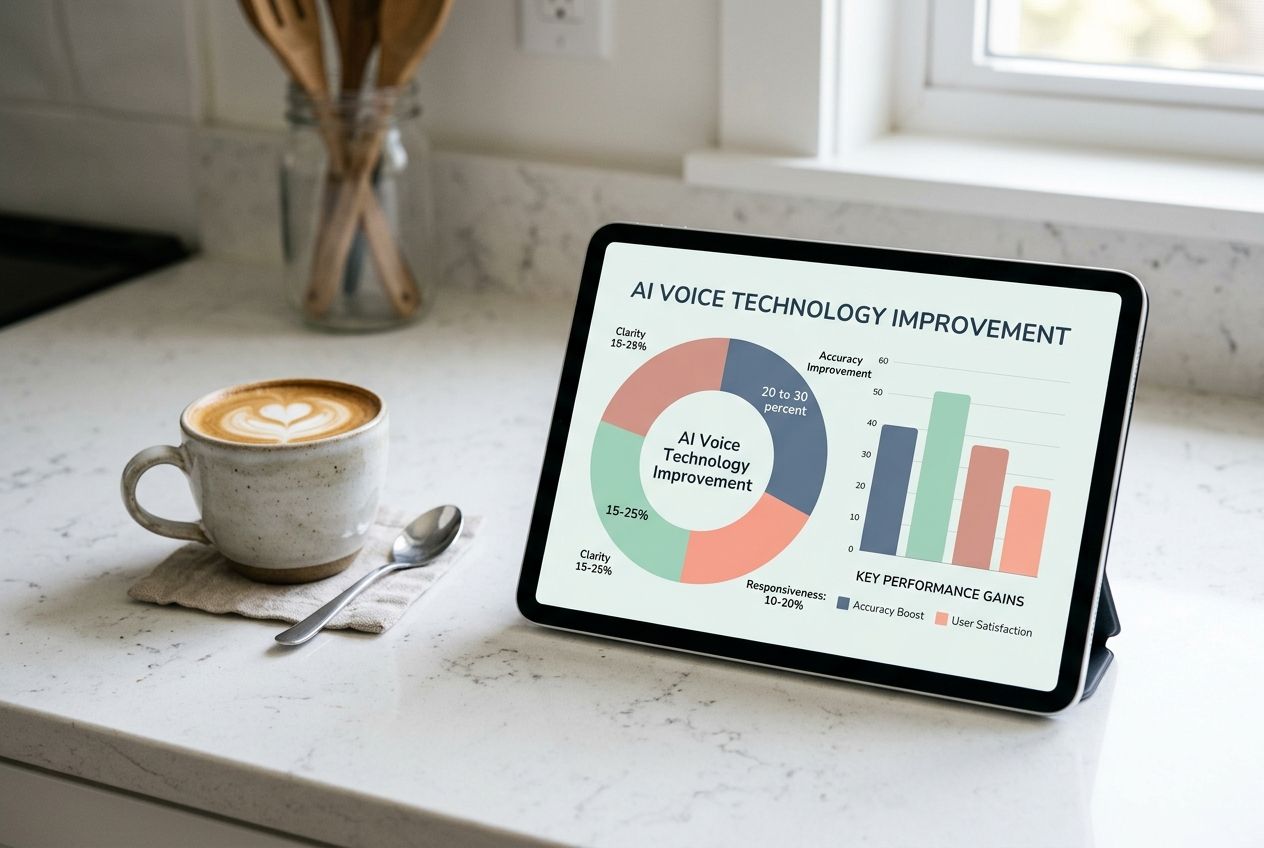
Your smart speaker sits on your kitchen counter. You ask it a question, and it gives you an answer that feels like it came from a robot reading a script. Sound familiar? It is incredibly frustrating. The gap between what these tools can do and what you actually need them to do feels wider than it should be. Here is a fun fact: AI voice technology improves by about 20 to 30 percent every single year. Companies pour billions into making these assistants faster and more helpful.
The good news is that we are going to explore exactly how AI Voice Assistants are getting smarter every year. Grab a cup of coffee, and let’s go through it together. I will show you everything you need to know about the future of this tech.
What Are AI Voice Assistants?
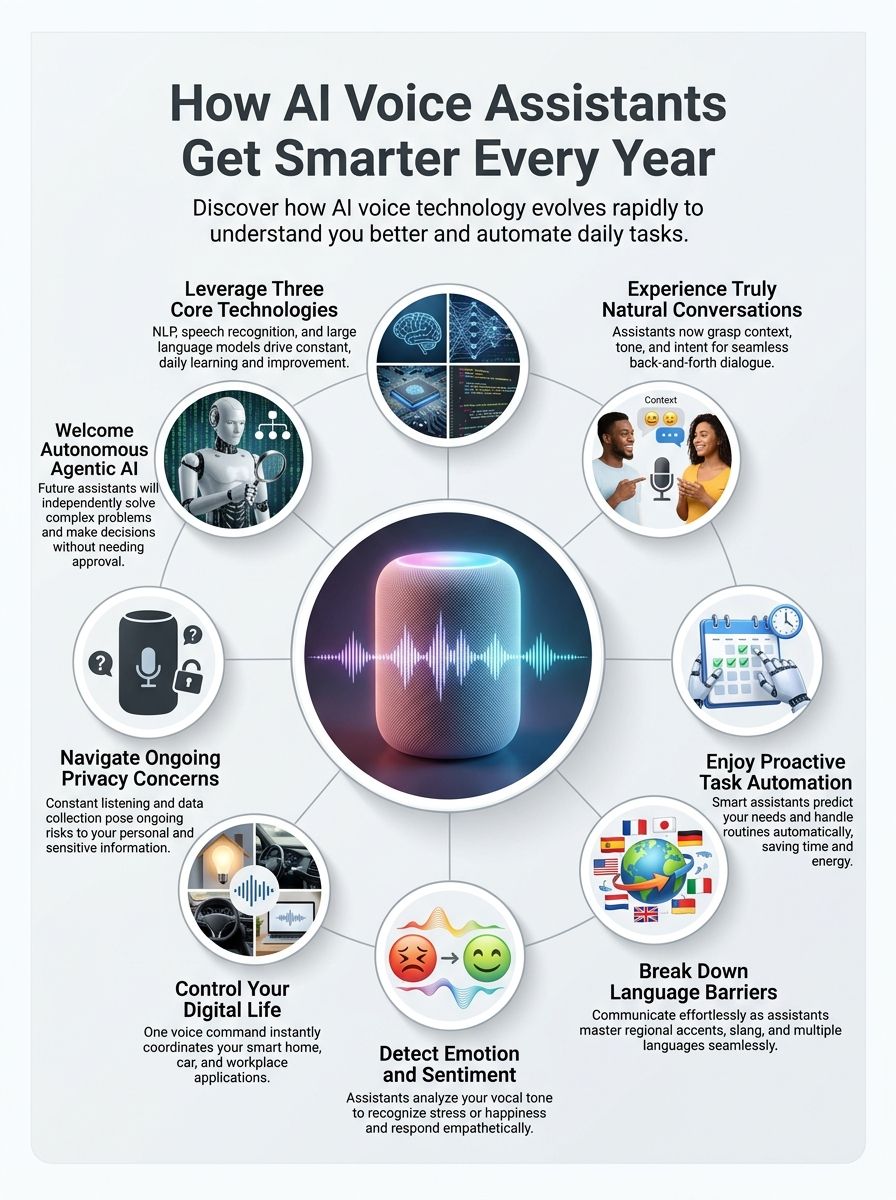
AI voice assistants are smart programs that listen to what you say, understand your words, and talk back to you in real time. They combine major technologies to turn your spoken commands into actions and helpful responses.
Definition and core functionalities
AI voice assistants are software programs that listen to your voice, understand what you say, and talk back to you. They live in your phone, smart speaker, or other devices. These digital assistants handle real tasks like setting alarms, playing music, answering questions, and controlling your smart home.
Think of them as tiny helpers that work around the clock. A 2025 report from eMarketer found that over 135 million adults in the US now use voice assistants monthly. That means these tools are as common as smartphones in many households.
Your voice assistant learns from conversations you have with it. It picks up on your preferences, your accent, and your communication style over time. Machine learning powers this growth, allowing the system to get better with each interaction you complete.
Key technologies: NLP, speech recognition, and LLMs
Three core technologies power modern voice assistants. Natural language processing helps these systems understand what you actually mean. Speech recognition converts your voice into text.
Large language models process that text and generate human-sounding responses. Here is a quick breakdown of how these technologies work together:
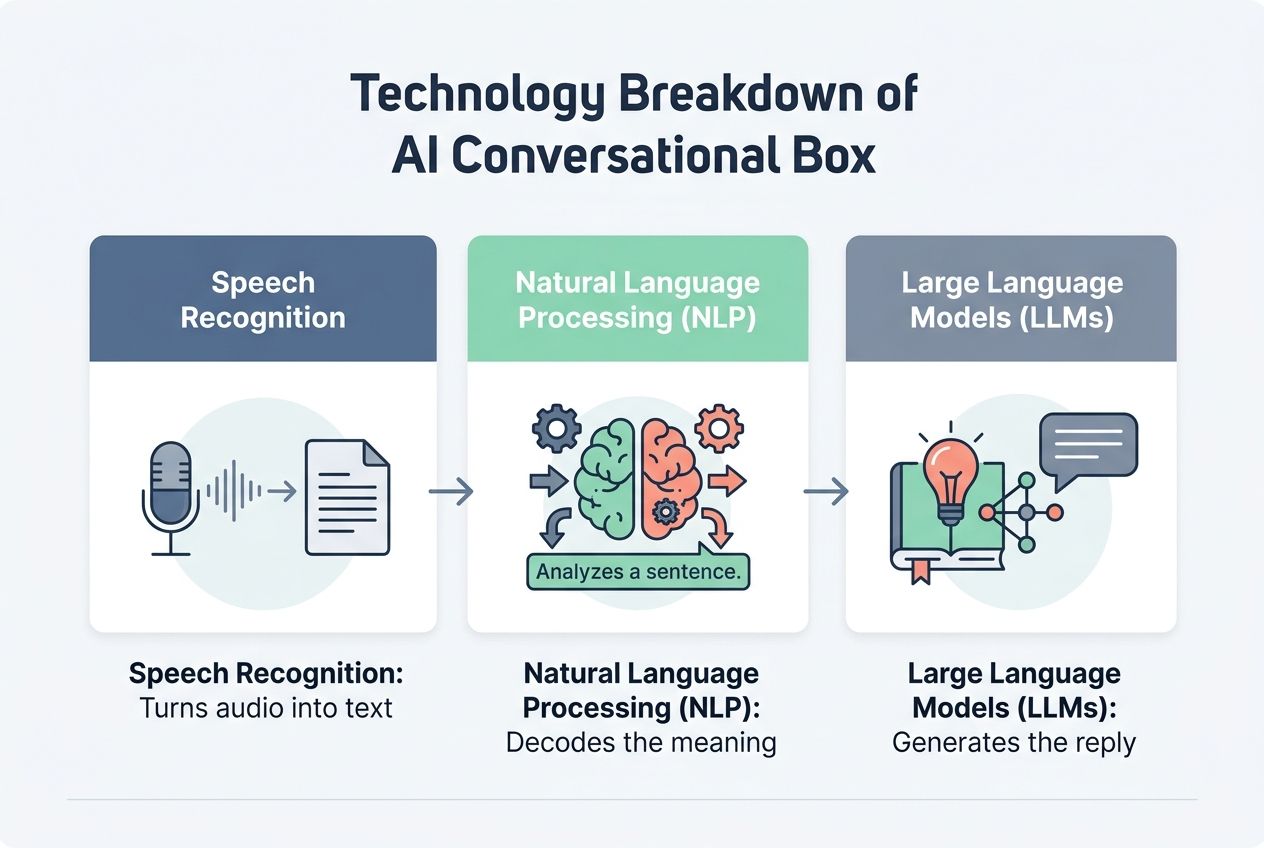
| Technology | What It Does | Real-World Impact |
|---|---|---|
| Speech Recognition | Turns audio into text | Catches thick accents and fast talkers accurately. |
| Natural Language Processing (NLP) | Decodes the meaning | Understands slang, context, and complex requests. |
| Large Language Models (LLMs) | Generates the reply | Creates conversational, friendly responses instantly. |
Together, these three technologies form the backbone of conversational AI. For example, OpenAI released its GPT-4 voice model recently. It boasts an average audio response time of just 320 milliseconds.
That speed is similar to human conversation times. This constant learning cycle means your digital assistant grows smarter with every interaction. It makes personalization feel less like talking to a robot and more like chatting with a friend.
How AI Voice Assistants Are Getting Smarter Every Year
AI voice assistants talk to you in ways that sound more human every single day. They learn what you need before you ask, handle multiple tasks at once, and understand what you really mean.
More natural conversations
Voice assistants now sound like real people having actual conversations with you. They catch what you mean instead of just analyzing what you say. If you ask about tomorrow’s weather, the assistant understands you want a forecast.
A great example of this is Apple’s major Siri update in iOS 18. Siri gained on-screen awareness, meaning it can understand the context of what you are currently looking at on your phone. It grasps context, tone, and intent all at once.
Speech synthesis technology makes their voices warm and human-like. You hear fewer robotic tones and more genuine communication. The gap between talking to a machine and talking to a friend keeps shrinking.
Proactive assistance and task automation
AI voice assistants now act like helpful teammates that get things done before you ask. They learn your daily routines and predict what you need next. Then, they take action automatically.
A popular tip from the r/smarthome community on Reddit is to fully utilize Google Home’s advanced routines. Many users find that setting up multi-step routines saves them hours of manual adjustments each week. Your assistant can execute several tasks at once.
- Adjust your home temperature before you arrive from work.
- Sending a reminder about your upcoming meeting.
- When ordering groceries, you always buy on a specific day.
- Sort your morning emails automatically.
Improved contextual understanding
Smarter AI voice assistants now understand what you really mean. Your assistant notices the details of your life, your habits, and your past conversations. This shift extends beyond simple command recognition into genuine comprehension.
OpenAI recently introduced a memory feature for ChatGPT. This allows the AI to remember details across all your chats, so you do not have to repeat your preferences. Context is the key element that transforms assistants from robotic responders into thoughtful helpers.
The best assistants do not make you think about the technology; they just help you get things done.
Your assistant remembers that you always ask for directions to the gym on Monday mornings. It offers the route before you request it. The technology interprets what you say, picking up on tone and intent.
Enhanced multi-language support
Voice assistants now break down language barriers like never before. Your AI helper speaks more languages, understands regional accents, and switches between tongues without missing a beat. Machine learning trains systems on thousands of speech patterns from different cultures.
A major breakthrough in this area is Meta’s SeamlessM4T model. This technology provides nearly instant translation across nearly 100 languages. Conversational AI has grown sharp enough to catch slang and local expressions.
This matters because people want to talk to their devices naturally. Speech synthesis has improved so much that these responses sound authentic. Your AI voice assistant works harder to respect your communication style.
Key Innovations in AI Voice Assistants
AI voice assistants now pack powerful new features that make them smarter, faster, and more helpful than ever before. Let us look at what is changing the game.
Integration with advanced apps and devices
Your voice assistant now talks to your entire digital life. It connects with your smart home, your phone, your car, and your work apps all at once. This integration means you speak one command, and multiple devices spring into action.
This seamless connection is largely thanks to the Matter 1.3 smart home protocol. Released in 2024, Matter allows devices from Apple, Google, and Amazon to communicate perfectly with each other. It includes support for major home appliances and energy management tools.
Machine learning powers these connections. Your assistant learns which apps you use most and prioritizes them. Task management becomes effortless when your assistant coordinates your entire schedule.
Emotional intelligence and sentiment analysis
AI voice assistants now detect how you feel through your tone of voice. They listen to the emotion in your words, not just the words themselves. This skill is called sentiment analysis.
A company called Hume AI is leading this charge with its Empathic Voice Interface. Their technology can measure 53 distinct vocal expressions in real time. It picks up on stress, happiness, sadness, and confusion instantly.
Here is how emotional intelligence changes the interaction:
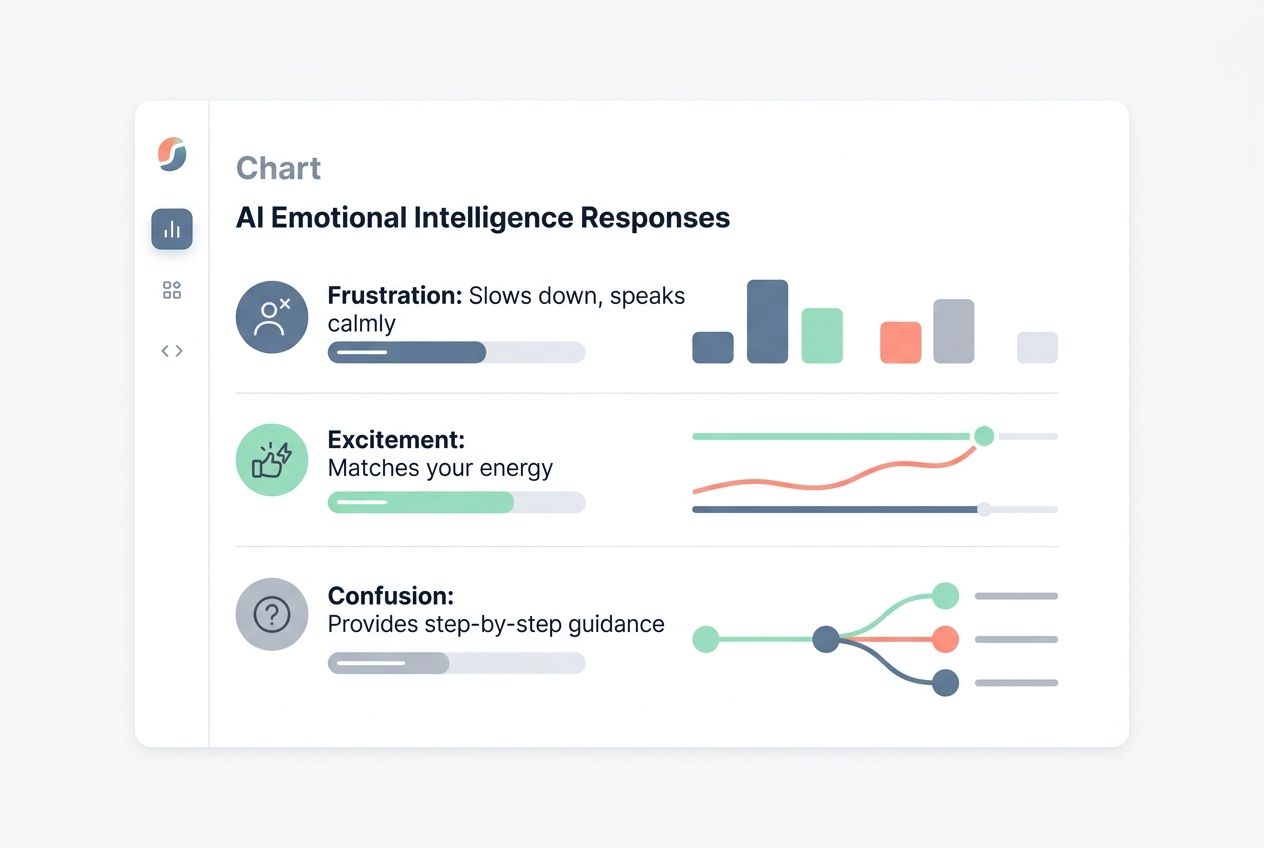
| Emotion Detected | How the Assistant Responds |
|---|---|
| Frustration | Slows down, speaks calmly, and offers alternative solutions. |
| Excitement | Matches your energy with a brighter, faster tone. |
| Confusion | Provides step-by-step guidance in simpler terms. |
This personalization makes interactions feel more human. Customers appreciate it when their voice assistant sounds genuinely interested in helping them. Each conversation feels customized to your emotional state.
Voice personalization and natural-sounding tones
Your voice assistant now sounds like a real person. Modern speech synthesis technology creates voices that flow naturally. They use proper pauses and emotional inflection.
Tools like ElevenLabs have revolutionized voice cloning and generation. They allow developers to create incredibly realistic synthetic voices that capture subtle human breathing patterns. These systems adapt their tone to match your personality.
Personalization goes further than just sounding nice. Machine learning algorithms study your interaction patterns and shape the assistant’s behavior. This human-computer interaction feels like chatting with someone who actually knows you.
Use Cases for Smarter AI Voice Assistants
AI voice assistants now handle real work that matters to millions of people daily. From organizing your schedule to controlling your lights, these smart helpers change how we live and work.
Personal productivity and task management
Voice assistants now handle your daily tasks without you lifting a finger. These smart tools learn what you need and help you stay organized. They keep you focused and on top of your workload.
For professionals, Microsoft Copilot has become an essential tool in Teams meetings. It uses natural language processing to transcribe the call and instantly generate action items for everyone involved. Here are a few ways these assistants boost productivity:
- Capturing to-do lists while driving or cooking.
- Reminding you of approaching deadlines based on past habits.
- Scheduling emails and setting calendar events automatically.
- Providing clear voice confirmations when tasks are completed.
Smart home automation
Your AI voice assistant transforms your home into a responsive environment. Smart home automation powered by voice recognition creates seamless control over your entire living space. You can manage everything from lighting to security with simple phrases.
According to the US Department of Energy, using a smart thermostat like the Ecobee can save you up to 10 percent on heating and cooling costs a year. The assistant learns your preferred settings and adjusts automatically. Here are common automated tasks:
- Adjusting lighting brightness and color temperature.
- Locking doors and viewing camera feeds for security.
- Playing music and switching streaming services.
- Starting coffee makers and scheduling dishwashers for energy efficiency.
Business workflows and customer support
AI voice assistants completely change how companies handle daily operations. These smart systems automate routine tasks and speed up response times. They free up your team to focus on complex problems.
A 2024 Gartner report found that using generative AI for customer service can reduce agent workload by up to 30 percent. Machine learning algorithms learn from past interactions to suggest the best solutions faster. Here is how businesses use them:
- Powering voice-activated ticketing systems without manual data entry.
- Handling incoming calls around the clock to cut wait times.
- Routing tickets to the right department automatically.
- Reducing repetitive work like password resets and account lookups.
Challenges and Limitations of AI Voice Assistants
AI voice assistants still struggle with privacy issues that make users hesitant to invite them into their homes. These systems also miss the mark on context sometimes, which leaves you frustrated and reaching for your keyboard instead.
Privacy concerns
Your voice assistant listens constantly. It records conversations, stores data, and sends information to company servers. This practice raises serious questions about who accesses your personal information.
In 2023, the FTC fined Amazon 25 million dollars for violating children’s privacy laws with its Alexa devices. This highlighted the urgent need for better data protection. Your voice recordings could end up in the wrong hands.
Strong privacy protections should come standard, not as an afterthought, because your voice belongs to you alone.
You share intimate moments with these devices. The US California Consumer Privacy Act gives residents the right to delete this data, but many users do not know how. You deserve to know exactly how organizations handle your conversational AI data.
Barriers to full contextual accuracy
AI voice assistants still struggle to grasp the full context in real conversations. They often miss nuances, sarcasm, and cultural references that humans catch instantly. Accents and regional dialects confuse speech recognition systems.
A major hurdle is the Cocktail Party Problem, where AI struggles to isolate one voice in a noisy room. Background noise disrupts their ability to hear what you actually say. Here are a few other common limitations:
- Lacking knowledge about your personal history to connect facts.
- Struggling with uncommon languages or highly specialized vocabulary.
- Failing to follow complex back-and-forth exchanges seamlessly.
- Losing context when tasks span multiple apps and devices.
The Future of AI Voice Assistants
AI voice assistants will make decisions on their own, without waiting for you to ask. These smart systems will soon handle complex tasks across healthcare, education, and business without human intervention.
Agentic AI and autonomous decision-making
Agentic AI takes voice assistants to a whole new level. It lets them make decisions without waiting for your approval first. These smart systems learn your goals and take action on their own.
We are seeing the rise of Large Action Models, or LAMs. Devices like the Rabbit R1 attempted to use LAMs to navigate apps for you, though the early tech showed we still have room to grow. Your voice assistant might book a doctor’s appointment or reorder groceries before you ask.
This autonomous decision-making saves you time and effort. It turns your digital assistant into a real partner. As smart technology improves, your voice assistant will handle increasingly complex tasks.
Broader adoption in healthcare and education
AI voice assistants are changing how doctors, nurses, and teachers work every single day. These smart tools make work faster, safer, and more connected. They are popping up in hospitals and classrooms across the country.
For example, Microsoft’s Nuance DAX Copilot is a clinical documentation tool. It securely listens to doctor-patient conversations and automatically drafts clinical notes. Studies show this saves physicians an average of seven minutes per patient encounter.
Here is how it is helping across these fields:
- Saving doctors’ time with hands-free documentation.
- Keeping operating rooms sterile with voice-activated surgical systems.
- Helping students with dyslexia complete assignments independently.
- Training medical staff with interactive patient simulation software.
Wrapping Up
Voice assistants continue to change how we interact with technology. These smart tools handle everything from setting reminders to controlling your home. They keep getting better at understanding what you actually mean. Machine learning powers these improvements. It lets systems learn from millions of conversations.
The future holds massive potential as this tech expands into healthcare and education. You might not even notice all the ways conversational AI helps your daily life already. Smart technology blends perfectly into phones, speakers, and appliances. It makes communication completely effortless.
Frequently Asked Questions (FAQs)
1. How do AI voice assistants keep getting smarter every year?
It’s all about massive learning models, which is exactly why Google is fully replacing its classic Assistant with the much smarter Gemini AI across US Android phones in 2026. Just like a friend getting to know you better, these systems learn from billions of interactions to understand complex context and make every chat feel completely natural.
2. Can these digital helpers really understand what I mean now?
Yes, they are significantly better, boasting an average accuracy rate of 93.7% for search queries as of 2026. While heavy background noise or strong accents can still cause occasional hiccups, advanced natural language processing means they rarely misunderstand your daily conversational context.
3. What cool things can modern AI voice tools do that old ones couldn’t?
Unlike older models that just set timers or played music, modern AI assistants like ChatGPT’s Advanced Voice Mode and Google’s Gemini Live can now have deep, real-time conversations, handle complex interruptions, and even solve math equations by looking at your phone’s camera.
4. Are there risks as these talking gadgets get more advanced?
Absolutely, and privacy remains a massive concern, with over 40% of users still worried about these gadgets recording private moments. To help fix this, major tech companies are pushing hard for on-device processing throughout 2026, which means your voice data gets analyzed directly on your phone rather than being sent to distant cloud servers. Even with these upgrades, it is always a smart idea to regularly review your privacy settings and clear your conversation history.