Resident Evil Requiem Switch 2 “Open City” gameplay is significant right now because it signals a new threshold for handheld AAA performance and a design pivot for survival horror. If Capcom can keep fear intact inside a larger, more navigable city, Switch 2 becomes a day-one “serious platform,” not a later port destination.
How We Got Here
Capcom rarely moves the Resident Evil franchise without also testing where the brand sits in the wider market. Over the last decade, the series has shifted from blockbuster action back toward horror fundamentals, while also modernizing production values and expanding its audience. That’s a delicate balancing act: Resident Evil sells at global scale, but it succeeds long-term because it can reinvent its tone and pacing without losing its identity.
Nintendo’s platform story has also changed. The original Switch proved that hybrid play can be a mainstream behavior, not a niche. But it also forced a common compromise: many third-party “AAA” releases arrived late, arrived in cloud form, or arrived as scaled-down versions. Switch 2 is trying to break that pattern. Early hardware and software momentum matters here because publishers need proof that real engineering investment can pay off, not just in prestige but in volume.
This is why the first look at Resident Evil Requiem Switch 2 “Open City” gameplay lands differently than a normal trailer. City environments are punishing from a performance standpoint: long sightlines, streaming demands, dense lighting, and the need to keep motion stable when players move quickly. If Capcom is comfortable showing a city slice on Switch 2, it’s not just marketing. It is an implicit claim that portable hardware can carry modern pipelines with fewer “sorry, not on this system” caveats.
Capcom’s launch approach strengthens that reading. Requiem is not arriving alone. A broader Resident Evil stack coming to Switch 2 around the same window positions the new game as both a flagship and a gateway, pushing new players into the franchise backlog and strengthening long-tail revenue.
Why “Open City” Is A High-Risk, High-Reward Design Bet
Resident Evil traditionally manufactures fear through control. It squeezes the player through constrained spaces, limited visibility, and carefully staged resource scarcity. That’s why “open city” immediately raises a design question: can you give the player more freedom without giving them emotional distance from danger?
An open environment can reduce dread because it increases optionality. If you can simply run around a threat, fear becomes inconvenience. Survival horror works best when the player feels cornered, pressured, and uncertain.
So why do it now?
Because modern AAA design and market expectations are pushing in two directions at the same time:
- Bigger, more systemic environments are increasingly the baseline for “next-gen value.”
- Players also expect replayability, discovery, and emergent moments that can’t be fully scripted.
The likely solution is a city that appears open but behaves like layered pressure chambers. Think of it as “wide on the surface, tight at the core.” The streets may let you navigate, but the real horror density may be concentrated in interiors, underground routes, quarantined districts, and zones designed to collapse safety at the exact moment you start to feel comfortable.
Capcom has done versions of this before. Resident Evil 2’s police station is not technically “open,” but it feels expansive because it is a puzzlebox that recontextualizes itself as you learn it. Resident Evil Village presents multiple regions, but each region is structured around controlled peaks of pressure. “Open City” can be the next iteration: sell scale and autonomy without surrendering pacing authority.
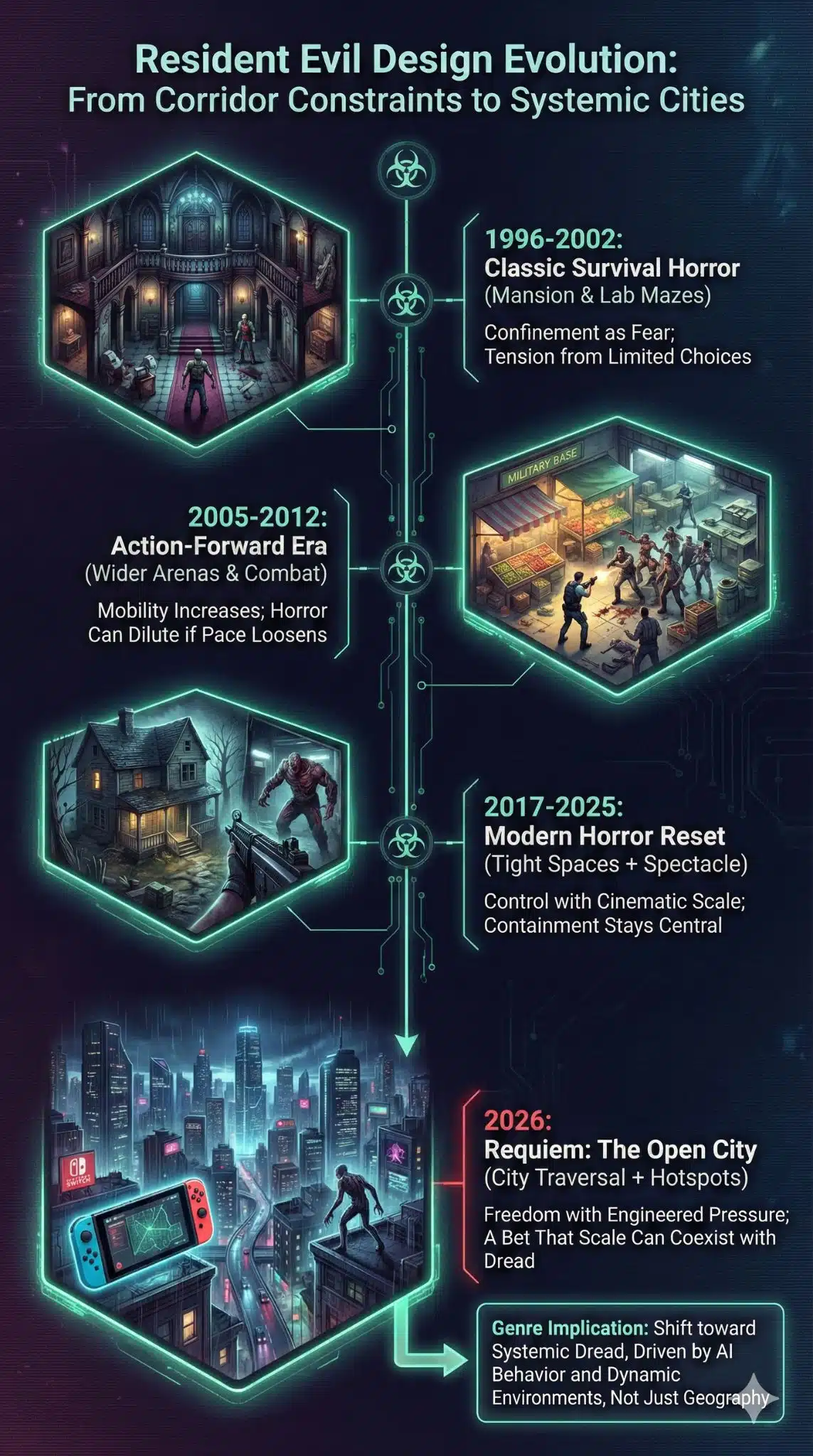
Here is what that evolution looks like when you zoom out across the franchise:
| Era | Representative Design | Space Philosophy | What It Suggests For Requiem |
| Classic survival horror | Mansion and lab mazes | Confinement as fear | Tension from limited choices |
| Urban outbreak era | City backdrop with segments | City as setting, not sandbox | Bigger world, still curated |
| Action-forward era | Wider arenas and combat | Mobility increases | Horror can dilute if pace loosens |
| Modern horror reset | Tight spaces plus spectacle | Control with cinematic scale | Containment stays central |
| Open city approach | City traversal plus hotspots | Freedom with engineered pressure | A bet that scale can coexist with dread |
If Capcom pulls it off, the genre implication is larger than one game: survival horror may be moving toward “systemic dread,” where fear is driven less by corridor geography and more by AI behavior, unpredictable pursuit patterns, dynamic lighting, and environmental rules that punish complacency even in open space.
Switch 2 As A Portable AAA Stress Test
The Switch 2 angle is not simply “it runs.” It is what “running” implies for the next three to five years of platform strategy.
Portable AAA is hard because it forces tradeoffs that are easy to hide in a trailer but impossible to hide in play: stutter during traversal, unstable frame pacing in combat, inconsistent darkness and contrast, and heavy pop-in that breaks immersion. Horror is even more sensitive to those problems, because timing and atmosphere are the product.
Switch 2’s positioning (as described publicly by its technology partner) centers on modern rendering building blocks like hardware ray tracing capability and AI upscaling. Those features matter less as buzzwords and more as production economics. If a handheld can use reconstruction to turn a lower internal resolution into a convincing final image, developers can spend their budget on stability and consistency instead of brute force. That is exactly what horror needs.
A practical “portable parity” checklist in 2026 looks like this:
| What Players Feel Most | What Devs Must Deliver | Why It Matters For Horror |
| Stable frame pacing | Conservative targets and good streaming | Stutter kills tension more than lower peak FPS |
| Legible darkness | Tuned contrast and clean reconstruction | “Dark but readable” is essential to fear design |
| Consistent traversal | Streaming that keeps up with movement | City spaces punish weak IO and asset management |
| Fast recovery loops | Reasonable loads and quick restarts | Horror relies on repetition and learning |
In other words, Switch 2 does not have to mirror the highest-end PC configuration to be successful. It has to be consistent, readable, and stable. If Requiem’s “Open City” slice can keep those fundamentals intact, it becomes a reference point. Other publishers will look at it and ask, “Is this the new baseline for hybrid platforms?”
Capcom’s Multi-Platform Hedge And Nintendo’s Third-Party Moment
Capcom’s approach looks like a hedge, but it is also a platform statement.
Launching a new Resident Evil across major systems at the same time spreads business risk. If one version struggles, another can carry momentum. But the deeper strategic angle is audience expansion. Nintendo’s audience includes many players who prefer portable play as their primary mode, not their secondary mode. A flagship horror release on Switch 2 effectively argues that “portable-first” no longer means “second-tier.”
Capcom also appears to be building a funnel. A flagship game drives attention, then older entries convert new players at lower price points. In an industry where lifetime value matters, that is a smart play, especially for a franchise with multiple modern entry points.
This launch-stack logic is clearer when you treat it as portfolio design:
| Release Stack Strategy | What It Does | Why It Matters |
| New flagship at full price | Captures peak demand | Defines the platform narrative |
| Back-catalog availability | Converts newcomers | Builds franchise literacy fast |
| Modern prior entry access | Bridges design expectations | Reduces “I missed the story” friction |
For Nintendo, third-party day-one parity matters because it shapes perception. If Switch 2 becomes the place where major releases show up immediately, it reduces the psychological need for a second device. That shift is slow, but it compounds, because it changes buying habits and storefront behavior.
AI Rendering Is Becoming The Default AAA Tool, Not A Bonus
There’s a reason modern hardware marketing keeps returning to AI upscaling and advanced lighting. AAA budgets have risen, and visual expectations have risen with them. AI-driven reconstruction is increasingly how studios make “next-gen leaps” economically viable.
For survival horror specifically, lighting realism is not just visual candy. It changes how players interpret safety and danger. Subtle shifts in shadow, reflection, and light falloff can guide the player or mislead them. That’s why the rendering pipeline matters to the design, not just to screenshots.
This dynamic creates a new form of platform stratification:
- High-end PC becomes the place where marketing can push “maximum fidelity” modes.
- Consoles become the place where studios optimize for stable cinematic quality.
- Handheld becomes the place where studios win by delivering a strong “perceptual image” and stable play feel, even if internal rendering is more constrained.
The industry implication is important: as AI reconstruction matures, handheld platforms can punch above their raw compute weight. That increases the likelihood that more AAA games target hybrid devices earlier, rather than treating them as late-cycle ports.
What The Market Signals Say About Timing
Requiem is landing in a market that is regaining momentum after a turbulent period, but with monetization and platform power restructured. Digital purchasing dominates. Subscriptions influence consumer expectations. Players are more selective, and publishers are more cautious about costly bets that don’t scale.
That backdrop makes Switch 2’s early momentum relevant. Publishers care less about hype and more about evidence of real buying behavior: attach rates, software volume, and whether a new platform can support premium pricing without constant discounting.
Key statistics that frame the business case:
- Switch 2 hardware units (reported through a recent fiscal window): 10.36 million
- Switch 2 software units (same window): 20.62 million
- Implied early attach rate: about 2.0 software units per hardware unit
- Original Switch lifetime hardware (same reporting family): 154.01 million
- Resident Evil franchise cumulative unit sales (as of the latest publicly stated Capcom milestone): 178 million
- Market forecasts from major industry trackers: global games spending remains massive, with growth expected to continue into the late 2020s, even as spending mix shifts toward digital and services
Those numbers do not guarantee that every AAA port will succeed, but they do explain why Capcom would treat Switch 2 as an upfront target rather than an afterthought. In portfolio terms, a launch-year hardware growth curve can be the difference between “profitable port” and “missed window.”
| Indicator | Why It Matters To Publishers | What It Suggests For Requiem |
| Early hardware momentum | Growing audience, lower competition density | Strong visibility if quality is solid |
| Software attach rate | Proof that owners are buying | Better odds for full-price conversion |
| Upgrade pool from prior gen | Marketing can target existing fans | Efficient customer acquisition |
| Digital-first market | Faster distribution, easier updates | More viable for complex AAA releases |
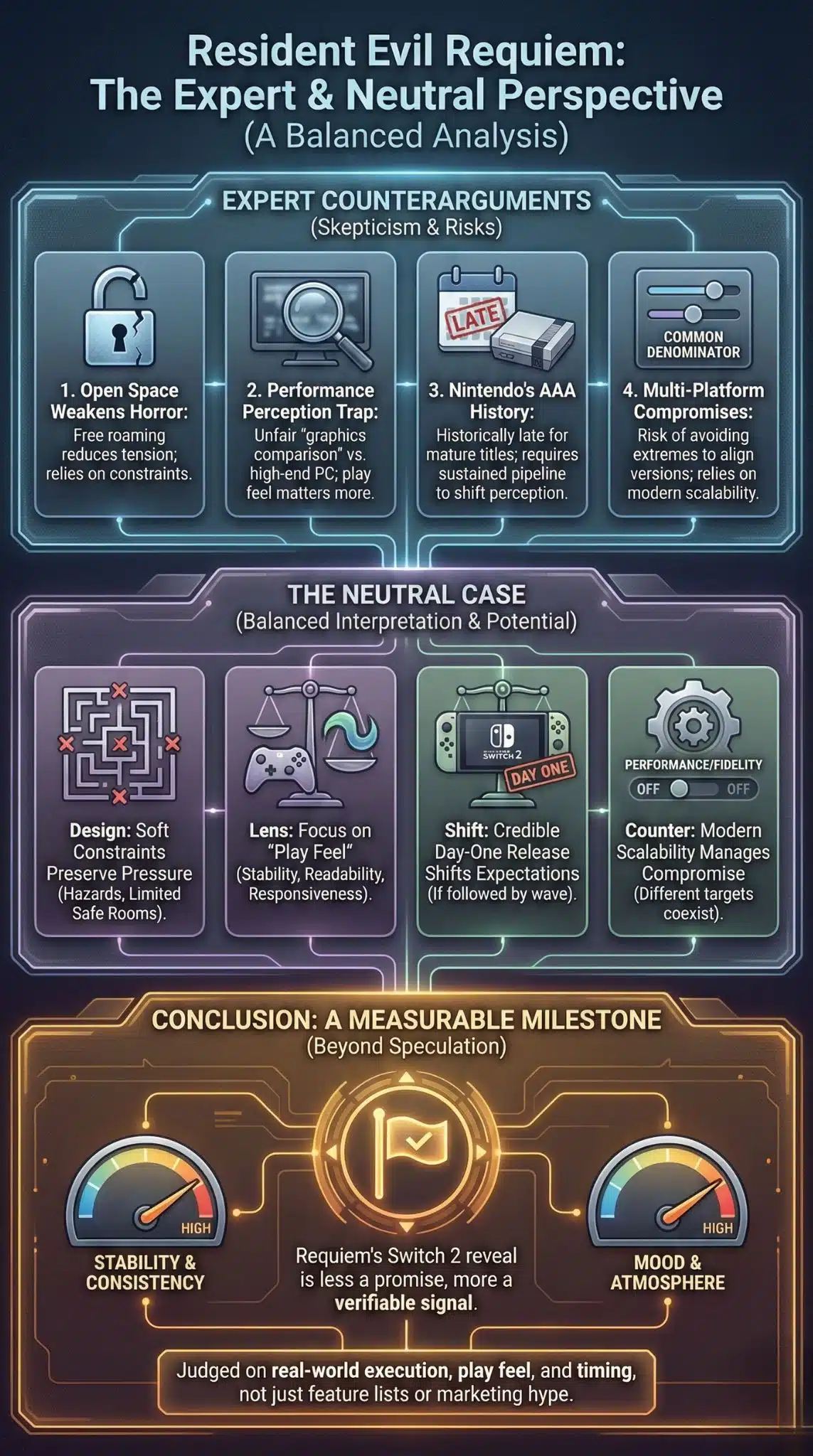
Expert Perspectives And The Neutral Case
A forward-looking analysis should also acknowledge legitimate counterarguments.
Counterargument 1: Open Space Can Weaken Horror
If players can roam freely, tension can drop. The genre thrives on constraint. The neutral interpretation is that Capcom will likely design “soft constraints” rather than remove constraint entirely. Environmental hazards, blocked routes, limited safe rooms, and roaming threats can preserve pressure even when the map is larger.
Counterargument 2: Performance Perception Can Become A Narrative Trap
If the conversation becomes a pure “graphics comparison,” the Switch 2 version could be framed unfairly against high-end PC marketing. The better lens is play feel: stability, readability, and responsiveness. Horror is less about pixel peeping and more about whether the game’s timing and atmosphere hold.
Counterargument 3: Nintendo Platforms Have Historically Been Late For Mature AAA
That history exists, but Switch 2 is attempting to change it. A credible day-one release from a publisher like Capcom can shift expectations, but only if it is followed by a broader wave. One flagship can prove capability, but a steady pipeline proves a market.
Counterargument 4: Multi-Platform Launches Can Create Compromises
When a game targets many platforms, designers sometimes avoid extremes to keep versions aligned. The counter to that is modern scalability: different lighting modes, different performance targets, and different streaming budgets can coexist. The risk is real, but so is the industry’s growing sophistication in managing it.
The balanced conclusion is that Requiem’s Switch 2 “Open City” reveal matters less as a promise and more as a measurable milestone. It will be judged on stability and mood, not just on feature lists.
A Comparative View Of Who Benefits And Who Faces Pressure
| Stakeholder | Potential Upside | Main Risk |
| Capcom | Bigger launch footprint and new portable-first audience | If performance is uneven, discourse can overshadow design |
| Nintendo | Proof of day-one AAA parity | Higher expectations for storage, patches, and pricing |
| Players | Portable access to flagship survival horror | If compromises are visible, immersion suffers |
| Other publishers | A roadmap for hybrid AAA feasibility | If Requiem struggles, it can discourage investment |
What Comes Next
Resident Evil Requiem’s release window is close enough that the next phase is about verifiable signals, not speculation. Here are the milestones that will actually determine the broader impact.
1) Hands-On Performance Coverage
The first sustained hands-on previews will answer the only question that matters for Switch 2’s AAA narrative: does the “Open City” segment feel stable in real play? Look for commentary on frame pacing, traversal smoothness, and consistency of darkness and contrast.
2) Demo Strategy
If Capcom releases a public demo and includes Switch 2, that will be a confidence signal. If the demo is absent on Switch 2 while present elsewhere, it may indicate last-mile optimization concerns.
3) Packaging And Patch Cadence
Hybrid platforms magnify distribution friction. Large day-one patches, heavy storage requirements, or inconsistent update schedules can shape consumer sentiment. For an atmospheric horror release, “I had to wait two hours to play” is not a great opening experience.
4) The Follow-On Wave
If Requiem lands well, the bigger question becomes what other publishers do next. Success turns an outlier into a template. A strong Switch 2 launch version would encourage more day-one parity bets across genres, not only horror.
5) Design Copycats And Genre Drift
If “Open City” horror works, expect more horror games to move toward city-scale systemic environments. That does not mean every game becomes open world. It means more games will attempt to create fear in spaces that feel alive, navigable, and unpredictable.
Here are clearly labeled predictions, not promises:
- Analysts may treat Resident Evil Requiem Switch 2 as a proof point that hybrid hardware can host modern flagship releases without cloud dependence.
- If Capcom’s city structure preserves tension, survival horror may continue drifting toward systemic urban environments, with more dynamic threat behaviors and less reliance on pure corridor design.
- If the portable version is praised for stability and readability, it could shift consumer expectations, making “handheld mode performance” a mainstream review pillar for AAA.