Many rural homes lack fast internet. They watch spinning wheels on videos. They struggle with slow digital subscriber line service. This gap in high-speed internet hurts families, farms, and small shops.
Fixed wireless beams service from a base station or mobile tower, and 5G technology boosts speeds past 100 Mbps. The USDA ReConnect Program pays to build more wireless sites in remote zones.
Here are the top reasons fixed wireless broadband is taking over rural America. You will learn how to cut costs, boost speed, and close the digital divide. Read on.
Key Takeaways
- Fixed wireless taps existing cell towers and base stations. It avoids trenching and cabling costs. The USDA ReConnect Program and FCC loans and grants top $1 billion to build sites in rural counties.
- Providers mount 5G base stations on hills and old towers in weeks. They deliver 100 Mbps–1 Gbps speeds, so rural towns get fiber-like connections fast.
- Aircom’s ASSET tool plans microwave paths over 30 miles. Engineers use beamforming and Massive MIMO. The FCC set up a USDA task force in June 2019 to steer rural 5G growth.
- Farmers link IoT sensors and drones for precision agriculture. Clinics stream telehealth at 80 Mbps. Schools beam live lessons. Remote workers upload reports from barns or cabins.
- The FCC allocates spectrum in the Citizens Broadband Radio Service. Regional operators like Midco expand networks. Only 1.5% of urban Americans lack 25/3 Mbps fixed broadband, but fixed wireless cuts rural gaps.
Cost-Effective Deployment in Rural Areas
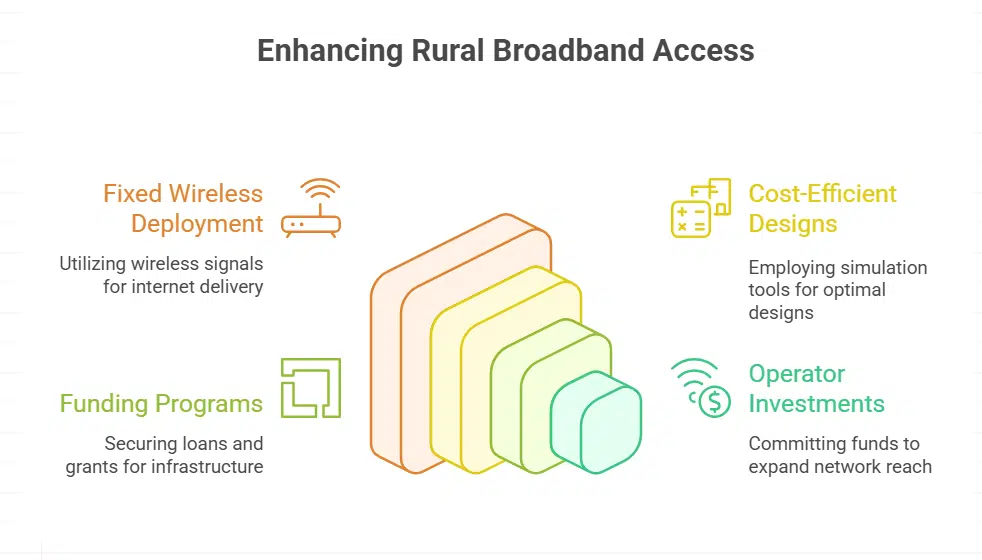
Fixed Wireless Internet uses wireless signals to deliver high-speed internet to homes, schools, and businesses in rural America. This approach taps existing cell towers and base stations, avoiding high trenching and cabling costs.
It links customers to nearby base stations via wireless infrastructure, boosting internet access and connectivity at low cost. Only 1.5% of urban Americans lack fixed terrestrial broadband at 25/3 Mbps, a stark contrast with rural broadband gaps.
FCC data shows rural areas still face low ROI issues that once halted wireline expansion.
Aircom uses ASSET, a simulation tool, to create cost-efficient fixed wireless designs. The Rural Development Broadband Reconnect Program awards loans and grants for broadband infrastructure in eligible rural counties.
Regional cable operator Midco commits funding to expand wireless network reach in underserved communities.
Rapid Expansion with 5G Technology
5G waves spread across rural landscapes like a spear cutting fog. Fixed wireless broadband springs up within weeks, it brings high-speed internet fast. Providers mount base station hardware on hills and old towers.
Aircom’s ASSET software charts microwave paths, it fine-tunes link budgets. It scales with ease, it links to any vendor kit. Rural towns grab new internet services, they hit fiber broadband speeds between 100 Mbps and 1 Gbps.
Remote areas ditch slow satellites and fix their digital divide with a solid broadband connection.
Congress kicked off the ReConnect Program with more than one billion dollars for unserved regions. The federal communications commission (FCC) set up a task force in June 2019, it teams with the U.S. Department of Agriculture.
That team boosts precision agriculture and organic farming, it drives smart farming sensors over 5G. Farmers steer iot devices and drones while crop production data zooms to smartphones.
Clinics tap telehealth services, they stream scans and patient files in real time. Teachers beam lessons, kids log on without lag. Households open doors to remote work and new economic development paths.
Reliable and High-Speed Connectivity for Remote Locations

Fixed wireless internet links farms, schools, clinics, even forests to high-speed internet. Engineers tie backhaul networks to signal towers, they beam signals across 30 miles using beamforming and Massive MIMO.
Farmers drop smart probes in fields, they monitor moisture live on a laptop for precision agriculture. Clinics run telehealth services at 80 Mbps, they counsel folks fighting opioid issues.
Residents in rural communities bridge the digital divide, they order medical supplies from their living rooms.
Local schools stream classes in real time, they host coding labs for teen learners. Small shops open online stores on fixed broadband, they ship crafts across state lines. Remote workers log in on a cell signal, they file reports from barns or cabins.
FCC allocates spectrum in Citizens Broadband Radio Service, it fuels wireless infrastructure and boosts internet access. Communities win rural internet access, they join the digital economy with confidence.
Takeaways
Rural towns get fast links with fixed wireless broadband on 5G towers. Providers set up base stations fast, so crews skip cable digs. Kids join online classes, clinics host video visits, farms run precision agriculture apps.
ASSET plans each network, it maps coverage and cuts cost. This boost will lift jobs, health care, and learning in small towns.
FAQs
1. What is fixed wireless broadband?
Fixed wireless broadband uses radio waves to link a base station to homes in rural communities. It delivers high-speed internet without laying new fiber cables.
2. Why is it a game changer for rural America?
Many areas lack broadband or solid mobile data. This tech, like a secret weapon, pulls out all the stops to bridge the digital divide fast.
3. How does fixed wireless broadband help rural healthcare?
Local clinics can run telehealth services without long waits, share patient data with the forest service labs, and tap into usda’s networks.
4. Can this tech boost agriculture and food systems?
Yes, it lets farmers use precision agriculture tools, check agroforestry tips online, link to nutrition aid program data, and track breeding in real time.
5. Will it drive economic development and remote work?
Absolutely. It fuels rural development, lets remote work flow smoothly, opens doors for environmental services projects, and helps small shops reach buyers online.
6. How does it stack up to broadband and satellite broadband?
Fixed wireless internet needs less new broadband wiring, spins up faster than satellite broadband, uses a simple modem, and taps into white space in the air.