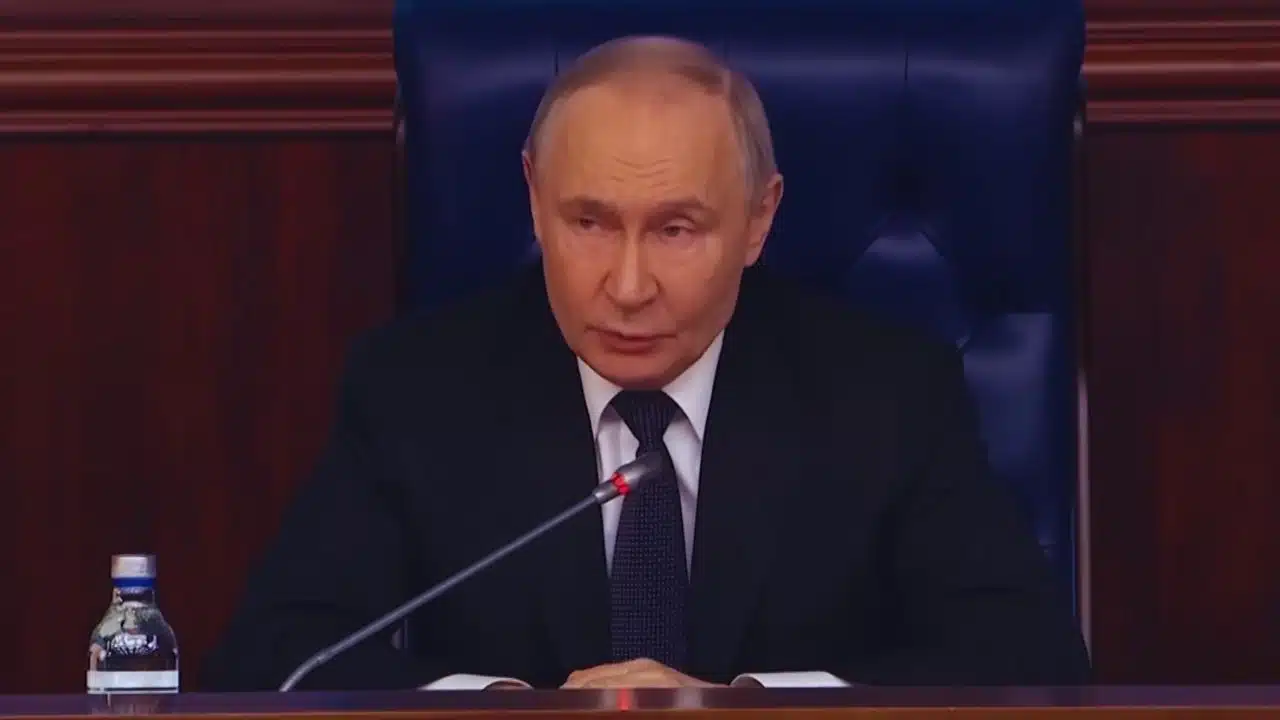
Putin rejects compromise on Ukraine as Moscow restated its hardline demands this week, even while US and Russian delegations planned fresh talks in Florida and Ukraine pressed for security guarantees to end the war.
Putin’s position: what “no compromise” means in practice?
Russia’s public line has stayed consistent: any settlement must reflect Moscow’s claimed territorial gains and address what it describes as the “root causes” of the conflict—especially Ukraine’s security alignment with the West. In recent remarks, the Kremlin again signaled it is not prepared to trade away its key demands for a quick ceasefire. Those demands, as repeatedly framed by Russian officials, revolve around three pillars: territory, Ukraine’s future military posture, and the security architecture in Europe.
A core point is territory. Russia maintains claims over four Ukrainian regions it says it has annexed, in addition to Crimea, which it seized in 2014. Ukraine and most of the international community reject these claims, arguing that borders cannot be changed by force. That disagreement is not just symbolic: it shapes everything from ceasefire lines to who governs cities, who controls resources, and where displaced people could safely return.
The second pillar is Ukraine’s long-term alignment. Russia has repeatedly opposed Ukraine’s drive toward NATO. Ukraine, meanwhile, has pursued NATO membership for years and has embedded that ambition into its political direction. Kyiv argues that credible security guarantees are essential because earlier arrangements and diplomatic processes failed to prevent renewed attacks.
The third pillar is enforcement. Even if negotiators drafted a ceasefire or peace framework, it would still require enforcement mechanisms—monitoring, guarantees, and consequences for violations. This is where negotiations become especially difficult: Moscow often frames outside guarantees as unacceptable “foreign military presence,” while Ukraine and several European governments argue that any deal without credible enforcement risks becoming a pause before another round of fighting.
Key negotiating gap at a glance
| Issue | Russia’s stated direction | Ukraine’s stated direction | Why it’s hard to bridge |
| Territory | Recognition of Russia’s claimed control | No territorial concessions | Both sides treat territory as non-negotiable |
| NATO / alignment | Blocking NATO path | Keeping sovereign right to choose alliances | Russia sees NATO as a threat; Ukraine sees NATO as protection |
| Security guarantees | Limits on Western role | Strong guarantees to deter future attacks | Guarantees require commitments others must be willing to enforce |
| Enforcement | Skepticism of foreign forces | Preference for robust monitoring and backstops | Enforcement can look like “occupation” to one side, “insurance” to the other |
The Florida talks: who is meeting, and what they are trying to achieve?
A new round of meetings in Florida has become the latest focal point in the diplomatic push to end the war. The current track reflects a reality that has shaped the conflict since 2022: even when battlefield dynamics shift, the war’s endpoint still depends on political decisions that only Kyiv and Moscow can ultimately accept.
According to the outlines shared publicly by officials and widely reported this week, the Florida contacts follow a sequence:
- US consultations with Ukrainian and European counterparts to align positions.
- A separate US–Russia meeting intended to test whether Moscow will engage beyond broad talking points.
- Ongoing drafting work around security guarantees and postwar recovery arrangements.
Ukraine’s delegation has said the discussions are focused on long-term security guarantees and a broader framework, including a reconstruction component. Officials have described work on multiple documents rather than a single “one-shot” peace deal.
That detail matters. In many negotiations, complex settlements are broken into packages—security, territory, economic recovery, and legal steps—because agreement tends to be uneven. One side may accept a security framework while rejecting territorial terms, or support reconstruction planning while disputing enforcement mechanisms.
But the Florida meetings also come with clear limitations. First, there is no sign that the fundamental territorial dispute has softened. Second, there is no clear indication that direct Russia–Ukraine negotiations are imminent in this particular round. Third, even if diplomats agree on language, implementation would still require sustained political backing, parliamentary approvals in some countries, and long-term funding.
A short timeline of the latest diplomatic steps
| Date (2025) | Development | Why it matters |
| Dec. 15 | Western partners issued a joint statement emphasizing security guarantees and recovery support | Publicly anchors the “guarantees + recovery” approach |
| Dec. 19 | Ukraine began a new round of talks with the US | Pushes drafting work on guarantees and frameworks |
| Dec. 20 | US and Russian delegations scheduled to meet in Florida | Tests whether Moscow is open to terms beyond demands |
The immediate question hanging over these meetings is simple: can diplomacy move from declarations to trade-offs? If Moscow continues to insist on territorial recognition and a restricted Ukrainian security future, and if Kyiv continues to reject territorial concessions, the talks may still be useful—but mostly as a way to manage escalation, exchange proposals, and map red lines rather than close a deal.
Security guarantees and Western support: what’s on the table?
Security guarantees are the centerpiece of the current diplomatic push because they are the bridge—at least in theory—between Ukraine’s refusal to surrender territory and Russia’s demand that Ukraine not become a Western military outpost.
In mid-December, US and European leaders publicly committed to work together on “robust security guarantees” and economic recovery support for Ukraine in the context of an agreement to end the war. One notable detail in that joint statement was the idea that Ukraine’s armed forces should remain at a peacetime level of 800,000 to deter future conflict and defend territory.
That number is striking because it suggests planners are not talking about a small postwar force. They are describing a large, capable military designed to make renewed aggression costly. For Ukraine, this aligns with the belief that deterrence must be built into any settlement. For Russia, a large Ukrainian force—especially if trained and supplied by Western partners—could be viewed as incompatible with Moscow’s security demands.
Western support is not only about weapons. It also includes training, intelligence cooperation, budget support, and recovery planning. The scale is enormous, and it shapes negotiating leverage. If Ukraine’s backers signal sustained support, Kyiv may feel less pressure to accept unfavorable terms. If support looks uncertain or fragmented, Ukraine may face stronger incentives to consider compromises—though Ukrainian leaders have repeatedly said sovereignty and territory are not bargaining chips.
Snapshot: major public support and recovery figures often cited in planning
| Area | Figure | What it indicates |
| Ukraine armed forces “peacetime level” concept | 800,000 | A deterrence-focused model rather than a minimal postwar force |
| US military assistance totals (publicly stated in official fact sheets in 2025) | Over $66B since Feb 2022 (varies by definition and reporting window) | Sustained, large-scale defense support |
| Estimated reconstruction and recovery needs (as of end-2024 damage assessment) | $524B over 10 years | The scale of rebuilding if fighting ends or stabilizes |
The reconstruction number underlines another reality: even if active combat slows, Ukraine’s recovery challenge will dominate policy for years. Roads, bridges, housing, power stations, schools, hospitals, and industrial sites have been damaged or destroyed across wide areas. Reconstruction planning is not only humanitarian—it is strategic. A credible recovery path can stabilize Ukraine’s economy, reduce migration pressures, and strengthen resilience against future coercion.
At the same time, reconstruction planning also raises hard questions:
- Who pays, and on what timeline?
- How are funds protected from corruption and mismanagement?
- How does rebuilding proceed if parts of the country remain contested or under occupation?
- What happens to reconstruction projects if a ceasefire collapses?
These questions matter because they shape whether peace plans look realistic to citizens. A ceasefire without a credible recovery model can feel like a pause with no future. A recovery plan without security guarantees can look like rebuilding targets for the next strike.
The war’s impact on civilians: why diplomacy is under pressure?
While diplomats talk, civilians continue to bear the brunt of the war. Monitoring by UN human rights teams has documented high civilian casualty levels in late 2025, driven by a mix of frontline fighting, drone attacks, and long-range strikes.
For November 2025, UN monitoring documented at least 226 civilians killed and 952 injured. From January to November 2025, the same monitoring recorded 2,311 killed and 11,084 injured, notably higher than comparable periods in 2024 and 2023.
The numbers are not just statistics; they reflect a pattern in how the war harms people. Casualties are often concentrated in two settings:
- Near-frontline communities, where artillery, drones, and short-range strikes create daily danger
- Cities and towns deeper inside Ukraine, where long-range missiles and drones can hit residential buildings and critical infrastructure
Infrastructure attacks add a second layer of suffering. Strikes on energy systems can lead to widespread power cuts, disruptions to heating and water supply, and cascading damage that affects hospitals, transport, and basic services. In winter, this becomes a direct risk to life, particularly for older people, children, and those with limited resources.
Diplomatically, civilian harm creates urgency—but it can also harden positions. Ukraine argues that civilian deaths demonstrate why security guarantees must be strong and enforceable. Russia often responds by defending its campaign or shifting blame, and by insisting its conditions address what it describes as the conflict’s underlying causes.
Civilian impact snapshot from late 2025 monitoring
| Period | Killed | Injured | What the pattern shows |
| October 2025 | 148 | 929 | High, sustained monthly toll |
| November 2025 | 226 | 952 | Continued high casualties; long-range attacks a major driver |
| Jan–Nov 2025 | 2,311 | 11,084 | A heavy annual toll and rising trend versus prior years |
The human toll is one reason international actors keep pushing diplomatic tracks even when progress looks unlikely. Leaders do not need to believe a deal is imminent to believe talks are worth attempting—especially when the alternative is an open-ended war with rising casualties and deepening economic damage.
What happens next, and what would count as a breakthrough?
The next immediate test is whether the Florida meetings produce anything more than familiar positions. A real breakthrough would likely require movement on at least one of these fronts:
- A credible ceasefire structure
That would include monitoring, verification, and clear definitions—where forces stop, what weapons are restricted, and how violations are handled.
- A security guarantee package that is strong enough for Ukraine and politically feasible for partners
The idea of “robust guarantees” sounds straightforward, but it can involve commitments that governments and parliaments must be willing to sustain for years.
- A phased approach on contested issues
If territory cannot be resolved immediately, negotiators could attempt phased arrangements—though history shows these are fragile without strong enforcement.
- A reconstruction plan linked to stability
Recovery funding can be tied to governance reforms, transparency measures, and staged delivery, but it still depends on security conditions.
Right now, the biggest obstacle remains the same Moscow’s hardline territorial and alignment demands collide with Kyiv’s refusal to cede land and its insistence on enforceable security. Without shifts on those fundamentals, diplomacy may continue—yet function more as conflict management than conflict resolution.
Still, negotiations can matter even without an immediate deal. They can reduce misunderstandings, open channels for prisoner exchanges and humanitarian arrangements, and establish frameworks that become useful if battlefield or political realities change.