

Hey there, are you a logistics pro struggling to keep up with crazy demand swings or shipment delays? It’s like trying to hit a moving target, right? Every day, you’re juggling inventory management, guessing customer needs, and praying deliveries arrive on time.
The stress can pile up fast, and mistakes in cargo planning can cost a bundle.
Here’s a cool fact to chew on: a whopping 80% of third-party logistics providers are now betting big on predictive analytics tools that tap into Internet of Things data. That’s a game-changer for supply chain management.
In this blog, we’re breaking down the Top 10 Predictive Analytics Platforms For Logistics Companies to help you tackle those bottlenecks. We’ll show you tools that boost demand forecasting and ramp up operational efficiency with smart data analysis.
Stick around; you’ll want in on this!
Key Takeaways
- SAP Integrated Business Planning (IBP) earns a high rating of 4.4 out of 5 from 42 reviews, helping logistics with demand forecasting and real-time data.
- Oracle Transportation Management, rated 4.1 out of 5 from 4 reviews, boosts route optimization and cuts costs for smoother goods movement.
- Blue Yonder TMS scores 4.3 out of 5 from 7 reviews, using predictive analytics to avoid supply chain disruptions with historical data.
- Kinaxis RapidResponse, rated 4.0 out of 5 from 13 reviews, predicts supply and demand weeks ahead for better inventory control.
- Tableau, with a 4.3 out of 5 rating from 87 reviews, simplifies data visualization for logistics trend spotting and forecasting.
SAP Integrated Business Planning (IBP)
SAP Integrated Business Planning, or IBP, stands out as a top tool for logistics companies aiming to elevate their supply chain performance. It’s earned a strong rating of 4.4 out of 5 from 42 reviews, which highlights its dependability.
This platform simplifies demand forecasting and inventory management, leveraging real-time data to keep operations seamless.
Consider IBP your reliable partner in the dynamic field of supply chains. It provides customized solutions, such as optimizing for Just-In-Time delivery, ensuring your shipments remain on schedule.
With improved supply chain visibility, it reduces late deliveries and supports meeting service level agreements. Embrace data-driven decision-making with this valuable tool, and see your operations thrive!
Oracle Transportation Management

Oracle Transportation Management is a powerful tool for logistics companies looking to boost their operations. It helps with route optimization and demand forecasting, making sure goods move smoothly.
With a solid rating of 4.1 out of 5 from 4 reviews, this platform shows it can deliver results. Imagine your trucks always taking the shortest path, saving time and cutting costs, kinda like finding the best shortcut on a road trip!
This system also ties in real-time data to keep everything on track. It supports supply chain visibility, so you know where your shipments are at any moment. Plus, it aids in predictive analytics to foresee issues before they pop up.
Think of it as a crystal ball for your logistics needs, helping dodge supply chain disruptions. Now, let’s move on to see how Blue Yonder TMS stacks up in this game!
Blue Yonder TMS
Hey there, folks, let’s talk about Blue Yonder TMS, a leading solution in supply chain management for logistics companies. This tool stands out with an impressive rating of 4.3 out of 5 from 7 reviews, which highlights its dependability.
It supports route optimization and enhances supply chain visibility, making your operations run as smoothly as a finely tuned engine.
Now, envision avoiding supply chain disruptions effortlessly, thanks to real-time data and predictive analytics. Blue Yonder TMS leverages historical data analysis to anticipate demand changes and sharpen decision-making.
Stay with this platform, and see your logistics performance reach new peaks with improved resource allocation.
Kinaxis RapidResponse
Kinaxis RapidResponse shines as a top tool for logistics companies. It helps you plan your supply chain with speed and smarts. With a solid rating of 4.0 out of 5 from 13 reviews, it’s clear that users trust its power.
This platform uses real-time data to spot supply chain disruptions before they hit. Pretty neat, right?
Imagine dodging delays like a pro, thanks to sharp demand forecasting. Kinaxis Maestro, a key feature, lets you predict supply and demand weeks or even months ahead. This means better inventory management and less waste.
If you’re in logistics, this tool can boost your game with data-driven decision-making. Let’s chat, how cool is that for keeping your operations smooth?
Alteryx AI Platform
Hey there, folks, let’s talk about the Alteryx AI Platform, a true standout for logistics companies exploring predictive analytics. This tool earns a strong 4.0 out of 5 from 15 user ratings, which proves it has a solid reputation.
What’s great about it? Alteryx provides a code-free setup, so you don’t need to be a tech expert to get started. It integrates machine learning seamlessly into the process, assisting with tasks like demand forecasting and inventory management.
Now, think of this as your reliable partner for data analytics. Alteryx makes handling numbers effortless, whether you’re forecasting sales or identifying trends with historical data.
It’s all about delivering clear insights for supply chain optimization. Plus, with machine learning models included, it supports route optimization and even improves customer retention.
Stay with this platform, and you’re headed for smarter, data-driven decisions!
Tableau
Tableau stands out as a leading tool for logistics companies exploring predictive analytics. It holds an impressive rating of 4.3 out of 5, drawn from 87 user reviews, which highlights its dependability.
Supported by Salesforce, this platform simplifies data visualization, enabling you to identify trends in supply chain management effortlessly. You can examine both historical and real-time data to improve demand forecasting and route optimization.
Have you ever attempted to transform chaotic numbers into a coherent image? Tableau accomplishes this with an intuitive interface, ideal for teams without data science expertise. It facilitates data-driven decision-making, allowing you to address inventory management or anticipate supply chain disruptions.
Eager to explore its compatibility with other tools? Let’s proceed to Microsoft Azure Machine Learning next.
Microsoft Azure Machine Learning
Hey there, wanna know how Microsoft Azure Machine Learning can boost your logistics game? This powerful tool uses smart algorithms to crunch real-time data and predict supply chain hiccups before they even happen!
H2O. ai
H2O.ai emerges as a formidable solution for logistics companies exploring predictive analytics. This open-source, cloud-based platform provides exceptional time-series forecasting.
It enables you to anticipate demand changes and identify trends with real-time data. Envision detecting a supply chain issue before it arises, much like a weather prediction for your operations! With machine learning algorithms, H2O.ai processes historical data to create precise predictive models.
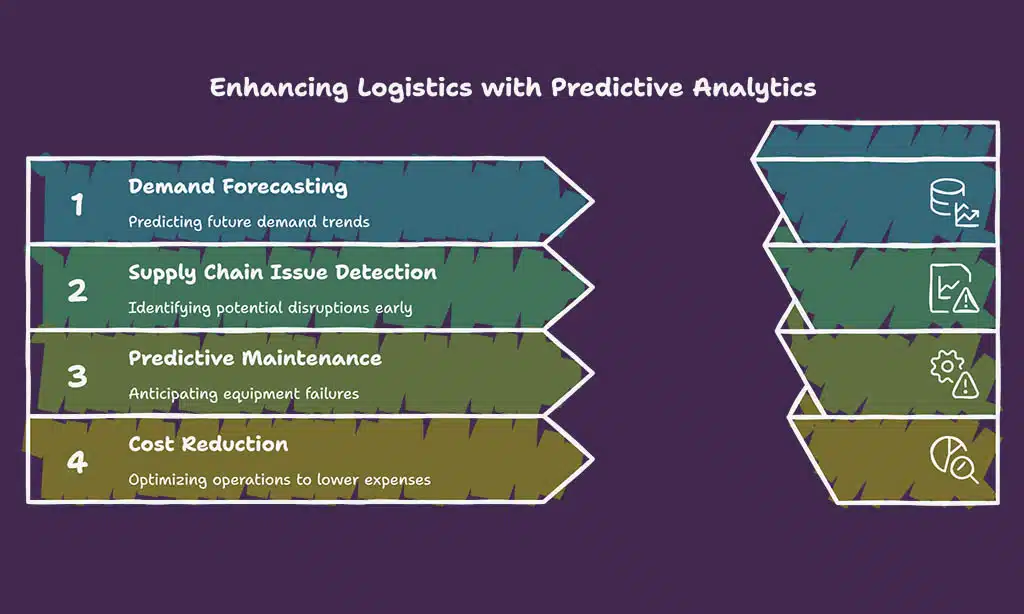
Explore its capabilities, and you’ll notice how it enhances supply chain visibility. It leverages artificial intelligence to aid in predictive maintenance, identifying equipment problems early.
This results in reduced downtime and increased uptime for your equipment. For logistics professionals, it’s like having a reliable partner for data-driven decision-making. Looking to reduce costs and boost efficiency? Try this platform, and see your inventory management receive a significant improvement.
Qlik Sense
Qlik Sense is a fantastic tool for logistics companies exploring predictive analytics. It helps you analyze data with ease, using sharp visuals to spot trends in your supply chain.
Imagine turning complex historical data into clear charts, almost like solving a puzzle with a simple trick. With this platform, real-time data becomes your best ally, guiding you to smarter choices on inventory management.
Got a hunch about demand forecasting? Qlik Sense uses machine learning to support it, making predictions sharper than a tack. It blends data integration seamlessly, so your team can focus on route optimization without any trouble.
Hey, if you’re aiming to cut costs and improve supply chain visibility, this tool stands by you with advanced analytics. Stick with it, and watch your decision-making become data-driven in a snap.
Manhattan Associates Supply Chain Solutions
Hey there, readers, let’s chat about Manhattan Associates Supply Chain Solutions. This platform is a game-changer for logistics companies aiming to boost their game with predictive analytics.
It helps with supply chain management by using real-time data to spot trends. Think of it as a crystal ball, showing you how to dodge supply chain disruptions before they hit.
Got inventory headaches? Manhattan Associates tackles those with smart tools for inventory management and demand forecasting. Their system pulls from historical data to predict demand fluctuations, keeping your shelves just right.
Plus, it offers supply chain visibility, so you’re never in the dark about what’s moving where. Stick around to see how it fits your needs!
Features to Consider in Predictive Analytics Platforms
Hey there, wanna know what makes a predictive analytics platform stand out for logistics? Let’s chat about a couple of key things, like how easy it is to grow with your business, and a simple design that anyone on your team can pick up fast!
Scalability and flexibility for growing logistics needs
Logistics can feel like a wild ride, can’t it, folks? Imagine handling data that’s set to hit a staggering 175 zettabytes by 2025. That’s a mountain of info for supply chain management! Platforms with strong scalability can grow with your business, managing huge amounts of historical data and real-time data without breaking a sweat.
It’s like having a truck that expands its cargo space as you load more goods.
Think about flexibility as your secret weapon in supply chain optimization. A solid predictive analytics tool adapts to your needs, whether you’re tweaking inventory management or boosting route optimization.
With user-friendly interfaces and human-in-the-loop feedback, these systems make adoption a breeze for your team. Tools like SAP Integrated Business Planning and Microsoft Azure Machine Learning stand out here, helping you tackle growing logistics demands with ease.
User-friendly interface for ease of adoption
Hey there, logistics folks, let’s talk about something that can simplify your work significantly. A user-friendly interface in predictive analytics tools is like having a reliable map on a long haul.
It clears up the confusion, helping you adopt these platforms with ease. With straightforward designs, you can explore supply chain predictive analytics and start using features like demand forecasting or route optimization immediately.
Isn’t it fantastic to have tools that connect effortlessly with your team? These interfaces, created with human-in-the-loop feedback, prioritize a seamless user experience. They make data visualization and data-driven decision-making simple, even if you’re not a data scientist.
So, whether you’re managing inventory or addressing supply chain disruptions, an easy setup gets you started quickly.
Benefits of Predictive Analytics in Logistics
Hey there, wanna know how predictive analytics can supercharge your logistics game? Stick with me, and let’s explore the awesome perks it brings to the table!
Enhanced demand forecasting accuracy
Let’s talk about how predictive analytics enhances demand forecasting accuracy for logistics companies. Imagine you’re estimating how much stock you’ll need next month, and instead of relying on a random guess, you have reliable data supporting your decisions.
Predictive solutions analyze historical shipment data, identify patterns, and even account for external factors like trends or seasonal changes. This leads to reduced uncertainty and greater accuracy in managing your inventory.
Now, consider the advantage this provides. With such tools, supply chain visibility gets better, allowing you to avoid overstocking or stockouts. It’s like having a glimpse into the future, but it’s driven by actual data and intelligent machine learning algorithms.
As a result, you minimize waste, lower costs, and ensure your customers receive on-time deliveries. Isn’t that impressive?
Improved operational efficiency and cost reduction
Moving from better demand forecasting, let’s talk about how predictive analytics boosts operational efficiency and slashes costs for logistics companies. It’s like having a crystal ball that shows you exactly where to cut waste and save money.
With tools like predictive maintenance, powered by AI, you can spot equipment issues before they break down, maximizing uptime and avoiding pricey repairs. This means fewer delays and happier customers, all while keeping your budget in check.
Picture your trucks running smoother with route optimization, a gem from predictive analytics. It cuts down on empty miles and transport emissions, saving fuel and reducing your carbon footprint.
By using real-time data and historical data analysis, platforms help with supply chain optimization, ensuring resources are used smartly. So, you’re not just moving goods; you’re doing it faster, cheaper, and greener with the power of machine learning and data-driven decision-making.
Takeaways
Hey there, logistics fans, let’s wrap this up with a bang! Predictive analytics is your secret weapon, helping you stay ahead in the fast-paced supply chain game. Imagine dodging disruptions before they hit, thanks to tools like SAP Integrated Business Planning and Blue Yonder TMS.
These platforms turn data into pure gold, boosting your decision-making power. So, dive right in, and watch your operations soar to new heights!
FAQs on Predictive Analytics Platforms For Logistics Companies
1. What are predictive analytics platforms for logistics companies all about?
Hey, let’s break this down. These platforms use predictive analytics, machine learning algorithms, and historical data analysis to help with supply chain management. They’re like a crystal ball, showing logistics folks how to dodge supply chain disruptions with data-driven decision-making.
2. How do these tools help with inventory management?
Picture this, you’ve got a warehouse full of goods, and predictive analytics tools step in to save the day. They use demand forecasting and real-time data to keep your inventory just right, so you’re never overstocked or scrambling for products.
3. Can predictive analytics improve route optimization?
Absolutely, they can! By tapping into data mining and advanced analytics, these platforms map out the best paths for your trucks, cutting time and costs in supply chain optimization like a hot knife through butter.
4. What role does machine learning play in these platforms?
Well, machine learning, or ML as the tech wizards call it, is the secret sauce here. It powers predictive models with techniques like regression analysis and decision trees, helping data scientists spot patterns in historical data for better risk management. Plus, automated machine learning, often called AutoML, makes model deployment a breeze for logistics teams.
5. How do platforms like SAS Viya support supply chain visibility?
Listen up, SAS Viya from the SAS Institute is a game-changer. It blends cloud-based analytics with data visualization to give you a clear view of your supply chain, helping with everything from warehousing to risk assessment.































