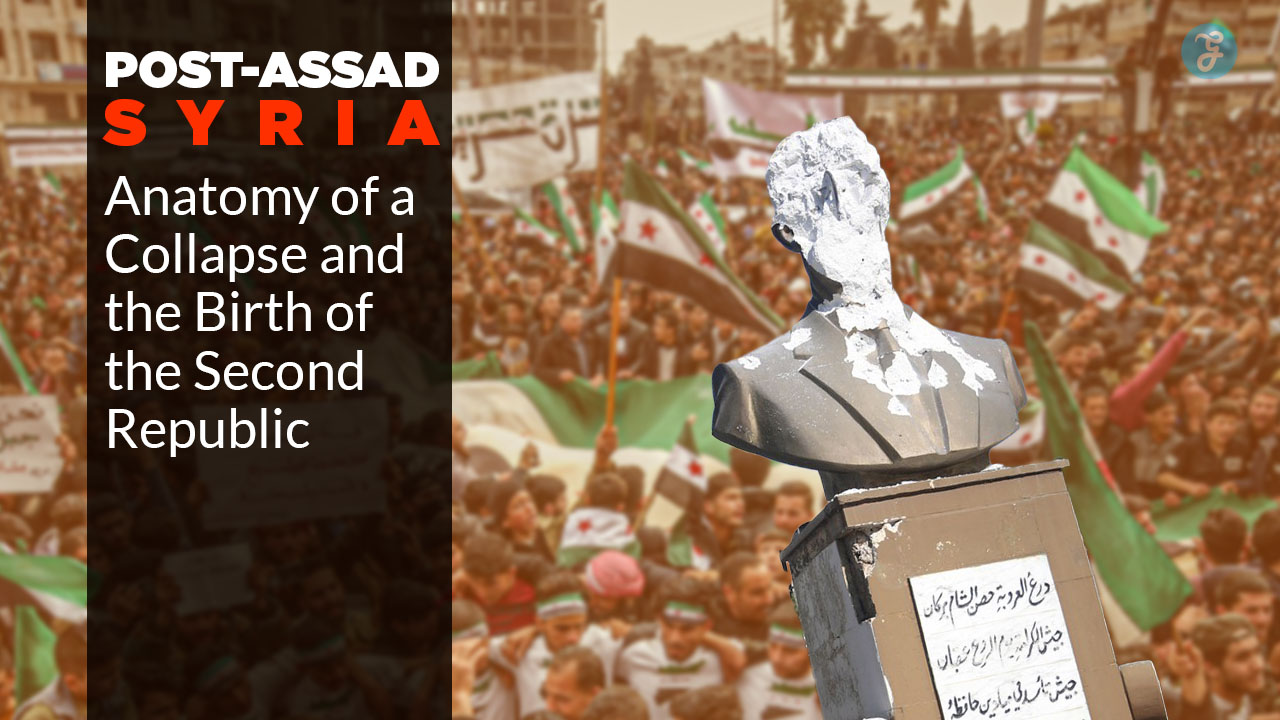
On the morning of December 8, 2024, the world woke up to a Middle East that had fundamentally changed overnight. The footage of Bashar al-Assad boarding a Russian Il-76 transport plane at Damascus International Airport, grainy, hurried, and devoid of the pomp that had defined his 24-year rule, marked the psychological end of the Ba’athist state.
But for those on the ground in Damascus, the “Fall” was not a singular moment of cinematic closure; it was the beginning of a suffocating, terrifying vacuum. The streets that had been plastered with the leader’s face for decades were suddenly bare, leaving a void that was equal parts euphoric and terrifying for a population that had known nothing but the Assad family’s grip for half a century.
This first part of our three-part series analyzes the anatomy of this collapse and the immediate, messy birth of the “Second Syrian Republic”, the post-Assad Syria transition. We examine how a former Al-Qaeda affiliate leader, Ahmed al-Sharaa (formerly Abu Mohammad al-Julani), managed to pivot from a designated terrorist to a suit-wearing head of state, and how the foundations of the current transitional government were laid not in the marble halls of the UN in Geneva, but in the gritty, backroom deals of Idlib and the “Shadow Government” that now rules Damascus.
Key Takeaways
- The “Fall” was a Collapse: The SAA died of exhaustion and Russian abandonment, creating a vacuum that HTS filled.
- No Prime Minister: Sharaa consolidated absolute power by eliminating the PM role, directly overseeing a cabinet split between technocrats and “Shadow Government” loyalists.
- The Idlibification of Damascus: The cultural friction between the conservative conquerors and the liberal capital remains the regime’s deepest social fault line.
- Legitimacy vs. Power: Sharaa has power (guns and money) but lacks broad legitimacy, relying on a 5-year “transition” to delay elections he might lose.
Defining the Collapse: A Systemic Implosion
Looking back from the vantage point of January 2026, the speed of the regime’s collapse seems almost inevitable. Yet, we must remember the sheer shock of those twelve days in December 2024. The “Damascus Dash,” as military historians now call it, was less a military conquest and more a systemic implosion. The Syrian Arab Army (SAA), a force that had once terrorized its own population with barrel bombs and chemical weapons, evaporated.
It did not fight for Damascus because, by late 2024, the “state” it defended was already a hollow shell, eaten away by corruption, Iranian overreach, and a Russian patron distracted by its own quagmire in Ukraine.
The Military Collapse: A Paper Tiger Burns [Dec 2024]
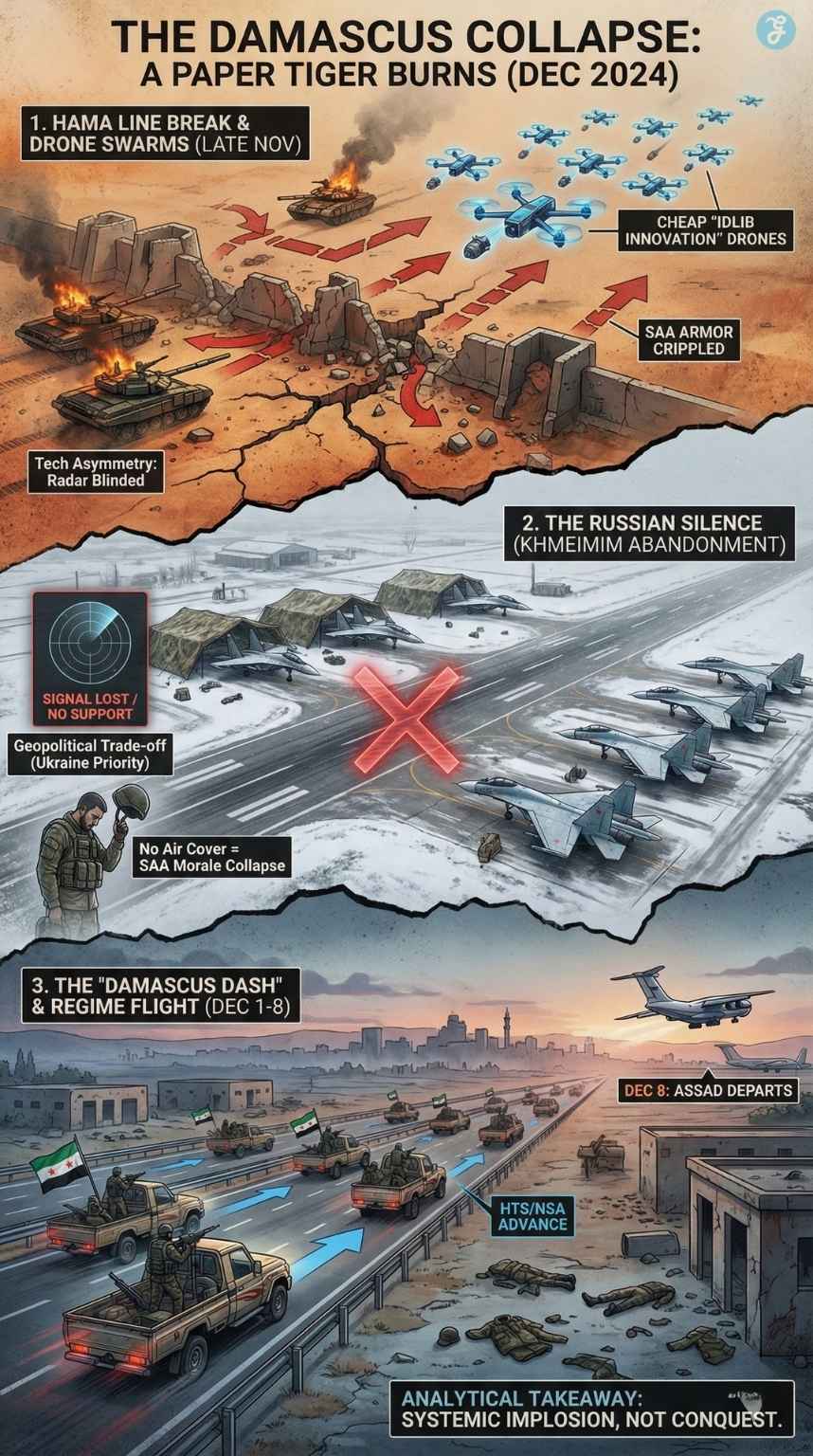
To understand the trajectory of the Transitional Government in 2026, one must first dissect the victory that birthed it. The offensive launched by Hay’at Tahrir al-Sham (HTS) and its allies in late November 2024 was expected to be a limited border skirmish. Instead, it exposed the fatal rot within the SAA’s defensive lines.
The “Idlib Innovation” and Drone Warfare
The pivotal factor was what analysts now call the “Idlib Innovation.” For years, HTS had been observing the war in Ukraine. They adapted cheap, commercial FPV (First Person View) drones into precision artillery. When the offensive began, the SAA’s heavy armor in the Hama countryside was not met with tanks, but with swarms of $500 drones that blinded radars and crippled T-72s.
The psychological impact was devastating. SAA conscripts, unpaid for months and led by officers who were the first to flee, abandoned their posts en masse. The “Hama Line,” fortified for a decade, fell in 48 hours. This technological asymmetry created a momentum that no one, not even Sharaa himself, had anticipated.
The Russian Betrayal
Perhaps the most critical variable was the silence from Khmeimim Air Base. For a decade, the Russian Air Force had been Assad’s guarantor. But in December 2024, with the frontlines in Eastern Ukraine buckling, Vladimir Putin made a cold, calculated geopolitical trade. Moscow judged that saving Assad again would require resources it no longer had. The Kremlin’s message to Damascus was clear: You are on your own.
This abandonment triggered a domino effect. Without Russian air cover, the “Tiger Forces” and the Republican Guard—reliant on air superiority, refused to engage in urban combat they knew they would lose. The regime’s collapse was a vertical disintegration; the head was cut off, and the body simply stopped moving.
The Race for the Capital
As the HTS-led “Military Operations Command” swept down from the north, a second front opened in the south. The “Southern Operations Room” in Daraa, dormant since 2018, mobilized. This created the “Damascus Dash”, a frenetic race between the Islamist factions of the north and the more secular, tribal factions of the south to reach Umayyad Square.
Sharaa, understanding the optics, ordered his forces to halt at the city limits and negotiated a “peaceful entry” with the terrified Damascus merchant elite. This masterstroke prevented a bloodbath but sowed the seeds of the north-south tension that plagues the government today. The capital was not taken; it was surrendered.
The Rebranding of a Warlord: The “Sharaa” Era Begins [Jan 2025]
The most remarkable phenomenon of the post-Assad era is the personal metamorphosis of its leader. In January 2025, the man known to the world as Abu Mohammad al-Julani officially ceased to exist. In his place stood Ahmed al-Sharaa, the “President of the Transitional Council.”
From Fatigue to Pinstripes
This was not merely a change of wardrobe. It was a sophisticated, PR-driven campaign to shed the “terrorist” label. Sharaa’s first public address from the Umayyad Mosque was not a sermon on jihad, but a nationalist speech referencing Syrian history, unity, and “civil peace.” He explicitly dissolved HTS as an organization, merging it into the new “Syrian Armed Forces.”
While Western intelligence agencies remained skeptical, the rebranding worked on the exhausted Syrian populace. They didn’t need him to be a democrat; they just needed him not to be ISIS. The imagery was carefully curated: Sharaa meeting with tribal elders, Sharaa inspecting bread factories, Sharaa in a suit and tie meeting with Turkish intelligence officers.
The “Sons of the Soil” Narrative
Sharaa played heavily on his Syrian heritage (unlike the foreign fighters of ISIS). He positioned himself as a “Son of the Soil” who fought against the foreign occupations of Iran and Russia. This nationalist pivot allowed him to court the Sunni urban class in Aleppo and Damascus, who had traditionally supported Assad out of fear of Islamists.
By promising to protect property rights and maintain the bureaucracy, Sharaa secured the acquiescence of the business community—a critical pillar for his survival. He offered them a simple deal: Accept my rule, and I will restore trade.
Diplomatic Triage
Behind the scenes, the role of Turkish Intelligence (MIT) was paramount. Turkey, eager to see the 4 million Syrian refugees on its soil return home, facilitated the transition. Ankara acted as the guarantor for Sharaa’s behavior, assuring the US and EU that the new government would not harbor transnational terrorists. This tacit “yellow light” from Washington allowed the transition to proceed without immediate Western intervention.
The Vacuum: Culture Clash and “Shadow Justice” [Jan – Feb 2025]
The period between Assad’s flight and the formation of the government in March was defined by a surreal “dual reality” in Damascus.
Two Cities, One Capital
For the residents of wealthy neighborhoods like Malki and Abu Rummaneh, life became a navigation of culture shock. The arrival of thousands of fighters from Idlib, rural, deeply conservative, and scarred by years of bombardment, clashed with the cosmopolitan lifestyle of the capital.
While Sharaa ordered his men to respect “personal freedoms,” incidents of “moral policing” were rampant. Cafes serving alcohol were “advised” to close; women were harassed for dress code violations. This “Idlibification” of Damascus created a deep psychological rift. The liberators were viewed by the urban elite not as heroes, but as uncouth occupiers.
Looting vs. The Leviathan
To prove he could govern, Sharaa unleashed a ruthless campaign against lawlessness. When looting broke out in the wealthy districts, Sharaa’s security forces (the General Security Service) executed looters on the spot, broadcasting the footage. It was a brutal message: The chaos of Iraq or Libya will not happen here.
However, this “order” came with a dark side. A “cleansing” of the deep state began. While a general amnesty was declared for army conscripts, officers from the notorious 4th Division and Air Force Intelligence vanished. The “Missing Persons Commission” set up later would find that many were summarily executed in the chaos of January.
The Constitutional Coup: March 2025
By February 2025, the honeymoon period of “liberation” was fading. The streets were safe, but the banks were closed, and the world was watching. Sharaa needed legitimacy. The international community pushed for the revival of the UN-led Constitutional Committee in Geneva. Sharaa ignored them.
The Death of Geneva
On March 1, 2025, Sharaa declared the Geneva process “dead and buried,” calling it a “relic of the era of weakness.” Instead, he convened a “National Dialogue Conference” in Damascus in mid-February. Critics noted that the invitees were carefully vetted. The Kurds (SDF) were invited, but under conditions that effectively demanded their surrender; they boycotted. The Druze leadership in Suwayda sent only observers.
The “March 13 Declaration”
The resulting document, the “Constitutional Declaration of 2025,” ratified on March 13, was a masterclass in authoritarian consolidation masked as transition.
- Source of Law: It established Islamic Sharia as “a primary source” of legislation—a nod to his base, but vague enough to allow for civil codes to remain.
- Presidential Supremacy: It granted the Transitional President (Sharaa) the power to appoint and dismiss the cabinet without parliamentary approval during the transition.
- The Transition Trap: By setting the transition period to five years (2025-2030), Sharaa effectively bought himself a half-decade of rule by decree before facing the electorate.
The Government of March 29: The Technocratic Mask
The cabinet announced on March 29, 2025, was a masterpiece of optical illusion. It was designed to look like a modern, technocratic administration to the West, while consolidating hard power in the hands of the “Idlib Clique.”
The Missing Prime Minister
Crucially, Sharaa broke with Syrian political tradition by abolishing the position of Prime Minister. Under the new system, the President holds direct oversight over all ministries. This centralization ensures that no rival center of power can emerge within the civilian government. Sharaa is not just the Head of State; he is the Head of Government, the Commander-in-Chief, and the final arbiter of all disputes.
The “Shadow Government” Revealed
While the cabinet lists respectable figures, the real power lies with the veterans of the Salvation Government who followed Sharaa from Idlib:
- Anas Khattab (Minister of Interior): A hardliner and former security chief in Idlib. Khattab controls the internal police and the intelligence services. His appointment signaled that the “police state” was not being dismantled, but merely changing management. He is the architect of the crackdown on the Alawite coast.
- Murhaf Abu Qasra (Minister of Defense): A battle-hardened commander who led the offensive on Aleppo. He oversees the integration of rebel factions into the “New Syrian Army.” His primary loyalty is to Sharaa, not the state.
- Asaad al-Shaibani (Minister of Foreign Affairs): The polished face of the regime, tasked with selling Sharaa’s “moderation” to Europe and the Gulf.
The Technocratic Facade
To balance these hardliners, Sharaa appointed Mohammed Yisr Barnieh as Minister of Finance. A respected technocrat with no militia ties, Barnieh was tasked with the impossible: fixing an economy crushed by hyperinflation and sanctions. However, reports from the Damascus Chamber of Commerce suggest that Barnieh is often overruled by a “Secret Economic Committee” of former HTS financiers who control the lucrative reconstruction contracts.
Wrapping Up: The Honeycomb State
As March 2025 drew to a close, the flags of the revolution flew over every government building in Damascus. The secret police dungeons of the Assad era were thrown open, exposing horrors that shocked the world. But as the euphoria settled, a chilling realization took hold of the Syrian populace. They had traded a Ba’athist dictatorship for a hybrid “Security-Theocracy.”
The state had been captured, but it was a honeycomb, full of holes and sweet promises, yet fragile. The economy was in ruins, the Kurds in the northeast were mobilizing, and the Alawites on the coast were barricading their villages. The “Damascus Dash” was over. The “War of Governance” was about to begin.
Coming Next: In Part 02, we will dig deeper into the “Shadow State,” exposing the economic machinery of the new regime, the struggle to stabilize the currency, and the growing internal dissent that would eventually lead to the crisis of late 2025. And in the final part will focus on the Syria Partition Crisis 2026.