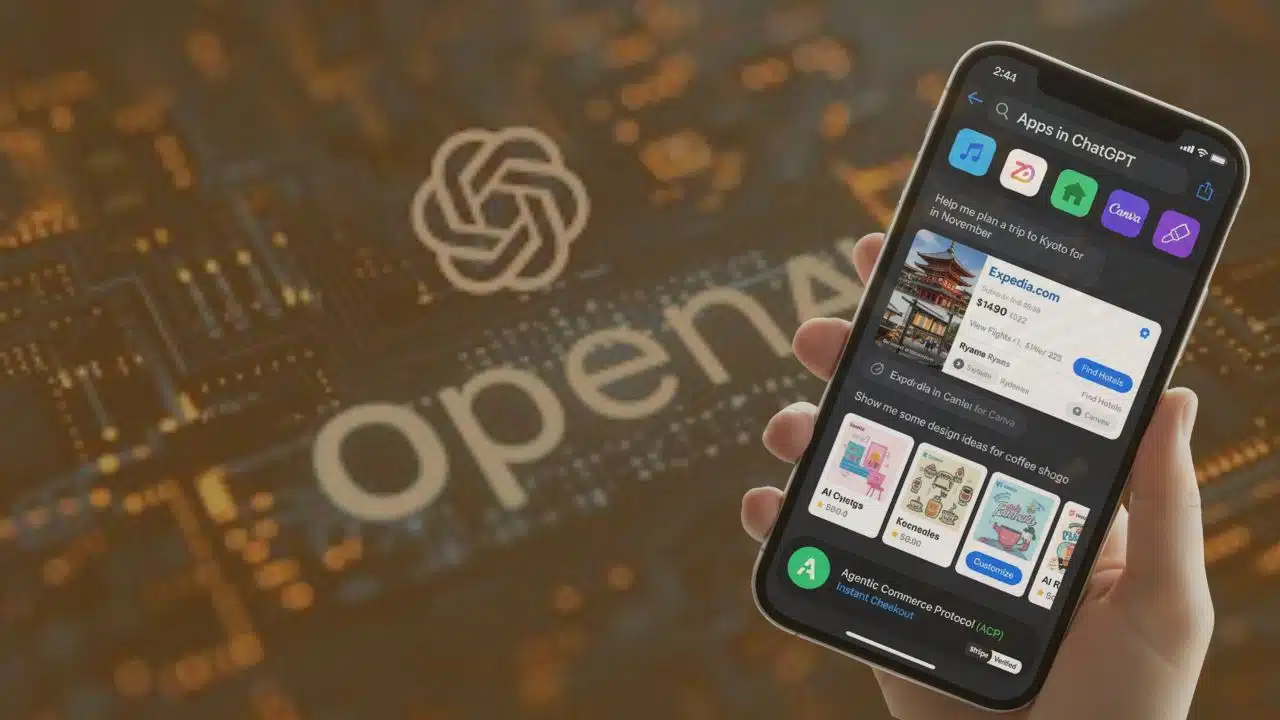
OpenAI today ignited a new front in the technology platform wars, announcing the launch of Apps in ChatGPT, a revolutionary ecosystem that embeds full-fledged applications directly within its conversational AI. The move, unveiled at the company’s annual DevDay conference, is a direct and formidable challenge to the long-standing dominance of Apple’s App Store and Google’s Play Store, aiming to fundamentally reshape how users interact with digital services.
In a paradigm shift away from the traditional grid-of-icons interface, OpenAI’s new platform allows its staggering 800 million weekly active users to summon and interact with third-party applications using natural language. This transforms ChatGPT from a powerful chatbot into an integrated digital hub where tasks like booking a trip, designing a graphic, or finding a home can be accomplished seamlessly within a single conversation, potentially bypassing the mobile operating systems that have governed the app economy for over a decade.
“We envision a new generation of apps that are interactive, adaptive, and personalized — that you can chat with,” OpenAI CEO Sam Altman announced during the DevDay keynote. This launch moves beyond the company’s existing GPT Store, which focuses on custom, persona-based chatbots, into a realm of deep, interactive software integrations with major global brands.
Key Facts & Quick Take
- What Happened: OpenAI launched “Apps in ChatGPT,” a platform for developers to build and integrate interactive applications directly into the ChatGPT interface, announced at its DevDay event on October 6-7, 2025.
- The Big Picture: This creates a new, conversational model for app discovery and use, directly competing with the traditional app store ecosystems of Apple and Google.
- Immediate Impact: Initial partners, including Spotify, Zillow, Canva, Expedia, Coursera, and Booking.com, are already live for many users, offering services like playlist creation and property searches within a chat.
- Underlying Technology: The platform is powered by a new Apps Software Development Kit (SDK) built on the open-standard Model Context Protocol (MCP) and will feature in-chat monetization through the Agentic Commerce Protocol (ACP), co-developed with Stripe.
- For Developers: OpenAI is offering access to its massive user base, with a formal app submission process and a public directory to launch later in the year. Details on a revenue-sharing model are promised to follow.
- What’s Next: The rollout is initially for logged-in users outside the European Union, with plans to expand access and add more partners like Uber and Target in the coming weeks.
From Chatbot to “Everything App”
Since the launch of ChatGPT, OpenAI has been methodically expanding its capabilities. This latest move is its most ambitious, aiming to position ChatGPT as a central “everything app”—a unified environment for search, productivity, commerce, and communication.
This strategy directly targets the core business model of Apple and Google, who for years have acted as gatekeepers of mobile software distribution, collecting commissions of up to 30% on app-related purchases. By embedding apps and commerce within its own platform, OpenAI could establish itself as a new kind of gatekeeper, one built on the power of conversational AI.
The announcement comes at a time of explosive growth for the company. At DevDay, OpenAI shared staggering new metrics:
- Massive User Base: ChatGPT now boasts 800 million weekly active users, up from 100 million in late 2023, providing an immense, ready-made audience for developers.
- Developer Ecosystem Growth: The number of developers building with OpenAI’s tools has doubled to 4 million.
- Surging API Usage: The platform now processes over 6 billion tokens per minute through its API, a 30-fold increase from previous figures.
How “Apps in ChatGPT” Works
The new system is a significant evolution from OpenAI’s earlier “Plugins” and the more recent “GPT Store.” While the GPT Store allows users to find and use custom versions of ChatGPT tailored for specific tasks (e.g., a “Math Tutor” GPT), “Apps in ChatGPT” are full-fledged software integrations that render interactive components.
For instance, a user planning a vacation can now ask Expedia for flight and hotel options and see interactive cards with details directly in the chat. Similarly, asking Zillow to find apartments will bring up an interactive map. When a user mentions an app for the first time, ChatGPT will prompt them to connect their account and consent to data sharing, a process managed through standardized OAuth protocols for security.
The Technology Backbone: MCP and ACP
This seamless integration is made possible by two key open standards:
- Model Context Protocol (MCP): The new Apps SDK is built upon MCP, an open standard initially introduced by Anthropic and now adopted by major AI players. MCP standardizes how AI models connect to external data sources and tools, acting like a universal connector that allows ChatGPT to reliably “talk” to different applications.
- Agentic Commerce Protocol (ACP): For monetization, OpenAI has co-developed the ACP with payments giant Stripe. This open-source protocol is designed to facilitate secure, in-chat transactions. It allows users to make purchases directly from businesses within the conversation, with the business remaining the merchant of record. This “Instant Checkout” feature is a crucial step toward building a self-sustaining economy on the platform.
Official Responses and Expert Analysis
As of October 8, 2025, neither Apple nor Google have issued an official public statement on OpenAI’s announcement. However, the move is widely seen by analysts as a significant long-term threat to their app store duopoly.
Industry analysts are already weighing the profound implications. Some have dubbed the new platform the potential “Windows of AI,” suggesting it could become the foundational operating system for a new generation of computing.
Shahar Chen, CEO of the AI startup Aquant, noted that this marks a pivotal industry shift. “In 2023, AI solutions were broadly focused, but with the launch of OpenAI’s marketplace… we’ll see a noticeable shift towards vertical, industry-specific AI,” he stated.
However, the path forward is not without challenges. For developers, the opportunity is a “double-edged sword,” according to a report from Towards AI. While the access to 800 million users is unprecedented, OpenAI is also bundling tools that compete directly with an ecosystem of startups built on its own APIs. Furthermore, concerns remain about the eventual revenue-sharing model and the potential for OpenAI to control app discovery and placement, echoing long-standing developer complaints about existing app stores.
A New Way to Interact with Technology
For the average user, this development signals the beginning of a major shift in digital interaction. Instead of navigating multiple apps to complete a task, users can simply state their intent in plain language. The process of finding, downloading, and learning a new app could be replaced by a single, fluid conversation.
This is exemplified by the initial partner integrations. A user could say, “Help me learn about data analytics,” and the Coursera app could surface relevant videos and course modules instantly. Or, a user could state, “Create a design for my new coffee shop’s Instagram,” and the Canva app could generate design templates within the chat. This removes significant friction from the user experience.
What to Watch Next
The coming months will be critical in determining the trajectory of this new ecosystem. Key developments to watch include:
- Developer Monetization Details: OpenAI has stated it will release specifics on its revenue-sharing program for developers later this year. The structure of this program will be crucial for attracting and retaining development talent.
- App Directory Launch: The company plans to launch a public directory for “Apps in ChatGPT,” which will be a key mechanism for app discovery. How this directory is curated and whether it will feature paid placements will be closely watched.
- Expansion to Europe and Enterprise: The initial rollout has notably excluded the EU. The platform’s expansion into this key market, along with its deeper integration into Business, Enterprise, and Education plans, will be significant milestones.
- Competitive Responses: The tech world will be watching for responses from Apple, Google, and Meta. These giants are unlikely to cede control of the app economy without a fight and will almost certainly accelerate their own AI-native platform strategies.
OpenAI’s launch of “Apps in ChatGPT” is more than just a new feature; it is a declaration of intent to build a new computing paradigm. By leveraging its massive user base and advanced AI, the company is making a bold play to become the central hub of our digital lives. While the success of this ambitious venture is not guaranteed, it has undeniably redrawn the battle lines for the future of the technology industry, shifting the focus from the mobile screen to the conversational interface. The age of the AI-native app store has begun.
The Information is Collected from Business Insider and OpenAI.