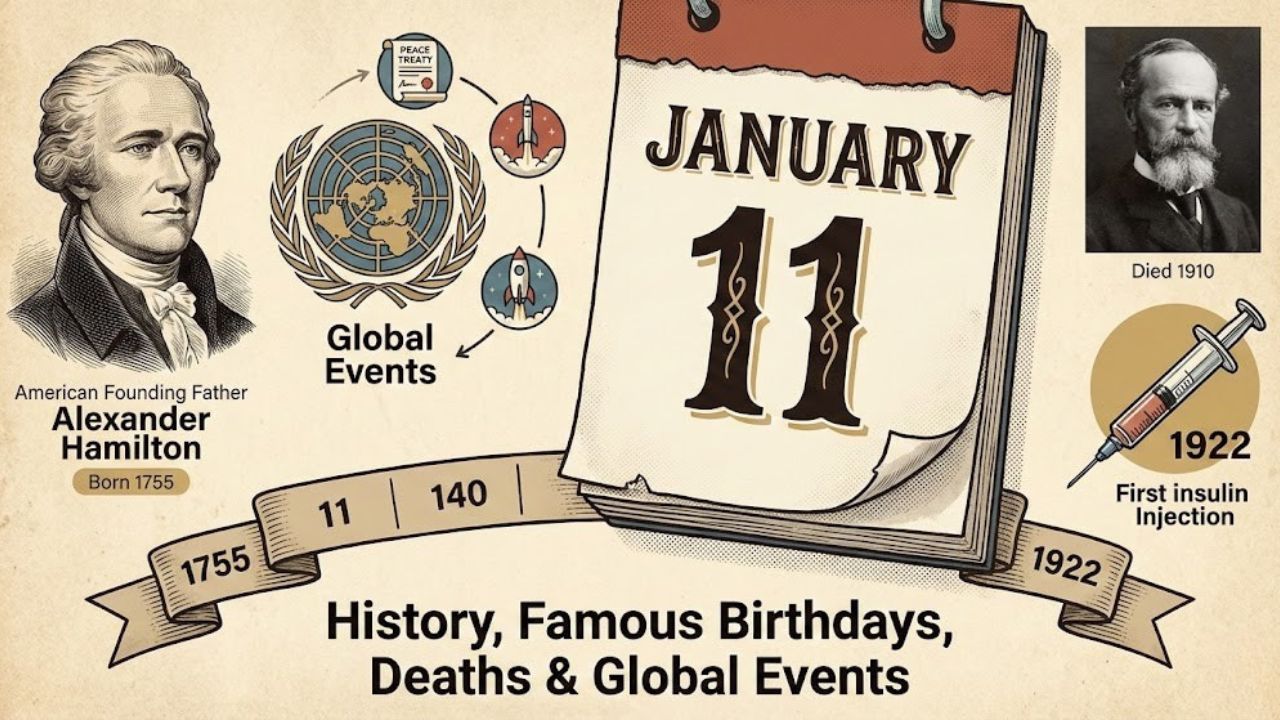
January 11 is a date that carries two kinds of history at once. Some of its moments are loud, like invasions, and regime level turning points. Others are quietly revolutionary, like a medical treatment that changed what it meant to be diagnosed with diabetes, or a conservation decision that preserved a natural wonder for the world.
This is an in-depth, reader-friendly guide to what happened on January 11, why it mattered then, and why it still matters now.
At A Glance: January 11 In History
| Year | Region | What Happened | Why It Still Matters Today |
|---|---|---|---|
| 1966 | India | PM Lal Bahadur Shastri dies hours after the Tashkent Declaration | A major political transition and a lasting public controversy |
| 1944 | Morocco | Independence Manifesto presented | A milestone of anti-colonial organizing and national memory |
| 1922 | Canada | First insulin injection given to Leonard Thompson | A medical turning point that transformed diabetes care |
| 1908 | United States | Grand Canyon declared a national monument | A defining moment in modern conservation policy |
| 1923 | Europe | Occupation of the Ruhr begins | A key link in the chain leading to interwar instability |
| 1943 | China | U.S. and U.K. end extraterritorial rights in China | Symbolic reversal of “unequal treaty” privileges |
| 2013 | Mali | France launches Operation Serval | A major chapter in the Sahel security crisis |
On This Day January 11 In The Bangalee Sphere
Shastri’s Death In Tashkent And The Politics Of Unanswered Questions
India remembers January 11 as the death anniversary of Prime Minister Lal Bahadur Shastri, who died in Tashkent in 1966, only hours after the Tashkent Declaration was signed to ease tensions after the 1965 India–Pakistan war. The official cause was a heart attack, but public suspicion and controversy persisted, fueled by the lack of an on-site post-mortem and decades of political debate.
Why it mattered then:
-
India lost a sitting prime minister at a sensitive diplomatic moment, creating a sudden leadership vacuum.
-
The country was still negotiating its post-independence political identity, and Shastri represented a distinct style of leadership marked by simplicity and firmness.
Why it matters today:
-
The episode remains a national case study in how modern states manage transparency during high-stakes events.
-
It shows how historical memory is shaped not only by official documents, but by what people believe was left unexplained.
For the Indian subcontinent, January 11 becomes a reminder of how diplomacy, national emotion, and political succession can collide in a single moment.
Bangalee Culture And Letters: A Season Of Memory And Production
January 11 does not align with one fixed, Bengal-wide festival every year, since many major observances follow lunar or regional calendars. Still, it sits inside the winter cultural season across Bangladesh and West Bengal. This is when institutions often hold recitals, book events, school programs, and community gatherings. The month builds toward mid-January harvest season celebrations that are deeply rooted in agrarian rhythms, food culture, and regional identity.
This seasonal context matters for “On This Day January 11” writing because it lets readers connect history with lived time. Not just what happened, but what the world feels like in early January: fog, winter markets, cultural programs, and the social energy of a new year.
Bangalee Sphere Birth And Death Anniversaries
Notable Births In Bangladesh And India
| Name | Born | Field | Why They Matter |
|---|---|---|---|
| Rahul Dravid | 1973 | India, cricket | One of India’s most respected batters and a major mentor figure in modern cricket culture |
| Shibu Soren | 1944 | India, politics | Tribal-rights leader and a key figure in Jharkhand statehood politics |
| Mary Kom | 1983 | India, boxing | Multiple-time world champion and Olympic medalist, a symbol of women’s sporting excellence from the Northeast |
Notable Deaths In Bangladesh And India
| Name | Died | Field | Legacy And Notes |
|---|---|---|---|
| Lal Bahadur Shastri | 1966 | India, politics | Officially reported as a heart attack, but controversy persists in public discourse |
International Observances And Holidays On January 11
January 11 is unusually rich in national and civic observances across regions. It also includes awareness campaigns that are widely recognized in modern public life.
Major Awareness Observance
National Human Trafficking Awareness Day is observed in the United States on January 11, often associated with “Wear Blue Day.” This is part of a broader January emphasis on prevention and awareness.
Why it matters:
-
Human trafficking is frequently misidentified, misunderstood, or dismissed because it does not always look like dramatic crime scenes.
-
Awareness campaigns focus on recognizing coercion, supporting survivors, and encouraging responsible reporting.
National Days And Public Commemorations
Morocco: January 11 marks the presentation of the Independence Manifesto in 1944, a key symbolic milestone in the country’s anti-colonial struggle and modern national narrative.
Nepal: January 11 is widely observed as Prithvi Jayanti and National Unity Day, commemorating King Prithvi Narayan Shah and Nepal’s unification story. The observance can be politically sensitive, since modern Nepal debates monarchy, nationalism, and civic identity in different ways.
Oman: January 11 is associated with Sultan Haitham bin Tarik’s accession day, which is commemorated nationally.
Observances Table
| Observance | Where | What It Emphasizes |
|---|---|---|
| Human Trafficking Awareness Day | United States | Awareness, prevention, survivor support, civic vigilance |
| Independence Manifesto Day | Morocco | Anti-colonial organizing and national sovereignty memory |
| Prithvi Jayanti / National Unity Day | Nepal | Unification narrative and national identity debates |
| Accession Day | Oman | State continuity, leadership commemoration, national ceremonies |
Global History On January 11 By Region
United States: Conservation, Conflict, And Contemporary Governance
January 11 appears in U.S. history in three ways that still matter: conservation, conflict-era political decisions, and modern security debates.
Grand Canyon National Monument (1908)
President Theodore Roosevelt proclaimed the Grand Canyon a national monument on January 11, 1908, using the Antiquities Act. This move protected an immense landscape from deeper commercial extraction pressures and laid groundwork for later national park status.
Why it matters today:
-
It is a defining example of government using legal tools to protect natural heritage at scale.
-
It continues to influence debates on land protection, federal authority, and the economics of conservation.
Civil War era secession milestone (1861)
Alabama’s secession is often dated to January 11, 1861, a key marker in the acceleration toward civil war.
Public health turning point (1964)
The U.S. Surgeon General’s report on smoking and health is associated with January 11 in many historical summaries. It reshaped public policy, advertising norms, and the cultural meaning of cigarettes.
Post-9/11 security era marker (2002)
The arrival of the first detainees at Guantánamo Bay is also tied to January 11 in many chronologies, making the date part of the long debate over security, rights, and the legal architecture of war.
Europe: The Ruhr Occupation And The Logic Of Economic Pressure
On January 11, 1923, French and Belgian troops moved into Germany’s Ruhr region to enforce reparations demands. This occupation contributed to severe political and economic turbulence in Germany.
Why it matters today:
-
It illustrates how punitive economic pressure can trigger instability rather than compliance.
-
It helps explain the emotional and political atmosphere of interwar Europe that made extreme politics easier to sell.
Russia And The Soviet Sphere: The Baltic Road To Independence
January 11 is part of the tense sequence of events in Lithuania’s 1991 confrontation with Soviet forces. Seizures of key buildings and escalating pressure preceded the deadly violence that would follow.
Why it matters today:
-
It is central to Baltic memory and modern European discussions about sovereignty and resistance.
-
It also helps explain why the Baltics interpret security threats through historical experience rather than abstract theory.
China: Ending Extraterritorial Rights And Reversing “Unequal Treaties”
On January 11, 1943, the United States and Britain signed agreements to relinquish extraterritorial rights in China. This had enormous symbolic meaning, as extraterritoriality had been a core feature of the unequal treaty system.
Why it matters today:
-
It remains a key reference point in narratives about sovereignty and the end of semi-colonial legal structures.
-
It also shows how wartime alliances can create openings for long-overdue corrections in international relations.
United Kingdom: Pop Culture As A Global Force
Many “On this day” summaries place the U.K. release of The Beatles’ “Please Please Me” on January 11, 1963, one of the signals of a cultural wave that would reshape global youth identity.
Why it matters today:
-
It reminds us that cultural exports are not soft trivia. They shape language, fashion, politics, and national influence.
-
It also shows how quickly music can cross borders and create shared generational memory.
Canada: The Insulin Breakthrough That Changed Medicine
January 11, 1922 is widely associated with the first insulin injection given to Leonard Thompson in Toronto, a turning point that transformed diabetes treatment and extended countless lives.
Why it matters today:
-
It is a reminder that medical breakthroughs often begin as high-risk experiments, guided by urgency and careful observation.
-
It also shows how health innovations reshape society, from family life to national healthcare systems and pharmaceutical policy.
Africa: The Sahel And The Debate Over Intervention
On January 11, 2013, France launched Operation Serval in Mali to halt armed extremist advances. The operation quickly became linked to broader debates about foreign intervention, sovereignty, and the long-running instability of the Sahel.
Why it matters today:
-
The region’s security crisis has continued to influence migration, humanitarian pressures, and regional politics.
-
It also remains a case study in the limits of military solutions when governance, economics, and legitimacy are under strain.
Notable Births And Deaths On January 11 Globally
This section highlights a mix of politics, science, activism, and culture, chosen for impact and recognizability across regions.
Notable Births
| Name | Born | Nationality | Why Famous |
|---|---|---|---|
| William James | 1842 | American | Foundational thinker in psychology and pragmatist philosophy |
| Alice Paul | 1885 | American | Key strategist of women’s suffrage and later equal-rights advocacy |
| Jean Chrétien | 1934 | Canadian | Long-serving prime minister during defining modern eras |
| Kailash Satyarthi | 1954 | Indian | Nobel Peace Prize laureate known for anti-child-labor advocacy |
| Mary J. Blige | 1971 | American | Defining artist in modern R&B and hip-hop soul |
Notable Deaths
| Name | Died | Nationality | Cause Or Legacy |
|---|---|---|---|
| Thomas Hardy | 1928 | British | Landmark novelist and poet whose realism shaped modern literature |
| Emanuel Lasker | 1941 | German | Long-reigning world chess champion and intellectual symbol of the classical era |
| Sir Edmund Hillary | 2008 | New Zealander | Everest pioneer and major humanitarian legacy in Nepal |
| Ariel Sharon | 2014 | Israeli | Influential and controversial political figure in modern Middle East history |
| Lal Bahadur Shastri | 1966 | Indian | Officially heart attack, public controversy continues |
Did You Know Trivia For January 11
-
The first insulin injection in 1922 is often described as a “medical line in the sand.” Before insulin, Type 1 diabetes was widely treated as a near-certain fatal diagnosis. After insulin, it became manageable for many patients.
-
The Ruhr occupation shows how economic enforcement can backfire. Policies designed to force payment and compliance can instead deepen resentment and instability, especially when ordinary civilians feel punished.
-
The Grand Canyon’s protection began as a legal act, not a tourism campaign. The national monument designation created a shield first, and mass cultural reverence followed.
Quote Of The Day
“I never doubted that equal rights was the right direction.”
This quote is closely associated with Alice Paul, born on January 11. It fits the date’s larger theme. January 11 repeatedly appears in stories where institutions face a moral test, whether the issue is rights, sovereignty, or the protection of human life.
Takeaways: What January 11 Teaches Us About Power And Progress
January 11 is a date that proves history is not a single storyline. It is a braid of emergencies and breakthroughs. If you read January 11 as a whole, one lesson stands out. Progress rarely arrives as a smooth upward line. It arrives through conflict, negotiation, and sudden change, with ordinary people living through the consequences.
That is why On This Day January 11 is not just a list of anniversaries. It is a window into how societies manage fear, build legitimacy, and sometimes choose to protect what is precious, whether it is a democracy, a human life, or a canyon carved over millions of years.