Nobel Prize ceremonies on December 10 will once again turn Stockholm and Oslo into twin global stages for science, literature, economics and peace, as the 2025 laureates gather to receive the world’s most prestigious awards. The day will highlight both the century‑old rituals of Nobel Day and the contemporary debates that the 2025 winners embody, from quantum technology and new materials to democracy struggles and the future of the global economy.
Nobel Day: Twin Capitals in the Global Spotlight
Every year on December 10, the anniversary of Alfred Nobel’s death, the Nobel Prize awards are formally presented in coordinated ceremonies in Stockholm and Oslo. Stockholm hosts the laureates in physics, chemistry, physiology or medicine, literature and economic sciences, while the Nobel Peace Prize is awarded at a separate ceremony in the Norwegian capital.
Nobel Week 2025 runs from December 6–12 across the two cities, culminating in the December 10 ceremonies that are both physical spectacles and global media events streamed around the world. For the laureates, that day is the public climax of months and often decades of scientific, literary or political work that the Nobel committees have chosen to elevate as a “greatest benefit to humankind.”
Timings, Venues and Key Moments
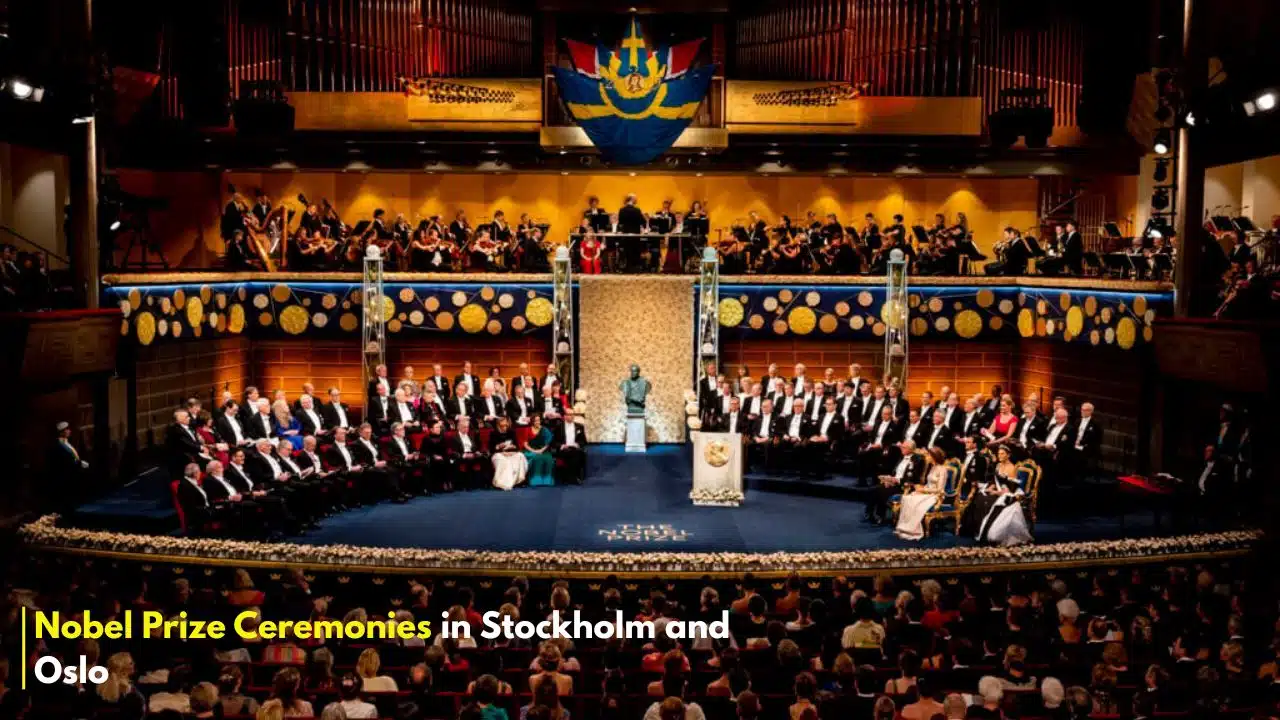
In Stockholm, the main award ceremony is held at the Stockholm Concert Hall, beginning at 16:00 CET on December 10, in front of an audience of more than 1,500 invited guests. The King of Sweden personally hands each laureate a Nobel diploma and medal after a formal presentation of their achievements by members of the prize‑awarding academies.
In Oslo, the Nobel Peace Prize ceremony takes place earlier in the day, at 13:00 CET in Oslo City Hall, presided over by the chair of the Norwegian Nobel Committee. The ceremony includes artistic performances and the traditional Nobel lecture by or on behalf of the Peace Prize laureate, in front of the Norwegian royal family, government representatives, and an invited international audience.
Core Nobel Day Events in Stockholm and Oslo
| City | Main venue | Local time on Dec. 10 | Main focus |
|---|---|---|---|
| Stockholm | Stockholm Concert Hall | 16:00 CET | Physics, Chemistry, Medicine, Literature, Economic Sciences awards |
| Oslo | Oslo City Hall | 13:00 CET | Nobel Peace Prize ceremony |
Who the 2025 Laureates Are
The 2025 Nobel roster spans six categories: physics, chemistry, physiology or medicine, literature, peace and economic sciences. The laureates were announced over several days in October, following the now familiar pattern of daily press conferences in Stockholm and Oslo.
In medicine, Mary E. Brunkow, Fred Ramsdell and Shimon Sakaguchi share the Nobel for foundational discoveries in peripheral immune tolerance, which explain how the immune system learns not to attack the body’s own tissues and have opened major therapeutic paths in cancer and autoimmune disease. The physics prize goes to John Clarke, Michel H. Devoret and John M. Martinis for demonstrating macroscopic quantum mechanical tunnelling and quantised energy in superconducting circuits—work central to the development of quantum technologies.
In chemistry, Susumu Kitagawa, Richard Robson and Omar M. Yaghi are honoured for the development of metal–organic frameworks (MOFs), porous crystalline materials with far‑reaching applications in gas storage, catalysis and energy. The literature prize is awarded to Hungarian writer László Krasznahorkai for a body of work that critics describe as visionary, dense and apocalyptic, yet affirming the enduring power of art.
The Nobel Peace Prize recognises Venezuelan opposition figure María Corina Machado for her efforts to advance democratic rights and a peaceful, just transition away from authoritarian rule in Venezuela. In economic sciences, Joel Mokyr is honoured for his influential research on the long‑run history of technology and growth, shedding light on why some societies break into sustained innovation while others fall behind.
Ceremonial Splendour in Stockholm
The Stockholm ceremony follows a script that has changed remarkably little over the past century, even as the world around it has shifted. The laureates are seated prominently on the concert hall stage, with members of the Swedish Royal Family, government officials, diplomats, academics and previous laureates in the audience.
Each prize is introduced by a representative of the awarding body—such as the Royal Swedish Academy of Sciences for physics and chemistry, the Nobel Assembly at Karolinska Institutet for medicine, and the Swedish Academy for literature—who summarises the laureate’s work in language meant to be accessible to the general public. After these presentations, the laureates individually receive their medal and diploma from the King, usually amid sustained applause and accompanied by carefully selected musical performances.
Outside the concert hall, central Stockholm transforms into a festival of light and culture loosely themed around the Nobel tradition. Exhibitions, illuminated installations inspired by Nobel‑awarded discoveries, and public lectures invite residents and visitors to engage with the science and ideas behind the prizes.
The “Feast of Feasts”: Stockholm Banquet
Once the awards in Stockholm are presented, the focus shifts to Stockholm City Hall for the Nobel Banquet, a formal dinner for about 1,300 guests often described as the “feast of feasts.” Laureates are seated alongside the Swedish Royal Family and other dignitaries under the high ceilings of the Blue Hall, with dessert traditionally served in the Golden Hall decorated with mosaics.
The banquet is a carefully choreographed blend of culinary artistry, protocol and spectacle: each year’s menu is kept secret until the evening, the table settings are designed specifically for the event, and the décor changes annually while maintaining certain traditional motifs. Speeches from laureates, often mixing gratitude, humour and reflection on the broader meaning of their work, give the evening an intellectual counterpoint to the pageantry.
Oslo’s Peace Ceremony and Banquet
The Nobel Peace Prize has always stood somewhat apart, not only in its subject matter but also in its geography and ceremony. Since 1990, the Peace Prize has been awarded in Oslo City Hall, where the laureate delivers a Nobel lecture framed explicitly around conflict, rights and the conditions for lasting peace.
The Peace Prize ceremony is followed by its own Nobel Banquet in Oslo, traditionally held at the Grand Hotel, where around 250 guests—including Norwegian political leaders, foreign diplomats and civil society figures—join the laureate. The day also increasingly includes public‑facing events, such as children’s programmes linked to the Peace Prize and outdoor celebrations designed to bring the message of peace into the heart of the city.
Laureate Lectures and Public Dialogue
The December 10 ceremonies cap a week that is as much about public dialogue as formal recognition. During Nobel Week, laureates deliver lectures in Stockholm and Oslo, where they explain their work for a broad audience, often reflecting on the ethical and societal implications of their discoveries or activism.
Television programmes such as “Nobel Minds” gather laureates for round‑table discussions that touch on topics ranging from the state of global democracy and climate risk to the future of artificial intelligence, quantum computing and materials science. These conversations extend the meaning of the awards beyond individual achievement, framing them as part of larger debates on how knowledge and policy can address global challenges.
Security, Protocol and Geopolitical Sensitivities
Behind the elegance and ritual lies a vast security and protocol operation that has grown more complex with each passing decade. With heads of state, royals and high‑profile political figures often in attendance, Swedish and Norwegian authorities coordinate extensive security around venues, hotels and public events, including tightened controls in central Stockholm and around Oslo City Hall.
The guest lists themselves can carry subtle diplomatic messages. In earlier years, Swedish organisers have faced debates over whether to invite certain political leaders whose domestic policies appear at odds with the values associated with the prizes, revealing how a scientific and cultural celebration inevitably intersects with geopolitics. The choice of Peace Prize laureate is routinely scrutinised by governments, activists and scholars, and the 2025 focus on Venezuelan democracy is already being interpreted as a signal about global support for political transition in that country.
Economic and Cultural Impact on Host Cities
Nobel Week and the December 10 ceremonies have become central cultural markers and tourist draws for Stockholm and Oslo. Hotels, restaurants and cultural institutions build programming around Nobel Day, from themed menus and exhibitions to guided “Nobel walks” that trace the history of past laureates.
Local universities and museums use the week to host parallel events, highlighting their own research and reinforcing the image of the two cities as hubs of knowledge and culture. The fact that many events are now streamed online allows the Nobel institutions to use December 10 as a global outreach platform, targeting students and the broader public worldwide.
The Money Behind the Medals
While the Nobel medal and diploma carry immense symbolic value, each award also comes with a substantial monetary prize, funded by returns from the capital originally endowed by Alfred Nobel and subsequently managed by the Nobel Foundation. In recent years, that prize has been set at 11 million Swedish kronor per category, to be shared among laureates when there are multiple winners.
The financial award is not only a personal recognition but often a practical resource that laureates use to support laboratories, foundations, or advocacy campaigns. For younger laureates and those working in under‑funded fields or politically risky environments, the Nobel spotlight and funding can significantly change their capacity to influence both public debates and policy.
Tradition, Criticism and Reinvention
The December 10 ceremonies sit at the intersection of tradition and reinvention. The basic format—solemn presentations, royal participation, banquets—has remained remarkably stable since the early 20th century, anchoring the event in a sense of continuity.
At the same time, recent years have forced adaptations, from pandemic‑era restrictions and remote elements to deeper discussions about diversity, gender representation and the concentration of laureates from a relatively small number of countries and institutions. The 2025 prizes, with their focus on quantum technologies, advanced materials, immune regulation, Latin American democracy and long‑run economic history, reflect both the persistence of certain research powerhouses and ongoing efforts to recognise contributions from a wider geographical and disciplinary spectrum.
Why December 10 Still Matters
More than a century after the first Nobel awards were handed out in 1901, Nobel Day continues to function as a kind of secular global holiday dedicated to ideas, innovation and moral courage. The events in Stockholm and Oslo on December 10 are choreographed in a way that celebrates not only individual genius but also international collaboration, from cross‑border scientific teams to transnational democracy movements.
As the 2025 laureates take the stage in the Stockholm Concert Hall and Oslo City Hall, the ceremonies will crystallise ongoing conversations about how societies value knowledge, power and responsibility—questions that will linger long after the lights fade on what remains one of the world’s most watched annual rituals of recognition.