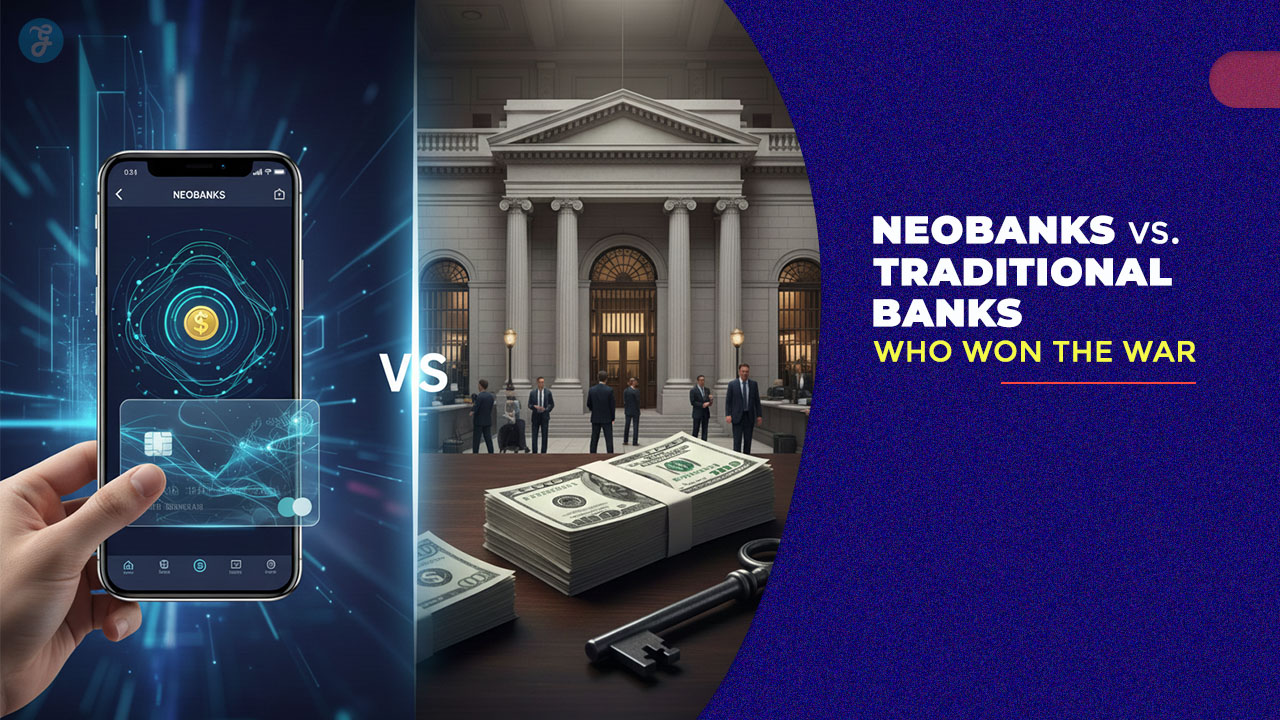
Banking “wars” make for good headlines. But money is not a battlefield where one side gets wiped out. It is more like a market where habits change, trust shifts, and the rules keep tightening.
Still, one question keeps coming up: neobanks vs traditional banks, who actually won?
If you judge by app quality and day-to-day ease, neobanks have pushed the whole industry forward. If you judge by credit power, balance sheets, and how systems behave during stress, traditional banks still hold the center.
The more honest answer is that the “war” did not end. It evolved. And in 2026, the winner depends on what you mean by winning.
The War Isn’t Over, But The Battlefield Changed
For years, “digital banking” sounded like a niche. Now it is simply how most people expect financial services to work. Even in emerging markets, more adults have accounts and more payments are digital than a decade ago. The World Bank’s Global Findex shows global account ownership reached 76% in 2021, up sharply over the prior decade.
That matters because neobanks were built for a world where:
-
Customers want instant onboarding
-
Cards and transfers should update in real time
-
Support should feel like a modern app, not a branch queue
Traditional banks did not stand still. They improved their apps, upgraded onboarding, and launched digital-first brands. So the real contest shifted from “who has an app” to “who owns the primary relationship.”
How “Winning” Gets Measured In Banking
| Metric | Why It Matters | What It Signals |
|---|---|---|
| Primary account share | Where salary and bills land | Deep trust and daily use |
| Deposit balances | Core fuel for lending | Stability and pricing power |
| Credit depth | Mortgages, SME credit lines | Full-service strength |
| Profitability | Sustainable operations | Long-term survival |
| Safety and compliance | Fraud, AML, dispute handling | Platform and regulator confidence |
| Product ecosystem | Wealth, insurance, business tools | Stickiness beyond payments |
What Exactly Is A Neobank

A neobank is usually a digital-first banking brand with no meaningful branch network. But the definition gets messy because “neobank” can describe two very different structures.
Licensed Digital Banks Vs Fintech Front Ends
Some neobanks hold a banking license. They can take deposits and lend under direct supervision.
Others operate as a fintech layer on top of licensed partner banks. They may control the app, user experience, and product design, while the regulated bank holds the deposits and handles core compliance.
In India, this partnership model is common. PwC’s report on India’s neobanking landscape describes the growing tie-ups between financial institutions and neobanks, and notes that standalone regulation may become necessary as the segment matures.
Why This Distinction Matters
It changes the answers to practical questions like:
-
Who is legally holding your money?
-
What deposit insurance applies, and under which institution?
-
Who handles disputes and fraud claims?
-
Who is responsible for compliance failures?
Clear Definitions Without The Buzzwords
| Term | Simple Meaning | Typical Structure |
|---|---|---|
| Neobank | Digital-first bank brand | Licensed bank or partner model |
| Challenger bank | Newer bank attacking incumbents | Often licensed, fast-growing |
| Digital brand of a bank | Traditional bank’s digital label | Same bank license and balance sheet |
| BaaS model | Banking services via APIs | Fintech + licensed bank partnership |
Why Neobanks Took Off So Fast
Neobanks did not grow because people suddenly stopped trusting banks. They grew because old banking workflows felt slow compared to everything else on a smartphone.
A Better Fit For How People Live
A neobank’s pitch is simple:
-
Start in minutes
-
Track spending instantly
-
Freeze a card with one tap
-
Get paid earlier (in some markets)
-
Travel with low FX friction
That is not only convenience. It is behavior design.
Infrastructure Got Friendlier To New Entrants
The Basel Committee’s work on digitalisation of finance highlights how new technologies and new suppliers of services, plus more partnerships, are reshaping the banking topology. It also notes how APIs, AI/ML, and cloud are changing delivery and operations.
This is a key point. Neobanks benefited from a world where:
-
Card networks and payment rails were easier to integrate
-
Cloud lowered infrastructure costs
-
Partnerships let new brands launch without full bank licenses
The Forces That Made Neobanks Possible
| Force | What Changed | Why It Helped Neobanks |
|---|---|---|
| Smartphones | Banking moved to apps | Mobile-first UX became a weapon |
| Instant payments growth | Faster transfers became normal | Reduced reliance on branches |
| Cloud and APIs | Infrastructure got modular | Faster launches and iteration |
| Consumer expectations | “Real time” became default | Banks with slow systems felt outdated |
| Banking partnerships | Brands could launch via licensed banks | Lowered regulatory barriers |
Neobanks Vs Traditional Banks: The Scorecard That Decides The Winner
This is the part most debates skip. Banking is not a single product. It is a bundle of services with different “difficulty levels.”
-
Payments and budgeting are easy to digitize.
-
Mortgages, SME lending, and compliance-heavy products are not.
So the fairest way to judge neobanks vs traditional banks is a scorecard, not a slogan.
Category 1: Everyday Money
This includes cards, P2P transfers, budgeting, and subscriptions. Neobanks often lead here because UX is their core advantage.
Category 2: Financial Depth
This includes lending, wealth products, insurance, and business services. Traditional banks usually lead because they have balance sheet scale and mature risk systems.
Category 3: Safety And Resilience
This includes fraud handling, deposit protection clarity, complaint resolution, and regulatory track record. Incumbents tend to lead, though the gap is shrinking.
Scorecard Snapshot
| Category | Who Usually Leads | Why |
|---|---|---|
| App UX and speed | Neobanks | Built for mobile, fewer legacy constraints |
| Fees for basic banking | Neobanks | Simple products and transparent pricing |
| Mortgages and large credit | Traditional banks | Scale, underwriting history, capital strength |
| Business lending and trade finance | Traditional banks | Deep risk and regulatory muscle |
| Global travel features | Neobanks | Multi-currency, instant controls, good FX |
| Trust in crisis moments | Traditional banks | Long track record and strong processes |
Where Neobanks Win Today
Neobanks win in the “daily money loop.” That is where most customers feel banking the most.
Speed, Clarity, And Control
Neobanks built features people now expect everywhere:
-
Instant spend notifications
-
Easy card freeze and limits
-
Clean categorization and budgeting tools
-
Fast onboarding with fewer steps
They also built a “product surface” that keeps users inside one app. Travel, subscriptions, investing, and cashback features reduce the need to use multiple services.
Fee Pressure And Transparency
Many neobanks grew by making fees feel fairer:
-
Clear subscription tiers
-
Low or transparent FX fees
-
Fewer surprise charges
That forced traditional banks to respond. Even when a customer stays with a traditional bank, their expectations now look more like neobank expectations.
Real Proof Points: Revolut And Nubank
Some neobanks are no longer “growth stories.” They are scale businesses with real profitability.
Revolut’s 2024 annual report highlights £3.1B revenue, £1,089M profit before tax, and £790M net profit, along with 52.5M customers and higher customer balances.
Nubank’s full-year 2024 results highlight rapid expansion and large scale deposits. Its releases note total deposits of $28.9B in Q4 2024 and FY 2024 revenue reaching $11.51B.
Where Neobanks Win (With Concrete Examples)
| Neobank Advantage | What It Looks Like In Practice | Example Evidence |
|---|---|---|
| Strong engagement | Users do daily banking inside the app | Multi-product “super app” strategies |
| Fast scaling | Tens of millions of customers | Revolut 52.5M customers (2024) |
| Profit momentum | Profits are no longer rare | Revolut net profit £790M (2024) |
| Deposit growth | More “real bank” behavior | Nubank deposits $28.9B in Q4’24 |
Where Traditional Banks Still Dominate
Neobanks improved the front end. Traditional banks still dominate the financial core.
Credit Is The Big Divide
Most people do not choose a “main bank” because of spending charts. They choose it because of credit:
-
Mortgages
-
Credit lines
-
Complex underwriting cases
Traditional banks have long histories of managing credit cycles. They also have regulatory capital frameworks and internal models built for these products.
Complex Services Still Favor Incumbents
Traditional banks remain strong in:
-
Corporate banking
-
Trade finance
-
Wealth management at scale
-
Multi-entity business accounts
-
Large dispute and claims operations
Scale Economics Still Matter
McKinsey’s Global Banking Annual Review points out that banking remains a huge profit-generating sector, but faces long-term value creation pressure, while still spending heavily on tech and dealing with ongoing regulatory investment needs.
That is the paradox. Incumbents are modernizing fast, but they also carry heavy obligations that neobanks often avoid early on.
Traditional Banks’ Durable Advantages
| Advantage | Why It Persists | What Could Weaken It |
|---|---|---|
| Large-scale lending | Balance sheet and capital strength | Better neobank credit models over time |
| Institutional trust | Familiarity and crisis history | Big failures or bad service |
| Regulatory maturity | Strong controls and governance | Slow adaptation to new tech |
| Product breadth | One-stop financial ecosystem | Specialized fintech bundles |
Profitability: Who Is Building A Sustainable Model

This is where the “war” becomes real. Users are nice. Profit is survival.
How Neobanks Make Money
Common revenue engines include:
-
Interchange on card spending
-
Subscriptions
-
Net interest income from deposits and lending
-
Wealth and trading spreads
-
Referral and partner marketplace income
The strongest neobanks now look less like “free apps” and more like diversified financial platforms. Revolut’s results are a good example of a neobank expanding beyond payments into broader services while maintaining profitability.
How Traditional Banks Make Money
Traditional banks still dominate profit pools because they own:
-
Large lending books
-
Business banking relationships
-
Wealth products with scale
McKinsey reports the global banking sector generated a record $1.2 trillion in net income for 2024 and reached 10.3% ROE, even as markets remain skeptical about long-term value creation.
What Research Suggests About Early Neobank Performance
An open-access academic paper on European neobanks reports that, on average, neobanks performed worse than traditional peers in the period studied, including negative average ROA for neobanks versus positive ROA for traditional banks.
This supports a practical point: digital-first does not automatically mean profitable. Scale and scope matter, even in digital banking.
Profit Model Comparison
| Topic | Neobanks | Traditional Banks |
|---|---|---|
| Early-stage economics | Often subsidy-driven growth | Stable revenue base |
| Main profit levers | Fees, subscriptions, NII growth | Lending, fees, wealth, NII |
| Cost structure | Lower branch costs, high tech spend | Higher fixed costs, compliance overhead |
| Risk exposure | Growing as lending expands | Mature risk systems, bigger credit cycles |
| Evidence trend | Some now highly profitable | Still dominant profit pools |
Regulation, Safety, And Deposit Insurance
This section decides whether a neobank can become a true primary bank for most users.
Licensing Is The Hidden Divider
A licensed digital bank is supervised like a bank. A fintech front end using a partner bank operates under a different risk structure.
PwC’s India report explicitly discusses how regulation may need to evolve as neobanks mature, which reflects a wider global pattern: new models force regulators to clarify responsibility.
Deposit Protection: The Question Customers Should Ask First
In the US, the FDIC explains “pass-through” deposit insurance as a method of insuring depositors whose funds are held at an FDIC-insured bank through a third party, provided requirements are met.
In the UK, deposit protection is handled via the FSCS. The FSCS states the deposit protection limit rose to £120,000 on 1 December 2025 for eligible deposits, per person, per authorized firm.
This matters because “neobank branding” can confuse people. The real question is: which authorized institution holds the deposit, and what scheme covers it?
Compliance Pressure Increases With Scale
As neobanks grow, regulators focus more on internal controls, especially AML. A Morningstar DBRS commentary notes leading European challenger banks have rapidly expanded and faced increased oversight, particularly in anti-money laundering, with some entities fined.
On the operational side, regulators also watch outsourcing and third-party risks. The EBA’s outsourcing guidelines reflect the stricter governance expectations financial institutions face when relying on third parties.
Consumer Safety Checklist
| What To Check | Why It Matters | What “Good” Looks Like |
|---|---|---|
| Who holds the deposit | Determines deposit protection | Clear licensed bank name shown |
| Deposit insurance type | Protects against bank failure | FDIC/FSCS/EU DGS clarity |
| Fraud and dispute process | Impacts real-world outcomes | Fast, documented procedures |
| AML and controls maturity | Reduces shutdown and freezes | Strong governance and monitoring |
| Customer support quality | Small issues become big fast | Rapid human resolution options |
So Who Won The War
Here is the clearest way to say it without hype.
Neobanks won the user experience battle. Traditional banks still control most of the financial gravity.
If you are judging neobanks vs traditional banks by who forced the other side to change, neobanks deserve credit. They made instant controls, better UX, and transparent pricing feel non-negotiable.
If you judge by who owns the deepest financial relationships, traditional banks still lead in most markets. That is because credit, regulation, and balance sheet scale take time to build.
A Simple Winner-By-Metric Verdict
-
Daily spending and app control: neobanks often win
-
Complex lending and mortgages: traditional banks usually win
-
Trust and deposit clarity: traditional banks still have an edge
-
Innovation pace: neobanks push faster, banks follow with scale
Winner By Category
| Category | “Winner” Today | Why |
|---|---|---|
| Spending, budgeting, controls | Neobanks | Designed for mobile-first behavior |
| Mortgages and large loans | Traditional banks | Deep underwriting and capital |
| SME and corporate banking | Traditional banks | Breadth and risk infrastructure |
| Multi-product digital ecosystem | Mixed | Neobanks growing fast, banks catching up |
| Safety clarity | Traditional banks | Long-standing supervision and processes |
What Happens Next (2026–2030)
The future is less about one side “winning” and more about convergence.
Traditional Banks Will Keep Becoming More “Neobank-Like”
The Basel Committee outlines multiple stylized scenarios for how fintech reshapes banking, including “better bank” modernization and “distributed bank” fragmentation across incumbents and fintech firms.
That is basically what we are seeing. Traditional banks modernize while also partnering, outsourcing, and plugging into fintech ecosystems.
Neobanks Will Keep Becoming More “Bank-Like”
To become primary banks, neobanks have to:
-
Expand credit products responsibly
-
Prove resilience during downturns
-
Build compliance and governance at scale
DBRS commentary and academic research both point to the friction here. Scale can improve economics, but governance must keep up.
Likely Outcomes Over The Next Few Years
| Trend | What It Means | Who Benefits |
|---|---|---|
| Convergence | Products and UX start to look similar | Customers |
| Consolidation | Some neobanks get acquired or merge | Strong platforms |
| Tougher oversight | More focus on AML and controls | Regulated incumbents |
| Profit focus | Growth without margins becomes harder | Efficient operators |
Final Thoughts
If you expected a clean winner, banking won’t give you one. It rarely does.
Neobanks proved that customers want speed, control, and transparency. Traditional banks proved that credit depth, regulation, and resilience still matter most when money gets serious.
So when people ask “neobanks vs traditional banks, who won the war,” the best answer is this: neobanks won the experience battle, traditional banks still hold the core, and the long game is convergence.