You know, I used to think a story was just a string of text you displayed on a screen. But after years of debugging complex UI states, I realized that narrative design is actually a lot like front-end architecture. It’s not just about what you show the user; it’s about how the system reacts to their input. Are you tired of seeing the same “chosen one” save the day in every single game? You aren’t alone. Players today get bored walking in someone else’s shoes down a single, hard-coded path from zero to hero.
Narrative design is refactoring itself in 2026. We are moving away from static scripts and toward systems that let players compile their own stories at runtime. In this guide, I’ll walk you through how narrative structure is evolving past the classic “Hero’s Journey.”
We will look at player agency, fresh storytelling frameworks like “emergent narrative,” and the specific tools like Inworld AI that you need in your tech stack this year. So, grab a coffee, and let’s debug your storytelling process together.
What is Narrative Design?
Narrative design is the user experience (UX) of the story. It is the code that links the plot, player choices, and game mechanics into one smooth runtime environment.
Definition and core principles
Think of narrative design as the API that connects the writer’s script to the game engine. It lays out a clear path for player engagement, character development, and meaningful choices. The core principles focus on strong structure, audience engagement, and giving players real agency, allowing them to execute functions that actually change the game state.
Game studios like Naughty Dog have mastered blending plot arcs with gameplay, ensuring every button press feels like part of the story. But in 2026, we are seeing a shift toward “narrative systems” rather than just narrative scripts.
Key Principles for 2026:
- Systemic Consistency: The story must match the gameplay rules (avoiding “ludonarrative dissonance”).
- Player Agency: The user’s input should trigger a visible change in the world state.
- Collaborative Authorship: The developer provides the sandbox, but the player builds the castle.
“Stories give us a place to walk inside another’s shoes.”
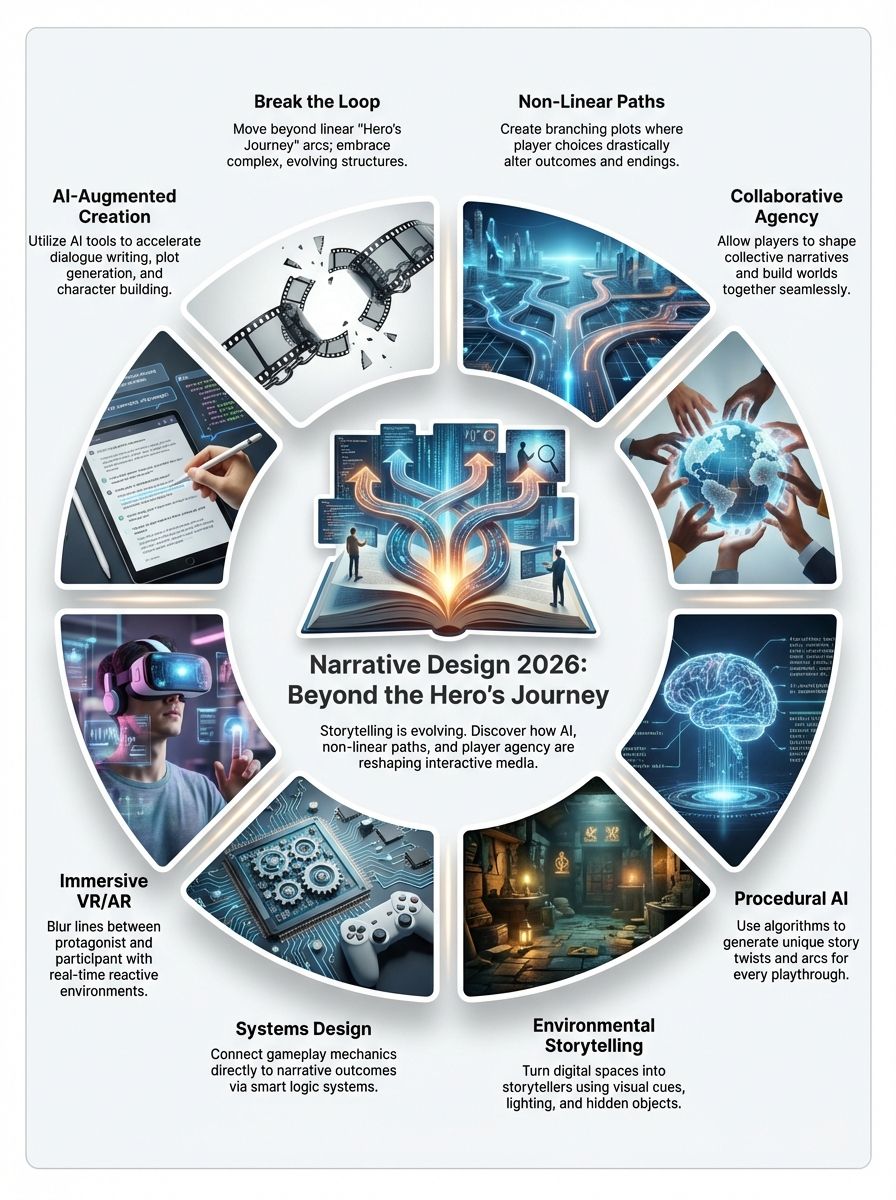
Using frameworks like collective storytelling breaks away from old hero myths. This style values inclusivity, letting everyone take part in the unfolding tale. Interactive stories now build meaning through theme exploration and immersive environments that feel alive each time you play.
Importance in video games and interactive media
These principles shape how players feel, act, and connect with your application. A 2025 report from Newzoo highlighted that game growth is now shaped less by the volume of releases and more by “sustained engagement.” A strong narrative is what keeps that retention metric high.
Interactive narratives let you pick paths and create your own adventure. When players feel their choices matter, they stick around. Good narrative structure helps players think about choices, face tough decisions, and find their place inside fictional worlds.
This way, video games move beyond simple winning or losing. They make space for empathy and collaboration between players through story arcs and character development.
The Traditional “Hero’s Journey” Framework
The Hero’s Journey is like the “jQuery” of storytelling; it shaped the web for a long time, and it still works, but modern apps need something more reactive. Writers are starting to look beyond this old map to support the complex features players expect in 2026.
Overview of the Hero’s Journey structure
Joseph Campbell first mapped the Hero’s Journey in 1949. This narrative structure shows a character leaving home, facing trials, gaining wisdom, and returning changed. Writers use it in myths, books, movies like “Star Wars,” and even business narratives.
The steps form a simple loop: call to adventure, crossing into new worlds, meeting helpers and enemies along the way. A protagonist starts an ordinary life but soon gets pulled into challenge after challenge. With each stage, tests, setbacks, or mentors, they grow stronger or wiser before confronting their hardest task yet.
“You must give up the life you planned so as to have the life that is waiting for you.” – Joseph Campbell
Limitations of the Hero’s Journey in modern narrative design
While the Hero’s Journey set the stage for many classics, it has a major bug: it focuses on a single user. Modern narrative design now stretches well beyond this single-player path. Many players spot repeats in this structure, which can make games feel predictable.
Newer audiences expect deeper character development and fresh forms of engagement. The traditional model leaves little room for collective storytelling. Today’s media leans into nonlinear storytelling, so sticking to a single linear arc misses creative opportunities.
Players crave more agency. They want choices that matter across branching storylines or even procedurally generated worlds. While mythological archetypes have value, designers now seek new frameworks that welcome diversity and break away from old molds.
Emerging Trends in Narrative Design for 2026
Stories in games are changing shape fast. We are seeing “emergent narratives” where the plot isn’t written by a writer, but generated by the collision of game systems.

Non-linear storytelling
Non-linear storytelling lets players piece together the plot in their own way. Instead of following one path, choices branch out like a complex Git repository. Stories shift based on player actions or skipped scenes.
Twists may come early or late, depending on who you talk to first. Death Stranding 2: On the Beach (2025) pushed this by making the “cost” of connection a central, dynamic mechanic rather than just a plot point. Games now weave memories and events into environments using clues spread across maps.
Story arcs now support collaboration and give more agency than a simple hero’s journey ever could. Next up is how collaborative narratives change player roles even more.
Collaborative narratives and player agency
Players now shape the story arc, not just follow a set path. The breakout example of this is Helldivers 2 and its infamous “Game Master Joel.”
In this system, a real person (Joel) at the studio monitors the global war in real-time and adjusts enemy difficulty or narrative goals based on the collective actions of millions of players. It is like Dungeons & Dragons on a massive server scale.
Why this works:
- Shared Consequence: If the community fails a Major Order, the story changes for everyone.
- Real-Time Updates: The narrative isn’t patched in months later; it happens live.
- Community Bonding: Players bond over shared victories and defeats orchestrated by a “human” element in the code.
Collaboration also fuels inclusivity since every voice shapes how myths, themes, and conflicts unfold across the game world.
Procedurally generated storytelling
Games now use AI and algorithms to shape stories as you play. Every time you start, the story twists in new directions. Dwarf Fortress has long been the king of this, but new engines are making it mainstream.
Unreal Engine 5’s Procedural Content Generation (PCG) framework allows designers to build rules for how a world is populated. This means the environment itself tells a unique story for every player. Instead of one set path, each player creates their own plot arc through simple choices.
This form of interactive narrative boosts audience engagement and keeps things fresh for every protagonist. It opens doors to collective storytelling where no two adventures follow the same pattern.
Environmental storytelling advancements
Developers have started to use narrative design to turn digital spaces into storytellers. Buildings with broken windows or hidden graffiti can whisper secrets about past battles or lost dreams.
In the physical world, the art collective Meow Wolf (with locations in Santa Fe, Las Vegas, and Denver) is the master of this. They use capacitive sensors and hidden RFID tags to trigger narrative audio and lighting changes when you touch specific objects. A simple torn poster on a wall may reveal a forgotten rebellion without one spoken word.
Nonlinear storytelling blends with visual clues. Players piece together collective narratives by noticing changes in the environment as they play. The world itself becomes an active character.
Integrating Narrative Design with Gameplay Mechanics
Game stories and player actions should fit together like a well-integrated backend and frontend. If they don’t, you get bugs in the user experience.
The role of systems design in storytelling
Systems design builds the backbone of interactive narratives. It connects player actions to story outcomes. In 2026, games use smart rules and logic to create stories that change with each choice.
Think about a detective game like Shadows of Doubt. The game doesn’t “know” the story; it simulates citizens with schedules, fingerprints, and jobs. The “story” is the system of you catching them. This approaches storytelling as a simulation rather than a script.
This approach lets writers build branching plots and deep character development. NPCs may respond to players’ choices in unpredictable ways. Environmental storytelling also benefits here; light changes, sound cues, or weather shifts can signal big plot moments without words.
Creating meaningful interactions between player actions and narrative
Player choice can shape the story arc in real time. Each action sends ripples through the game’s plot structure. Character development feels natural because of this cause-and-effect rhythm.
For example, changing sides during a mission changes who trusts you and even rewrites dialogue later. Baldur’s Gate 3 remains the benchmark here, with over 17,000 variation states in its ending sequence based on player flags.
In 2026, narrative design tools track every small move by the protagonist to build immersive experiences. Now nothing sits on rails; your path is yours alone.
Beyond Video Games: Expanding Narrative Design
Narrative design now shapes wild new experiences. From VR to interactive theater, we are seeing the principles of game design applied to the real world.
Applications in VR and AR experiences
VR and AR now let players step into the story. Users can walk around, touch items, and talk with characters. Storytelling jumps off the page and fills your living room or classroom.
Designers use interactive narratives that respond to users’ choices in real time. A simple hand wave can change the plot arc or bring new twists to a character’s journey. AR overlays turn city parks into fantasy quests or history lessons using collective storytelling methods.
The line blurs between protagonist and participant. Everyone becomes part of the story structure itself, shaping each chapter as it unfolds.
Use in immersive theater and interactive media
Actors and digital tools work hand in hand to shape live stories around the audience. Lights shift, sounds change, and scenes move as people walk through each space.
Sleep No More pioneered this, but newer experiences are adding tech layers. Wearable tech tracks choices in real time, and it can trigger changes to music or even rewrite dialogue on the fly based on which room you entered first.
Immersive theater often uses environmental storytelling techniques from video games. Instead of watching a single hero’s journey, groups shape the collective story arc together. This method creates personal connections and gives everyone agency over the outcome.
Potential Application of Hero’s Journey in Corporate Change Management
A business team can use the Hero’s Journey as a framework during big changes. The leader acts like the protagonist, facing challenges, gaining allies, and learning new skills.
The Corporate Narrative Arc:
- The Call to Adventure: A new market shift or product launch.
- Refusal of the Call: Internal resistance to new software or workflows.
- Crossing the Threshold: The official “Go Live” date.
- The Ordeal: Initial bugs, confused clients, and crunch time.
- The Return: Mastering the new system with higher efficiency.
According to a 2025 study by Marketing LTB, storytelling marketing grew 46% in the last year, and companies using narrative strategies see conversion rates improve by about 30%. This data shows that investing in narrative isn’t just fluff; it’s a conversion tool.
This narrative structure helps employees see themselves as part of a collective journey. It boosts collaboration and engagement since everyone plays a role in overcoming obstacles together.
Challenges in Evolving Narrative Design
Writers want to give players freedom, but we still need a solid build that doesn’t crash. New tools help, yet they bring fresh hurdles for teams who want stories that feel alive.
Balancing player freedom with cohesive storytelling
Game designers walk a fine line between player freedom and keeping the story tight. Players love to shape their path, but if you give them too much freedom, the story can break.
Developers use interactive narratives, branching quests, and environmental clues to keep engagement high. A smart mix of systems lets players explore but always leads them back to the main thread. This is often called the “String of Pearls” model, with wide open areas connected by tight, linear choke points.
2026 brings more collaborative storytelling tools and AI helpers that track decisions and serve up fresh content fast. But keeping the “voice” consistent across thousands of AI-generated lines is a massive quality assurance challenge.
Technical constraints in implementing advanced systems
Powerful stories need strong systems, but tech can slow things down fast. Old hardware sometimes cannot handle nonlinear storytelling or quick plot changes. Even the best computers face memory and speed limits.
Common Tech Hurdles:
- State Management Complexity: Tracking 500 decisions per player bloats save files.
- AI Latency: Generating dialogue in the cloud can cause awkward pauses in conversation.
- Testing Hours: How do you QA a game with a million potential variations?
Studios juggle budgets, too, so complex interactive narratives often land on the cutting room floor before launch day. These hurdles keep narrative design crawling forward instead of sprinting.
The Future of Narrative Designers
Narrative designers learn new skills fast. We are swapping old rulebooks for clever tools and fresh ideas. AI now shapes story paths, so writers become both architects and gardeners.
Skills and tools required for narrative designers in 2026
A strong narrative designer in 2026 knows both classic storytelling and new tech. They can build a story arc, design nonlinear tales, and shape player agency all at once.
The 2026 Narrative Stack:
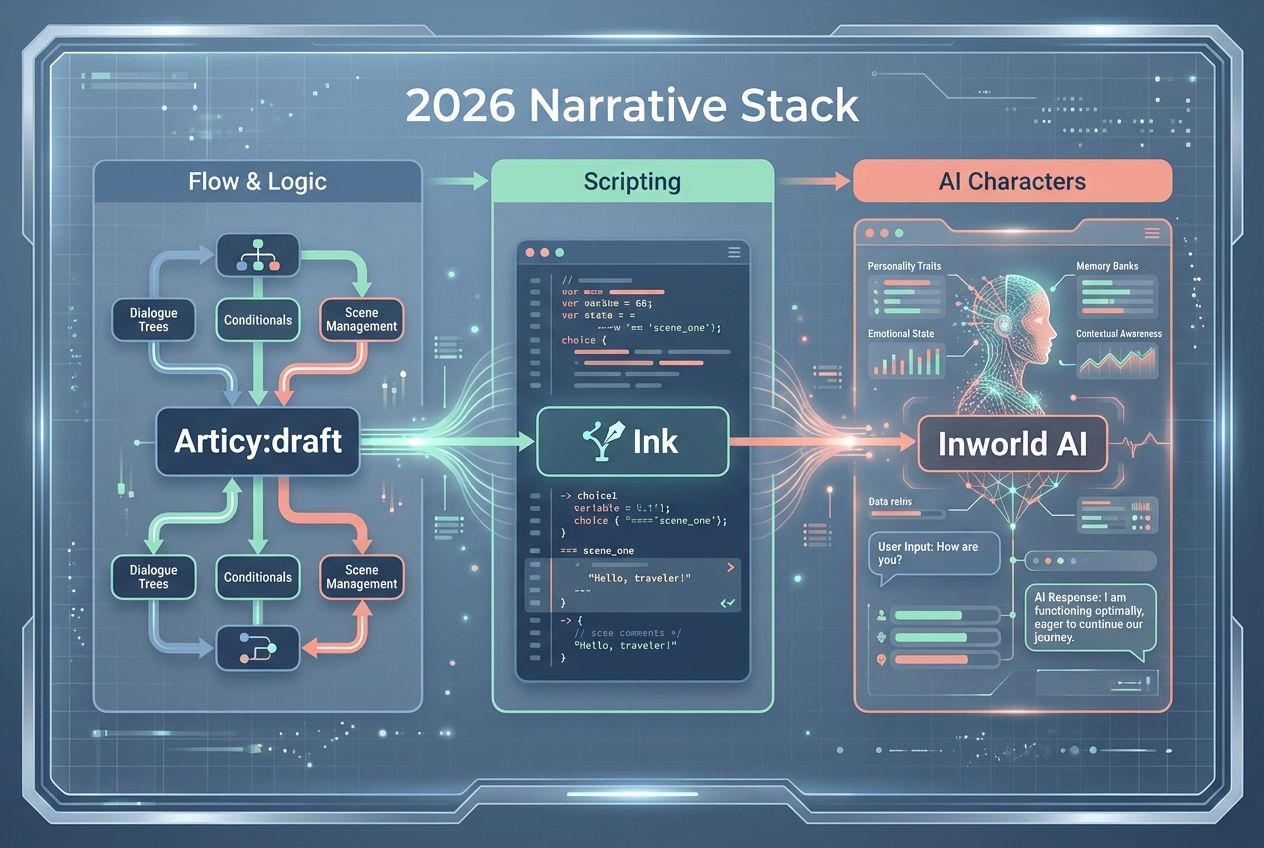
| Tool Category | Recommended Software | Use Case |
|---|---|---|
| Flow & Logic | Article: draft 3, Arcweave | Mapping complex branching dialogue trees visually. |
| Scripting | Ink, Yarn Spinner | Writing dialogue that integrates directly into Unity/Unreal. |
| AI Characters | Inworld AI, Replica Studios | Creating dynamic NPCs with personality parameters. |
Code skills matter more than ever. You don’t need to be a full-stack engineer, but knowing the basics of Python or Lua allows you to weave code with narrative to adjust stories as players interact.
The growing role of AI in narrative creation
AI is changing how stories are made in games and apps. Tools like Inworld AI are leading the charge with “Neo NPCs.”
Unlike old chatbots, these characters have memory modules, emotional profiles, and specific knowledge bases. They can remember that you stole an apple three towns ago and treat you poorly because of it. This isn’t just random text generation; it’s a “Narrative Graph” that ensures the AI stays on plot while improvising the dialogue.
Studios now feed player choices into machine learning models so the next scene fits what the audience does. That means more interactive narratives and collective storytelling where everyone shapes part of the arc.
Writers have to learn new skills to guide these smart systems while keeping stories fun. As AI gets smarter by 2026, watch how it links gameplay mechanics even closer with storytelling features.
Final Thoughts: Redefining the “Hero”
Storytelling in 2026 breaks the old mold. We are leaving the rigid Hero’s Journey behind for richer, multi-threaded paths. We covered non-linear plots, group stories like Helldivers 2, and the tech magic of Inworld AI that brings tales to life.
These ideas make story design smoother, faster, and easier for both makers and players. A good narrative adds huge value; it keeps people thinking long after their screens go dark or actors step off stage.
Want to keep learning? Check out the documentation for Articy: draft or try building a simple text game in Ink. As someone who builds with code every day, I see how small changes in story structure spark big leaps in fun, so take a shot at compiling your own story differently next time!