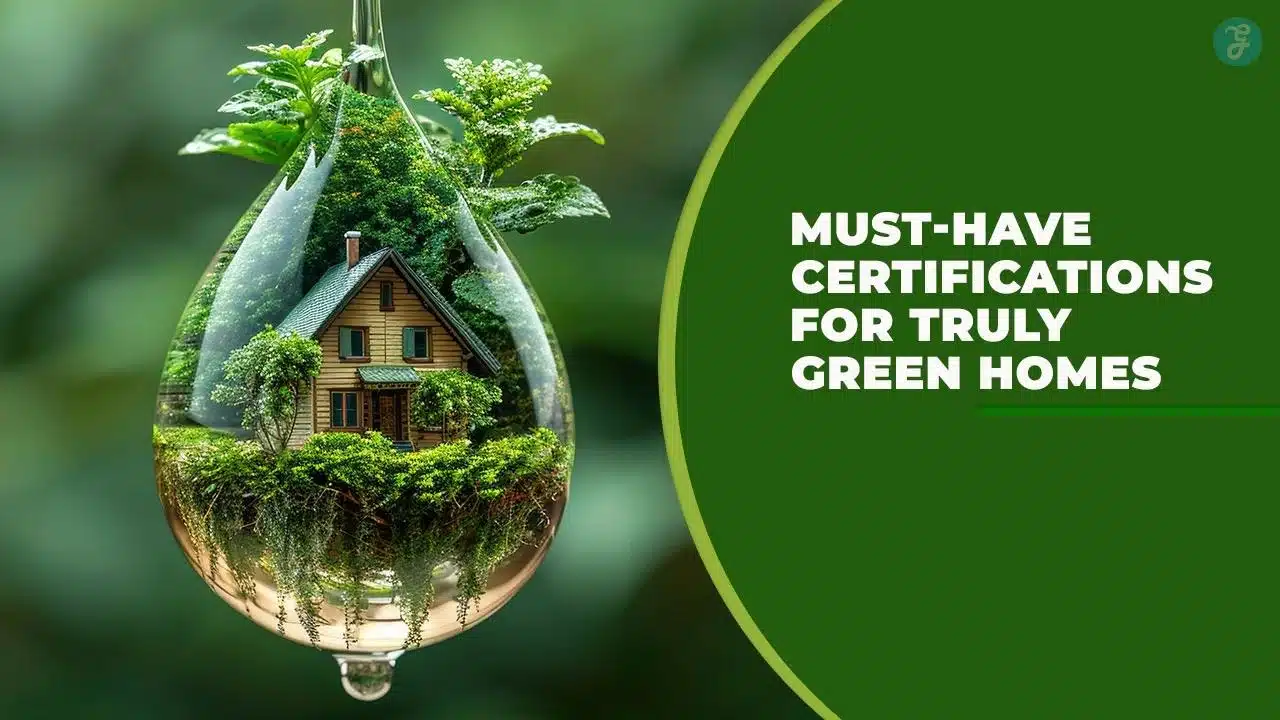
The language around sustainability has changed. “Eco-friendly” once meant a low-flow showerhead and a recycling bin. Today, buyers, regulators, and lenders expect proof that a home performs better. That proof increasingly comes in the form of green home certifications.
These labels do more than decorate a brochure. They verify that a home meets measurable standards for energy use, water efficiency, indoor air quality, and broader environmental impact. In a housing market grappling with climate risk and rising utility costs, green home certifications now shape everything from appraisals to insurance decisions.
Why Green Home Certifications Matter More Than Ever
For many households, sustainability starts with intent: use less energy, waste less water, improve comfort. Yet intent can easily dissolve into marketing. Certifications step in to translate ambition into verifiable criteria.
Most green home certifications check several pillars:
- Energy efficiency – insulation, airtightness, HVAC, lighting, and appliances
- Water efficiency – fixtures, landscaping, and sometimes reuse systems
- Materials – responsible sourcing and lower embodied impacts
- Indoor environmental quality – ventilation, filtration, moisture control, and low-emission finishes
- Site and community – land use, access to transport, and sometimes resilience
Homes that meet these standards often deliver tangible benefits: lower utility bills, more stable indoor temperatures, better air quality, and reduced carbon footprints. They can also command higher resale values and qualify for tax credits, rebates, or preferential mortgage products.
In other words, certification transforms “this home is green” from a claim into a testable statement.
1. LEED for Homes: Global Benchmark for Certified Green Homes
LEED for Homes sits at the top of many sustainability shortlists. Run by the U.S. Green Building Council (USGBC), LEED—Leadership in Energy and Environmental Design—is widely described as the most recognized green building rating system in the world.
For residential projects, LEED offers dedicated tracks that cover single-family houses, townhomes, and multifamily buildings. LEED-certified homes must meet prerequisites in several categories and can then earn points toward four certification levels:
- Certified
- Silver
- Gold
- Platinum
The categories themselves underline how comprehensive a certified green home must be under LEED. They include location and transportation, sustainable sites, water efficiency, energy and atmosphere, materials and resources, and indoor environmental quality, along with innovation and regional priorities.
In practice, that can translate into:
- Efficient building envelopes and HVAC systems
- Responsible stormwater management
- Low-VOC paints and finishes
- Verified ventilation rates and daylighting
- Thoughtful site planning to reduce car dependence
How LEED for Homes Works in Practice
LEED is not a self-certification. Projects must work with an accredited team, including a LEED Green Rater, and undergo onsite inspections and performance testing.
For homeowners and small developers, this has clear upsides:
- Strong market recognition
- Rigorous third-party oversight
- Structured path to higher performance
The trade-offs are cost and complexity. Documentation requirements can feel heavy, particularly for one-off custom homes. However, for many high-end or institutional projects, LEED remains the reference point among green home certifications, especially where investors and municipalities already understand the label.
2. ENERGY STAR Certified Homes: The Entry-Level Green Home Certification
Where LEED sets a broad sustainability framework, ENERGY STAR Certified Homes zero in on energy performance. Administered by the U.S. Environmental Protection Agency, ENERGY STAR labels homes that meet a defined set of energy-efficiency requirements.
These homes must be independently verified and are designed to be at least about 10% more efficient than standard code-built homes, often delivering greater savings in practice. In the context of green home certifications, ENERGY STAR often serves as a baseline.
It focuses on:
- High-performance windows and insulation
- Efficient heating, cooling, and ventilation systems
- Tight construction to reduce air leaks
- Qualified lighting and appliances
Because the program is national in scope, many utilities and states tie rebates or incentives to ENERGY STAR-labeled homes. That makes it an accessible first step for builders who want a recognized label without the broader scope and paperwork of LEED.
Why ENERGY STAR Still Matters for Buyers
For homebuyers, the blue ENERGY STAR mark offers a simple signal: this home should use less energy for heating, cooling, and hot water than a typical new home built to minimum code. That can translate into lower monthly bills and greater comfort, with fewer drafts and temperature swings.
In appraisals and lending decisions, ENERGY STAR sometimes functions as a shorthand. Lenders and underwriters may not know every residential green building certification, but ENERGY STAR is familiar, easy to verify, and backed by federal agencies. That recognition keeps it relevant even as more advanced programs enter the market.
3. National Green Building Standard (NGBS Green): Flexible, Whole-Home Framework
The National Green Building Standard (NGBS Green) takes a whole-building view that sits somewhere between ENERGY STAR’s energy focus and LEED’s broader sustainability net. Developed as the ICC 700 standard and administered today by Home Innovation Research Labs, NGBS Green provides third-party verification that a home or development meets defined green building performance levels.
NGBS Green looks at six major categories:
- Lot design and development
- Resource efficiency
- Water efficiency
- Energy efficiency
- Indoor environmental quality
- Operation and maintenance
Projects earn points across these categories, leading to tiered certifications that typically range from lower to higher performance levels (for example, Bronze through Emerald, depending on the version). This structure gives builders flexibility: they can lean more heavily on the strategies that work best for their climate and market.
Where NGBS Green Fits in Residential Green Home Certifications
NGBS Green is often attractive to production builders, multifamily developers, and community-scale projects. It integrates relatively well with other green home certifications and can sometimes sit alongside ENERGY STAR or HERS ratings.
For buyers, the appeal lies in balance. NGBS Green demands credible performance in energy and water use, but it also considers durability, site selection, and long-term operations. That makes it a useful label for households seeking more than energy savings alone, but who may not need the global profile of LEED.
4. Passive House: Ultra-Low-Energy Standard for True Performance
If LEED and NGBS Green aim for broad sustainability, Passive House goes deep on one core issue: operational energy. Originating in Europe and now administered through the Passive House Institute (PHI) and Passive House Institute US (PHIUS), these standards define an ultra-low-energy building based on strict performance criteria.
Rather than prescribing specific technologies, Passive House sets hard limits for:
- Annual space heating demand
- Cooling demand
- Primary energy use
- Airtightness and thermal comfort
- To meet those limits, Passive House homes typically feature:
- High levels of continuous insulation
- Virtually thermal-bridge-free design
- Exceptional airtightness
- High-performance windows and doors
- Mechanical ventilation with heat recovery
The result is a home that can reduce heating and cooling demand dramatically compared with conventional construction. In many climates, internal heat gains and passive solar energy cover a large share of heating needs.
Is Passive House Right for Every Certified Green Home?
From an energy perspective, Passive House sits at the sharp end of green home certifications. Yet it is not always the right fit.
Design teams must understand the standard early in the project, and construction quality has to be meticulous. Upfront costs can rise, especially in markets where builders are unfamiliar with airtight construction or triple glazing. However, long-term savings in energy bills and the comfort of stable indoor temperatures attract homeowners who intend to stay in place for years.
For those households, Passive House can serve as the backbone of their sustainability strategy, with other residential green building certifications layered on top if desired.
5. DOE Zero Energy Ready Home: Preparing for Net-Zero Living
Moving from deep efficiency to net-zero potential brings us to the U.S. Department of Energy’s Zero Energy Ready Home (ZERH) program, now aligned under the broader DOE Efficient New Homes framework. ZERH homes are designed so efficiently that a properly sized renewable energy system, such as rooftop solar, could offset most or all of their annual energy use. ZERH requirements build on ENERGY STAR and other baseline programs.
They typically include:
- Advanced insulation and air-sealing strategies
- High-efficiency HVAC and hot water systems
- Enhanced moisture management and ventilation
- Quality-controlled installation standards
Many ZERH-certified homes can access the U.S. Section 45L tax credit when they meet the program version in effect at the permit date, which can be worth several thousand dollars per home.
Why Zero Energy Ready Is Emerging as a Must-Have Label
In policy conversations, ZERH increasingly appears as a reference point for future codes and incentive structures. For homeowners, it offers something straightforward: a home that is already built to a standard compatible with net-zero operation.
This can matter in several ways:
- Protection against rising energy prices
- Easier integration of on-site solar and storage
- Strong narrative for climate-conscious buyers and lenders
Among green home certifications, ZERH signals clear alignment with climate goals. It reassures future buyers that the home will not feel outdated as performance expectations tighten.
6. HERS Index: The Score Behind Many Green Home Certifications
Not every label on this list is a “certification” in the traditional sense. The Home Energy Rating System (HERS) Index, administered by RESNET, functions as a standardized scoring system rather than a full sustainability label. Yet it underpins many green building certifications for homes and plays a central role in energy codes and mortgages in the United States.
In simple terms, the HERS Index is a numerical score. Lower scores indicate better energy performance. A reference home built to a baseline standard is scored at 100; each point lower represents roughly a one-percent improvement in energy efficiency relative to that baseline. New high-performance homes often target HERS scores in the 40–60 range, and net-zero homes can approach zero.
To generate a HERS score, a certified rater carries out:
- Plan review and energy modeling
- On-site inspections during and after construction
- Blower-door testing and sometimes duct testing
- Using HERS to Compare Residential Green Building Certifications
Because the HERS Index offers a single, comparable metric, many programs—including ENERGY STAR, ZERH, and NGBS—either reference or require a HERS rating. For buyers, HERS provides an intuitive way to compare homes even when the underlying certifications differ. For appraisers and lenders, it adds data to support valuations and underwriting decisions.
When evaluating green home certifications, asking for the HERS score can quickly reveal whether a home’s energy performance matches the marketing.
7. BREEAM and Home Quality Mark: International Green Building Certifications for Homes
While many of the programs discussed so far are North American, BREEAM and its residential offshoots extend the conversation globally. Created in 1990 by the UK’s Building Research Establishment (BRE), BREEAM is often cited as the first green building certification program and remains one of the most widely used, with hundreds of thousands of certificates across dozens of countries.
BREEAM assesses buildings across categories such as:
- Energy
- Water
- Materials
- Waste
- Health and well-being
- Transport
- Land use and ecology
- Management and resilience
For new homes specifically, BRE has developed the Home Quality Mark (HQM). Built on the same scientific framework as BREEAM, HQM aims to help housebuilders demonstrate performance and sustainability to the market, particularly in the UK.
When BREEAM Makes Sense for a Green Home
For an individual homeowner operating solely in a local market, BREEAM may feel less familiar than LEED or ENERGY STAR. But for developers with international portfolios—or for projects targeting institutional investors and ESG-focused funds—BREEAM’s long track record and global benchmarking provide strong advantages.
In that context, BREEAM and HQM belong on any shortlist of residential green building certifications that signal serious environmental performance beyond national borders.
How to Choose the Right Green Home Certifications for Your Project
With so many options, choosing a certification is less about finding a single “best” label and more about matching the program to your context.
Start with Your Market and Climate
Location matters. Some programs, such as HQM and certain Passive House variants, are stronger in specific regions or countries. Others, like ENERGY STAR and NGBS, are tuned to U.S. codes and incentives. Local climate also shapes which strategies will deliver the greatest benefits.
A cold-climate custom home might gain more from Passive House-level envelope performance. A mixed-use development in a dense urban area might lean toward LEED or BREEAM, where site and community connections carry more weight.
Clarify Your Performance Priorities
Not every household has the same priorities. Before you shortlist green home certifications, decide which outcomes matter most:
- Lowest possible energy bills and carbon emissions
- Healthy indoor air and low-emission materials
- Water conservation and resilience to drought
- Alignment with corporate ESG reporting or investor requirements
For pure energy performance, a combination of HERS, ENERGY STAR, and ZERH may suffice. For a broader sustainability story, LEED, NGBS, or BREEAM can anchor the project, with additional metrics layered on top.
Balance Certification Costs Against Long-Term Value
Certification is not free. Program fees, consultant time, testing, and documentation all add cost. The question is whether those costs generate enough value through:
- Reduced operating expenses
- Higher resale or rental income
- Access to tax credits, rebates, or green financing
- Lower long-term risk as regulations tighten
For many projects, the most cost-effective path is to use one or two well-aligned green building certifications for homes rather than chasing every available label. A thoughtful combination—such as ENERGY STAR plus ZERH, or NGBS plus HERS—can deliver strong performance and credible documentation without overwhelming the budget.
Final Thoughts: Certification as a Signal, Not a Shortcut
The rise of green home certifications reflects a broader shift. Housing is no longer judged solely by square footage and finishes. Performance now matters—how much energy a home uses, how it handles water, how it affects the health and comfort of its occupants, and how it fits into a carbon-constrained world.
LEED for Homes, ENERGY STAR, NGBS Green, Passive House, DOE Zero Energy Ready Home, the HERS Index, and BREEAM/HQM each offer a different lens on what a certified green home should be. None is perfect, and none can guarantee sustainability on its own. But together, these residential green building certifications give homeowners, builders, and regulators a shared language—and a set of tools—to move beyond promises and measure what truly counts.
For anyone planning a new build or deep retrofit today, the choice is no longer whether to certify. The real question is which combination of certifications best reflects your climate, your budget, and your definition of “truly green.”