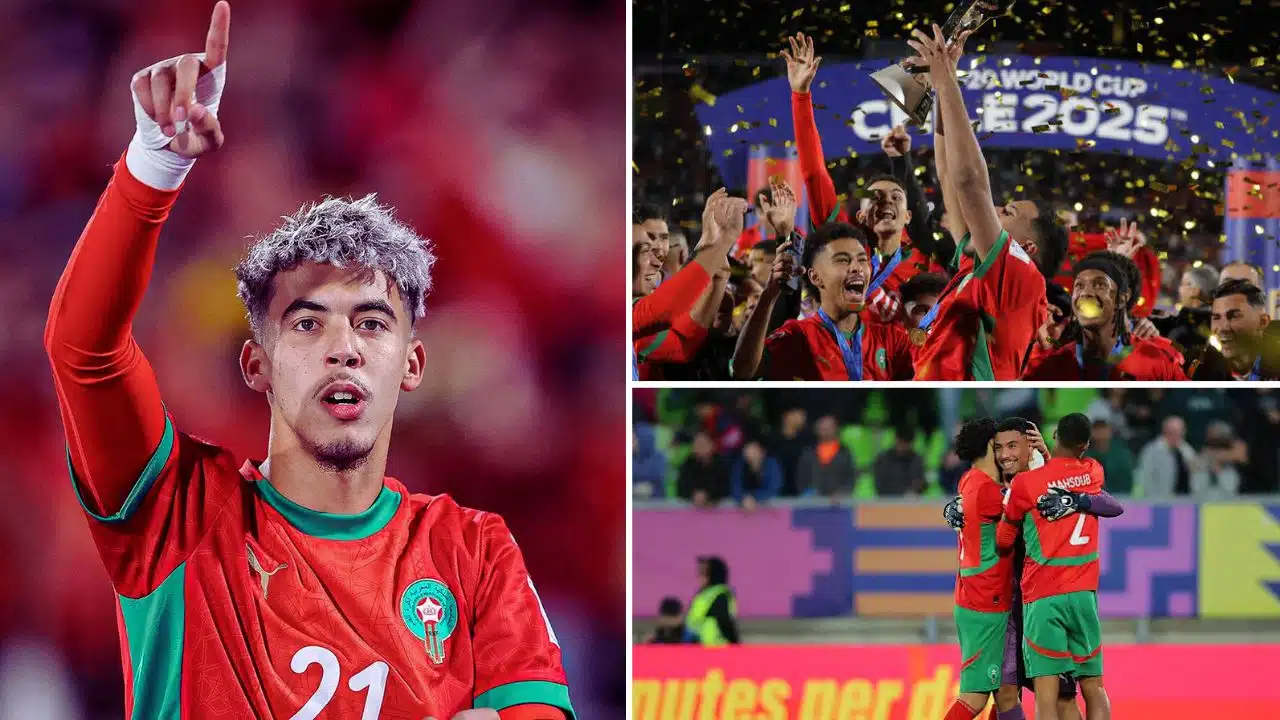
Morocco’s U20 team, the Atlas Cubs, completed a fairy-tale run by winning their first-ever FIFA U20 World Cup title, defeating host nation Argentina 2-1 in a pulsating and hard-fought final on Sunday night at the Estadio Único Madre de Ciudades.
A dramatic 88th-minute header from substitute striker Youssef El Idrissi sealed the historic victory, silencing the packed stadium and crowning an African nation as champions for the first time since 2009. The win represents a landmark achievement for Moroccan and African football, built on a foundation of tactical discipline, relentless counter-attacks, and unwavering team spirit that captivated the world over the past three weeks.
Key Facts from the Final
- Historic Victory: This is Morocco’s first-ever FIFA U20 World Cup title and the first for an African team since Ghana’s victory in 2009.
- Final Score: Morocco defeated Argentina 2-1. Salim Benghazi scored the opener (45+2′), with Argentina’s Alejo Véliz equalizing (61′) before Youssef El Idrissi’s late winner (88′).
- Golden Ball Winner: Moroccan captain Oussama El Azzouzi was awarded the Adidas Golden Ball as the tournament’s best player for his commanding midfield performances.
- Argentine Disappointment: Despite strong home support and being the record six-time champions, Argentina fell just short of a seventh title.
- Match Statistics: Morocco recorded 8 shots on target from 12 total attempts, despite having only 42% of the possession, highlighting their clinical efficiency.
An Unforgettable Final for the Ages
The final kicked off in a cauldron of noise, with over 30,000 Argentine fans creating an intimidating atmosphere. Argentina, led by coach Javier Mascherano, dominated the early possession, pinning Morocco back with quick passing and pressure from wingers Luka Romero and Valentín Carboni.
However, Morocco’s defensive wall, marshalled by centre-back Ayman El Wafi, held firm. The Atlas Cubs weathered the storm and began to pose a threat on the break. Their strategy paid off just before halftime. In the second minute of stoppage time, a swift counter-attack saw winger Saîf-Eddine Chlaghmo deliver a pin-point cross for midfielder Salim Benghazi, who fired a low, first-time shot past Argentine goalkeeper Federico Gomes Gerth to give Morocco a stunning 1-0 lead.
The second half saw a re-energized Argentina lay siege to the Moroccan goal. Their persistence was rewarded in the 61st minute when striker Alejo Véliz rose highest to head home a corner kick, sending the home crowd into a frenzy.
With the score tied and extra time looming, the game became a tense, tactical battle. Both sides traded blows, but it was a moment of brilliance from Morocco that decided the contest. With just two minutes of normal time remaining, El Azzouzi launched a searching long ball towards the Argentine box. Substitute Youssef El Idrissi, on the pitch for less than ten minutes, out-jumped his marker and looped a magnificent header over the stranded goalkeeper and into the back of the net.
The final whistle sparked scenes of jubilation among the Moroccan players and staff, who sank to their knees in prayer and celebration, while a stunned silence descended upon the home supporters.
Data-Driven Dominance: The Atlas Cubs’ Path to Glory
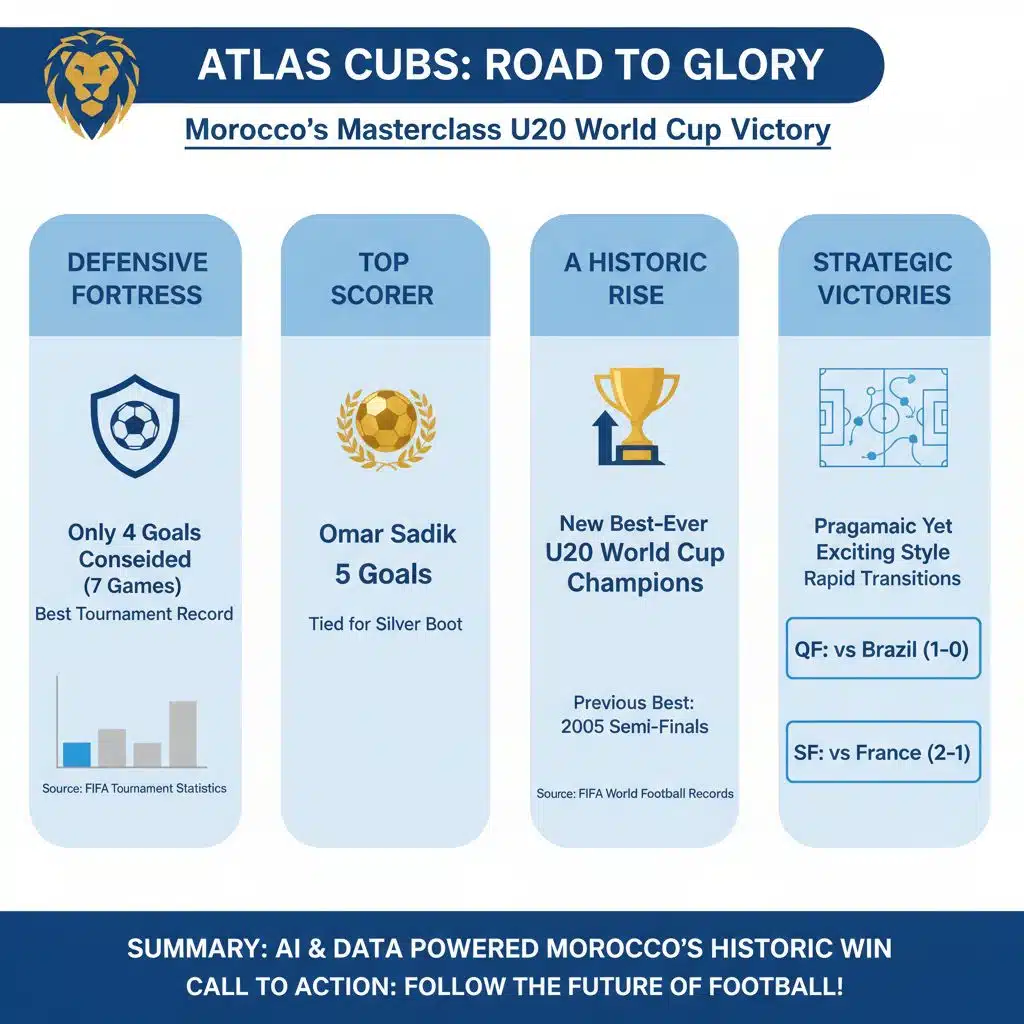
Morocco’s victory was no fluke. It was the culmination of a masterfully executed tournament plan by coach Mohamed Ouahbi. Their journey was defined by defensive solidity and lethal efficiency.
- Defensive Fortress: Throughout the knockout stages, Morocco conceded only three goals in four matches. Their total goals against for the entire tournament was just four in seven games, the best defensive record of any team.
- Top Scorer: Forward Omar Sadik finished as the team’s top scorer with 5 goals, tying for the tournament’s Silver Boot award.
- A Historic Rise: Prior to this year, Morocco’s best-ever finish at the U20 World Cup was a semi-final appearance in 2005. This victory represents a monumental leap for the nation’s football development programs.
The team’s style was pragmatic yet exciting, absorbing pressure for long periods before unleashing rapid transitions that consistently caught more possession-heavy teams off guard. Their victories against Brazil in the quarter-finals (1-0) and France in the semi-finals (2-1) were textbook examples of this successful strategy.
Official Reactions and Expert Analysis
Following the match, Moroccan coach Mohamed Ouahbi was overcome with emotion. In the official post-match press conference, he dedicated the win to the nation.
Football analysts have praised Morocco’s tactical maturity. ESPN football correspondent Julien Laurens noted, “What Morocco did was incredible. They were not the most talented team on paper, but they were the best team. Their organization, their discipline, and their belief in the coach’s system were second to none. Argentina had the ball, but Morocco had the plan.
Celebrations from Rabat to Casablanca
The victory ignited massive, spontaneous celebrations across Morocco. In major cities like Casablanca, Rabat, and Marrakech, streets were filled with cheering crowds waving flags, setting off fireworks, and chanting the names of their new heroes.
“We have waited for this moment our whole lives!” exclaimed Fatima Alami, a 22-year-old student celebrating with friends in Rabat, her voice hoarse from cheering. “To beat Argentina, in their home… it is more than a dream. These boys have made the whole country, the whole of Africa, proud.”
The outpouring of joy reflects the immense significance of this achievement for a nation deeply passionate about football, coming less than three years after the senior team’s historic run to the FIFA World Cup semi-finals in Qatar.
What Comes Next?
For Argentina, the heartbreak of a home final loss will be immense, but the tournament has showcased a new generation of talent like Véliz and Carboni who are expected to transition to the senior squad.
For Morocco, the future is incredibly bright. Players like Oussama El Azzouzi, Ayman El Wafi, and Omar Sadik are now on the radar of major European clubs. This victory is expected to accelerate the development of football infrastructure within Morocco and inspire millions of young children across Africa to pursue the sport. The world will be watching to see if this golden generation can translate its youth-level success to the senior international stage.
The Information is Collected from ESPN and Yahoo.