If Lionel Messi lifts the MLS Cup with Inter Miami, it won’t just be another trophy. It will be another data point in an argument that already feels settled.
He is already the most decorated footballer in history with 47 trophies. He already owns the all-time assist record with 405 career assists. He already has the World Cup, Copa América, Champions League, Olympic gold, and a record eight Ballon d’Ors. So the real question is slightly different:
What would an MLS Cup add to Messi’s post-World Cup story—and what does his Inter Miami journey say about his place in world football? Let’s trace that arc from Qatar to Fort Lauderdale.
From Lusail to Miami: The Night Everything Changed
On 18 December 2022, in Lusail, Messi finally grabbed the one trophy that had escaped him. Argentina’s wild 3–3 draw with France and penalty-shootout win produced perhaps the greatest final in World Cup history, with Messi scoring twice and calmly converting his penalty in the shootout.
That night did three things at once
- Closed the “GOAT” argument for many fans.
- Changed his relationship with Argentina, lifting the weight of 2014 and earlier failures.
- Freed him to think about football differently. If the biggest prize was finally in the bag, what came next didn’t have to be about chasing Europe’s harshest spotlight.
In October 2023, he was rewarded again: a record-extending 8th Ballon d’Or, largely for that World Cup run and his decisive role in Qatar. By then, the next chapter was already underway—in Florida.
Why Inter Miami? A Different Kind of Superclub
In July 2023, Messi signed for Inter Miami CF in MLS, turning down more lucrative offers from Saudi Arabia and a fairytale return to Barcelona. On paper, the move looked like a step down in sporting level.
In reality, it was a step sideways into a different kind of football project:
- A league hungry for relevance outside North America.
- A club partly owned by David Beckham, trying to build a global brand.
- A commercial ecosystem involving Apple’s MLS Season Pass, shirt sponsors, and a push to turn MLS into appointment viewing.
Within weeks, the impact was visible:
- Attendance spikes and sell-outs whenever Miami played, home and away.
- A jump in Apple TV’s MLS Season Pass subscriptions.
- A social media surge that pushed Inter Miami into the same digital conversation as European giants.
Messi hadn’t just joined a club. He’d joined a project to rewire U.S. soccer’s place in world football.
Season One (2023): Landing and Winning Immediately
Messi’s first months in Miami were a reminder that he can turn chaos into choreography almost overnight.
Leagues Cup: The First Pink Trophy
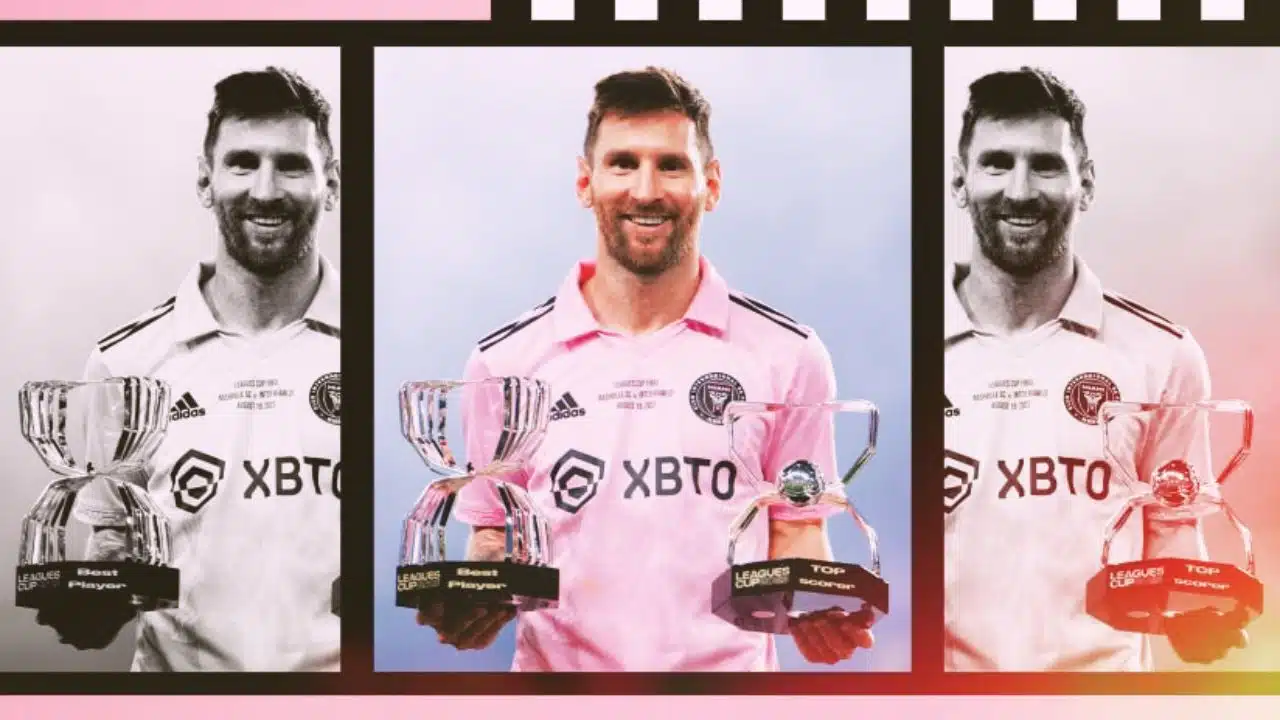
Within weeks of his debut, Inter Miami—bottom of the MLS table at the time—won the 2023 Leagues Cup, the first major trophy in the club’s history. Messi finished as the top scorer and the undisputed star of the tournament.
It set the tone:
- This wasn’t a ceremonial last dance.
- A struggling MLS franchise suddenly had a serial winner at its core.
The Statistical Preview of What Was Coming
Even with injuries and load management, Messi’s early numbers in 2023 hinted at a new storm:
- Goals, free-kicks, late winners.
- A habit of scoring or assisting in virtually every match he played.
It felt like an accelerated trailer for what a full season could look like.
Season Two (2024): Messi Turns MLS Into a Laboratory
2024 was the season MLS learned what it means to build a team around Lionel Messi for a full year.
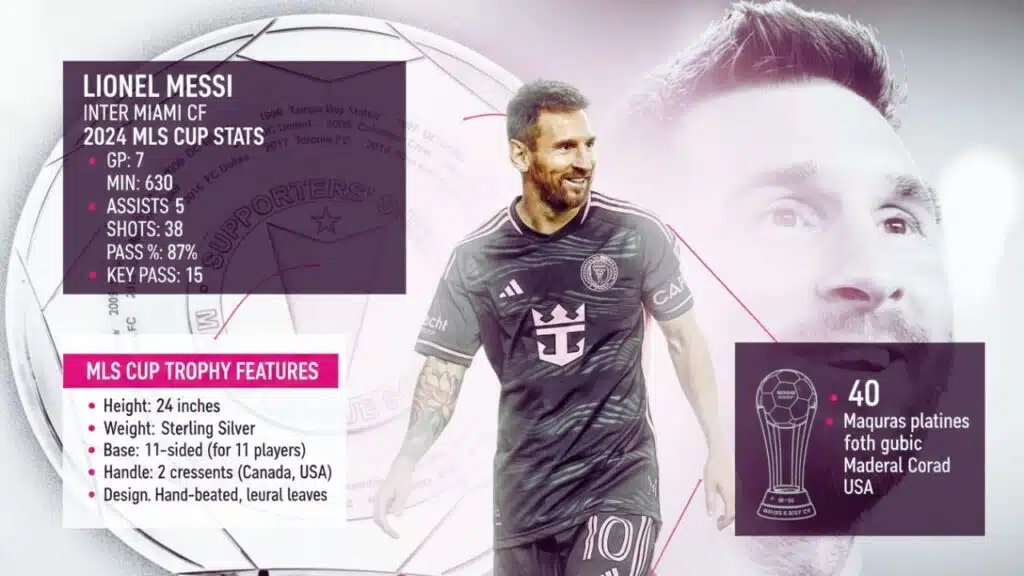
According to detailed tracking from Messi vs. Ronaldo’s stat database, by late 2025, Messi’s Inter Miami totals stood at 77 goals and 41 assists in 87 games in all competitions for the club.
1. Narrow it down to MLS league play, and it looks even more brutal:
- 50 goals and 28 assists in 53 MLS matches, averaging a goal every 86 minutes and a goal or assist every 55 minutes.
2. These are not nostalgia numbers. They’re prime output in a new environment.
In 2024 specifically:
- Messi’s productivity and on-field control powered Inter Miami from novelty act to serious contenders, and he went on to win MLS MVP.
By the end of that year, it was clear: MLS hadn’t slowed Messi down; it had given him a different kind of canvas.
Season Three (2025): Records, Dominance, and the Road to MLS Cup
If 2023 was the explosion and 2024 was the consolidation, then 2025 is the coronation phase of his Miami journey.
1. 2025: The Numbers of a League-Warping Star
By the close of the 2025 regular season and playoff run into MLS Cup:
- Messi captured the MLS Golden Boot with a league-leading goal tally (29 league goals).
- He combined that with 19 league assists, sitting at the top of both scoring and creative charts.
In the 2025 MLS Cup Playoffs:
- Inter Miami reached their first-ever MLS Cup final with a 5–1 demolition of NYCFC in the Eastern Conference decider.
- Tadeo Allende grabbed the headlines with a hat-trick, but Messi quietly added another assist, his seventh of the postseason.
Across his MLS Cup games overall for Inter Miami, the numbers are stark:
- 7 goals and 6 assists in 8 MLS Cup matches – that’s a goal or assist every 55 minutes in the league’s showpiece competition.
This is the definition of a big-game player still operating at the sharp end.
2. The Assist Record and Trophy No. 47
In that same 5–1 win over NYCFC, Messi’s pass to Mateo Silvetti did more than break a playoff tie.
It broke history:
- It was his 405th career assist, making him the all-time leader in recorded football history, surpassing Ferenc Puskás.
The match also locked in another milestone:
- Inter Miami’s Eastern Conference title became Messi’s 47th career trophy, cementing his status as the most decorated footballer of all time.
That’s the backdrop to the MLS Cup Final: he’s not chasing greatness; he’s extending it.
What Would an MLS Cup Actually Add?
Purely in trophy math, an MLS Cup would be Trophy No. 48 for Messi – every additional piece of silverware now extends a record nobody else owns.
But there are deeper layers:
1. Completing the “American Chapter.”
Messi has already:
- Won the Leagues Cup with Inter Miami.
- Claimed the Supporters’ Shield in 2024, as documented in recent breakdowns of his trophy cabinet.
An MLS Cup would mean:
- He has lifted every major club trophy on offer in his new environment.
- Inter Miami’s transformation—from bottom-of-the-table expansion team to champions—would be tightly bound to his presence.
He’d be remembered not just as someone who touched MLS, but someone who defined an era of it.
2. An Unmatched Set of Major Titles
Add an MLS Cup to Messi’s list, and you’re looking at a set that would read roughly as:
- World Cup and two World Cup Golden Balls (2014, 2022).
- Copa América 2021 and 2024.
- Four Champions League titles with Barcelona.
- Domestic league titles in Spain and France, plus major titles in MLS.
- Olympic Gold with Argentina in 2008.
Is there another player in history with that combination of:
- World Cup
- Multiple continental titles
- Multiple Champions Leagues
- Olympic gold
- Major trophies in three different club systems (La Liga, Ligue 1, MLS)
- And a leading role in all of them?
Not at this scale. Even without calling it a single “official record,” it’s a uniquely dense honours map.
Inter Miami and Messi’s Contribution to World Football
It’s easy to focus on the trophies and lose sight of the structural impact. Messi’s Inter Miami chapter matters for world football in three broad ways.
1. Redefining the “End of Career” Map
Before Messi, the default late-career path for European stars was:
- Brief stop in MLS or the Gulf,
- Low expectations,
- More farewell tour than sporting project.
Messi has altered that template:
- He arrived as World and Ballon d’Or champion, not as a faded star looking for minutes.
- He maintained near-prime productivity: almost a goal a game and another assist every other match for Inter Miami.
- He helped drag an entire franchise into relevance and push a league into a new commercial phase.
This sets a precedent: you can leave Europe and still shape the sport’s future, not just its nostalgia.
2. Accelerating MLS’s Global Integration
Off the pitch, the numbers underline his role as a market shaper:
- Attendance and ticket prices for MLS matches involving Miami shot up, driving sell-outs and scrambling stadium logistics.
- Apple’s gamble on the MLS Season Pass got a global marketing engine overnight – Messi became the subscription driver the service couldn’t buy in any other way.
- Inter Miami’s social-media and shirt sales rocketed into European-club territory.
The wider effect is subtle but real: North American club football has moved closer to the global center of the game’s attention.
3. Extending the Technical Legacy
At Inter Miami, Messi’s game has evolved again:
- Fewer long dribbles, more short, surgical movements.
- A deep-lying playmaking role where he dictates tempo, connects lines, and executes the final pass.
- Still enough acceleration to separate in tight spaces and score from distance.
His Inter Miami phase is a live lesson in how elite playmakers can age into the game without losing impact—something coaches and academies will study for years.
The Bigger Picture: From Qatar to a Sixth World Cup
One more angle: Messi isn’t done at the national-team level.
Alongside Cristiano Ronaldo, he is on course to become one of the first men ever to appear at six World Cups when 2026 kicks off in the U.S., Canada, and Mexico.
If he arrives at that tournament as:
- The reigning World Cup champion,
- The most decorated player ever,
- The man who turned Inter Miami into title winners in MLS,
It reinforces the idea that his Miami chapter isn’t a quiet epilogue. It’s a bridge between football’s traditional power centers and its future ones.
So, Will MLS Cup Be “Another Record”?
If Inter Miami wins the MLS Cup Final with Messi at the heart of it, a few things happen at once.
- His trophy record rises to 48, further out of reach.
- He would complete the full domestic-trophy set in the U.S. (Leagues Cup, Supporters’ Shield, MLS Cup) as the undisputed main man.
- The narrative of his post-2022 career becomes clear:
not a gentle fade, but a second peak in a new football universe.
Will it be the record that settles debates?
Probably not—those debates are emotional, not empirical. But in the logic of his career, an MLS Cup would be one more step in a pattern that has defined him from Rosario to Barcelona, Paris, Doha, and now Miami:
- Go somewhere.
- Change the expectations.
- Redefine what’s possible.
Whether he wins the final or not, Messi’s uprising journey with Inter Miami has already changed MLS and extended his influence on world football.
If he does win it, we won’t just mark another record. We’ll mark another moment when the sport had to adjust its scale to fit Lionel Messi, one more time.