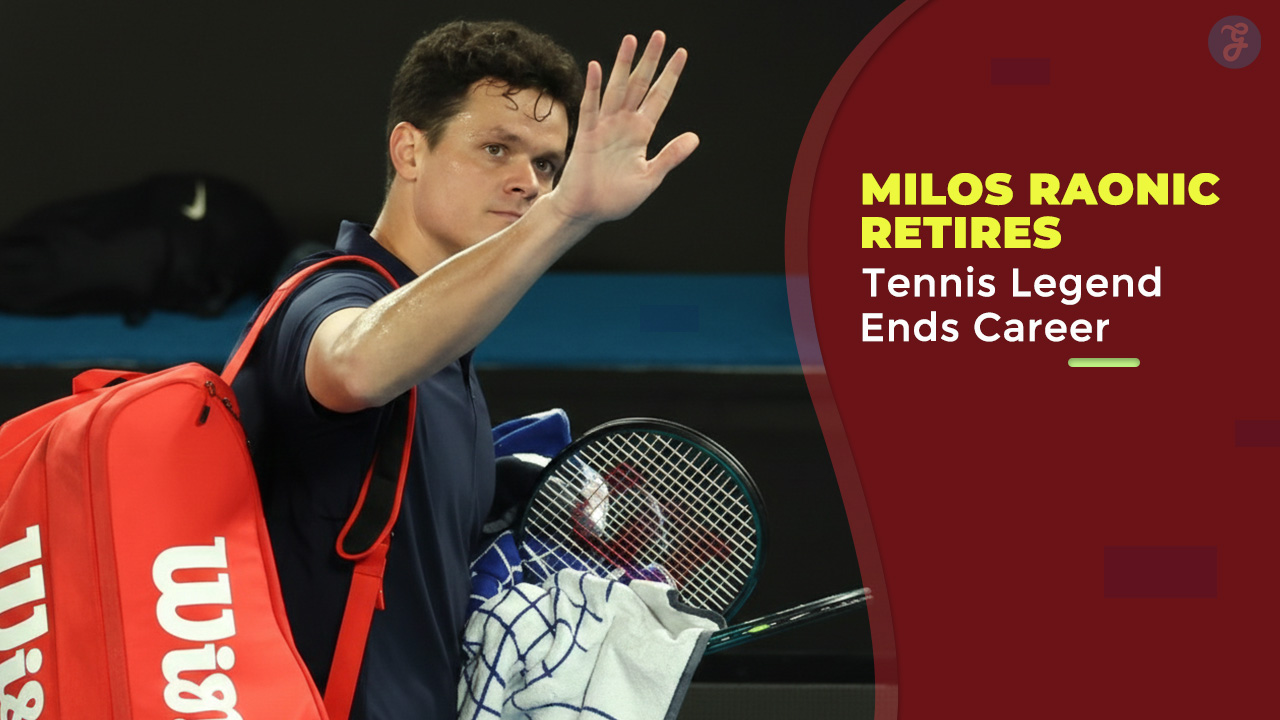
With the official announcement of Milos Raonic’s retirement on January 12, 2026, professional tennis loses one of its most defining servers, but Canada loses its pioneering architect. The “Missile” did not just fire aces; he shattered the ceiling of possibility for a nation that had never seen a male singles player reach a Grand Slam final. His departure marks the definitive close of the “breakthrough era” and forces a reckoning with the physical toll of modern power tennis.
Key Takeaways
- The Pioneer Effect: Raonic was the first Canadian male to crack the Top 10 and reach a Grand Slam final (Wimbledon 2016), directly paving the way for the successes of Felix Auger-Aliassime, Denis Shapovalov, and Leylah Fernandez.
- The Injury “What-If”: His career was a constant negotiation with his own body; despite world-class talent, he missed significant playing time in his prime due to adductor, glute, Achilles, and shoulder injuries.
- The “Big Three” Wall: Raonic’s prime coincided perfectly with the dominance of Djokovic, Nadal, and Federer, limiting his major title count despite Top-3 caliber play.
- Serve Dominance: He retires as statistically one of the top servers in Open Era history, holding the record for most aces in a best-of-three-set match (47).
The Architect of a Nation’s Belief
Before 2011, Canada was a “hockey nation” that occasionally dabbled in tennis. Milos Raonic changed the psychological baseline for the entire country. When he burst onto the scene with a fourth-round run at the 2011 Australian Open, he didn’t just play for himself; he validated the Tennis Canada development system. The National Training Centre in Montreal became a proven factory because Raonic was the proof of concept.
His retirement comes after an 18-month struggle to return from a shoulder injury sustained in 2025. His final match—a loss to Dominik Koepfer at the 2024 Paris Olympics—was a quiet end to a loud career. However, the ecosystem he leaves behind is thriving, a testament to the path he cleared.
The “Big Three” Barrier: Greatness Blocked by Legends

History may judge Raonic strictly by his trophy count (8 titles), but context is essential. He peaked during the most monopolistic era in tennis history. He was the prototype of the “challenger” class—players like Nishikori and Dimitrov—who had championship-level games but were consistently repelled by the defensive mastery of the Big Three.
The data below illustrates the specific tactical problem Raonic faced: his serve, a weapon of mass destruction against 99% of the tour, was often returned with interest by these three specific legends.
The “Big Three” Blockade
Raonic’s Head-to-Head record against the era’s titans.
| Opponent | Record (W-L) | Win % | Key Match Context |
| Novak Djokovic | 0 – 12 | 0% | The ultimate counter-puncher. Djokovic’s return neutralized Raonic’s serve better than anyone else in history. |
| Roger Federer | 3 – 11 | 21% | Highlight: Won 2016 Wimbledon Semi-final (Raonic’s greatest career win). |
| Rafael Nadal | 2 – 8 | 20% | Struggled with Nadal’s passing shots, but beat him at Indian Wells (2015) and Brisbane (2017). |
| Total | 5 – 31 | 13.8% | Takeaway: Raonic could beat anyone else, but the Big Three were a distinct tier he couldn’t consistently breach. |
The Body Betrayed the Will: Anatomy of a Stalled Prime
The narrative of Raonic’s career cannot be told without the medical charts. In an era where Djokovic and Nadal extended their primes into their mid-30s through elasticity and recovery, Raonic’s stiff, explosive power frame struggled to hold up. The “Missile” required a heavy launchpad, and the constant torque required to generate his 140mph+ serves eventually eroded the machine.
Timeline of Critical Interruptions
A look at the major injuries that derailed his momentum.
| Year | Injury / Event | Impact on Career Trajectory |
| 2011 | Hip Surgery | Stalled his initial breakout season just as he was rising. |
| 2015 | Foot Nerve (Morton’s Neuroma) | Required surgery; derailed a Top-4 ranking trajectory. |
| 2016 | Adductor Tear | Occurred during Australian Open SF vs. Murray while leading 2-1 in sets. A massive “What If” moment. |
| 2021-23 | Achilles & Glute | Missed nearly two full years (July 2021 – June 2023), effectively ending his time as a full-time contender. |
| 2025 | Shoulder | The final blow; prevented any further comeback attempts after the Olympics. |
The Legacy of the Serve
Raonic’s serve remains a case study in efficiency. Unlike the fluid, whip-like motion of Federer, Raonic’s was mechanical and violent—a true kinetic chain explosion.
- The Mechanics: He utilized a massive leg drive and a high contact point (6’5″ frame). His ability to hit all four corners of the service box with the same toss made his delivery unreadable.
- The Record: In June 2024 at Queen’s Club, Raonic set the all-time ATP record for aces in a best-of-three-set match (47) against Cameron Norrie, a final reminder of his raw power even in his twilight years.
- The Stat: He retires winning over 91% of his service games historically, a figure that places him in the pantheon alongside Isner and Karlovic.
The Serve Kings (Open Era Efficiency)
| Player | Height | Aces (Career) | Service Games Won % | Style |
| John Isner | 6’10” | 14,470 | ~92% | Angle & Height |
| Ivo Karlovic | 6’11” | 13,728 | ~92% | Pure Angle |
| Milos Raonic | 6’5″ | ~8,445 | ~91% | Power & Precision |
| Roger Federer | 6’1″ | 11,478 | ~88% | Placement & Disguise |
The “Raonic Effect”: A Nation Transformed

From a business and cultural perspective, Raonic was the catalyst for tennis becoming a tier-one sport in Canada. Before his rise, tennis funding was sparse, and media coverage was limited to the Grand Slams.
Canadian Tennis — Before vs. After Raonic
Measuring the impact of his career on the national ecosystem.
| Metric | Pre-Raonic Era (Pre-2010) | The Raonic Era & Legacy (2026) |
| Highest Male Ranking | Greg Rusedski (No. 41)* | Milos Raonic (No. 3) |
| Grand Slam Finals (Men) | 0 | 1 (Wimbledon 2016) |
| ATP Titles (Men) | Sparse (e.g., Laurendeau) | 8 (Raonic) + 5 (Felix) + 2 (Shapo) |
| Davis Cup | World Group Elevator Team | Champions (2022) |
| Top 20 Players | 0 | 3 (Raonic, Auger-Aliassime, Shapovalov) |
Note: Rusedski represented Canada before switching to Great Britain. Raonic is the first to achieve Top 10 status solely for Canada.
Expert Perspectives
The Supporter View
“Milos is the most underrated player of his generation. If he played in the 1990s on faster grass and hard courts, without the slow-court homogenization that favored baseliners like Djokovic, he wins 2-3 Slams easily.” — Former ATP Coach.
The Critical View:
“He maximized his tools, but his body was too rigid for the modern game. The injuries weren’t bad luck; they were the inevitable result of a heavy frame trying to move like a lightweight on hard courts for a decade.” — Sports Biomechanist.
Future Outlook: What Comes Next?
Hall of Fame Candidacy
Raonic’s numbers are borderline for the International Tennis Hall of Fame given the lack of a Major title. However, he is a lock for the Canadian Sports Hall of Fame. His influence on the growth of the game in a G7 nation may weigh heavily in his favor for international recognition eventually.
The Coaching Pivot
Raonic possesses one of the highest “Tennis IQs” regarding serving mechanics and pattern play. He is a prime candidate to become a “super-coach” for future stars who need to improve their serve (similar to how Goran Ivanisevic helped Novak Djokovic).
The Vacuum
With Raonic gone, the pressure fully shifts to the current generation (Auger-Aliassime, Gabriel Diallo, Denis Shapovalov). They no longer have the “Missile” as a veteran shield. They are now the standard-bearers responsible for carrying the Davis Cup legacy forward.
Final Thoughts
Milos Raonic leaves the sport not with a whimper, but with the quiet dignity of a professional who emptied the tank. He did not get the Grand Slam title he chased so fervently, denied by the greatest trio the sport has ever seen and a body that couldn’t quite keep up with his ambition. Yet, when history looks back at Canadian tennis, the timeline will always be divided into two distinct eras: Before Milos and After Milos. That, perhaps, is a legacy heavier than any trophy.