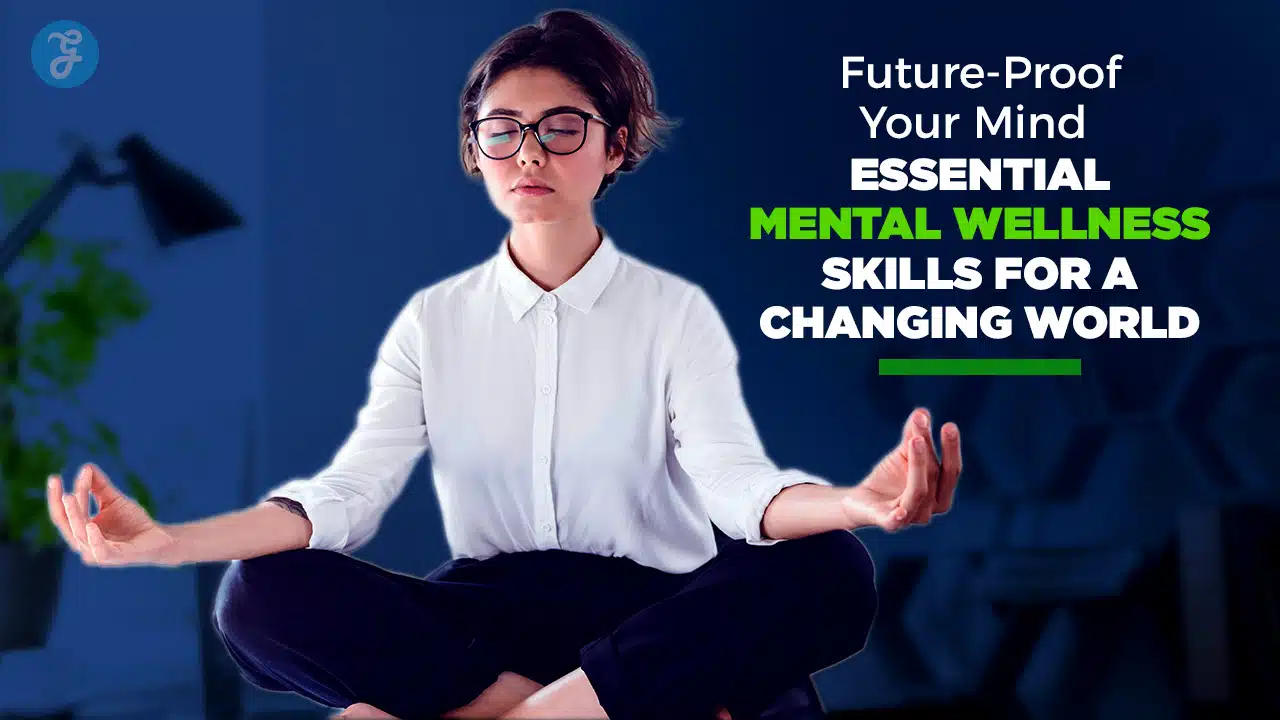
In an era defined by rapid technological acceleration and shifting global dynamics, the most valuable currency you possess is no longer just your technical expertise; it is your psychological adaptability. Mental wellness skills are rapidly becoming the primary differentiator between those who merely survive the changes of the modern world and those who thrive within them. As artificial intelligence automates routine cognitive tasks, the human capacity for resilience, emotional regulation, and deep focus is moving from “nice-to-have” soft skills to essential survival mechanisms.
We are living in what experts call a VUCA world—Volatile, Uncertain, Complex, and Ambiguous. Traditional coping mechanisms, often reliant on distraction or rigid planning, are failing to meet these new demands. The emerging frontier of self-improvement isn’t about productivity hacks or working harder; it is about cultivating a robust internal architecture. By mastering specific mental wellness skills, you can build a mind that is not only protected from burnout but is also capable of agile innovation and profound human connection.
This guide outlines 15 essential skills categorized into three pillars: Cognitive Resilience, Emotional Regulation, and Digital Hygiene. These are the tools that will help you navigate the future with clarity and calm.
Key Takeaways
-
Adaptability is Key: The future requires psychological flexibility more than technical perfection.
-
Emotions are Data: Skills like emotional granularity turn feelings into useful information rather than overwhelming obstacles.
-
Regulation Over Reaction: The ability to regulate your nervous system is the foundation of all other soft skills.
-
Protect Your Attention: Deep focus and digital boundaries are essential for preserving mental energy in a distraction economy.
-
Connection is Vital: Vulnerability and active listening are the antidotes to the isolation of the digital age.
The Paradigm Shift: From “Soft Skills” to Survival Strategy
Before diving into the specific skills, it is crucial to understand why the conversation around mental wellness skills has changed so drastically. For decades, emotional intelligence and resilience were categorized as “soft skills”—nice extras for a resume, but secondary to technical expertise.
Hierarchy has flipped
As we enter the mid-2020s, the “half-life” of a learned technical skill has dropped to just five years. This means what you learned about software, marketing, or operations a few years ago is already becoming obsolete. In contrast, the skills of the mind—how you handle stress, how you relate to others, and how you focus—are durable assets. They do not depreciate; they gain value as the world becomes more automated.
Mental wellness is no longer just about “fixing what is broken” or reactive self-care (like taking a mental health day after you burn out). It is about proactive psychological capacity. It is the ability to maintain high cognitive function and emotional stability in environments that are designed to fracture them.
This shift requires us to look at wellness through three distinct lenses:
-
Cognitive: How we process the chaos.
-
Emotional: How we regulate the pressure.
-
Environmental (Digital): How we protect our energy.
Mastering these areas transforms mental health from a passive state of “not being sick” into an active competitive advantage.
Pillar 1: Cognitive Resilience – Skills for a Flexible Mind
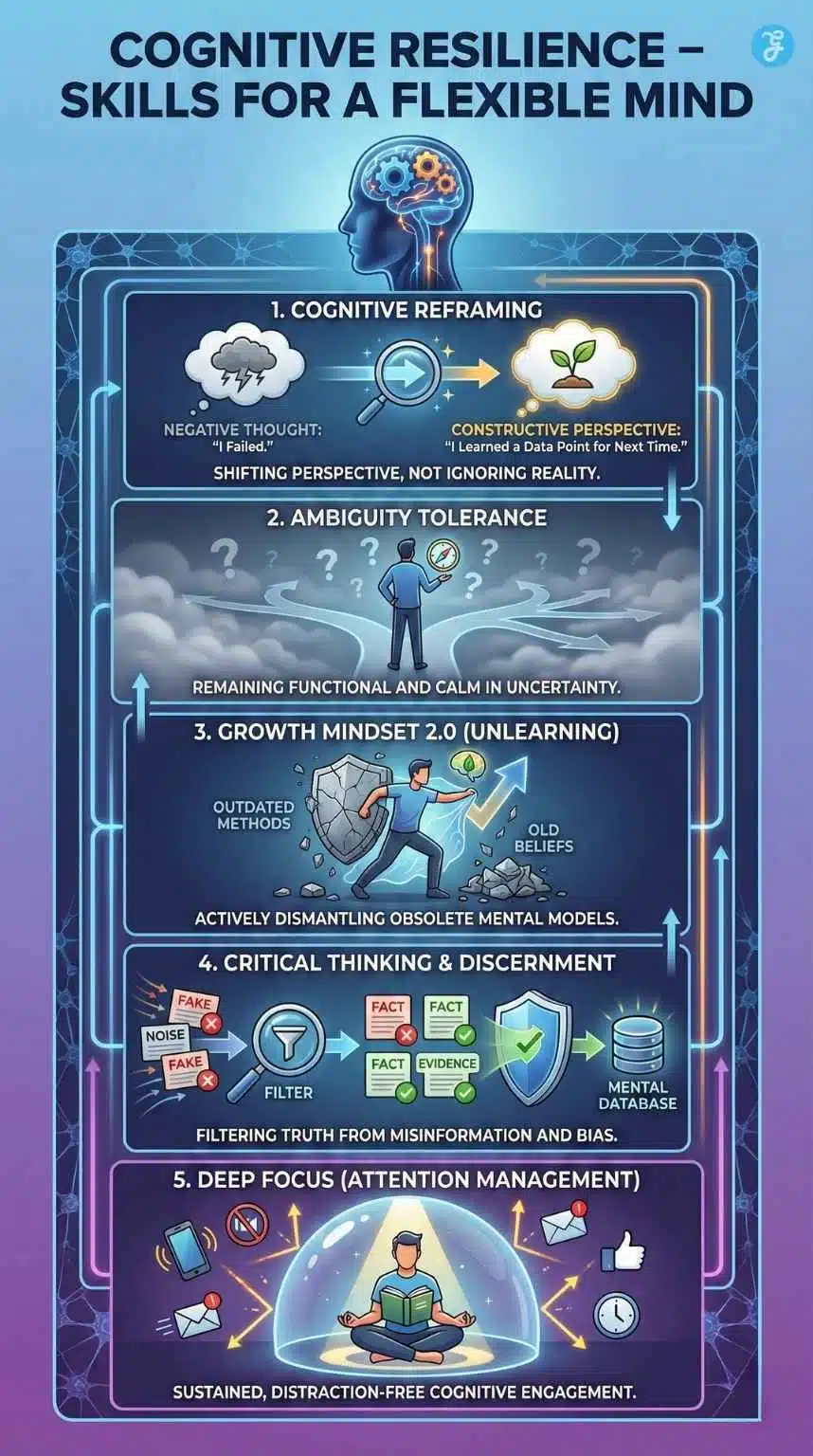
The future belongs to the adaptable. Cognitive resilience is the ability to mentally pivot when faced with new information or unexpected setbacks. It is the mental muscle that prevents you from snapping under the pressure of uncertainty.
1. Cognitive Reframing
Cognitive reframing is the foundational skill of psychological flexibility. It involves identifying irrational or destructive thought patterns and actively shifting them to more constructive perspectives. This is not about “toxic positivity” or ignoring reality; it is about acknowledging a difficult situation and choosing a narrative that empowers you to act.
-
The Mechanism: It relies on the Cognitive Behavioral concept that our thoughts create our feelings. By changing the thought (“This failure defines me”) to a growth-oriented alternative (“This failure is a data point for my next attempt”), you alter the emotional outcome.
-
Why it Matters: In a rapidly changing job market, setbacks are inevitable. Reframing ensures these setbacks are speed bumps rather than roadblocks.
2. Ambiguity Tolerance
Humans naturally crave certainty, but the future offers very little of it. Ambiguity tolerance is the ability to remain functional, calm, and productive even when you do not know the answers or the outcome is unclear.
Note: Low ambiguity tolerance often leads to premature closure—making a bad decision just to end the discomfort of not knowing.
High tolerance allows you to sit with the discomfort of the unknown, gathering information and waiting for the right moment to act. This is a critical leadership trait for the future.
3. Growth Mindset 2.0 (Unlearning)
We are familiar with the “growth mindset”—the belief that abilities can be developed. However, the next evolution of this skill is the ability to unlearn. As industries transform, best practices that worked yesterday may be obsolete today. Holding onto old methods because “that’s how we’ve always done it” is a liability. This skill involves actively dismantling outdated mental models to make room for new frameworks without ego getting in the way.
4. Critical Thinking & Discernment
In an age of information overload and AI-generated content, the ability to discern truth from noise is a mental wellness imperative. Consuming misinformation creates anxiety and skewed worldviews. Critical thinking acts as a filter, protecting your mental space from the chaos of the internet. It involves questioning sources, recognizing biases, and delaying judgment until sufficient evidence is presented.
5. Deep Focus (Attention Management)
Your attention is a finite resource under constant siege. The ability to engage in “Deep Work”—sustained focus on a cognitively demanding task without distraction—is becoming rare and highly valuable. This is more than just productivity; it is a mental wellness skill because fragmented attention fractures our sense of peace. Reclaiming your attention from algorithms restores a sense of agency and reduces background anxiety.
| Skill | Definition | Benefit for Future |
| Cognitive Reframing | Shifting perspective on stressors. | Reduces the emotional impact of failure. |
| Ambiguity Tolerance | Staying calm without answers. | Prevents panic during uncertainty. |
| Unlearning | Letting go of obsolete knowledge. | Enables faster adaptation to new tech. |
| Discernment | Filtering high-quality info. | Reduces anxiety from misinformation. |
| Deep Focus | Sustained, distraction-free work. | Protects against dopamine burnout. |
Pillar 2: Emotional Regulation – Anchors in the Storm
If cognitive skills are the steering wheel, emotional regulation is the braking system. It allows you to manage the internal chemical reactions to external stress, keeping you within a “window of tolerance” where you can function effectively.
6. Nervous System Regulation
This is the physiological basis of mental wellness skills. It involves recognizing when your body has shifted into a sympathetic state (fight or flight) and manually switching it back to a parasympathetic state (rest and digest). Techniques include somatic exercises, box breathing, or cold exposure. Mastering this means you are not at the mercy of your stress hormones; you have a manual override switch.
7. Emotional Granularity
Most people describe their negative emotions in broad strokes: “I feel bad” or “I am stressed.” Emotional granularity is the precise labeling of feelings. Are you angry, or are you frustrated? Are you sad, or are you lonely?
Research shows that the more specific you are in naming an emotion, the faster your brain can process and regulate it. It bridges the gap between feeling an emotion and understanding what that emotion is trying to tell you.
8. Self-Compassion
Self-compassion is often mistaken for self-indulgence, but it is actually a rigorous tool for resilience. It involves treating yourself with the same kindness you would offer a friend during a crisis.
-
The Science: Harsh self-criticism triggers the threat defense system (cortisol), while self-compassion triggers the caregiving system (oxytocin).
-
The Result: You recover from burnout and failure significantly faster when you practice self-compassion rather than self-punishment.
9. Radical Acceptance
Pain is inevitable; suffering is optional. Suffering arises when we refuse to accept reality (“It shouldn’t be this way!”). Radical acceptance is the skill of accepting reality exactly as it is in this moment, without judgment or attempts to fight it. This doesn’t mean you approve of the situation, but it stops the energy drain of denial, freeing up resources to actually solve the problem.
10. Optimistic Explanatory Style
This is the specific way you explain the causes of events to yourself. A pessimist views bad events as permanent, pervasive, and personal. An optimist views them as temporary, local, and changeable. Learning to shift your explanatory style is one of the most effective mental wellness skills for preventing learned helplessness.
The Explanatory Style Matrix:
| Dimension | Pessimistic View (leads to burnout) | Optimistic View (leads to resilience) |
| Time | “This will last forever.” | “This is a temporary setback.” |
| Scope | “This ruins everything in my life.” | “This is just one specific area.” |
| Agency | “It’s all my fault/I can’t fix it.” | “I can influence the outcome next time.” |
Pillar 3: Digital & Social Hygiene – Preserving Humanity
As our environments become increasingly digital, preserving our humanity requires conscious effort. These skills focus on how we interact with technology and each other to maintain psychological safety.
11. Digital Boundary Setting
In a hyper-connected world, the “always-on” culture is a primary driver of mental health decline. Digital boundary setting is the proactive skill of defining how and when you engage with technology. This includes:
-
Temporal Boundaries: strict “offline” hours.
-
Spatial Boundaries: “phone-free zones” like the bedroom or dining table.
-
Content Boundaries: Curating your feed to exclude triggering or toxic content.
12. Active Listening
In an automated world, high-quality human attention is a luxury. Active listening—truly hearing others without planning your response or glancing at a phone—is a healing practice for both the listener and the speaker. It fosters deep connection, which is the strongest protective factor against depression and anxiety.
13. Vulnerability Competence
Vulnerability is the courage to show up authentically, even when you cannot control the outcome. In professional settings, this translates to “psychological safety”—the ability to admit a mistake or ask a question without fear of punishment. Cultivating the skill to be vulnerable invites trust and collaboration, whereas masking your struggles leads to isolation and exhaustion.
14. Conflict De-escalation
Conflict is natural, but destructive conflict is avoidable. This skill involves shifting the dynamic from “Me vs. You” to “Us vs. The Problem.” It requires checking your ego, regulating your own nervous system during a heated moment, and seeking a resolution that respects both parties. In a polarized world, the ability to de-escalate tension is a superpower.
15. Help-Seeking Efficacy
Knowing when to ask for help is a skill, not a weakness. Many high performers crash because they wait until a crisis to seek support. Help-seeking efficacy involves:
-
Recognizing early warning signs of distress.
-
Knowing who to turn to (mentor, therapist, peer).
-
Overcoming the internal stigma of “needing help.”
Mini-Audit: Where Do You Stand?

Before you begin building these skills, it is helpful to establish your baseline. Read the following statements and honestly assess how often they apply to you.
| The Statement | The Skill Gap |
| “I often feel guilty when I am not being productive.” | Needs Self-Compassion & Digital Boundaries |
| “I spiral into panic when I don’t have all the answers.” | Needs Ambiguity Tolerance |
| “I can’t name exactly what I’m feeling; I just feel ‘bad’.” | Needs Emotional Granularity |
| “I constantly check my phone, even during movies or dinners.” | Needs Deep Focus & Digital Hygiene |
| “I view feedback as a personal attack on my character.” | Needs Cognitive Reframing & Growth Mindset |
| “I wait until I am completely burned out to take a break.” | Needs Nervous System Regulation |
How to Build These Skills: The “1+1+1” Method
Trying to learn all 15 mental wellness skills simultaneously is a recipe for overwhelm. Instead, adopt the “1+1+1” approach for a sustainable practice.
The Strategy:
Select one skill from each pillar (Cognitive, Emotional, Digital) and focus on it exclusively for 30 days.
Example Month:
-
-
Cognitive: Growth Mindset (Unlearning) – Every time you say “I can’t do this,” add “…yet.”
-
Emotional: Nervous System Regulation – Practice 2 minutes of box breathing before every meeting.
-
Digital: Digital Boundaries – No screens for the first 30 minutes of the morning.
-
By isolating these variables, you can track your progress and turn these abstract concepts into concrete habits.
Frequently Asked Questions (FAQ)
1. Why are mental wellness skills considered “future of work” skills?
As AI and automation take over routine and technical tasks, human-centric skills like empathy, complex problem-solving, and adaptability become the primary value drivers in the economy. Employers are increasingly hiring for resilience and emotional intelligence over hard skills.
2. Can I really “learn” these skills, or are they personality traits?
They are absolutely learnable. Thanks to neuroplasticity, the brain can rewire itself throughout life. While some people may have a natural disposition toward optimism or calmness, these are skills that can be strengthened with deliberate practice, much like learning a language.
3. Which mental wellness skill should I start with?
Nervous System Regulation is the most effective starting point. If your body is in a chronic state of “fight or flight,” it is biologically impossible to access higher-order thinking skills like reframing or empathy. Calming the body unlocks the mind.
4. How do digital boundaries improve mental wellness?
Constant digital connectivity keeps the brain in a state of continuous partial attention and low-grade anxiety. clear boundaries allow the brain to enter “rest mode” (the default mode network), which is crucial for creativity, memory consolidation, and emotional processing.
5. What is the difference between “toxic positivity” and “optimistic explanatory style”?
Toxic positivity denies reality (“Everything is great!”) and suppresses negative emotions. Optimistic explanatory style acknowledges the difficulty (“This situation is terrible right now”) but frames it as a temporary and solvable challenge rather than a permanent personal failure.
The Bottom Line: Mental Wellness Skills
The future is often painted as a landscape dominated by algorithms and automation, but the most sophisticated technology remains the human mind. Mastering these mental wellness skills is not just about career survival; it is about reclaiming your quality of life in a high-pressure world.
Do not let the scope of these 15 skills overwhelm you. Resilience is built in small increments—one deep breath, one honest conversation, and one moment of focus at a time. By prioritizing your internal architecture today, you are effectively future-proofing yourself for whatever tomorrow brings. Ultimately, the best investment you can make for the future is not in a new tool or credential, but in your own capacity to adapt, feel, and endure.