

More than one billion people around the world now live with a mental health condition, including depression, anxiety, bipolar disorder, and more. Yet many people still struggle to talk about these issues with friends, family, or even themselves.
This is where mental health movies and shows come in. When you see a character having a panic attack, hearing voices, or sitting in therapy, it can feel like you are not alone. These mental wellness releases can name feelings, show coping tools, and start honest conversations at home.
In recent years, researchers have also found that well-written mental health storylines can reduce stigma and increase the chance that viewers will seek help, join support groups, or talk to someone they trust. At the same time, harmful stereotypes in film and TV can still spread fear and shame.
Let’s walk you through 25 must-watch mental wellness releases, including mental health movies, documentaries, and series that are thoughtful, responsible, and moving. You will find classic titles, new releases, and global stories that explore the many sides of the mind.
Key facts at a glance
| Point | Detail |
| Global mental health | Over 1 billion people live with a mental disorder. |
| Why it matters | Movies and shows can shape how we think and talk about mental health. |
| Aim of this guide | Curated list of 25 titles that inform, move, and respect lived experience. |
What Are Mental Health Movies?

Mental health movies are films where a mental health condition, emotional struggle, or healing journey is central to the story. They can be intense dramas, quiet character studies, animated films, or even gentle comedies.
These stories often focus on:
- Depression and anxiety
- Bipolar disorder and schizophrenia
- PTSD and trauma
- Addiction and recovery
- Grief, loss, and identity
- Therapy, medication, and support systems
In the last few years, there has been a clear rise in more nuanced portrayals of mental health in both film and TV. Experts who track scripts and storylines note more characters going to therapy, talking about diagnosis, and seeking help in realistic ways.
In this article, when we talk about mental wellness releases, we mainly mean films and shows where emotional well-being, mental illness, and recovery are treated as key parts of the story, not just background details.
Snapshot: What counts as “mental wellness releases”?
| Type | Examples | How it helps viewers |
| Feature films | Dramas, biopics, psychological stories | Show inner worlds and relationships. |
| Documentaries | Real-life cases, expert insights | Explain systems, treatments, and lived experience. |
| TV and streaming series | Ongoing character arcs | Show long-term recovery and relapse. |
| Animated and YA stories | Family or teen-friendly titles | Teach emotional literacy and coping skills. |
How Mental Health Movies Shape Attitudes
When done well, mental health movies and shows can help viewers:
- Put words to feelings they could not explain
- Recognize signs of depression, anxiety, or trauma
- Understand why someone acts in a certain way
- Feel more open to therapy or peer support
Some studies suggest that viewers who watch mental health storylines informed by experts and people with lived experience have better knowledge, less stigma, and more willingness to seek help.
However, older films and some recent titles still show people with mental illness only as “violent,” “crazy,” or “dangerous.” Reviews and analyses of media coverage warn that this kind of portrayal strengthens fear and discrimination.
So this list focuses on titles that lean toward accuracy, human dignity, and hope, even when the stories are painful.
How screen stories can help or harm
| Effect | Positive example | Risky example |
| Stigma | Shows that people with mental illness are complex and human. | Links mental illness only to violence or horror. |
| Help-seeking | Characters go to therapy or ask for support. | No help is offered or all help is mocked. |
| Understanding | Explains symptoms and coping tools. | Uses mental illness as a punchline or plot twist only. |
What Makes Great Mental Health Movies?
Before we jump into the list, it helps to know what separates a great mental health movie from a shallow one.
Researchers and mental health advocates often highlight three key points:
- Accuracy and sensitivity
- Diversity of stories and identities
- Emotional impact that leads to reflection, not despair alone
For this list, each title was chosen because it does at least one of these things well, and many do all three.
Criteria used in this guide
| Criterion | What we looked for | Why it matters |
| Accuracy | Realistic symptoms, treatment, and language | Reduces confusion and myths. |
| Sensitivity | Avoids glamorizing self-harm or suffering | Protects vulnerable viewers. |
| Diversity | Different cultures, genders, ages, and diagnoses | Reflects real-world mental health. |
| Impact | Prompts empathy, insight, or action | Makes screen time meaningful. |
25 Must-Watch Mental Wellness Releases
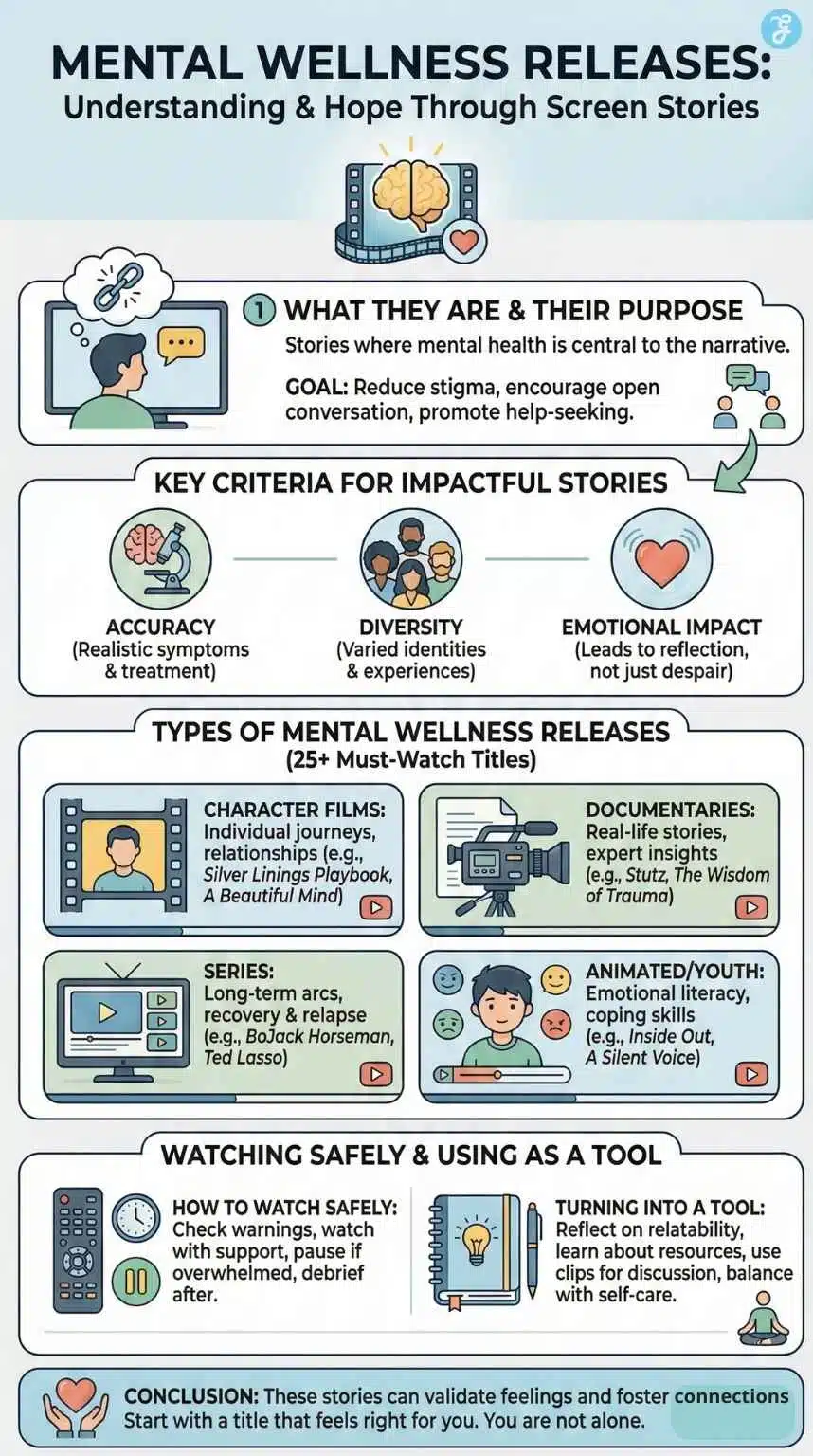
This is the heart of the guide. It brings together 25 must-watch mental wellness releases, grouped into films, documentaries, TV series, and animated or youth-focused titles.
Overview of the list
| Group | Number of titles | Focus |
| Character-driven movies | 10 | Individual journeys and relationships |
| Documentaries and docuseries | 6 | Real-life stories and expert insight |
| TV and streaming series | 6 | Long-term arcs and complex characters |
| Animated and youth-focused | 3 | Emotions, growing up, and resilience |
Character-Driven Mental Health Movies (10 Titles)
These are narrative films where mental health is central to the main character’s life. Many appear in recent “best mental illness movies” or “top mental health movies” lists due to their emotional depth and strong performances.
1. A Beautiful Mind (2001)
Follows mathematician John Nash as he lives with schizophrenia, explores treatment, and fights to keep his work and marriage.
2. The Perks of Being a Wallflower (2012)
A shy teen struggles with depression and buried trauma while forming life-changing friendships.
3. Good Will Hunting (1997)
A working-class math genius confronts childhood abuse and self-sabotage through therapy and friendship.
4. The King of Staten Island (2020)
A young man stuck after his firefighter father’s death slowly begins to process grief, depression, and directionless living.
5. Silver Linings Playbook (2012)
A man with bipolar disorder and a woman grieving her husband build an uneasy partnership, showing how love, boundaries, and medication interact.
6. Girl, Interrupted (1999)
Based on a memoir, this film portrays borderline personality disorder, self-harm, and life in a 1960s psychiatric hospital.
7. Little Miss Sunshine (2006)
A darkly comic family road trip that touches on depression, a suicide attempt, and the pressure to appear “perfect.”
8. Black Swan (2010)
A ballerina’s obsession with perfection leads to hallucinations, paranoia, and a terrifying breakdown.
9. The Father (2020)
A powerful look from inside the world of a man with dementia as time, place, and relationships blur.
10. The Outrun (2024)
Based on Amy Liptrot’s memoir, the film centers on addiction, relapse, and recovery in the wild landscape of the Orkney Islands.
Key themes in these mental health stories
| Film focus | Main topics | Viewer takeaway |
| Depression and anxiety | Perks, King of Staten Island, Little Miss Sunshine | Pain can be hidden; support and time matter. |
| Bipolar and personality disorders | Silver Linings Playbook, Girl, Interrupted | Relationships are complex but healing is possible. |
| Psychosis and dementia | A Beautiful Mind, Black Swan, The Father | Shows how reality can feel unstable from within. |
| Addiction and recovery | The Outrun | Relapse is part of many journeys; nature and community can help. |
Mental Health Documentaries And Docuseries (6 Titles)
Documentaries and docuseries can explain conditions and systems in a way fiction cannot. They combine personal stories with expert analysis and often highlight failures and gaps in mental health care.
11. Stutz (2022)
Directed by Jonah Hill, this film sits inside real sessions with his therapist, Dr. Phil Stutz, while they talk openly about depression, grief, and practical tools.
12. The Wisdom of Trauma (2021)
Dr. Gabor Maté explores how trauma underlies many addictions, mental health conditions, and social problems, and why compassionate care matters.
13. The Me You Can’t See (2021)
A docuseries from Oprah Winfrey and Prince Harry, featuring well-known and everyday people talking about depression, PTSD, stigma, and healing.
14. The Mind, Explained (2019–2021)
Short episodes on memory, anxiety, mindfulness, and psychedelics make brain science easy to grasp, using animation and clear language.
15. Headspace Guide to Meditation (2021)
An animated series that teaches the basics of breathing, focus, and present-moment awareness as tools for mental well-being.
16. Depression: Out of the Shadows (PBS)
A deep look at depression across ages and backgrounds, combining science, real stories, and treatment options.
How these titles support mental wellness
| Title type | What it offers | Ideal viewer |
| Personal journey docs | Honest stories of pain, therapy, and resilience | Anyone feeling “alone” in their struggle. |
| Brain and emotion explainers | Simple science behind stress and mood | Viewers who like data and visuals. |
| System-focused docs | How health systems help or fail | Advocates, students, and policy-interested readers. |
TV And Streaming Series With Strong Mental Health Arcs (6 Titles)
TV series can follow mental health journeys over many seasons. They are able to show relapse, growth, and long-term consequences in ways a two-hour film cannot.
17. BoJack Horseman
An animated dramedy about a washed-up actor dealing with addiction, depression, self-loathing, and attempts at change. It has been praised for an honest, messy look at recovery.
18. Ted Lasso
Ted Lasso starts as a light sports comedy, then reveals panic attacks, therapy, grief, and father-son wounds behind the coach’s optimism.
19. Normal People
Follows Marianne and Connell from school into adulthood as they confront anxiety, depression, class, and attachment patterns.
20. Euphoria
A raw look at addiction, trauma, identity, and self-harm among teens and young adults. Strong content warnings are essential due to graphic scenes.
21. 13 Reasons Why
Focuses on suicide, bullying, and trauma. It sparked huge debate about portrayal of self-harm and led to calls for clearer guidance for vulnerable viewers.
22. Riot Women
A recent series was praised for a nuanced, realistic portrayal of dementia in older women and the stress on “sandwich” carers.
What TV adds to the picture
| Strength of the series | Example | Benefit |
| Long-term arcs | BoJack Horseman, Normal People | Shows cycles of relapse and progress. |
| Ensemble casts | Euphoria, This Is Us-style dramas | Reflects multiple diagnoses and backgrounds. |
| Mix of humor and pain | Ted Lasso | Helps viewers approach hard topics more gently. |
| Spotlight on carers | Riot Women | Shows the mental health impact on families, too. |
Animated And Youth-Focused Mental Wellness Releases (3 Titles)
Animated stories and youth-oriented films can help children, teens, and adults name their feelings and understand what is happening inside their minds. They are often used by teachers, parents, and therapists as conversation starters.
23. Inside Out (2015)
Personifies emotions like Joy, Sadness, Anger, and Fear inside a young girl’s mind as she moves to a new city. It shows that sadness has a healthy role and that “bad” feelings are not enemies.
24. Inside Out 2 (2024)
Continues the story in early adolescence, adding Anxiety and other new emotions as the main character faces social pressure and self-doubt.
25. A Silent Voice (2016)
A Japanese animated film about bullying, disability, shame, and suicidal thoughts that offers a powerful path toward apology and self-forgiveness.
Why are these so effective
| Focus | Example | How it helps |
| Emotional literacy | Inside Out films | Gives children and adults simple language for complex feelings. |
| Social mental health | A Silent Voice | Shows how bullying and isolation affect self-worth. |
| Family discussion | All three | Easy to watch together and discuss afterward. |
Best Mental Wellness Releases To Start With
If you are new to this topic, you might not want to start with the heaviest titles. A gentle or hopeful entry point can make a big difference.
Good starting mental wellness releases include:
- Inside Out and Inside Out 2 – Accessible for almost any age and full of insight.
- Silver Linings Playbook – Balances romance, humor, and bipolar disorder in a human way.
- Good Will Hunting – Shows therapy as a place of trust and honest talk.
- Stutz – Directly focused on tools for everyday mental health.
- Ted Lasso – Light and funny on the surface, deeper as you keep watching.
As your comfort grows, you can move to more intense films like Black Swan, Euphoria, or Girl, Interrupted, but only when you feel ready.
Quick “starter list” comparison
| Title | Intensity level | Why is it a good first pick |
| Inside Out | Low | Suitable for families, clear message about feelings. |
| Silver Linings Playbook | Medium | Honest but hopeful, with humor. |
| Good Will Hunting | Medium | Focus on trust, vulnerability, and therapy. |
| Stutz | Medium | Shares practical tools and a warm therapist-client bond. |
| Ted Lasso | Low–medium | Uses humor to gently open deeper issues. |
How To Watch Mental Health Movies Safely
Mental health movies can be emotional. Some scenes may remind you of your own trauma, grief, or crisis moments. It is important to watch in a way that protects your well-being.
Before You Press Play
- Check content and trigger warnings, especially for films that include suicide, sexual violence, or self-harm.
- Decide who you will watch with. A trusted friend or partner can make heavy scenes easier to handle.
- Plan some grounding activities for after the film, such as a walk or a cup of tea.
While You Are Watching
- Notice your body. If your heart races or you feel numb or overwhelmed, it is okay to pause.
- Remind yourself that you can switch to something lighter at any time.
- Take notes of scenes that feel important; you can discuss them with someone later.
After The Movie Or Episode Ends
- Give yourself time to process, not just jump to the next autoplay.
- Talk about what came up for you with a friend, support group, or therapist.
- If the movie triggered strong urges to self-harm, use your safety plan or contact a crisis service in your country.
Safety checklist
| Step | Question to ask yourself | Action |
| Before | “Is today a good day for heavy content?” | Choose lighter titles if not. |
| During | “Am I still okay, or do I need a break?” | Pause, breathe, or change the film. |
| After | “Do I need to talk to someone about what this brought up?” | Reach out to a friend, helpline, or therapist. |
Turning Screen Time Into A Mental Wellness Tool
Watching mental wellness releases is not only about entertainment. With a bit of intention, you can turn screen time into a tool for education, reflection, and growth.
Reflective Questions To Ask Yourself
After watching, you could journal or think about:
- Which character did you relate to most, and why?
- Did the film change how you think about any diagnosis or treatment?
- Did you notice any stereotypes that felt unfair or harmful?
- What healthy coping tools did you see in the story?
Using Clips In Classrooms, Groups, Or Therapy
Many teachers, group leaders, and therapists use short clips to:
- Start conversations about feelings, bullying, grief, or trauma
- Help people name their own experiences
- Show that therapy and help-seeking are normal, not shameful
If you plan to do this, always preview scenes alone first and give clear warnings to your group.
Balancing Heavy Stories With Everyday Wellness
Even the best mental wellness releases can be intense. It helps to balance them with daily habits that support your mind.
Such as:
- Walking or light exercise
- Healthy sleep and screen breaks
- Mindfulness or breathing practices
- Time with safe, supportive people
- Creative outlets like writing, drawing, or music
Making screen time supportive, not draining
| Idea | Example | Benefit |
| Combine film + reflection | Journal or discuss after watching | Turns emotion into insight. |
| Combine film + action | Book a therapy session, call a friend | Moves from awareness to support. |
| Mix heavy and light content | Follow a tough movie with a calm show | Protects your mood and energy. |
FAQs About Mental Health Movies
Are mental health movies accurate?
Accuracy varies widely. Some films consult psychologists and people with lived experience, leading to realistic symptoms and treatment scenes. Others exaggerate or simplify mental illness for drama.
Clues that a film is more accurate:
- It avoids calling people only “crazy” or “psycho.”
- Characters are more than their diagnosis.
- Treatment is shown as complex, not magical or useless.
- Mental health advocates or professionals praise the film.
Can watching these films be triggering?
Yes. Movies dealing with suicide, self-harm, abuse, or graphic violence can be triggering for some viewers. Media research warns that sensational portrayals can increase distress or fear, especially if there are no warnings or context.
That is why content warnings, pacing yourself, and having support matter so much.
Can mental health movies replace therapy?
No. Movies and shows can:
- Help you understand what you are going through
- Give you the language to ask for help
- Make you feel less alone
But they cannot:
- Diagnose you
- Offer a personalized treatment plan
- Replace professional support in a crisis
If a film makes you realize that you might need help, that is a sign to reach out, not to keep watching more content instead.
FAQ summary
| Question | Short answer | Next step |
| Are they accurate? | Some are, some will show the reality. | Check expert reviews and lists before watching. |
| Can they be triggering? | Yes, especially for people in crisis. | Use content warnings and watch with care. |
| Can they replace therapy? | No. They are a complement, not a substitute. | Seek professional help if you are struggling. |
Final Words: Why Mental Wellness Movies and Series Belong On Your Watchlist
Mental wellness releases can do more than fill an evening. When chosen well, they can help you:
- See your feelings reflected on screen
- Understand what friends or family might be going through
- Learn about diagnoses, treatment, and recovery
- Feel less isolated and more hopeful
These 25 must-watch titles across films, documentaries, series, and animation to help you build a watchlist that is both meaningful and safe. From A Beautiful Mind and Silver Linings Playbook to Stutz, BoJack Horseman, and Inside Out, these stories show that pain is real, but so is support.
As mental health becomes a larger global concern, using mental wellness releases wisely can be one small but powerful step in your own wellness journey. Start with one title that feels right for you, take your time, and remember: your story matters just as much as any character on screen.






























