By 2026, the definition of effective leadership has fundamentally shifted. It is no longer enough for managers to simply oversee improved workflows or hit quarterly targets; they must now act as the first line of defense for their team’s well-being. Mental Health First Aid for managers has graduated from a “nice-to-have” HR perk to a critical operational competency. As we navigate a workplace landscape redefined by AI integration, remote isolation, and global instability, the psychological safety of employees has become directly tied to business continuity.
The modern workforce is facing unprecedented pressure. From the “always-on” digital culture to the anxieties surrounding automation, employees are carrying heavier cognitive loads than ever before. For managers, the ability to spot the early warning signs of burnout, anxiety, or depression is now as essential as reading a balance sheet. This article explores why Mental Health First Aid (MHFA) is the defining skill for 2026, how it impacts the bottom line, and how organizations can implement it effectively.
The Shift in Workplace Dynamics in 2026
The year 2026 marks a turning point where the friction between rapid technological advancement and human capacity is at its peak. We are seeing a “silent crisis” in workplaces where high performance often masks deep-seated psychological distress. Managers are currently operating in an environment where the boundaries between professional and personal life have all but dissolved, necessitating a new toolkit for leadership.
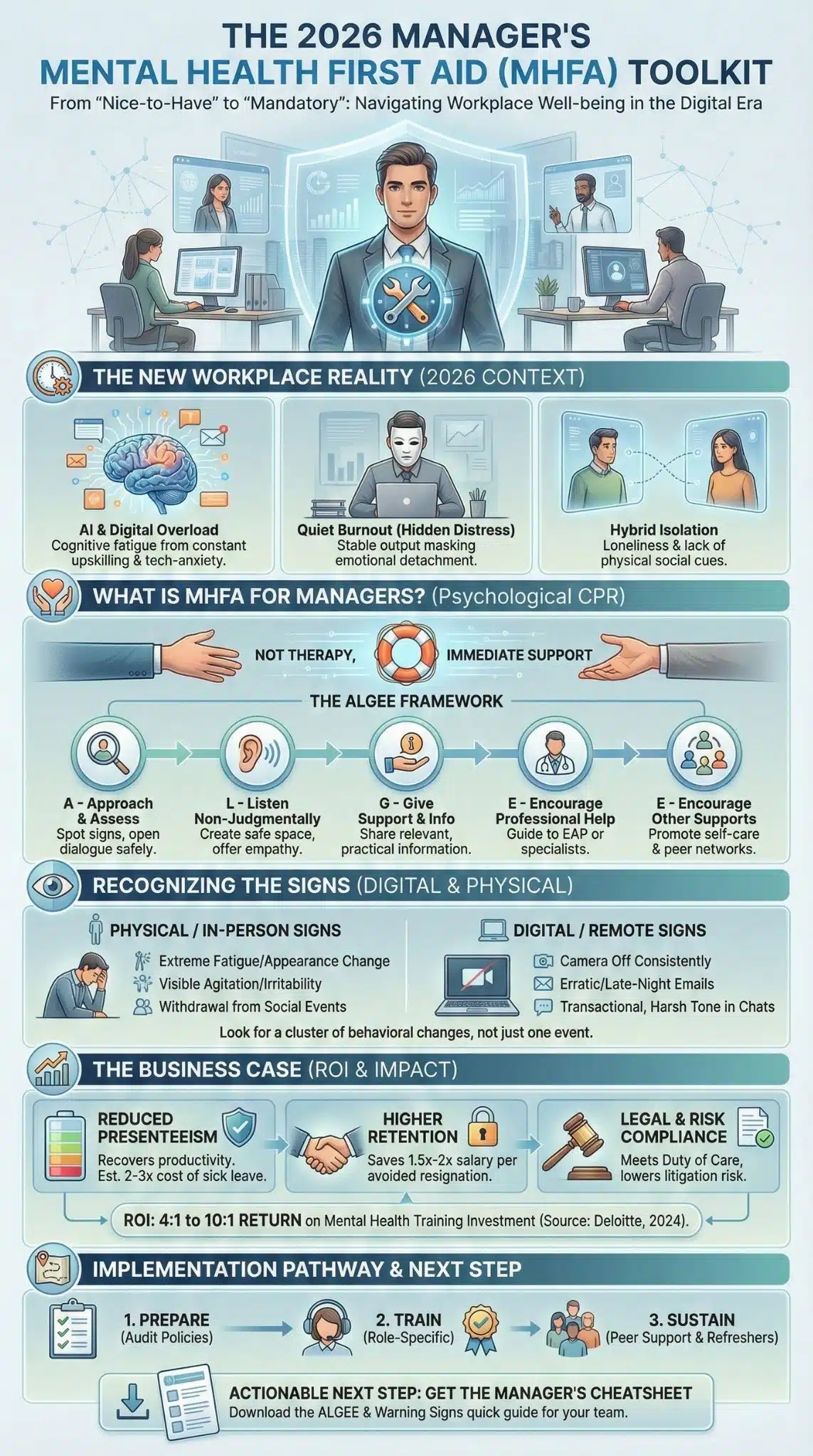
The Impact of AI and Digital Overload
The integration of Artificial Intelligence into daily workflows has streamlined operations but created a new form of “cognitive fatigue.” Employees are constantly upskilling to stay relevant, leading to chronic anxiety about job security and obsolescence. For managers, understanding this specific anxiety is crucial. It’s not just about workload; it’s about the existential stress of working alongside algorithms.
The Rise of “Quiet Burnout”
Unlike the dramatic “burnouts” of the past, 2026 is characterized by “quiet burnout”—where employees maintain output but are emotionally detached and psychologically exhausted. This is harder to spot because performance metrics may remain stable while the employee’s mental health deteriorates. Mental Health First Aid for managers provides the framework to identify these subtle shifts in engagement and morale that traditional performance reviews miss.
Hybrid Isolation and Disconnection
Remote and hybrid work models are mature in 2026, but the long-term effects of reduced social interaction are becoming clear. Loneliness is a significant workplace hazard. Managers can no longer rely on “water cooler moments” to gauge team sentiment. They need structured, intentional methods to assess well-being across digital divides.
Workplace Shifts Driving the Need for MHFA
| Trend | 2026 Challenge | Managerial Implication |
| AI Integration | Fear of replacement; constant need to upskill. | Managers must manage “tech-anxiety” and reassure teams of their human value. |
| Hybrid Work | Digital isolation and lack of physical cues. | Need for proactive check-ins; inability to rely on visual observation alone. |
| Economic Pressure | Financial stress affecting focus and productivity. | Managers need to recognize signs of financial anxiety without overstepping privacy. |
| Regulatory Change | Stricter laws on psychosocial hazards (e.g., UK Mental Health Act). | Compliance is now a managerial duty; ignorance of mental health risks is a liability. |
What is Mental Health First Aid for Managers?
Mental Health First Aid is often misunderstood as “therapy” or “counseling.” It is neither. Instead, it is the psychological equivalent of physical CPR. Just as a physical first aider isn’t a doctor but knows how to stabilize a patient until help arrives, a mental health first aider is trained to spot distress, provide initial support, and guide the person to professional help. For managers, this skill set is tailored to the professional environment.
The ALGEE Action Plan
At the core of MHFA is the ALGEE framework (Approach, Listen, Give support, Encourage professional help, Encourage other supports). For a manager, this translates into specific behaviors: approaching an employee who seems withdrawn, listening without judgment during a 1:1, and knowing exactly which EAP (Employee Assistance Program) resources to recommend. It transforms a vague concern (“John seems off”) into a structured intervention.
Distinguishing Support from Therapy
A critical component of Mental Health First Aid for managers is establishing boundaries. Managers must learn that their role is not to fix the problem or diagnose a condition. The training explicitly teaches how to offer empathy without absorbing the trauma or attempting to play the role of a psychologist. This protection is vital for the manager’s own mental health, preventing “compassion fatigue.”
De-escalation and Crisis Management
Sometimes, a situation is not a slow burn but an acute crisis—a panic attack in a meeting or a sudden emotional outburst. MHFA equips managers with de-escalation techniques to handle these moments with dignity and safety. Knowing how to speak calmly, remove an audience, and ensure immediate safety is a hard skill that every leader in 2026 must possess.
Core Components of MHFA for Leadership
| Component | Description | Managerial Application |
| Observation | Detecting changes in behavior, tone, or output. | Noticing an outgoing employee becoming silent in Slack channels. |
| Non-Judgmental Listening | Creating psychological safety for open dialogue. | Conducting a “stay interview” focused on feelings, not just KPIs. |
| Resource Navigation | Knowledge of available professional support. | Directly guiding an employee to the company’s specific mental health benefits. |
| Crisis Response | Managing acute distress or safety risks. | Handling a panic attack or expression of self-harm calmly and safely. |
The ROI of Mental Health Training
The business case for Mental Health First Aid for managers is undeniable. In 2026, organizations are data-driven, and the metrics regarding mental health support point to a massive Return on Investment (ROI). Deloitte and other major analysts have consistently shown that for every dollar spent on mental health training, organizations reap a return of roughly 4 to 10 dollars. This comes from avoided costs in turnover, presenteeism, and insurance claims.
Reducing “Presenteeism”
Presenteeism—when employees are physically at work (or logged in) but too unwell to function effectively—costs businesses significantly more than absenteeism. Employees struggling with untreated anxiety or depression may work at 60% capacity for months. Trained managers can intervene early, facilitating a short break or adjustment that restores the employee to 100% functionality much faster than if the issue were ignored.
Retention and Employer Branding
In the competitive talent market of 2026, psychological safety is a top tier benefit. Top talent, especially from Gen Z and Alpha, prioritizes mental health support over office perks. A manager trained in MHFA is a retention tool. Employees are far less likely to quit if they feel their manager “gets it” and supports them through rough patches. Conversely, a toxic or oblivious manager is the single biggest driver of resignation.
Mitigating Legal and Insurance Costs
Disability claims related to mental health have skyrocketed. By 2026, many jurisdictions have tightened regulations regarding “psychosocial hazards” at work. Employers who fail to provide adequate support can face litigation. Training managers acts as a protective measure, demonstrating that the organization took “reasonable steps” to care for employee well-being, which is crucial for compliance and insurance liability.
The Business Case for MHFA
| Metric | Impact of Trained Managers | Financial Benefit |
| Productivity | Reduces “presenteeism” losses. | Recovers lost hours estimated at 2-3x the cost of sick leave. |
| Retention | Increases loyalty and trust in leadership. | Saves 1.5x – 2x annual salary per avoided resignation. |
| Absenteeism | Prevents long-term disability leave. | Short-term interventions prevent months-long burnout leaves. |
| Risk Management | Demonstrates duty of care compliance. | Lowers risk of negligence lawsuits and insurance premium hikes. |
Recognizing the Signs of Burnout and Anxiety
Effective Mental Health First Aid for managers relies heavily on pattern recognition. It is rarely one single event that signals a problem; rather, it is a cluster of behavioral changes. In a remote or hybrid world, these signs are subtle. Managers must be trained to look for “digital body language” cues that differ from traditional in-office red flags.
Changes in Work Patterns and Output
A sudden drop in performance is an obvious sign, but erratic performance is more common. An employee who is usually reliable might start missing small deadlines, making uncharacteristic errors, or working at odd hours (e.g., sending emails at 3 AM). This “always-on” behavior often signals anxiety—a frantic attempt to keep up while drowning.
Behavioral and Social Withdrawal
In 2026, withdrawal often manifests digitally. An employee who used to use emojis and participate in team chats might become purely transactional, using monosyllabic responses. In video calls, they might keep their camera off consistently when they used to have it on. This retreat is a classic defense mechanism against overwhelm and is a primary trigger for a MHFA intervention.
Physical and Emotional Indicators
While managers are not doctors, they can observe physical changes if they see employees on video or in person. Extreme fatigue, changes in appearance, or visible agitation are key indicators. Emotionally, a team member might become uncharacteristically irritable, cynical, or tearful. Recognizing these not as “attitude problems” but as symptoms of distress is the core pivot MHFA training provides.
Warning Signs Checklist
| Category | Signs to Watch For | Digital Equivalent |
| Productivity | Missed deadlines, error rates up. | erratic login times, delayed email responses, overworking (3 AM emails). |
| Social | Withdrawal from lunch/events. | Camera off, silence in group chats, declining virtual coffees. |
| Emotional | Irritability, tearfulness, cynicism. | Harsh tone in emails, defensive responses to feedback, fatalistic slack status. |
| Cognitive | Indecisiveness, memory fog. | Repeating questions, confusion on clear tasks, inability to focus on video calls. |
Implementing MHFA in Your Organization
Adopting Mental Health First Aid for managers requires a strategic rollout. It is not enough to send a few executives to a weekend seminar. For the training to stick and change the culture, it must be systemic and supported by policy. Successful implementation in 2026 involves a three-phase approach: Preparation, Training, and Integration.
Phase 1: Preparation and Policy Review
Before training begins, HR and leadership must audit existing policies. Do you have an accessible EAP? Are your leave policies flexible enough to support mental health days? Managers cannot offer support if the company infrastructure doesn’t exist. This phase involves creating a “referral pathway”—a clear flowchart that tells a manager exactly what to do after they have the conversation.
Phase 2: Mandatory Role-Specific Training
Generic training often fails. The training should be tailored to management levels. Executive leadership needs training on culture and funding, while line managers need tactical training on having difficult conversations. Simulation training, using role-play with actors or AI avatars, is highly effective in 2026 for building muscle memory in handling sensitive dialogues.
Phase 3: Continuous Support and Refresher Courses
Mental Health First Aid is a perishable skill. Without practice, confidence wanes. Organizations must implement quarterly refreshers or “community of practice” sessions where trained managers can discuss anonymized scenarios and learn from each other. This normalizes the skill and keeps it top-of-mind, preventing the training from becoming a “one-and-done” checkbox exercise.
Implementation Roadmap
| Phase | Key Actions | Success Metric |
| Audit | Review EAP, legal compliance, and leave policies. | Creation of a clear “Manager Referral Guide.” |
| Train | Roll out accredited MHFA courses to all people leaders. | % of managers certified (Target: 100%). |
| Embed | Add “Well-being Check-in” to performance review templates. | Frequency of documented well-being conversations. |
| Sustain | Establish peer support networks and annual refreshers. | Improvement in employee engagement/health survey scores. |
Legal and Ethical Considerations
In 2026, the legal landscape surrounding workplace mental health has tightened significantly. Governments globally are recognizing that psychological injury is as damaging as physical injury. For managers, this means that Mental Health First Aid is not just a moral good—it is a compliance necessity. Ignorance of a subordinate’s mental health decline can increasingly lead to negligence claims.
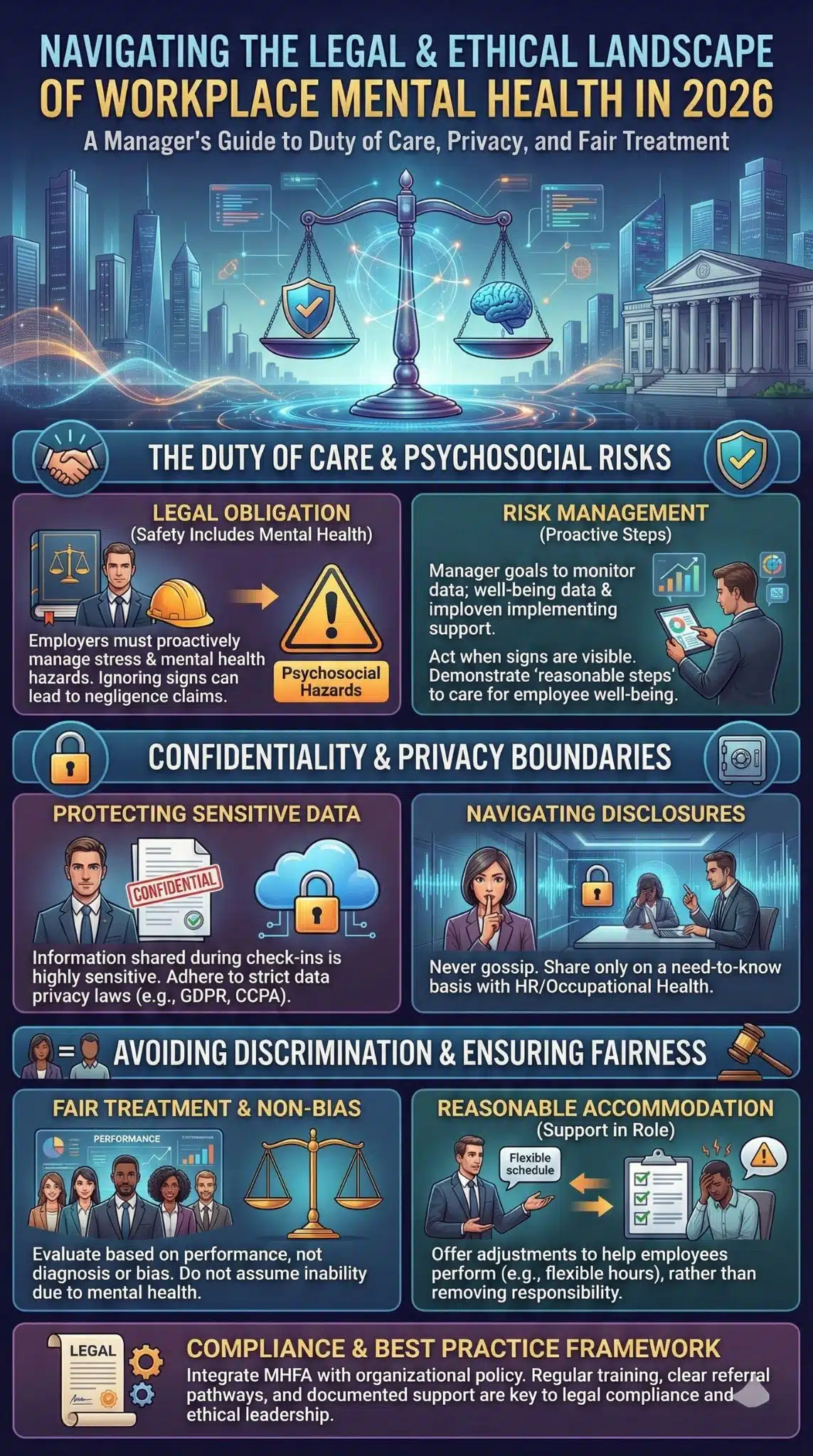
Employers have a “duty of care” to ensure the health and safety of their staff. Recent legislation (such as updates to the UK Health and Safety Executive guidelines and similar EU directives) explicitly includes stress and mental health as hazards to be managed. If a manager ignores clear signs of distress and the employee suffers a breakdown, the organization can be held liable for failing to act.
Confidentiality and Privacy Boundaries
A major component of MHFA training is navigating the delicate balance of privacy. Managers must know what they can document and what they cannot. Information shared during a mental health check-in is highly sensitive. In 2026, with strict data privacy laws (like GDPR and its successors), mishandling this data—e.g., putting “John is depressed” in a shared HR file—can be a legal violation. Training ensures managers know exactly how to handle disclosures confidentially.
Avoiding Discrimination Claims
Managers must ensure that their attempts to help do not cross into discrimination. For example, assuming an employee cannot handle a project because they disclosed anxiety could be seen as discrimination. MHFA teaches managers how to support the employee in their role (through reasonable accommodations) rather than removing them from the role, which is a common legal pitfall.
Legal & Ethical Framework
| Concept | Explanation | Managerial Duty |
| Duty of Care | Legal obligation to ensure safety (physical & mental). | Act when signs of risk are visible; do not ignore distress. |
| Reasonable Accommodation | Adjustments to help employees perform. | Offer flexible hours or deadlines rather than removing responsibility. |
| Confidentiality | Protecting sensitive health data. | Never gossip; only share with HR/Occupational Health on a need-to-know basis. |
| Non-Discrimination | Fair treatment regardless of health status. | Evaluate based on performance, not diagnosis or bias. |
Final Thoughts
As we look toward the remainder of the decade, the role of the manager has irrevocably changed. The days of the purely task-oriented supervisor are gone. The manager of 2026 is a coach, a guardian of culture, and a first responder to the psychological needs of their team.
Mental Health First Aid for managers is the bridge between a struggling workforce and a resilient one. It provides the vocabulary to discuss the undiscussable and the framework to act when action is most needed. By prioritizing this skill, organizations don’t just protect their bottom line; they protect their most valuable asset—their people. In an era of AI and automation, it is this uniquely human capacity for empathy and support that will define the successful companies of the future.