
Social media is an effective connection and self-expression tool in the information exchange in this digital era. However, in case you are in the middle of child custody litigation, your activity on the Internet may have severe legal implications.
Social media posts are increasingly being used in family court, so whatever you say, either deliberately or accidentally, may have a direct effect on the final decision of your case. Parents who go through custody battles must know about the influence of social media over the ruling in the court.
The Usage of Social Media in Custody Proceedings
The best interests of the child are observed in family law courts in case of a custody decision. Among the reviews performed by family lawyers in Surrey, one can mention the physical and emotional welfare of the child, stability offered by each parent, and the behavior that could disrupt a proper upbringing.
The posts in the social media can be of evidence in the court to:
- Evaluate parent behavior: They can be photographs of excessive partying, using drugs or engaging immature actions an aspect that can be criticized of the father or mother.
- Disprove assertions: When one of the parents argues that he/she is losing all his money, and the pictures depict lavish vacations or shopping high-end goods, it can dismiss the honesty of the second party.
- Social media monitoring: The courts can access the social media to determine whether a parent was adhering to custody arrangements or the court requires or prohibits.
- Documented fighting: A housing of posts concerning the other parent in a negative approach or ranting about the organizing of custody might recommend an incapacity to approach co-parenting in a cautious way.
Precisely said, anything published on the Internet can be utilized toward constructing a notion of your personality, parenting aptitude, and general fitness to custody.
What You Don’t Post when There Is a Custody Battle
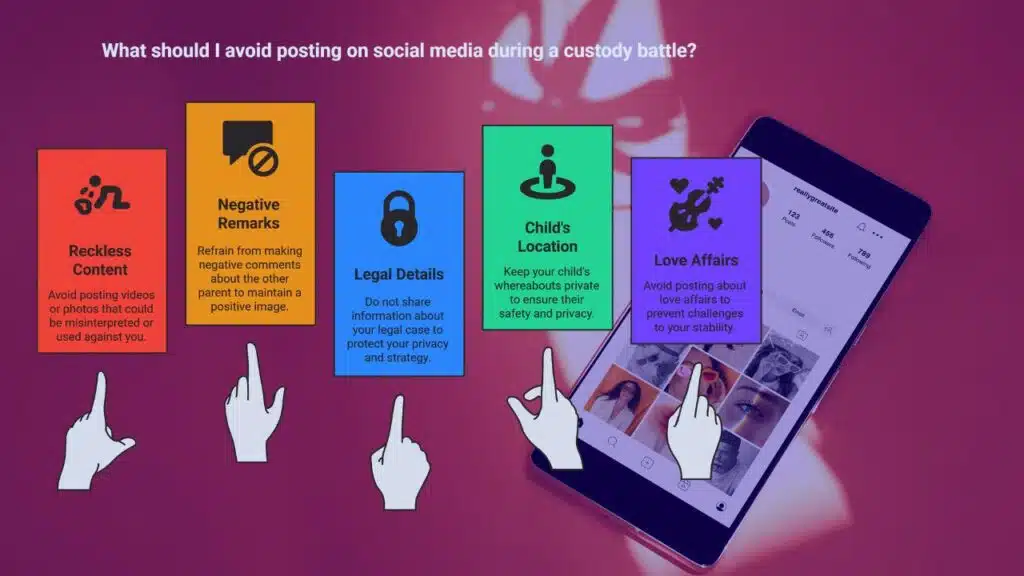
When dealing with the case of custody, it is always wise to be extremely careful with social media. Such are some of the posts that can hurt your case:
- Reckless video or photo.
- Negative or bad remarks about the other parent
- Information regarding your legal case or court case
- Details of where your child is or what s/he is doing
- Mob scenes of love affairs which can be employed to challenge solidity
Even those posts that are not harmful may be taken out of context and will be used against you in a court of law.
How to Safeguard Your Self on Social Media
Things like these can hurt your custody case, which is why you should take in account the following best practices:
- Cut down on your internet presence: This means that the safest option is to limit the amount of posts that you make until your case can be handled.
- Check privacy settings: Nothing in the Internet is confidential per se, but you can improve privacy through the settings.
- Be smarter than you post: Would there be repercussions in court, if a judge was to read such a post in the court?
- No confrontation over the Internet: Do not conduct a debate with your former partner or react to his/her provocations through the Internet.
- Save screenshots: In case your co-parent is publishing something inappropriate or even harmful, save the matter as evidence to give to your attorney.
Final Thoughts
Social media may seem an innocent way to relieve stress but in a child custody case; it may be a strong force–against you or on your side. Digital evidence is being given greater relative weight by courts and what you say online is constituting your legal imprint.
To parents, playing it safe is to act as though everything you say on social media would be exhibited in a court. Through becoming informed and conscientious, one is able to guard against such gambits in defending one can double up in concentrating in what is important and that is the future of the child.