You know that dread when your gaming rig starts whirring like a jet engine and the frame rate drops? That is basically Earth right now. We are running high-demand software on hardware that needs a serious cooling upgrade. You might hear the number 1.5°C thrown around constantly. Maybe you have wondered if a single degree actually matters. It sounds small, like the difference between a warm and a slightly warmer cup of coffee.
Here is the reality check. Since the late 1800s, our planet has already warmed by roughly 1.3°C to 1.4°C due to greenhouse gas emissions. In fact, 2024 was the first year on record to temporarily breach that 1.5°C limit, hitting an average of 1.55°C above pre-industrial levels. The latest IPCC report is essentially the patch notes for our planet. It says we are racing toward a permanent system error faster than expected.
I am going to break down exactly what this target means without the dense academic jargon. We will look at how close we are to the edge, what happens if we cross it, and the specific tools you can use to help cool things down. Small numbers can cause massive glitches. Let’s dig into why this one matters.
What is the 1.5°C Target According to the IPCC Report?
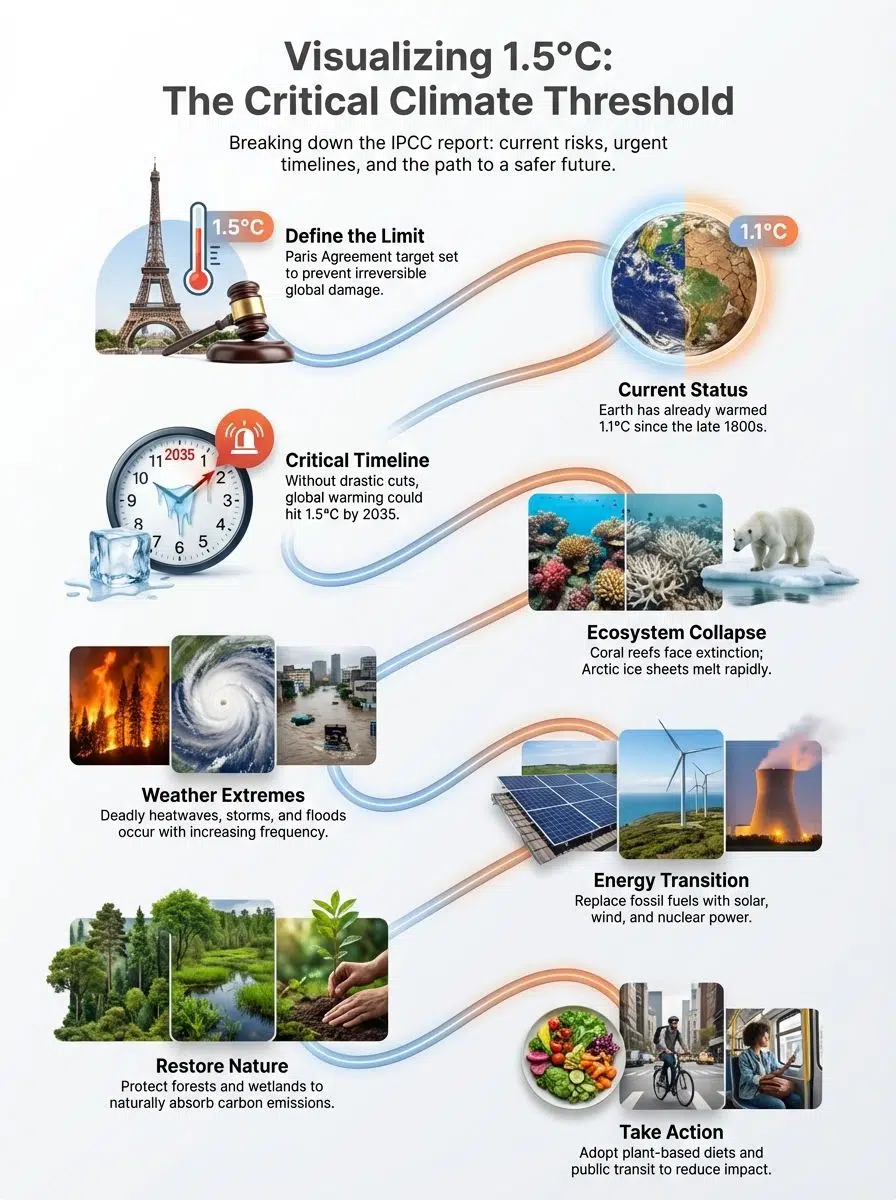
Scientists set the 1.5°C target as a critical safety limit. Crossing it permanently is like overclocking your CPU without a proper heat sink; eventually, components start to fry.
What does 1.5°C represent?
Think of 1.5°C as the “safe operating temperature” for human civilization. It is the limit agreed upon by world leaders at the Paris Agreement in 2015. They listened to climate experts who warned that pushing past this point invites chaos.
This number means Earth’s average temperature should not rise more than 1.5 degrees Celsius above pre-industrial times. That was the era before we started pumping massive amounts of carbon dioxide into the atmosphere from factories and cars.
Why is the margin so razor-thin? The difference between 1.5°C and 2°C is not just a slightly hotter summer. It is the difference between manageable changes and catastrophic system failures. For small island nations, it is literally a survival limit; anything higher could put their homes underwater.
The IPCC data shows that passing 1.5°C makes dangerous tipping points much more likely. We are talking about entering uncharted territory where the climate system behaves unpredictably.
“Every fraction of a degree matters. It is the difference between a fever you can sweat out and one that lands you in the hospital.”
Why is it a critical threshold?
To understand the stakes, we need to look at the “Wet Bulb” temperature. This is a term you will hear more often in tech and science circles. It refers to a combination of heat and humidity where the human body can no longer cool itself by sweating.
Scientists identify a wet-bulb temperature of 35°C as the theoretical limit for human survival. However, real-world data suggests the danger zone starts much lower, around 31°C for daily activity. At 1.5°C of warming, these dangerous heat events become common but remain somewhat manageable with adaptation. If we push past that, risks escalate rapidly:
- Coral Reefs: At 1.5°C, we lose 70-90% of reefs. At 2°C, over 99% are destroyed. That is a total server wipe for ocean biodiversity.
- Extreme Weather: Every extra fraction of a degree adds energy to the system. This fuels stronger hurricanes and more intense heatwaves like the ones we saw in Phoenix and Texas recently.
- Tipping Points: We risk triggering irreversible events, like the collapse of the West Antarctic Ice Sheet. This would lock in meters of sea-level rise for centuries.
The IPCC report says staying below this level gives us a fighting chance to protect our water supplies, jobs, and cities. It is about keeping the game playable for the next generation.
The Origins of the 1.5°C Goal
This number wasn’t pulled out of thin air. It comes from decades of data collection and intense global negotiations. It is the result of thousands of scientists running simulations to find the breaking point.
Historical context
Climate awareness didn’t render overnight. Back in 1992, world leaders met in Rio de Janeiro to discuss slowing down global warming. It was the early alpha version of global climate policy.
By 2015, the science was much clearer. Almost every country signed the Paris Agreement. They initially aimed to keep warming “well below 2°C,” but vulnerable nations fought hard for the 1.5°C limit. They knew that 2 degrees was a death sentence for low-lying islands.
Climate models began showing scary predictions as CO₂ emissions climbed. We are currently sitting at around 427 parts per million (ppm) of CO₂ in the atmosphere, a massive jump from the pre-industrial average of 280 ppm.
“We’re not inheriting this planet from our ancestors; we’re borrowing it from our children.”
Role of the Paris Agreement
The Paris Agreement in December 2015 was the global pact to fix the glitch. It set the first clear goal to keep warming under control. Countries promised to cut emissions using their own custom plans, known as Nationally Determined Contributions (NDCs).
The deal included a mechanism to update these goals every five years. It is like a scheduled firmware update to improve performance over time. The agreement pushes for clean energy, carbon reduction, and support for communities on the front lines.
Now, the latest IPCC findings are testing whether those promises are actually working. The data suggests we need to speed up the transition significantly.
Key Findings from the Latest IPCC Report
The numbers are in, and the clock is ticking louder than a bomb timer in a movie. Communities everywhere are feeling the heat as we inch closer to that red line.
Current global temperature trends
Earth has warmed significantly since the late 1800s. According to the World Meteorological Organization (WMO), 2024 was the warmest year on record, with global average temperatures temporarily hitting 1.55°C above the pre-industrial baseline.
We are seeing the effects in real-time. In the US alone, 2024 saw 27 separate weather and climate disasters that each cost over $1 billion. The total price tag for these events was approximately $182.7 billion. That is money draining directly from the economy due to extreme weather.
Oceans are absorbing most of this excess heat. This causes thermal expansion and hurts marine life. Ice sheets in Greenland and Antarctica are shedding mass, and glaciers are retreating globally.
Data shows we are racing toward the permanent 1.5°C mark. While touching it for one year doesn’t mean we have failed the Paris Agreement yet, it is a massive warning sign.
Projected timelines for reaching 1.5°C
If we continue on our current emissions path, we will likely cross the 1.5°C threshold permanently between 2030 and 2035. That is effectively tomorrow in geological time. To avoid this, greenhouse gas emissions must peak immediately and fall rapidly. We need to cut global emissions by roughly 43% by 2030 compared to 2019 levels.
Stalling is not an option. Every year of delay steepens the curve we have to climb later. It is like waiting until the night before the final exam to start studying; the stress and difficulty skyrocket.
Impacts on ecosystems and communities
We are already seeing the frame drops. In the Arctic, sea ice is vanishing. Animals that rely on it, like polar bears and walruses, are losing their habitats. In the US, recent hurricanes like Helene and Milton have shown how warmer oceans supercharge storms. These events bring record-breaking rainfall and wind speeds that our current infrastructure cannot handle.
Farmers are struggling with unpredictable growing seasons. Crops are failing due to drought in some areas and floods in others. This disrupts food supply chains and drives up prices at the grocery store. The damage gets exponentially worse if we pass the target. We need to look at exactly what happens if we let the system overheat.
What Happens if We Exceed 1.5°C?
If we blow past 1.5°C, we are looking at a cascade of failures. It is not just about hotter days; it is about the stability of the entire biosphere. Here is the data on how 1.5°C compares to 2°C.

| Feature | Impact at 1.5°C Warming | Impact at 2°C Warming |
|---|---|---|
| Arctic Sea Ice | An ice-free summer once every 100 years | An ice-free summer once every 10 years |
| Coral Reefs | Decline of 70-90% | Virtual elimination (>99% lost) |
| Extreme Heat | 14% of the global population is exposed | 37% of the global population is exposed |
| Water Scarcity | 350 million urban residents are exposed | 410 million urban residents are exposed |
| Species Loss | 6% of insects, 8% of plants lose range | 18% of insects, 16% of plants lose range |
Potential tipping points
Crossing 1.5°C risks triggering tipping points that we cannot reverse. These are like save points you can’t reload from. The Amazon rainforest could degrade into a savanna, releasing billions of tons of stored carbon. Permafrost in the Arctic could thaw, releasing methane, a greenhouse gas that is 80 times more potent than CO₂ in the short term.
These feedback loops would speed up warming regardless of human action. It is the runaway effect that scientists fear most.
Long-term consequences for the planet
Sea levels will continue to rise for centuries. By 2050, coastal flooding that used to happen once a century could happen every year in many US cities, from Miami to New York. Economic impacts will be severe. A report by Consumer Reports estimates that a baby born in the US in 2024 could lose up to $500,000 in lifetime earnings due to the economic drag of climate change.
Food security becomes a major issue. With hotter temperatures and changing rain patterns, growing staple crops like wheat and corn becomes much harder. This could lead to higher prices and scarcity globally.
Pathways to Limit Warming to 1.5°C
The situation is serious, but we have the tech to fix it. We just need to deploy it faster. It is time for a massive hardware upgrade for the planet.

Transitioning energy systems
Moving away from fossil fuels is the main quest. We are already making huge progress in the US.
- Solar Power Boom: Solar accounted for about 66% of all new electricity-generating capacity added to the US grid in 2024. The industry installed nearly 50 gigawatts of capacity in a single year.
- Wind Energy: Both onshore and offshore wind farms are scaling up. They provide cheap, clean power that complements solar.
- Battery Storage: This is the game-changer. Batteries allow us to store solar power for use at night. Utility-scale storage in the US is growing exponentially.
- Nuclear Power: It remains a key source of carbon-free baseload power. It provides stability while renewable energy scales up.
- Smart Grids: Using AI and sensors to balance the grid is essential. It prevents waste and ensures power goes where it is needed instantly.
- Electric Vehicles (EVs): Sales are rising as prices drop and range improves. They cut tailpipe emissions to zero.
- Heat Pumps: These devices are incredible. They move heat rather than creating it. The Inflation Reduction Act (IRA) offers a tax credit of 30% of the cost, up to $2,000, for installing heat pumps. It is a massive discount on top-tier tech.
These technologies are cleaner, cheaper, and more efficient. The transition is already happening; we just need to hit the accelerator.
Enhancing land and ecosystem resilience
Technology alone isn’t enough. We also need to work with nature. Think of this as optimizing the game engine.
- Reforestation: Planting trees is a proven way to suck carbon out of the air.
- Wetland Restoration: Marshes and swamps are incredibly efficient at storing carbon and protecting cities from floods.
- Regenerative Agriculture: Farmers are using techniques like cover cropping to keep soil healthy and lock carbon underground.
- Urban Greening: Adding parks and green roofs to cities cools them down. It combats the “urban heat island” effect.
- Protecting Old Growth: Mature forests store vastly more carbon than new ones. Keeping them standing is priority number one.
- Local Biodiversity: Using native plants in your garden supports local pollinators and requires less water.
Healthy ecosystems are our best defense against the impacts of climate change. They provide a buffer that technology cannot replicate.
Promoting sustainable urban and industrial systems
Our cities and factories are the biggest users of resources. We need to redesign them for efficiency. Urban planners are focusing on walkable cities and better public transit. Electric buses and bike lanes reduce the need for cars. In industry, we are seeing a shift toward “circular economy” models, where waste is minimized, and materials are reused.
Companies are also using digital twins and AI to optimize energy use in factories, cutting emissions and costs simultaneously.
The Role of Individual and Collective Action
You might feel like a single player in a massive MMO, but your actions add up. Plus, there are some great tools to help you level up your impact.
Lifestyle changes and behavioral shifts
Here are some high-impact moves you can make right now. I have included some specific apps that make it easier.
- Cut Food Waste: Use the app Too Good To Go. It connects you with local restaurants and bakeries to buy surplus food at a huge discount. You get cheap eats, and the food stays out of the landfill.
- Plant Trees While Browsing: Switch your default search engine to Ecosia. They use their ad revenue to plant trees where they are needed most.
- Gamify Your Habits: Check out JouleBug. It turns sustainability into a game, awarding points for actions like biking to work or recycling. It is great for competitive types.
- Reforest from Your Phone: The Treeapp lets you fund tree planting projects daily for free by watching short ads.
- Electrify Your Home: Use the calculator from Rewiring America to see how much money you can get from the Inflation Reduction Act for upgrades like induction stoves and heat pumps.
- Eat More Plants: Reducing meat consumption is one of the most effective ways to lower your carbon footprint.
- Unplug Vampires: Use smart plugs to kill power to devices that drain energy even when they are off.
Importance of policy and governance
Individual action is great, but we also need system-wide patches. That means strong policy. Governments need to set strict limits on emissions and stop subsidizing fossil fuels. The Paris Agreement was the start, but we need updated NDCs that reflect the urgency of the 1.5°C target.
Your vote matters. Supporting leaders who prioritize climate action is the most powerful tool you have. It pushes the entire system in the right direction.
Challenges and Opportunities Ahead
We are facing a boss battle, but we are well-equipped. The path forward is difficult but full of potential.
Technological innovation
New tech is rolling out constantly. Solar panels are getting more efficient with new materials like perovskites. Solid-state batteries promise to make EVs cheaper and longer-lasting. We are also seeing advances in green hydrogen for shipping and heavy industry. These are sectors that were previously hard to clean up.
Climate finance and global cooperation
The biggest hurdle is money. Wealthy nations pledged to provide $100 billion annually to help developing countries adapt. We need to meet and exceed this goal. Global cooperation is non-negotiable. Climate change does not respect borders. Sharing technology and resources is the only way to ensure a fair transition for everyone.
Final Thoughts
We have covered the hard data on 1.5°C, the risks of crossing it, and the tools we have to stop it. The situation is urgent, but it is not hopeless. We have the hardware, the software, and the user base to fix this. You can start today. Download one of the apps I mentioned, check your home for energy leaks, or just start a conversation with a friend. For more verified data, keep an eye on NASA Climate Kids or the IPCC website.
As my grandma used to say after a stormy night, “Bright mornings come when enough folks light a candle.” Let’s get to work.