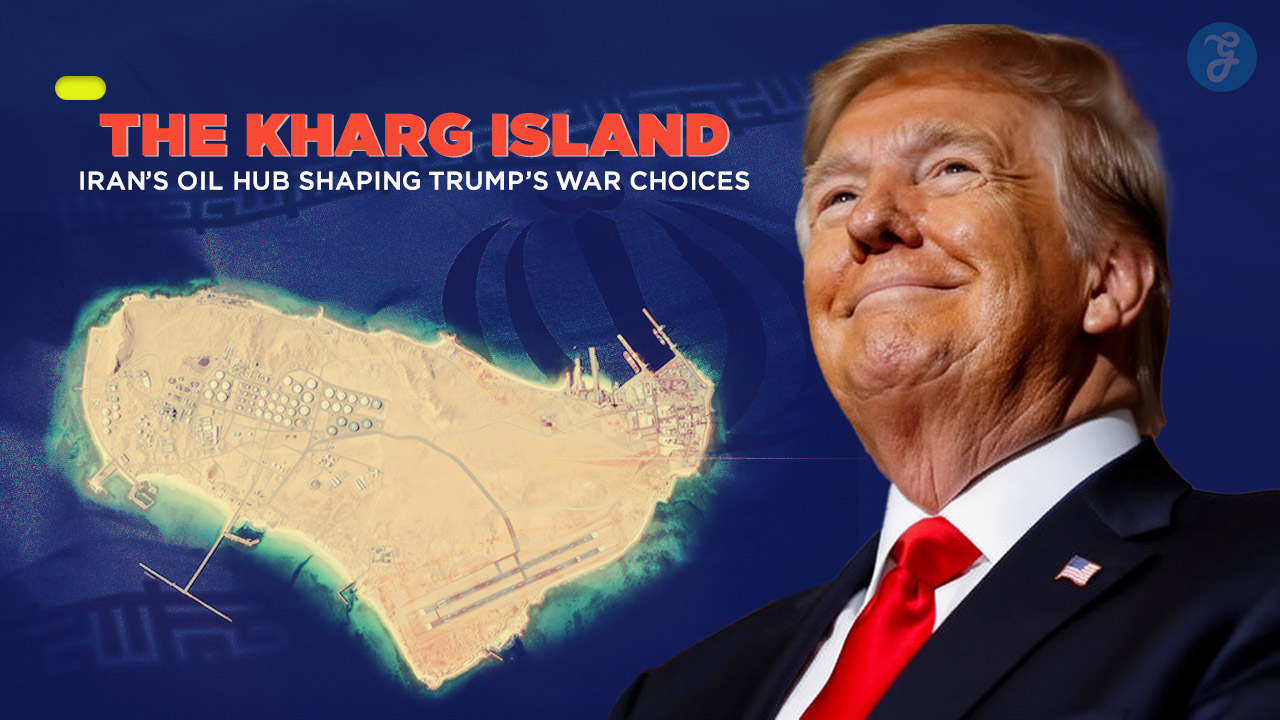
The fires across the Iranian mainland suggest a story of relentless, total military pressure. Under the banner of Operation Epic Fury, American and Israeli strikes have systematically targeted the nodes of the IRGC command structure while burying Tehran’s nuclear infrastructure under tonnes of concrete. To the casual observer, this is a campaign of absolute erasure. Yet, a few miles offshore in the Persian Gulf, a tiny limestone outcrop remains eerily tranquil. This is the Kharg Island Iran oil lifeline, and it is the only patch of Iranian territory that Donald Trump pointedly refuses to touch.
The restraint is not born of mercy. It is the product of a cold, backstage economic calculation that the general public often misses. While the White House is willing to hollow out the regime’s military wings, it is terrified of the global economic heart attack that would follow the destruction of this terminal. We are witnessing a war where the most potent target is also the most dangerous to hit.
Trump is effectively betting the global economy on a game of chicken. If those jetties go up in flames, oil prices could double overnight. The resulting shock would ripple across global markets and trigger a recession in economies already struggling with inflation. By leaving the pumps running, Washington maintains a fragile equilibrium. It is a precarious balance built on the back of a fossil fuel monopoly.
This silence in the Gulf is the loudest part of the conflict. The island has become a ghostly haven of productivity while the mainland burns. It represents a tense equilibrium between the risk of total regime collapse and the need for international financial stability. Whether this gamble pays off depends on whether Tehran decides to torch its own house and take the world economy down with it.
The Silent Lever: Beyond the Battlefield Theatre
Beyond the smoke of the cruise missiles and the rhetoric of the briefing rooms lies a far more calculated reality. The restraint shown toward Kharg Island looks like a tactical oversight or a momentary lapse in aggression. In reality, this is the cold application of leverage that bypasses traditional battlefield logic. Intelligence circles have long understood that in a conflict of this scale, the most important targets are not always the ones you destroy. They are the ones you keep functional to maintain a grip on your opponent’s windpipe.
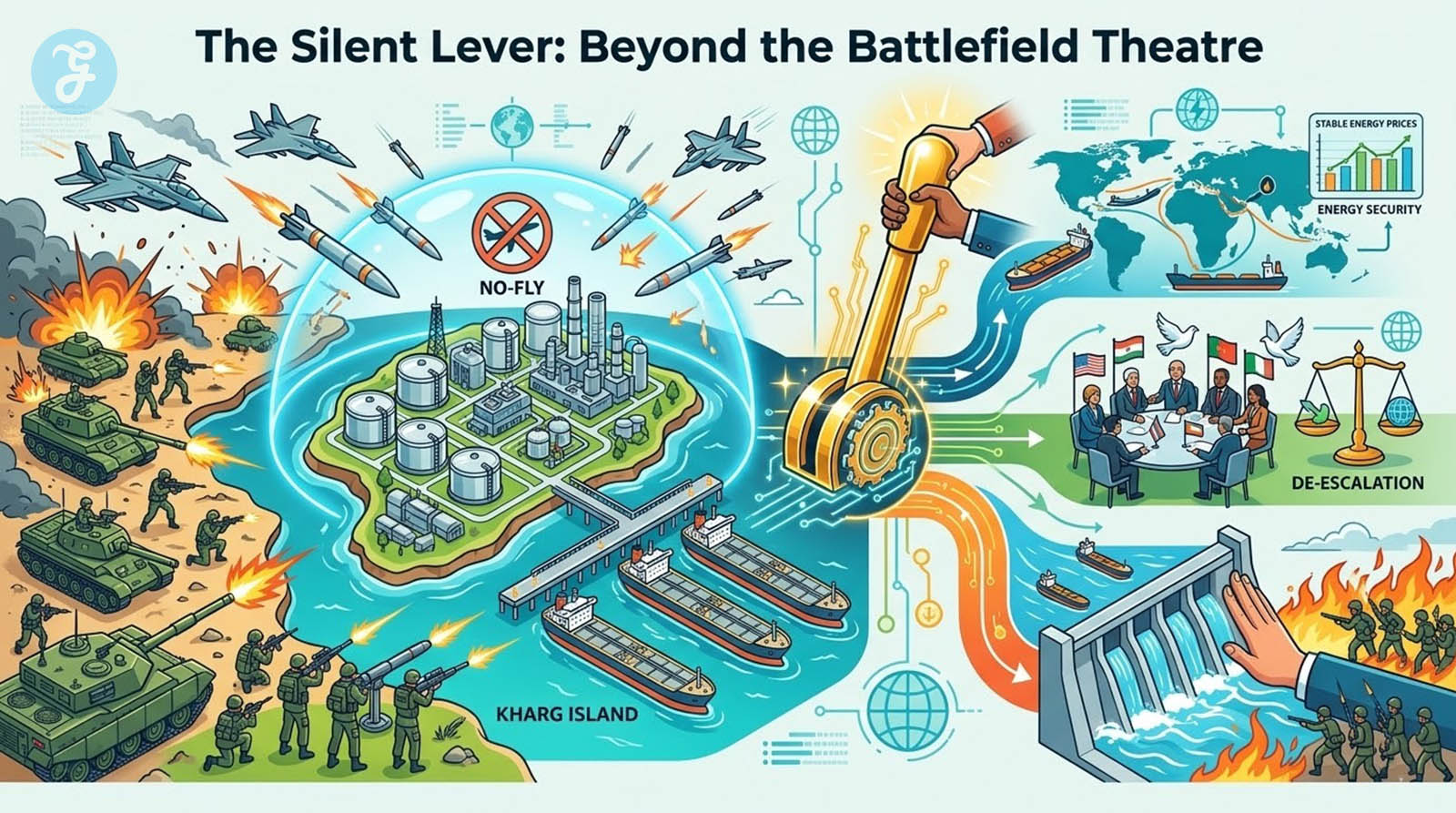 This is not about the next news cycle. It is a play for the next decade. While the public hears about “peace through strength,” the quiet reality involves managing the transition of power before the old guard has even left the stage. If the terminal remains intact, it becomes the cornerstone of a new regional arrangement where energy revenue is no longer an Iranian weapon but a Western tool. We are seeing a shift where the military is merely the clearing agent for a much larger institutional takeover.
Looking five years out, the survival of these jetties suggests a future where the Persian Gulf is no longer an Iranian lake, but a managed resource. The red line drawn around this limestone rock is actually a blueprint for a post-regime economy. It is a signal to Beijing and the markets that while the political order is being dismantled, the economic plumbing will remain under new management. This is the quiet reality of modern warfare. It is not about how much you can burn, but what you are clever enough to keep.
The Anatomy of an Economic Giant: Kharg Island
To understand the sheer weight of this conflict, one must look at a speck of land barely twenty-five square kilometres in size. Kharg Island is little more than a limestone platform rising from the sea. Yet this tiny patch of earth functions as the central nervous system of the Iranian state. It funnels nearly 90% of the country’s crude oil into the global market. Without this single point of exit, the regime would struggle to remain financially solvent.
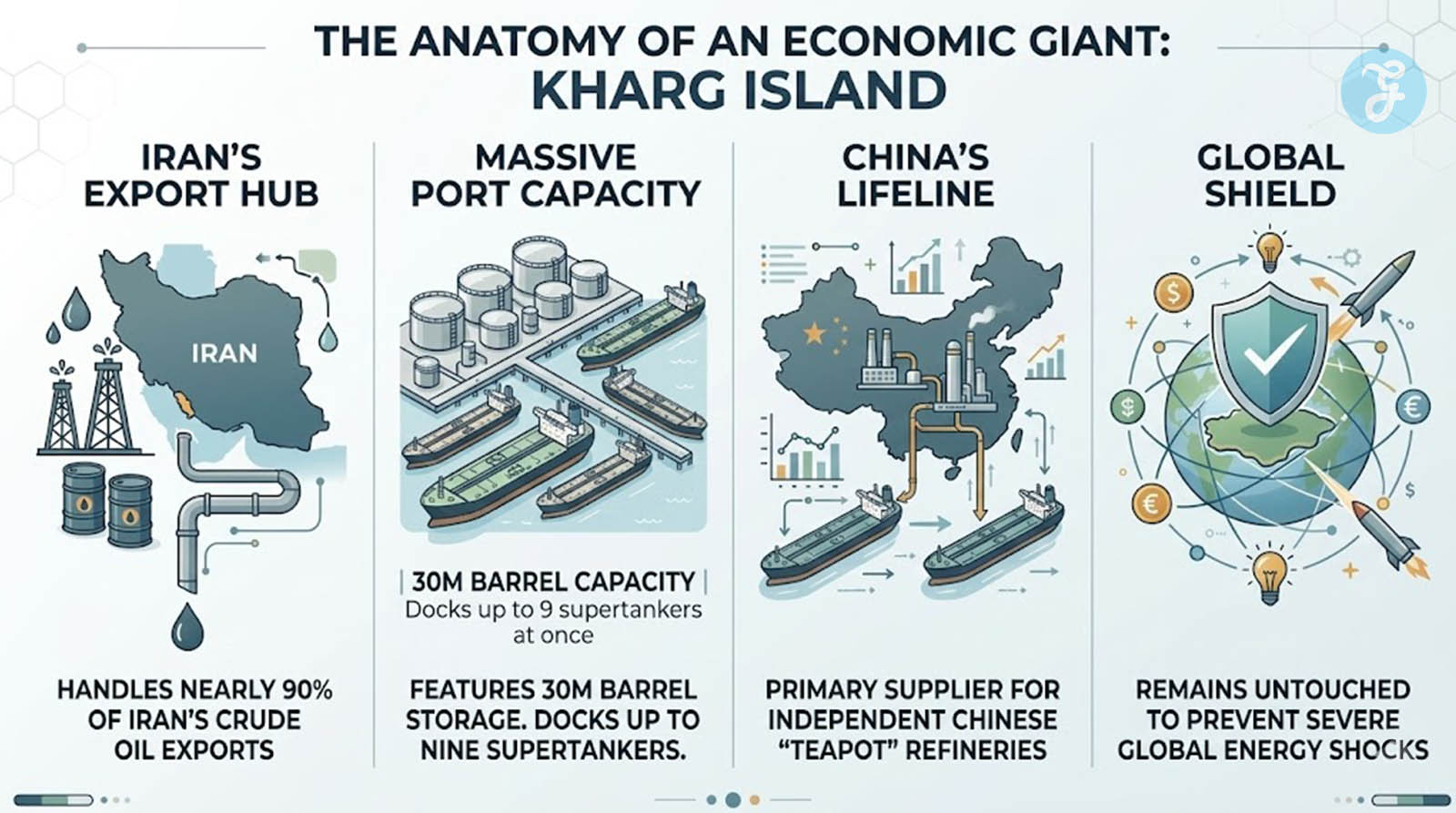 The scale of the operation is staggering. The island sits atop massive storage tanks capable of holding approximately 30 million barrels of oil. Along its coast, heavy steel jetties stretch into the deep waters of the Gulf. These piers are built to handle the largest vessels on the planet. At any given moment, nine Very Large Crude Carriers can dock simultaneously. These supertankers are the size of skyscrapers laid on their sides and each can carry roughly two million barrels of oil to distant shores.
Most of those ships are destined for a specific set of docks in the Far East. This brings us to the most delicate part of the equation. Iran’s primary customers are the independent teapot refineries of China. These private firms rely on a steady stream of Iranian crude to keep their operations running. By leaving Kharg untouched, Trump is not just managing a war with Tehran. He is also avoiding a direct economic confrontation with Beijing.
A strike on these jetties would likely be interpreted as an assault on Chinese energy security. It could force Beijing’s hand and potentially drag the world’s second largest economy into a conflict it currently watches from the sidelines. The infrastructure on Kharg is therefore protected by more than just Iranian anti-aircraft batteries. It is shielded by a complex web of global trade and the looming threat of an international supply chain shock. For now, it remains the one place where the gears of commerce and the machinery of war grind together without sparking a fire.
The Mirage of Surgical Warfare
We often talk about these strikes as if they happen in a vacuum of digital maps and satellite feeds. The reality is that the decision to spare the Kharg Island Iran oil lifeline creates a bizarre moral friction.
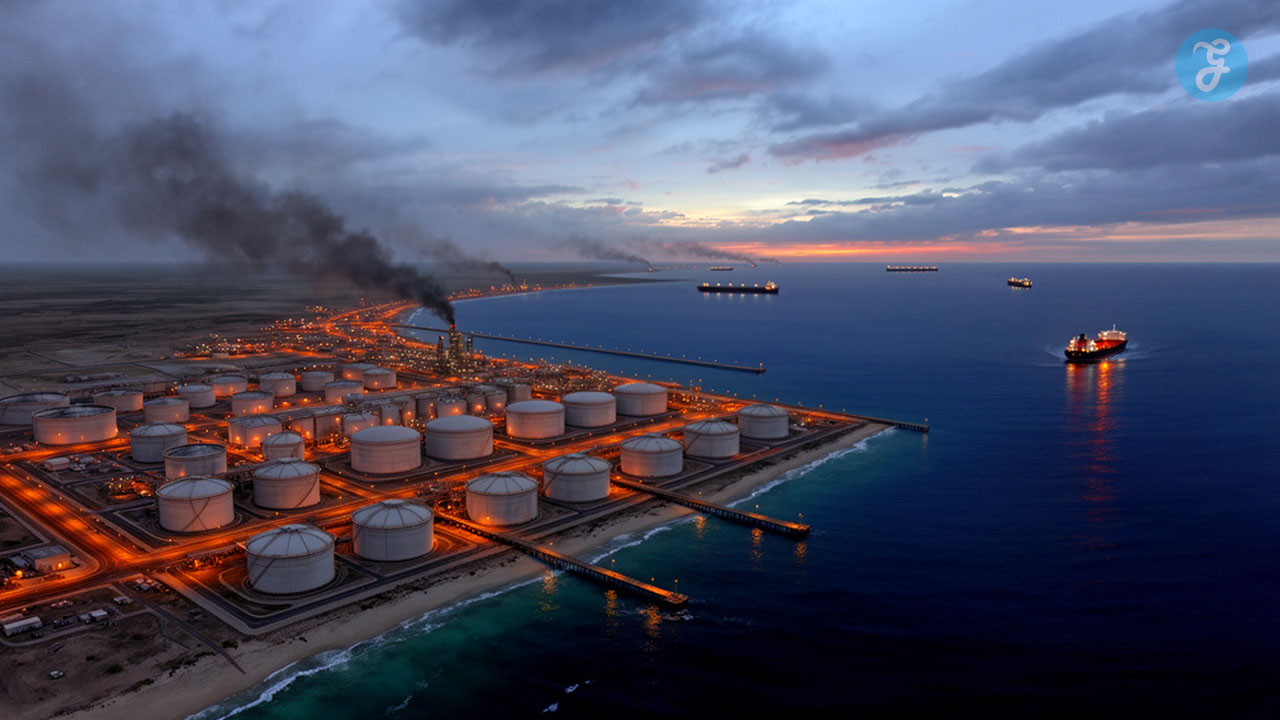 By leaving the jetties intact, the West is effectively subsidising the very regime it claims to be dismantling. It is a paradox that is hard to stomach. We are watching a campaign that destroys the barracks but preserves the bank account. This suggests that our fear of paying three pounds per litre at the petrol pump outweighs our desire for a definitive conclusion to the conflict. It is a messy, uncomfortable truth that exposes the limits of modern superpower influence. We are not just fighting a war. We are managing a global utility. This restraint keeps the lights on in London and Beijing, but it also leaves the door ajar for the IRGC to fund a long, bloody insurgency from the shadows.
The High Cost of Playing it Safe
There is a growing conviction among seasoned analysts that this caution might actually be the most dangerous path of all. By allowing the oil to flow, we are extending the shelf life of a collapsing system. It is like trying to put out a fire while still pumping gas into the basement. If the goal is truly to liberate the Iranian people from a decades-long grip of autocracy, then partial measures only serve to prolong their suffering. We are essentially asking the Iranian public to endure the rain of missiles while the regime continues to collect its dividends from the sea. A bolder strategy would involve a total blockade that forces a fast, sharp transition. Instead, we are settling for a slow burn that protects our portfolios but risks a much wider, more chaotic explosion down the line. We must decide if we are actually committed to a new era or if we are simply too afraid of the bill that comes with real change.
The Trump Calculus: Seizure vs Destruction
If the current campaign has a defining characteristic, it is the shift from remote bombardment to a more intimate form of economic warfare. Recent reports suggest a significant pivot in the West Wing. While some voices call for the total destruction of the Kharg Island Iran oil lifeline, Donald Trump appears to be eyeing a different prize. The conversation has moved from whether to bomb the jetties to whether the United States should simply go and take them.
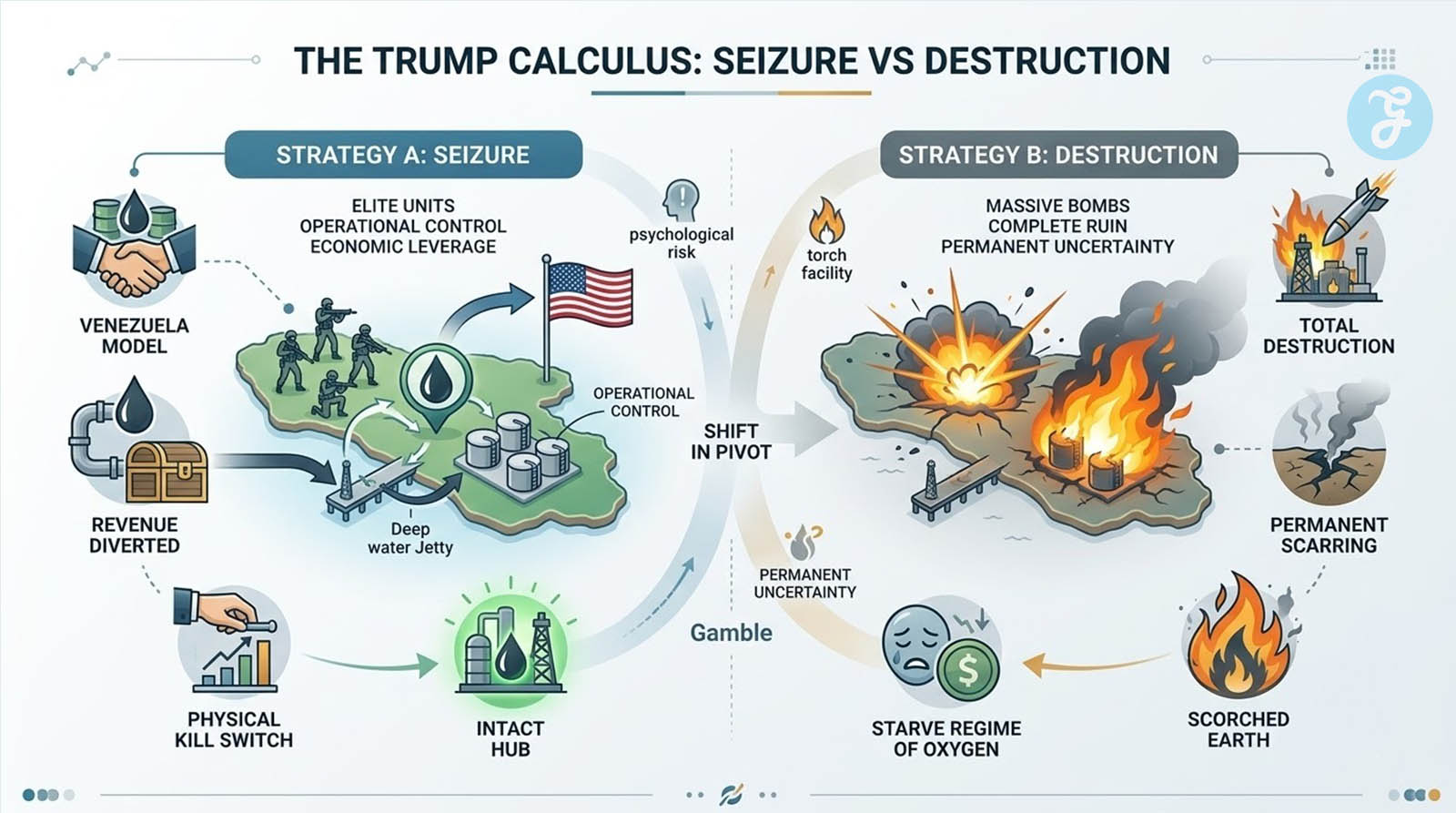 This strategy is being framed through the lens of the “Venezuela Model,” a concept championed by Jarrod Agen, Executive Director of the White House National Energy Dominance Council. In a recent interview, Agen was blunt about the shift. He argued that the goal is to take Iran’s massive oil resources out of the hands of those he terms “terrorists.” In this vision, the terminal remains intact, but the revenue is diverted. It is a plan that avoids the permanent scarring of the Iranian economy while effectively starving the current regime of its oxygen.
The logistical reality of such a move would involve small, elite special forces units rather than a massive ground invasion. The idea is to secure the island’s deep water piers and storage tanks, turning the facility into a strategic asset for further operations. By seizing the island, the US would gain a physical kill switch over Tehran’s finances without firing a shot that could permanently destabilise the energy market. It is a high frequency gamble that assumes the Iranian military is too degraded to mount a counter attack.
However, this path is fraught with psychological risks. The Iranian leadership has already seen its command structures hollowed out. If they perceive a seizure as the final act of their downfall, they may choose to torch the facility themselves. It is the ultimate scorched earth scenario. Trump is betting that the regime values its survival enough to keep the oil flowing, even under American management. It is a play for total control that treats the world’s most sensitive oil hub as a trophy rather than a target.
The Economic Paradox
| Stakeholder | The Surface Narrative | The Backstage Reality |
| Global Markets | Panicked by price spikes and supply instability. | Anchored by a managed utility that prevents systemic collapse. |
| The IRGC | Protected by a persistent and vital revenue stream. | Compromised as the terminal turns into a Western lever. |
| Beijing | A concerned bystander watching a regional war. | The silent beneficiary of a shielded crude supply. |
| The Iranian Public | Spared from the pain of total economic erasure. | Trapped in a slow burn that funds their own suppression. |
| Washington | An aggressor seeking absolute military erasure. | A manager overseeing an institutional takeover of energy. |
The $200 Barrel Threat: Global Economic Stakes
The financial markets are currently breathing through a straw. On Monday, 9 March 2026, Brent crude prices behaved like a fever chart, screaming past $114 and briefly touching $119 per barrel. This is not just a statistical blip. It is a reflection of a world terrified of what happens if the Kharg Island Iran oil lifeline is finally cut. Every dollar added to the price of a barrel is a tax on global recovery, pushing transport costs and heating bills into a territory most families simply cannot afford.
The threat from Tehran is no longer veiled. The Khatam al-Anbiya Central Joint Headquarters, the supreme operational command of the Iranian armed forces, has issued a blunt warning to the West and its neighbours. They claim that if Kharg is targeted, they will ensure no one else in the region enjoys energy security. They have spoken of “levelling” the vast processing hubs in Saudi Arabia, the Emirates, and Qatar. This is the “suicide vest” strategy. If Iran cannot export its oil, it intends to ensure the entire Persian Gulf becomes a graveyard of industrial machinery.
We have already seen the first tremors of this fallout in the gas markets. Qatar, which provides a staggering twenty percent of the world’s liquefied natural gas, has been forced to declare force majeure. Following drone strikes on the industrial hubs of Ras Laffan and Mesaieed, production has ground to a halt. This adds a layer of scarcity that goes beyond oil. Europe and Asia, already sensitive to gas shortages, are now facing a reality where electricity itself becomes a luxury.
The math of this conflict is becoming increasingly grim. Experts at the Anadolu Agency and regional analysts suggest that we are one spark away from two hundred dollar oil. Such a price point would not just be an inconvenience. It would be a systemic collapse. By leaving Kharg Island untouched, Washington is effectively paying a premium for time while the rest of the world holds its breath.
Ghosts of the Gulf: Carter, Reagan, and the Long Shadow of Restraint
This is not the first time an American president has stared across the water at Kharg and hesitated. In 1979, as the hostage crisis paralyzed Washington, Admiral James “Ace” Lyons presented Jimmy Carter with a plan to seize the island. Carter, wary of a direct war and tethered to a policy of neutrality, ultimately shelved the idea. He chose sanctions over seizing the Kharg Island Iran oil lifeline. A decade later, Ronald Reagan showed a different kind of restraint. During the “Tanker War,” he launched Operation Praying Mantis, obliterating Iranian speedboats and smaller platforms. Yet, even as he crippled the Iranian navy, he left Kharg untouched. The logic then was the same as it is now: the global markets simply could not withstand the shock of its destruction.
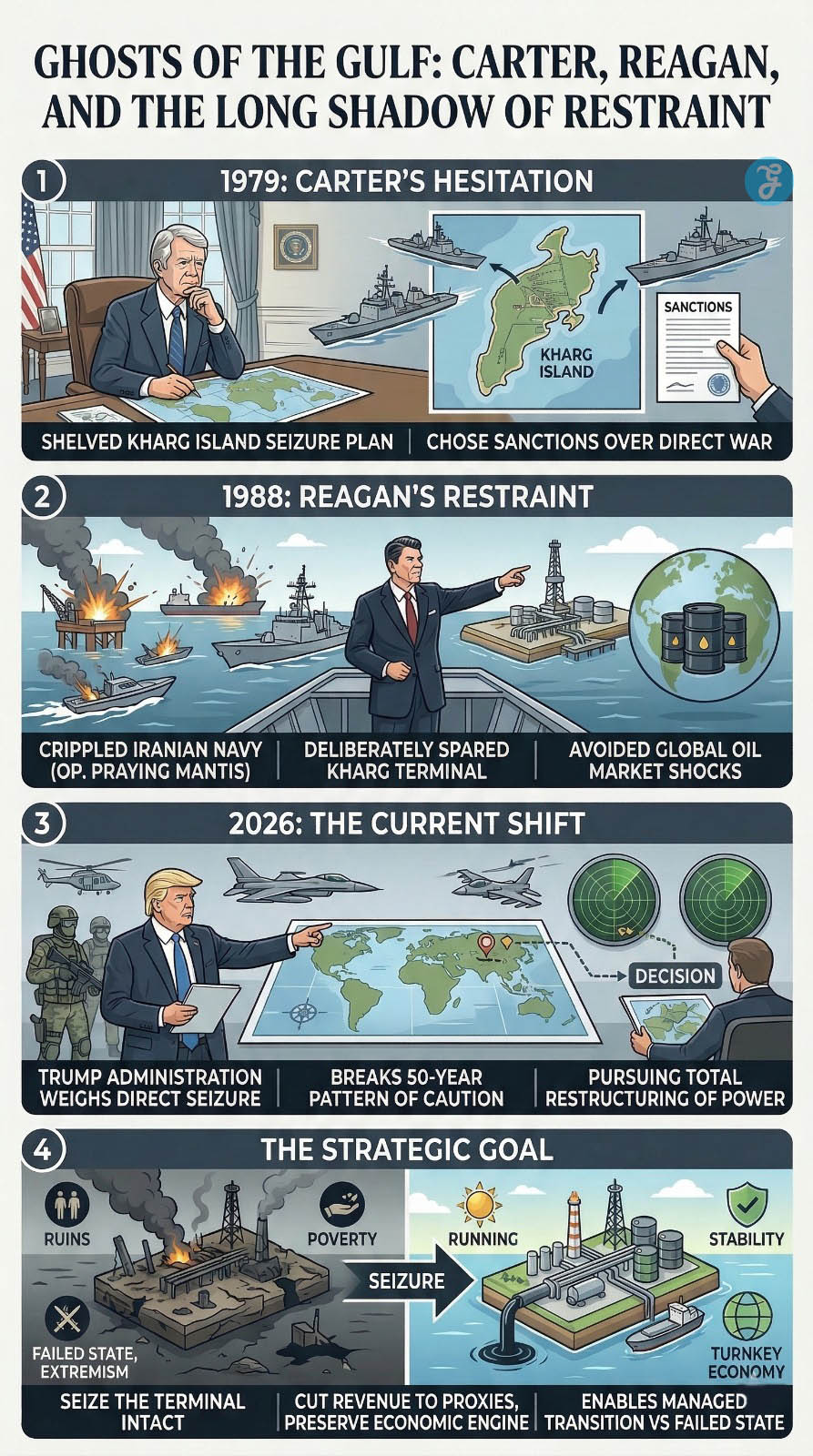 However, the current administration is operating on a different timeline. Trump’s aggression marks a departure from the cautious patterns of the late twentieth century. Unlike his predecessors, he is not merely seeking to protect shipping lanes or encourage diplomatic shifts. He is pursuing a total restructuring of regional power. The debate in the Oval Office has moved beyond simple avoidance. If the US proceeds with a seizure, it would be the first time a president has called the bluff that has kept this island safe for fifty years.
The stakes here involve the difference between a failed state and a managed transition. If American missiles were to level the terminal, they would leave behind a bankrupt nation with no hope of recovery. A destroyed Kharg means a post-war Iran would be a vacuum of poverty and extremism. By contrast, seizing the island intact provides a turnkey economy. It keeps the revenue flowing while ensuring that the funds are no longer used to fuel regional proxies. It is a plan that seeks to dismantle a regime while preserving the engine that keeps the country, and the world, from stalling.
The Final Play: A Centenary Gamble
Kharg Island has become the ultimate kill switch for the global economy. As Operation Epic Fury enters its most decisive phase, the tiny outcrop remains the only piece of the board that has not been overturned. Trump is playing a high frequency game of chicken with both Tehran and the international markets. The restraint shown so far is a recognition of a terrifying truth: we are all hostages to this single point of failure.
The coming days will determine the shape of the next century. If the administration blinks and chooses to strike, the ensuing Great Depression could reshape the West more than any Iranian missile ever could. But if the gamble to seize the island succeeds, it will rewire the Middle East’s power structure permanently. Trump is betting that he can exert maximum pressure without triggering a global meltdown. It is a moment of historic tension where the silence of a single island is the loudest signal in a world at war.
Disclaimer: Editorialge maintains a steadfast commitment to responsible reporting on the evolving conflicts in West Asia involving Israel, Iran, U.S., Gulf nations and non-state actors like Hezbollah, Hamas, Houthis, Islamic State, and others. In an environment where digital disinformation is widespread, we cannot independently verify every social media post or claim involving national and non-state actors. Our priority remains factual accuracy and the exercise of extreme caution when documenting all regional media.