
In a dramatic, last-minute intervention, two federal judges ordered the Trump administration on Friday to immediately tap a multi-billion-dollar contingency fund to pay November benefits for the 42 million Americans who rely on the Supplemental Nutrition Assistance Program (SNAP). The rulings from federal courts in Massachusetts and Rhode Island came just hours before the benefits were set to completely halt for the first time in the program’s history, a crisis precipitated by the ongoing government shutdown.
The rulings are a stunning rebuke to the administration’s claims that it was legally powerless to issue payments. This Trump administration SNAP benefits shutdown has exposed the profound vulnerability of the nation’s primary food safety net, transforming a political budget impasse into an imminent humanitarian crisis.
Key Facts: The SNAP Funding Crisis
- Imminent Cutoff: 42 million Americans in 22 million households were slated to receive no SNAP benefits on November 1, 2025, due to the government shutdown.
- The Rulings: On Oct 31, 2025, federal judges in two separate cases ordered the USDA to use its contingency fund to issue payments.
- Funding Gap: The SNAP contingency fund holds an estimated $5.5 to $6 billion. The program costs $8 to $9 billion per month, meaning the court-ordered funds can only partially cover November’s needs.
- Administration’s Stance: On Oct 24, 2025, the USDA issued a memo suspending all November benefits, claiming it lacked the legal authority to tap the contingency fund.
- Legal Challenge: A coalition of 25 states and the District of Columbia sued the administration, arguing the suspension was illegal and violated the Administrative Procedure Act.
‘You Cannot Crowdsource $8 Billion’
The crisis began in earnest on October 24, 2025, when the U.S. Department of Agriculture (USDA) sent a memo to state agencies instructing them to “take immediate action to implement this suspension” of all November SNAP benefits.
The directive, which came as the partial government shutdown dragged into its fifth week, triggered panic among recipients and chaos for state-level administrators. For the first time, the program—which has operated for decades and continued payments through previous shutdowns, including the 35-day lapse in 2018-2019—was set to fail.
The 2018-2019 shutdown saw the administration use a different legal loophole to pay February 2019 benefits early. This time, no such mechanism was employed.
The potential impact was immediate and devastating. “I had what I thought was a stable job. I had savings,” Tina Gigioli, who lost her job earlier in the year and now relies on SNAP, told PBS NewsHour. “You cannot crowdsource $8 billion to prevent the harm that will come from the failure of the administration to follow the law.”
The potential cutoff sent shockwaves through local economies. Food banks, already strained, reported preparing for an unprecedented surge. “We are bracing for a tidal wave,” a spokesperson for a Colorado food bank told CPR News. “This isn’t a matter of tightening belts; it’s a matter of families having no food.”
‘Likely to Succeed’: The Courtroom Rebuke
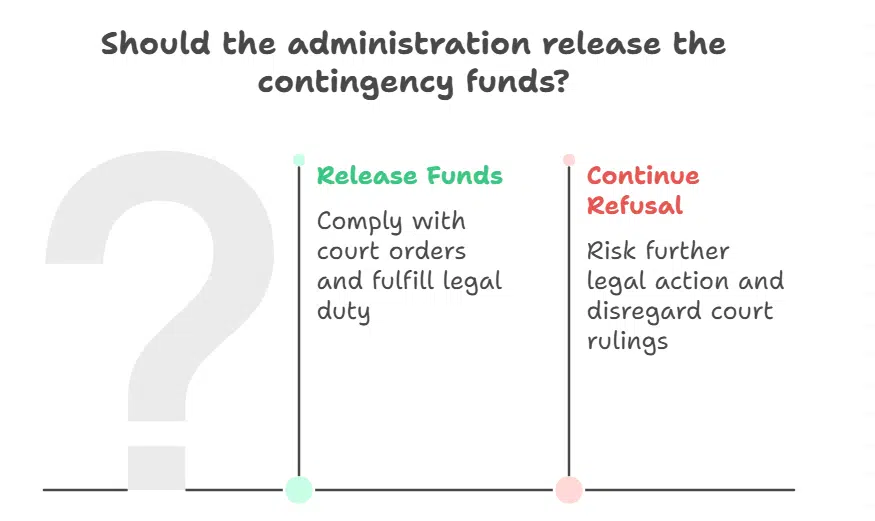
In response to the Oct 24 memo, a coalition of 25 states, led by Massachusetts and California, along with the District of Columbia, filed a federal lawsuit. They argued the administration’s refusal to use available funds was “arbitrary and capricious” and a clear violation of federal law.
On Friday, October 31, 2025, their arguments found a receptive audience.
In Rhode Island, U.S. District Judge John McConnell issued a direct order, stating, “There is no doubt that the contingency funds are appropriated funds necessary to carry out the program’s operation.”
Minutes later, U.S. District Judge Indira Talwani in Boston issued a similar 15-page order in the states’ case. She wrote that the states “are likely to succeed” on their claim that the suspension of benefits is unlawful. She ordered the administration to decide by Monday, November 3, whether it would authorize the release of the funds.
The rulings rejected the administration’s core argument that the contingency fund could not be used. The court’s intervention affirmed that the USDA, led by Secretary Brooke Rollins, has both the authority and the legal duty to use the available money.
The ‘Deleted’ Plan and Political Pawns
The legal battle was intensified by investigative reports revealing the administration’s own internal planning contradicted its public stance.
A 55-page USDA “Lapse of Funding Plan” dated September 30, 2025, explicitly stated that SNAP’s contingency reserves could be used to cover regular benefits during a shutdown. The document, first reported by Sentient Media, stated, “Congressional intent is evident that SNAP’s operations should continue.”
This plan was later deleted from the USDA’s website. It was replaced with a notice that blamed the funding lapse on “Senate Democrats” and their support for “healthcare for illegal aliens and gender mutilation procedures.”
The administration’s political messaging was echoed by President Trump. When asked Friday if money could be found for SNAP, he replied, “Well, there always is,” before urging Democrats to reopen the government.
A Partial Fix: The Crisis Is Not Over
While the court rulings provide a critical lifeline, the crisis is far from resolved. The core of the problem is simple math.
Data: SNAP Funding vs. Contingency Reserve
| Program Need | Amount | Source |
| Est. Monthly Cost of SNAP | $8 billion – $9 billion | ANI News, The Washington Post |
| Available in Contingency Fund | ~$5.5 billion – $6 billion | PBS, OFW Law |
| Funding Shortfall | ~$2.5 billion – $3.5 billion | (Derived) |
The $5.5 billion in the contingency fund is not enough to cover the full month of November benefits for all 42 million recipients.
This means states will likely be forced to issue partial benefits or face significant administrative delays as they scramble to process the court-ordered funds. “Even if the emergency SNAP benefits are released, there would likely still be an administrative delay in the disbursement of funds,” reported Sentient Media.
Some states, like Virginia and Delaware, have already declared states of emergency and are using state money to pay a small fraction (25%) of benefits. But most states do not have the resources to cover the massive federal shortfall.
What to Watch Next
All eyes are now on the White House and the USDA. As of Saturday afternoon, the administration has not issued a formal response or confirmed it will comply with the orders, though USDA Secretary Brooke Rollins told CNN the department was looking at all the options.
The administration could appeal the rulings to a higher court, though the political and human cost of doing so would be immense.
The Trump administration SNAP benefits shutdown has exposed a deep, structural flaw in America’s food safety net. Unlike entitlement programs like Social Security, which are funded automatically, SNAP’s reliance on annual appropriations makes it a uniquely powerful and vulnerable hostage in budget negotiations.
The court rulings have, for now, pulled the program back from the brink. But they have also affirmed that the only thing standing between 42 million Americans and hunger was not a foolproof law, but a last-minute order from a federal judge.