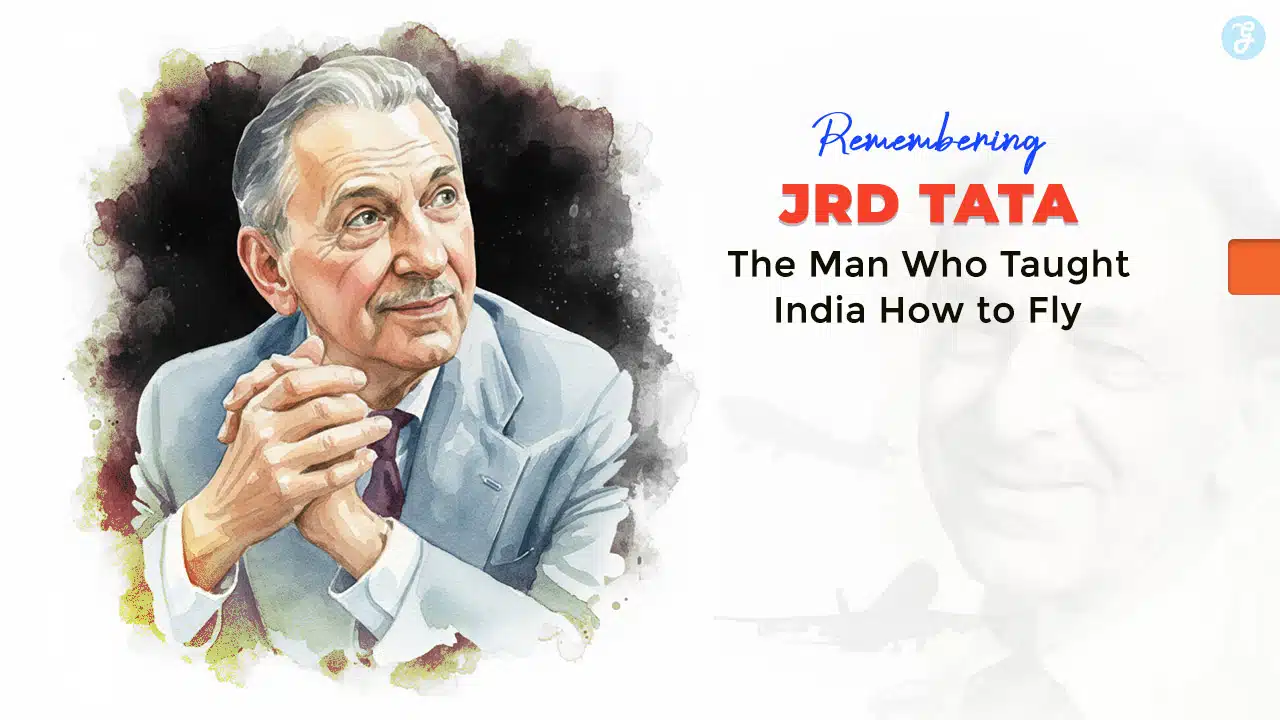
On 29 November 1993, Jehangir Ratanji Dadabhoy (JRD) Tata passed away in Geneva, and today marks his 32nd death anniversary—a moment to remember the man who quite literally taught India how to fly.
Three decades after his demise, JRD Tata continues to have a significant impact on corporate history. He is still a reference point whenever India debates ethical business, responsible capitalism, or the idea that industry can be a force for nation-building. As the “Father of Indian Aviation” and one of the architects of modern Indian industry, his story reads like a bridge between pre-Independence India and the aspirations of a global, 21st-century economy.
On his death anniversary, it is also an invitation to ask a tough question: are we still living up to the standards he set?
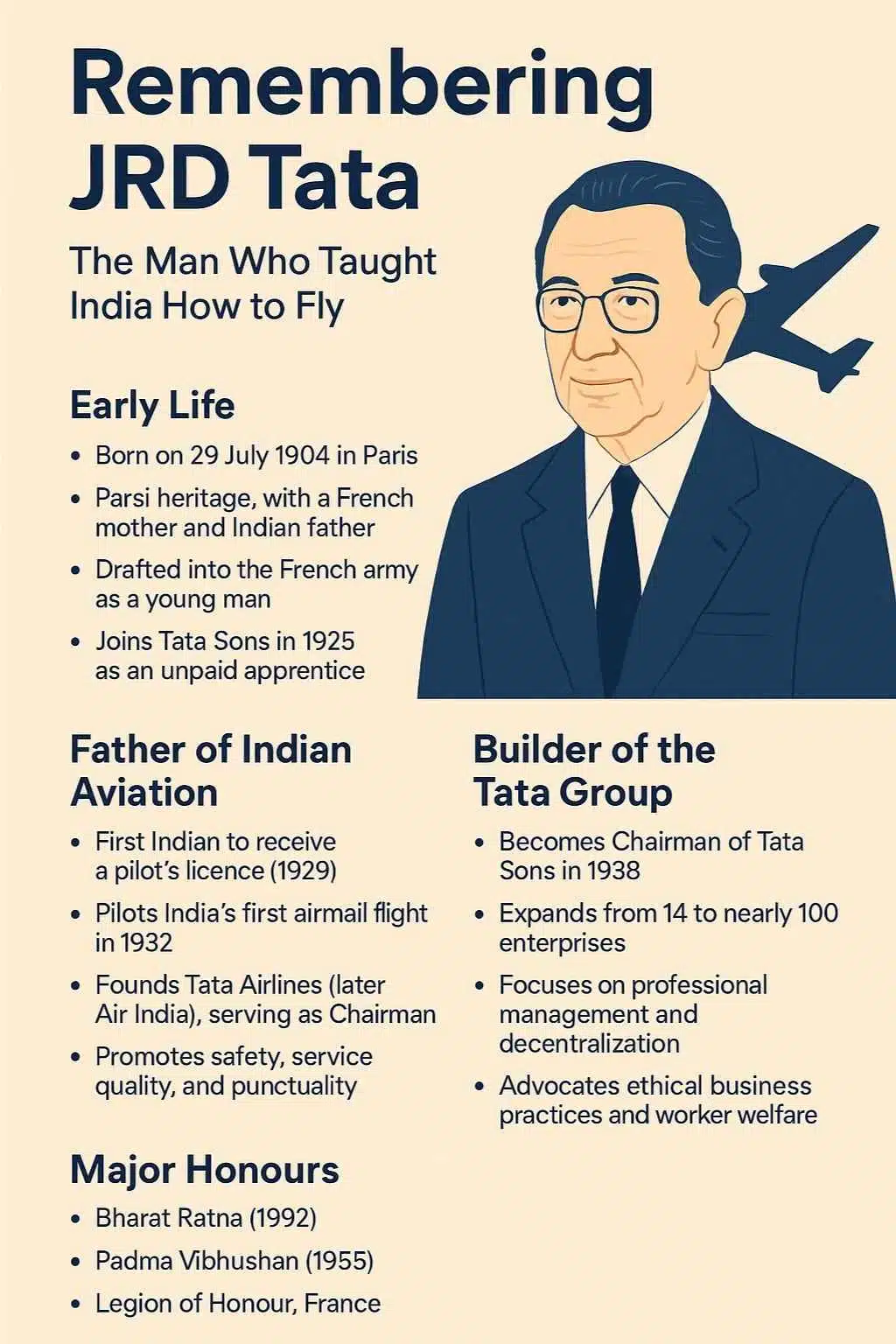
JRD Tata at a Glance
Before we dive into the narrative, a quick snapshot helps frame the scale of his impact:
- Full name: Jehangir Ratanji Dadabhoy Tata
- Born: 29 July 1904, Paris
- Died: 29 November 1993, Geneva
- Heritage: Parsi, with a French mother and Indian father
- Key roles:
- Chairman of Tata Sons from 1938 to 1991
- Founder and driving force behind Tata Airlines (later Air India)
- Mentor and catalyst for companies like TCS, Tata Motors, Titan, Voltas, Tata Chemicals, and more
- Signature titles:
- “The Father of Indian Civil Aviation”
- “Doyen of Indian Industry”
- Major honors:
- Bharat Ratna (India’s highest civilian award)
- Padma Vibhushan
- French Legion of Honour
- Global aviation awards and recognitions
These facts only hint at the scale of the JRD Tata legacy. To really understand his influence, we need to go back to his unusual beginnings.
Early Years: The Making of an Unlikely Indian Icon
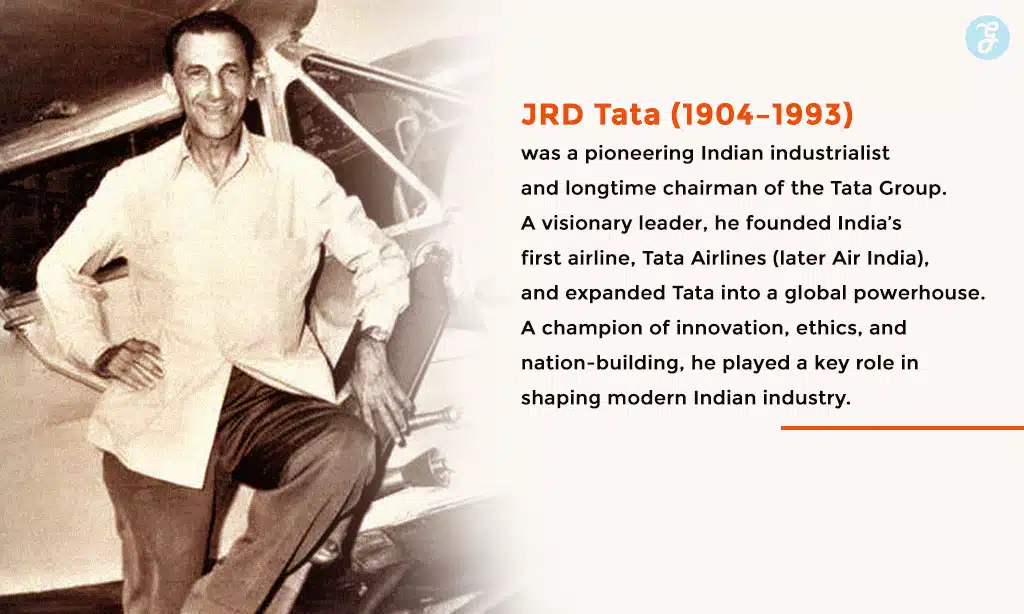
JRD Tata’s biography does not start in Bombay or any Indian industrial hub. It begins in Paris, where he was born into a cosmopolitan environment. His French mother and Indian father exposed him to two worlds from an early age. This duality shaped his outlook: European in Polish, Indian in purpose.
As a young man, he was briefly drafted into the French army. There, he learned discipline and structure, but his heart was elsewhere—captivated by machines, speed, and the romance of flight. Aviation, not industry, was his first love.
Yet destiny pulled him towards the family enterprise. His father, Ratanji Dadabhoy Tata, belonged to the broader Tata family that Jamsetji Tata had anchored as a force for industrial and social transformation. That tradition of combining profit with public purpose became the invisible script that guided JRD’s life.
In 1925, he joined Tata Sons as an unpaid apprentice. He did not have the luxury of a corner office. No instant power. He spent his early years learning from the ground up, observing factories, meeting workers, and absorbing the Tata ethos: business as a vehicle for nation building, not just personal wealth.
At that point, nobody could have predicted that this quiet, aviation-obsessed young man would become the face of Indian aviation and one of the most admired industrial leaders of the 20th century.
The Man Who Lifted India’s Dreams Off the Ground: Father of Indian Civil Aviation
If there is one image that defines JRD Tata, it is of a young pilot guiding a fragile aircraft over the Indian landscape, carrying mail between cities that had never been linked by air before.
India’s First Licensed Pilot
In 1929, JRD became the first Indian to hold a pilot’s license. For him, flying was not a hobby; it was a calling. At a time when aviation globally was still experimental and dangerous, he saw the potential for connecting a vast, diverse country by air.
The Historic Karachi–Ahmedabad–Bombay Flight
On 15 October 1932, he piloted a tiny Puss Moth aircraft on a pioneering flight from Karachi to Ahmedabad to Bombay, carrying mail. That moment is often remembered as the day India’s civil aviation truly took off.
Out of this effort emerged Tata Air Mail, which soon evolved into Tata Airlines. JRD ran it with obsessive attention to detail. For him, aviation was about safety, reliability, and dignity for passengers, long before those became industry clichés.
From Tata Airlines to Air India
After Independence, Tata Airlines became Air India, first as a public–private partnership and later, in 1953, as a nationalised carrier. Despite nationalisation, JRD was retained as the chairman of Air India and served on the board of Indian Airlines for decades.
Under his leadership:
- Air India became known worldwide for its service quality.
- The airline’s brand stood for Indian hospitality, punctuality, and professionalism.
- Pilots, crew, and staff often spoke of how seriously he took safety and how personally he followed up on complaints.
He was not just an administrator. He was a working aviator who understood the cockpit, the hangar, and the passenger cabin. In every sense, JRD Tata, the man who taught India how to fly, did so both literally and metaphorically.
A Legacy That Returned to the Skies
Years after his passing, when the Tata Group once again took over Air India, many saw it as the closing of a historical loop. The house that built Air India framed its return as a tribute to JRD’s original vision for Indian aviation. It underlined how strong his imprint remains on the story of flight in this country.
The Architect of the Modern Tata Group
While the world remembers him as the Father of Indian Aviation, JRD Tata’s influence on industry is even broader.
A Young Chairman in a Pre-Independence India
In 1938, at just 34, he became the Chairman of Tata Sons, the holding company of the Tata Group. India was still under colonial rule. Industrial policy was evolving. The infrastructure was weak. Yet JRD was expected to lead a sprawling enterprise and make decisions that would shape the group for decades.
At that time, Tata comprised around 14 companies. By the time he stepped down in 1991, that number had expanded to nearly 100, spanning sectors from steel and power to automobiles, hospitality, chemicals, and consumer goods.
Creating Future-Facing Enterprises
During his tenure, JRD Tata nurtured or catalyzed many companies that have since become household names:
- Tata Motors (originally TELCO), which later transformed India’s automotive landscape
- Tata Consultancy Services (TCS), which helped define India’s IT services revolution
- Tata Chemicals, Tata Power, Voltas, Tata Tea, Titan, Tata Salt, and more
When we think of “JRD Tata and Tata Group,” we are really looking at how one leader used his long tenure to deliberately diversify, professionalize, and modernize a family-led conglomerate.
Professional Management and Decentralisation
A crucial part of JRD Tata’s leadership style was his insistence on professional management. He did not want the Tata empire to be run by relatives alone. He brought in professionals, empowered them, and encouraged independent thinking.
He believed in:
- Decentralization: letting each company have autonomy rather than centralizing every decision at Bombay House.
- Expertise over lineage: giving responsibility to those who demonstrated competence, not just family ties
- Long-term thinking: focusing on sustainable growth, not quarterly optics
This philosophy laid the foundation for the Tata Group’s enduring strength, even after his retirement and death.
Ethics at Altitude: JRD Tata’s Leadership Style and Values
In an era when industrialists often cut corners, JRD Tata built his reputation around something less glamorous but far more durable: integrity.
No Shortcuts, No Black Money
Stories from colleagues and biographers repeatedly highlight one theme: he refused to use black money, bribes, or political favors to advance Tata’s interests. If a contract demanded underhanded payments, he preferred to walk away.
This approach sometimes costs the group in the short term. But it built immense goodwill over time. Even critics of big business often made an exception for JRD, acknowledging that he tried to conduct capitalism with a conscience.
People-First Capitalism
Long before the term “ESG” became fashionable, JRD Tata embedded worker welfare into corporate decision-making:
- Better working conditions and safety in factories
- Employee benefits and social security
- A culture where workers were encouraged to speak up
He saw employees not as “labor” but as partners in the enterprise. This people-first mindset helped Tata companies earn a reputation for being trustworthy employers.
A Listener, Not Just a Leader
JRD Tata’s leadership style also stood out for its humility. He was known to:
- Read letters from customers and workers
- Visit plants and walk the shop floor
- He listened to managers at different levels without taking sides.
He demanded excellence but disliked ostentation. When he was awarded the Bharat Ratna in 1992, his reaction reportedly was one of surprise and discomfort, not triumph. That anecdote captures his personality more accurately than any official citation.
Nation Building Beyond Business: Institutions, Philanthropy and Public Good
To understand JRD Tata philanthropy and nation-building, we must look beyond corporate balance sheets and into the institutions he nurtured.
Choosing Hospitals and Labs over Palaces
JRD inherited wealth and influence. He could have used them to accumulate personal luxuries. Instead, he followed the Tata tradition of channeling resources into public institutions.
Under his watch, Tata trusts and companies supported or helped create:
- Tata Memorial Centre—a leading cancer treatment and research institution
- Tata Institute of Social Sciences (TISS)—shaping generations of social workers and policy professionals
- Tata Institute of Fundamental Research (TIFR)—a key pillar in India’s scientific ecosystem
- National Centre for the Performing Arts (NCPA)—a premier arts and culture hub
These institutions created an impact far beyond the immediate orbit of Tata businesses. They helped define fields like social sciences, oncology, physics, and the performing arts in modern India.
Structured Philanthropy and the CSR Template
JRD played a central role in managing the Tata trusts, which hold a significant portion of Tata Sons. The idea that corporate wealth should be held in trusts and redeployed for the public good is deeply embedded in the Tata model. It continues to influence how Indian companies view CSR (Corporate Social Responsibility) today.
This is a critical part of the JRD Tata legacy. It shows that for him, nation-building was not a side project; it was part of his core business philosophy.
The Man Behind the Legend: Habits, Passions, and Contradictions
Public figures often become abstractions. JRD Tata, the man, was more complex than the clean lines of his official portrait.
A Private, Soft-Spoken Personality
Despite his towering stature, he was known to be soft-spoken and reserved. He married Thelma Vicaji, and their relationship, by most accounts, was a quiet, enduring partnership rather than a high-profile social spectacle.
He enjoyed simple pleasures:
- Cars and driving, with an eye for engineering detail
- Gardening, where he found calm and focus
- Flying, which remained a lifelong passion even after he became a global business figure
Perfectionism with Compassion
JRD could be exacting. He expected high standards from those who worked with him. Yet, many colleagues recall his kindness and discretion when it came to helping individuals in trouble.
There are stories of him:
- Quietly funding education for promising students
- Helping employees or their families in medical emergencies
- Remembering small details about people, even at his level of responsibility
This blend of perfectionism and compassion gave his leadership a human edge.
His Final Days and Unusual Honors
In 1993, JRD travelled to Geneva, where his health deteriorated due to a kidney infection. There, on 29 November, his life ended with a phrase that reflected both his French upbringing and his calm acceptance of mortality.
Back in India, the response was extraordinary. The Indian Parliament adjourned in his memory, an honor rarely given to someone who was never a member of the House. It symbolized how deeply he was considered a national figure, not just a corporate leader.
How JRD Tata’s Legacy Shapes India’s Future
Three decades after his passing, what does JRD Tata really mean to contemporary India?
The Tata Ethos in a New Era
Today, the Tata Group competes in a global marketplace across sectors like IT, autos, retail, aviation, and more. Yet many of its core values—ethics, long-term thinking, employee welfare, and philanthropy—can be traced back to the JRD era.
When people say “Tata can be trusted,” they are indirectly acknowledging the culture that JRD helped formalize.
A Blueprint for Responsible Capitalism
In a time when startup valuations, unicorn status, and rapid exits dominate headlines, JRD’s life offers a different yardstick for success:
- Build institutions, not just companies
- Balance profit with purpose
- Treat employees with dignity
- Keep ethics non-negotiable, even when nobody is watching
For young founders, his story is a reminder that scale is impressive, but character is what endures.
Lessons for New Frontiers: AI, Space, EVs and More
India today is exploring new frontiers: artificial intelligence, space technology, electric mobility, clean energy, and digital platforms.
JRD’s journey from a young pilot to a national icon suggests a template:
- Start with curiosity and passion
- Respect technology, but ground it in human values
- Use innovation as a tool for national progress, not only private gain
In that sense, the man who taught India how to fly still has a lot to teach a country entering the age of algorithms and rockets.
Final Words: Why Every Death Anniversary of JRD Tata Still Matters
On every death anniversary of JRD Tata, it is easy to reduce him to a set of labels: Father of Indian Aviation, Tata chairman, and Bharat Ratna awardee. But if we look closer, we see a more demanding legacy.
He was:
- An aviator who proved that India could master the skies
- An industrialist who expanded the Tata Group into a modern, diversified conglomerate
- A citizen-philanthropist who believed wealth carried obligations, not just privileges
Remembering him is not just about paying tribute. It is about holding up a mirror to the present. Are Indian companies still as committed to ethics as they were? Are we still building hospitals, universities, and research centers with the same seriousness? Do we still see business as a form of nation-building?
On this 32nd JRD Tata death anniversary, one line captures his enduring relevance: he not only taught India how to fly, but he also tried to teach India how to fly right. The real tribute to JRD Tata will not be in statues or speeches, but in whether future generations of leaders decide to follow the altitude of his values, not just the trajectory of his success.