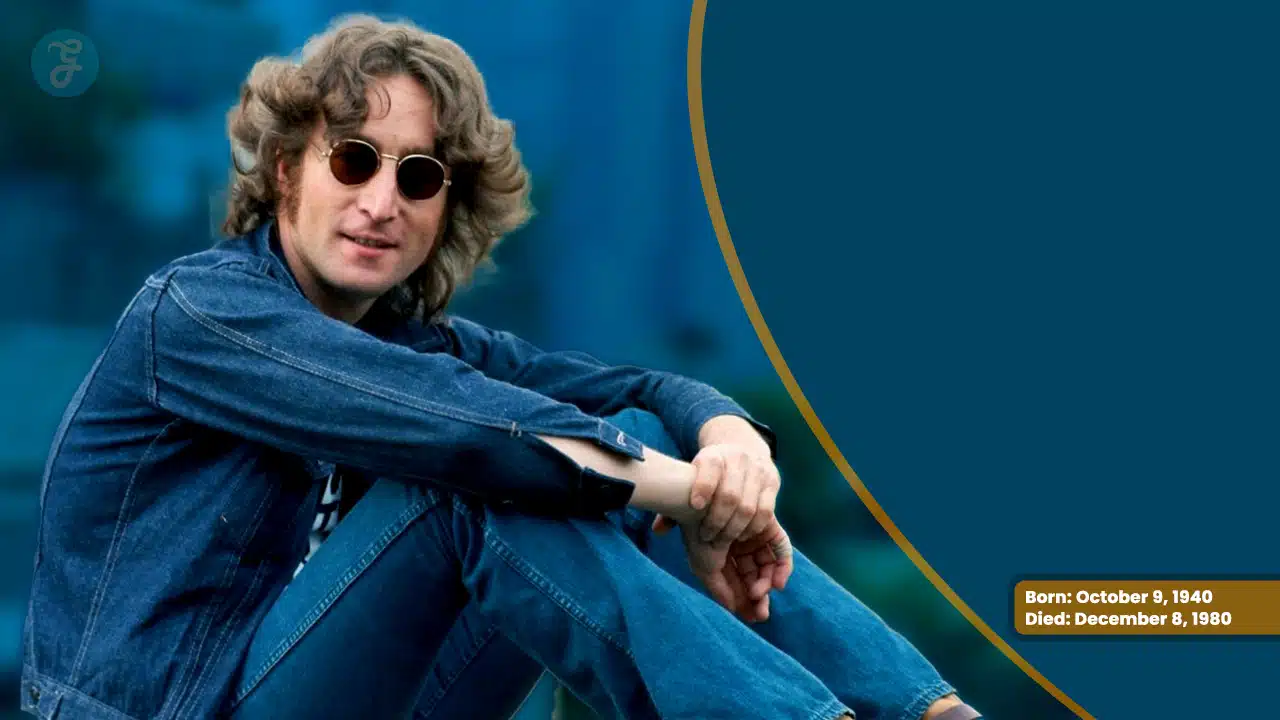
Have you ever found yourself humming “Imagine” and wondering about the man behind the round glasses? You’re not the only one. John Lennon wasn’t just a rock star; he was a force of nature who changed how we think about music, art, and peace. Today is his 45th death anniversary.
But sometimes, the legend can overshadow the real person.
You might know the hits, but do you know the story of the £10 mail-order guitar that started it all? Or the specific legal loophole a determined lawyer used to keep John in New York City? I’m going to walk you through the John Lennon story you haven’t heard yet.
We’ll go beyond the headlines to look at the grit, the love, and the specific moments that defined him. So, grab a cup of coffee and let’s go through it together.
Key Takeaways
- John Lennon was born in Liverpool on October 9, 1940, and later formed the most influential band in history with Paul McCartney, George Harrison, and Ringo Starr.
- The Beatles honed their craft during grueling 8-hour sets in Hamburg clubs like the Indra and Kaiserkeller (1960-1962) before conquering America with a record-breaking Ed Sullivan Show performance.
- Lennon’s activism was as loud as his music; he returned his MBE medal to the Queen and fought a years-long deportation battle in the US with lawyer Leon Wildes.
- His solo career produced anthems like “Imagine” and “Give Peace a Chance,” the latter recorded live in Room 1742 of the Queen Elizabeth Hotel in Montreal.
- Lennon’s legacy continues through projects like the Strawberry Fields memorial in Central Park and recent charity campaigns for War Child in 2024-2025.

What Shaped John Lennon’s Early Life and Musical Influences
John Lennon grew up at 251 Menlove Avenue in Liverpool, a home we now know as “Mendips.” While his father Alfred was absent and his mother Julia lost custody, his Aunt Mimi provided a stable, if strict, foundation. Interestingly, Yoko Ono later purchased this childhood home and donated it to the National Trust to ensure it remained preserved for fans like you.
Music entered his life through his mother, Julia. She played Elvis Presley records for him and taught him banjo chords, sparking a fire that school never could. While teachers at Dovedale Primary and Quarry Bank High School labeled him a class clown, he was busy creating The Daily Howl, a handmade magazine that showcased his sharp wit.
His first guitar wasn’t a fancy Fender or Gibson. It was a Gallotone Champion, a cheap acoustic model that he bought by mail order for about £10. It was a humble start for a future icon, but it was enough to launch the Quarrymen.
“The guitar’s all very well John, but you’ll never make a living out of it.”
— Aunt Mimi Smith (A famous warning she gave John, which he later engraved on a plaque for her after proving her wrong.)
The Beatles: Formation and Rise to Fame
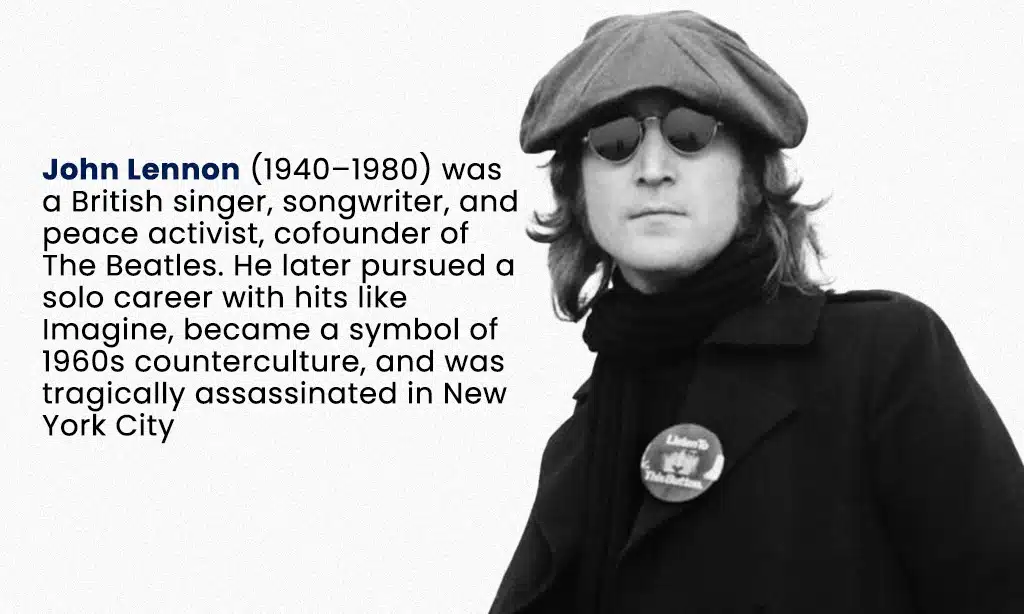
John Winston Lennon didn’t just stumble into fame; he worked for it. He met Paul McCartney at a church fête in Woolton on July 6, 1957, and their musical chemistry was instant. George Harrison joined soon after, auditioning on the top deck of a bus, and Ringo Starr completed the lineup later to replace Pete Best.
How Did The Beatles Form and Gain Popularity
The road to stardom wasn’t paved with overnight success. Before the screaming fans, the band cut their teeth in the gritty clubs of Hamburg, Germany. They played at venues like the Indra Club and the Kaiserkeller for up to eight hours a night. This exhausted them but also forged them into a tight, professional unit.
Their big break in America came on February 9, 1964. They performed on The Ed Sullivan Show to a staggering audience of 73 million viewers. To put that in perspective, that was roughly 40% of the entire US population at the time. It remains one of the most-watched television events in history.

| Era | The Grind (Hamburg 1960-62) | The Glory (Beatlemania 1964-66) |
|---|---|---|
| Venues | Small, smoky clubs like The Indra and The Star-Club | Massive arenas like Shea Stadium (55,000+ fans) |
| Pay | Barely enough to cover rent and food | Millions of dollars per tour |
| Schedule | Grueling 8-hour sets, 7 days a week | Short 30-minute sets due to screaming crowds |
Their songwriting partnership became legendary. Nobody before had woven pop hooks with smart lyrics quite like Lennon and McCartney did together. They moved from simple love songs like “Love Me Do” to complex masterpieces like “Strawberry Fields Forever,” which John wrote while reminiscing about a children’s home run by the Salvation Army near his aunt’s house.
What was The Beatles’ Impact on Music and Culture?
The Beatles changed everything. They stopped touring in 1966 after a final concert at Candlestick Park so they could focus on studio innovation. This decision led to Sgt. Pepper’s Lonely Hearts Club Band, an album that redefined what a rock record could be.
They also pioneered global broadcasting. In June 1967, over 400 million people watched them perform “All You Need Is Love” via satellite. It was the first live global musical event of its kind, proving that music could unite the world in real time.
John Lennon’s Solo Career and Activism
After the Beatles, John didn’t just make music; he made headlines. He used his platform to fight for what he believed in, often at great personal cost. His solo work, from the raw pain of John Lennon/Plastic Ono Band to the utopian hope of Imagine, was always honest.
How Did John Lennon Express His Political and Social Views
John’s activism was practical and bold. In 1969, he and Yoko Ono staged their famous “Bed-In for Peace” in Room 1742 of the Queen Elizabeth Hotel in Montreal. They didn’t just lie there; they invited the press and recorded “Give Peace a Chance” right in the room, with a chorus of celebrities and journalists singing along.
His outspoken stance against the Vietnam War scared powerful people. The Nixon administration actually tried to deport him to silence his voice before the 1972 election. John fought back by hiring Leon Wildes, a brilliant immigration lawyer. Wildes not only kept John in the US but also set legal precedents that are still used in immigration cases today.
What are John Lennon’s Most Iconic Solo Albums
Lennon’s solo discography is a journey through his mind. Imagine (1971) is the most famous, with its title track becoming a secular hymn for peace. The recording sessions at his home in Tittenhurst Park were captured on film, showing the meticulous way he built the song.

- John Lennon/Plastic Ono Band (1970): A raw, primal scream of an album where he dealt with the abandonment by his parents.
- Walls and Bridges (1974): Recorded during his separation from Yoko, this album features “Whatever Gets You thru the Night,” his only solo #1 hit during his lifetime.
- Double Fantasy (1980): His comeback album with Yoko Ono, released just weeks before his death, celebrating domestic bliss and new beginnings.
What Were John Lennon’s Key Personal Relationships
John’s relationships were intense and fueled his art. His first marriage to Cynthia Powell gave him his son Julian, but it was kept secret initially to protect his “heartthrob” image. However, it was his partnership with Yoko Ono that defined the second half of his life.
How did Yoko Ono Influence John Lennon’s Creativity
Meeting Yoko Ono at the Indica Gallery in London on November 9, 1966, changed John’s trajectory. She introduced him to conceptual art and avant-garde expression. Together, they weren’t just a couple; they were an artistic unit. They released experimental albums like Two Virgins and used their honeymoon to protest war.
What was John Lennon’s Family Life Like
It wasn’t always smooth sailing. In 1973, John and Yoko separated for 18 months in a period John called his “Lost Weekend.” During this time, he lived in Los Angeles with their assistant, May Pang. It was a chaotic but productive time; he produced an album for Harry Nilsson and famously got kicked out of The Troubadour club for heckling the Smothers Brothers.
He eventually reunited with Yoko, and on October 9, 1975—John’s own 35th birthday—their son Sean was born. John famously retired from the music business for five years to become a “house husband,” baking bread and raising Sean in their apartment at The Dakota in New York City.
John Lennon’s Legacy and Cultural Impact
John Lennon’s influence is woven into the fabric of modern culture. You can feel it when you visit the Strawberry Fields memorial in Central Park. The black-and-white “Imagine” mosaic there wasn’t a local purchase; it was a gift from the city of Naples, Italy, showing just how global his impact really was.
How has John Lennon Influenced Music and Art
His songs are timeless. “Imagine” is played at Olympics and protests alike. Artists like David Bowie and Elton John credited him as a major influence; he even co-wrote “Fame” with Bowie, giving the younger star his first US #1 hit.
His estate continues to keep his work alive for new generations. In 2024 and 2025, his song “Happy Xmas (War Is Over)” was the centerpiece of a campaign for the War Child charity, proving that his message of peace is as relevant now as it was 50 years ago. New mixes and “demixing” technology used in The Beatles Anthology projects allow us to hear his voice with stunning new clarity.
Takeaways
John Lennon was more than a Beatle. He was a father, a husband, a rebel, and a seeker of truth. From the small clubs of Liverpool to the streets of New York, he never stopped asking us to imagine a better world.
His legacy isn’t just in the records he sold but in the courage he showed. He taught us that peace isn’t just a wish; it’s something you have to make.
Tomorrow is uncertain, but John’s message is clear. If you want peace, you have to stand up and ask for it. War is over, if you want it.
FAQs on John Lennon
1. Who was John Lennon, and why do people call him a legend?
Born John Winston Lennon, he later changed his name to John Ono Lennon and evolved from writing simple tunes like “Hello Little Girl” to creating anthems that defined a generation. He was fearlessly honest, referring to his vulnerable 1965 phase as his “Fat Elvis” period and courting controversy with bold statements like “we’re more popular than Jesus.” His legacy as a rebel and poet remains powerful, from his “Strawberry Fields Forever” genius to his activism in New York.
2. How did Yoko Ono influence John Lennon’s life and work?
Yoko Ono introduced John to the avant-garde world, leading to the “John and Yoko” creative partnership that produced conceptual art and the hit “Happy Xmas (War Is Over).” They chronicled their wedding in “The Ballad of John and Yoko” and experimented with unique sounds on tracks like “Airmale,” which used automated machines built by Fluxus artist Joe Jones. While some fans blamed her for the group’s tension, she unlocked a new level of artistic freedom in him.
3. What led to The Beatles’ break-up?
The band’s break-up was caused by a mix of business disputes involving manager Allen Klein, personal creative clashes, and the death of Brian Epstein during a seminar in Bangor, Wales. Tensions were high during the “White Album” sessions, where Ringo temporarily quit during “Back in the U.S.S.R.,” and outside influences like “Magic Alex” (Alexis Mardas) caused distractions. Even loyal aides like Mal Evans could not hold the group together as they drifted apart after their time with the Maharishi.
4. Did John Lennon ever perform without The Beatles?
Yes, he performed with The Dirty Mac at “The Rolling Stones Rock and Roll Circus” and debuted his Plastic Ono Band at Live Peace in Toronto 1969. After the split, he wrote “I’m the Greatest” for Ringo Starr and played piano on the album “Ringo’s Rotogravure,” proving he remained active with his former bandmates.
5. Why is “I Am the Walrus” so famous among fans?
“I Am the Walrus” is celebrated for its surreal lyrics and complex production, which John deliberately wrote to confuse students and scholars who were over-analyzing his work.
6. How does John Lennon’s legacy live on today?
The John Lennon Estate continues to share his work through projects like the “Real Love” anthology release, while historians like Jon Wiener have fought to release FBI files detailing his political support for the Chicago Seven and the International Marxist Group. His interview with the “Red Mole” newspaper remains a key document of his radical politics, ensuring his voice as an activist is remembered alongside his music.