
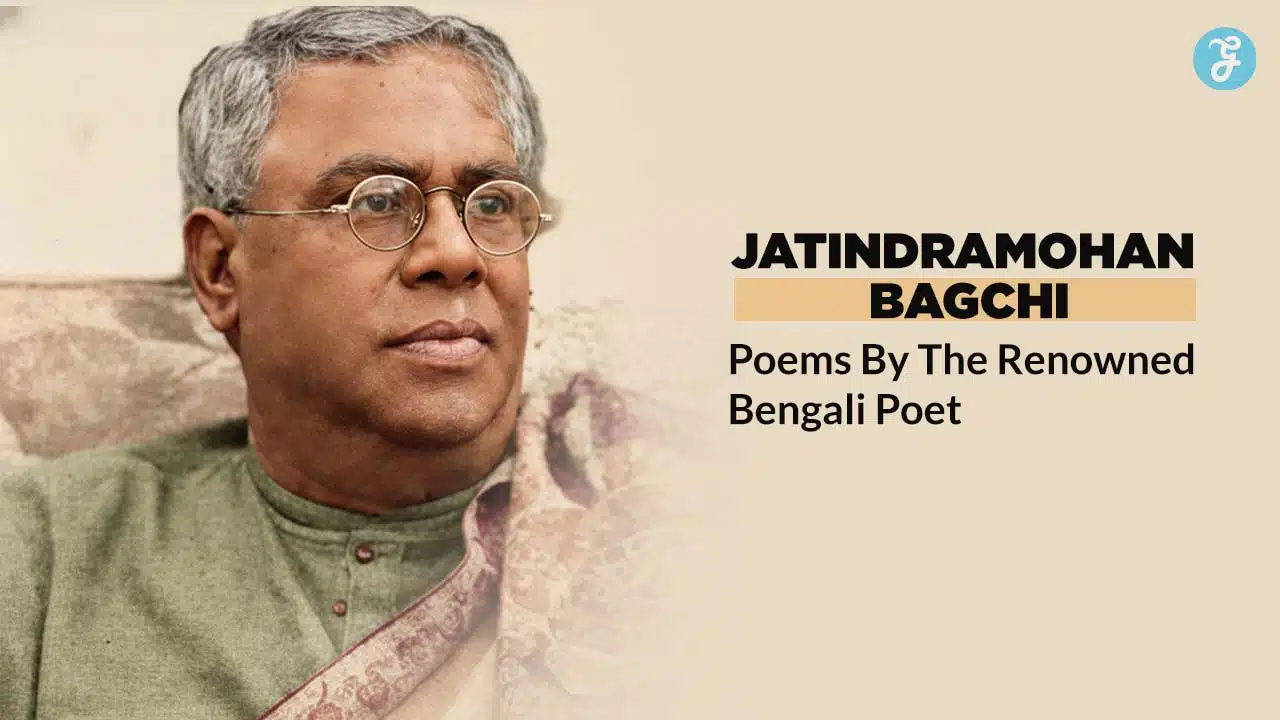
You want to learn about Bengali poets, but good information is hard to find. Maybe you’ve heard of Jatindramohan Bagchi. Maybe you’ve read some of his poems. But nobody explains his work in simple words.
You just want someone to tell you why his poetry matters. You want to know where to read it.
Jatindramohan Bagchi was He was born on November 27, 1878, in Jamerpur, Nadia district. His name appears in many Bengali books. Banglapedia mentions him. So does the Encyclopaedia of Indian Literature. But he doesn’t have a full Wikipedia page yet.
This post explains who Jatindramohan Bagchi was. It shows why his poetry still matters today. You’ll learn about his best works. You’ll also discover where to find his poems online or in libraries like archive.org.
Want to learn about this great Bengali poet? Keep reading. You’re about to find something special!
Key Takeaways
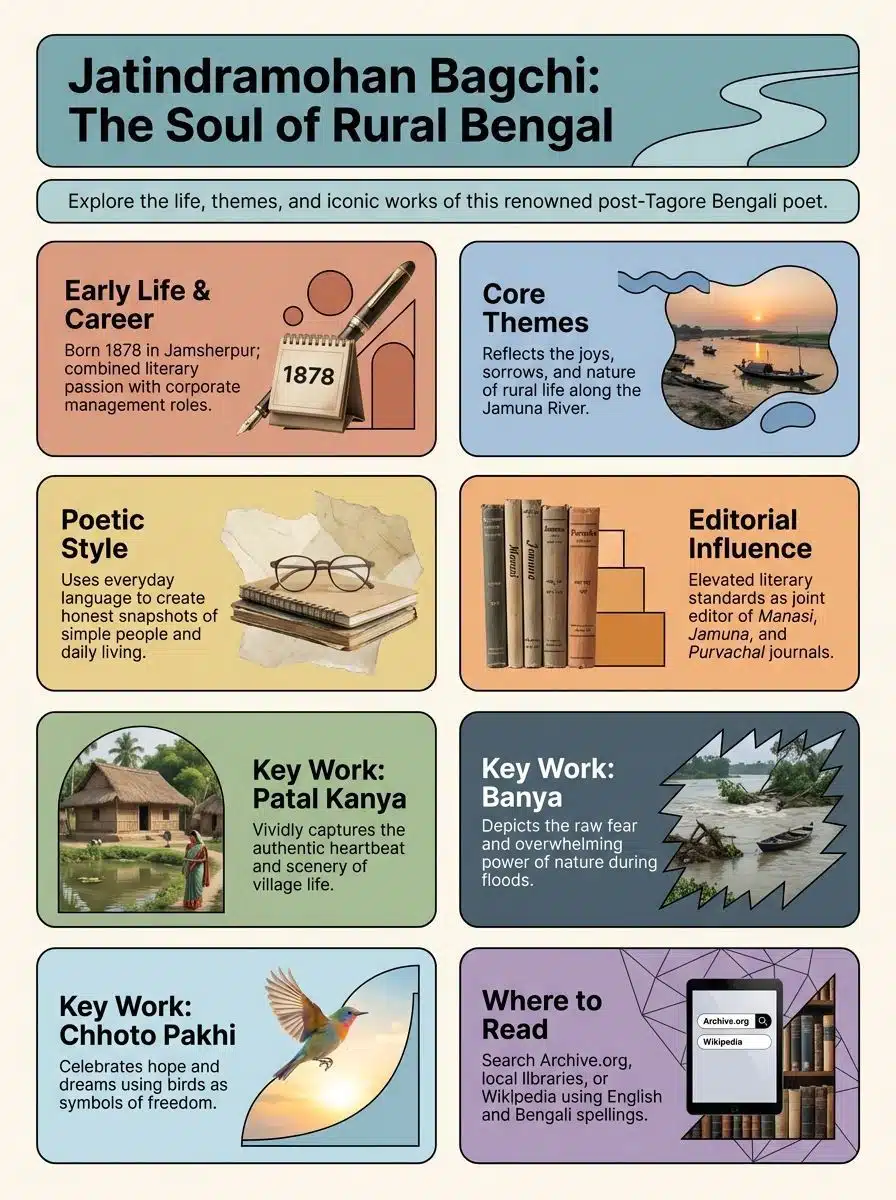
- Jatindramohan Bagchi was born on November 27, 1878, in Jamsherpur, Nadia district. He died in February 1948.
- His poems show rural Bengal life. He writes about nature, rivers, fields, family bonds, happiness, and sadness.
- His famous works include “Patal Kanya,” “Banya,” “Smriti,” “Chhoto Pakhi,” and “Phul Mala” (1909-1913).
- He edited journals like Manasi (1909-1913), Jamuna (1921-1922), and Purvachal (1947-1948). He helped young writers while working at FN Gupta Company.
- You can find his poems on archive.org. Search for “Jatindramohan Bagchi” in libraries or Bengali websites.
Importance of Jatindramohan Bagchi’s Poetry
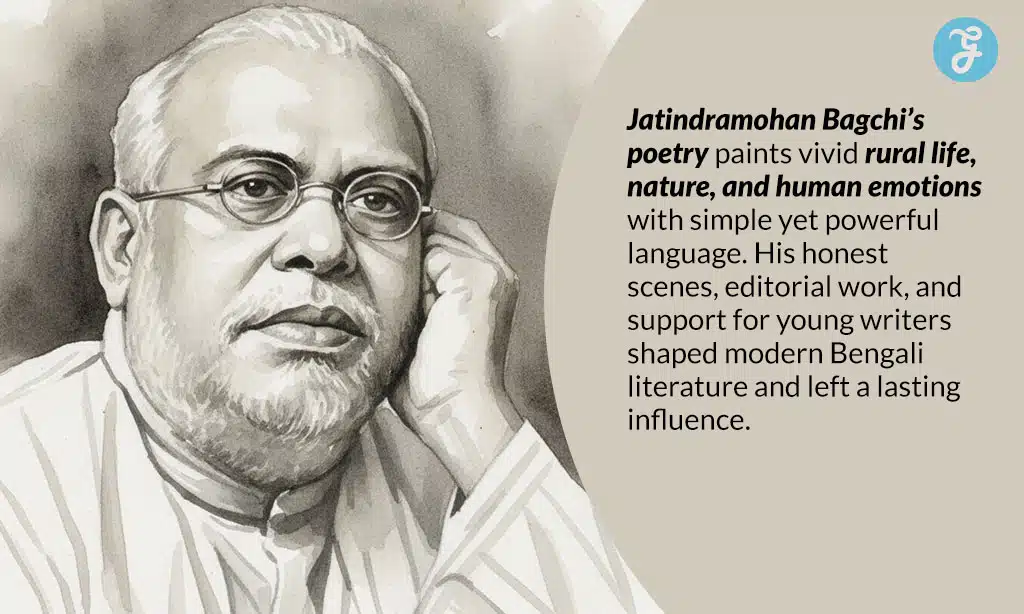
Jatindramohan Bagchi’s poems capture village life like pictures in words. His writing shaped Bengali poetry. He inspired many editors at journals like Manasi in Kolkata. The way he describes joy and sorrow feels like watching ripples on the Jamuna River.
What themes and emotions are explored in his poems?
Fields and rivers come alive in his poetry. The Jamuna River flows through his words. Village life breathes in every line. He writes about nature and simple people with deep feelings.
Each line makes you feel present in the scene. You walk with farmers. You sit by the Kolkata countryside at sunset. His words paint these pictures clearly.
Bagchi uses simple words to share big feelings. He writes about calm hope and quiet pain. He captures laughter after hard times. His work shows the worries of zamindar life. He explores social change and family bonds. From 1909 to 1922, his poems caught small moments. A child’s smile during a festival becomes powerful. Loss feels real and close.
Critics say he captures Bengali poetry’s heart through honest scenes. He doesn’t need grand palaces. He just needs real people under wide skies. These people live from Calcutta to Natore. They face real problems and find real joy.
How did he influence Bengali literature?
Jatindramohan Bagchi changed Bengali literature in important ways. He learned from Rabindranath Tagore’s style. Then he added his own ideas. This created something new after Tagore’s time.
He worked as manager of FN Gupta Company. Later, he became secretary to Justice Saradacharan Mitra. Even with these busy jobs, he kept writing poems. His poems touched readers’ hearts deeply.
His work in magazines helped many writers grow. As joint editor at Manasi (1909-1913), he raised standards. He did the same at Jamuna (1921-1922) and Purvachal (1947-1948). These journals became better across West Bengal because of him.
Bagchi gave young writers chances to publish. Their work appeared next to his poems. His contributions to Mahabharati magazine spread across বাংলা সাহিত্য. The Kolkata Municipal Corporation noticed his work. Even Sahitya Akademi recognized him.
He was born in November 1878 in Jamshedpur. He studied at Duff College. Scottish Church College ideals shaped his thinking. These ideas stayed with him until February 1948.
In every poem and edit, he welcomed new thoughts. He mixed old stories from the Mahabharata with modern life. He wrote about life near the Jamuna River in Bangladesh. Today, you can see his style in modern Bengali poetry. His work appears on the Internet Archive. Libraries list his books with ISBN codes worldwide.
What are some notable poems by Jatindramohan Bagchi?
Jatindramohan Bagchi worked as both a poet and an editor. His poems still shine in Bengali literature. Students study them today. Here are his most famous works:
- “Patal Kanya” shows rural Bengal with amazing detail. It captures village life like a perfect photograph.
- “Banya” describes the fear and power of floods. It shows how nature changes people’s lives in Bangladesh.
- “Smriti” explores deep feelings about memory. It talks about loss in ways that touch many hearts.
- “Chhoto Pakhi” celebrates hope through simple joys. Birds become symbols for freedom and dreams in this poem.
- “Phul Mala” came out between 1909 and 1913. Its sweet melodies stayed popular in Kolkata’s literary circles for years.
- Journals run by Jagadindra Nath Roy published his poems. This happened while he managed FN Gupta Company.
- The Encyclopedia from the Asiatic Society of Bangladesh mentions many of his works. Writers like Ishita Bhaduri celebrate these poems. Projects like Jatindramohan Bagchi 125 honor his memory.
- He used rural themes in his writing. Critics say he came right after Tagore’s era with his own voice. He inspired later writers to love their simple roots.
Where can I find collections of Jatindramohan Bagchi’s poems?
Start your search on Wikipedia. Type “Jatindramohan Bagchi” in the search box. Try different spellings too. Wikipedia’s titles need exact spelling to work. The site lets you save files and print pages. You can even use QR codes to read poems on your phone during your commute.
Search tools help you find new articles about his work. Sometimes new content takes time to show up. This happens because databases need updating. Check the deletion log if a page seems missing. Sometimes collections get removed but still appear in logs.
Want more options? The Wayback Machine saves old web pages. It has past collections of Jatindramohan’s poetry stored online. Local libraries might have his books too. Kolkata’s Duff College could have printed books from his time.
He worked as owner and editor of literary journals. He managed FN Gupta Company. Books from these times might be in special collections. Many works connect to Bengal’s rich history. You might find maharaja stories or magazine debates he led.
This poet earned his degree from Duff College. He later joined the Maharaja of Natore’s circle. Libraries near these places often have his work.
Takeaways
Jatindramohan Bagchi’s poems light up Bengali literature like bright stars in the night sky. His words make people think about life’s happiness and sadness. Schools from Kolkata’s Duff College to Scotland shaped his path. His wisdom fills many libraries today.
You can find his poetry in journals and books if you look for them. Search online or visit your local library. Jatindramohan Bagchi’s work keeps inspiring new readers. One simple verse at a time, his poetry lives on.
FAQs on Jatindramohan Bagchi
1. Where did Jatindramohan Bagchi study, and what degree did he earn?
He studied at Kolkata’s Duff College and earned a degree from there. Later, he also attended the Scottish Church College.
2. What roles did Jatindramohan Bagchi hold outside poetry?
Besides writing poems, he worked as manager of the FN Gupta Company. He was involved with several literary journals and spent time in library settings for research and criticism.
3. Did his poems touch on topics like Islam or Scotland?
Yes, some of his works mention themes related to Islam or even places like Scotland; these references add layers to his poetry that readers often discuss.
4. How is education reflected in Bagchi’s life and work?
Education shaped him deeply; you see it not just through his degrees but also through how he used libraries for learning and contributed thoughtful criticism to a number of literary journals.