Post-holiday burnout is no longer a personal weakness. In 2026, “January Anxiety” is spiking in remote teams because the calendar resets faster than the mind can recover, while always-on digital work, isolation, and Q1 pressure collide. What looks like mood is often an operational design problem.
Key Takeaways
- “January Anxiety” is rising because remote work turns the new-year reset into a high-friction restart: backlog, goal-setting, and coordination costs all hit at once.
- Digital work has quietly expanded into an “infinite workday,” where interruptions, ad hoc meetings, and after-hours messaging make recovery harder.
- Remote teams often show strong engagement but weaker overall thriving, driven by loneliness, boundary erosion, and cognitive overload.
- The business risk is measurable: higher burnout indicators, higher turnover intent, and a growing gap between benefits offered and support felt.
- 2026 will reward companies that redesign how work flows, not just where it happens: boundary rules, manager capability, and asynchronous norms will separate resilient teams from fragile ones.
The Post-Holiday Collision: Why The “Reset” Feels Like A Restart Without A Runway
January has always carried psychological weight. But remote work changes the mechanics of the month. In a traditional office rhythm, the first week back often includes informal re-entry: hallway conversations, soft scheduling, and quick visibility into priorities. Remote teams return to a different reality. Work resumes at full speed the moment devices turn back on, and many of the cues that help people reorient are missing.
This is the first driver of January Anxiety in Remote Teams: remote work compresses the “re-entry period.” People come back to overflowing channels, reopened projects, and a new set of Q1 expectations, while their bodies and routines are still recovering from disrupted sleep, travel, and social intensity. The result is a mismatch between emotional bandwidth and operational demand.
The second driver is structural. Over the last few years, distributed work has encouraged more meetings, more “quick pings,” and more cross-time-zone collaboration. That can be productive, but it also creates a constant sense of being behind. The holiday break does not just pause work. It pauses coordination. When everyone returns, coordination debt comes due.
A third driver is goal pressure. January is where strategy becomes execution. Leaders cascade objectives, teams rebuild roadmaps, and individuals try to prove momentum early. In remote settings, the urge to demonstrate value can intensify because visibility feels fragile. That can push people into performative busyness: extra meetings, faster replies, and more after-hours cleanup, even when the organization says it values wellbeing.
Below is what the “infinite workday” looks like in real operational signals, not emotions. The pattern matters because anxiety grows when people feel they cannot control their time.
| Signal Of Always-On Work | What It Means In Practice | Why It Hits Hard In January |
| Interruptions every ~2 minutes during core hours (high-volume users) | Focus breaks constantly from meetings, emails, and chat | People try to “catch up” and plan Q1, but cannot get uninterrupted time |
| Up to 275 “pings” per day across a 24-hour period (high-volume users) | Work follows employees into the evening and morning | The brain never fully exits work mode, so recovery stays incomplete |
| 60% of meetings called ad hoc (high-volume users) | Calendars become reactive, not planned | January planning becomes chaotic because the schedule cannot stabilize |
| After-hours chats up year over year, with many messages arriving outside 9–5 | Communication shifts into off-hours as default | Remote teams restart across time zones, increasing late and early messaging |
| Late meetings and multi-time-zone scheduling rising | Coordination expands globally | January goal cascades multiply stakeholders, increasing cross-zone load |
The deeper point is this: January Anxiety in Remote Teams is not only a seasonal feeling. It is a predictable response to a work system that restarts at full intensity without rebuilding guardrails first.
Engaged But Not Thriving: Why Remote Work Can Amplify Anxiety Through Isolation And Boundary Erosion
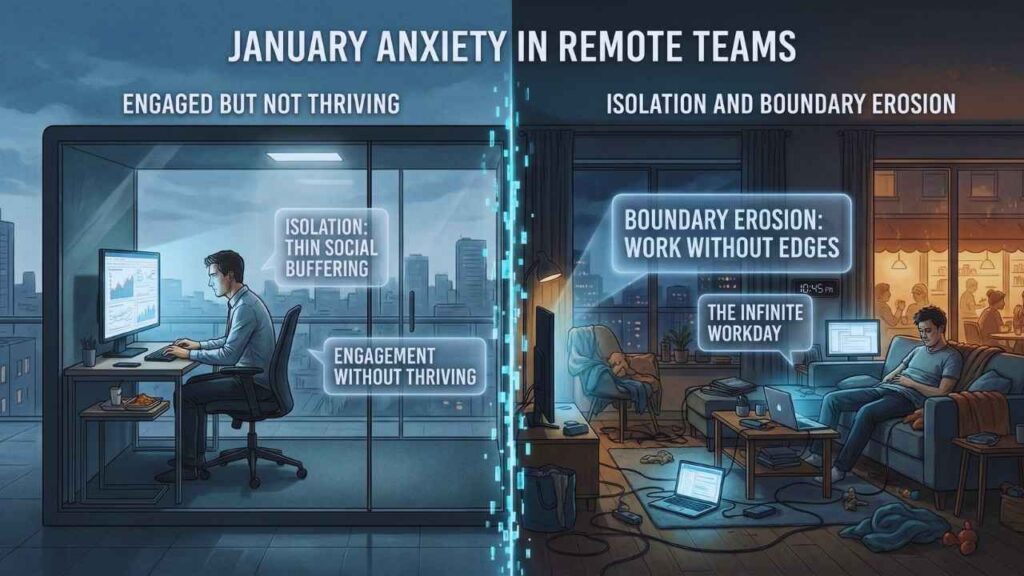
A major reason “January Anxiety” is spiking is that remote work can produce a paradox: people can feel committed to their work while feeling worse in their lives. That combination is especially destabilizing in January because the month already pushes reflection, comparison, and self-judgment.
Remote workers often report higher engagement, partly because autonomy helps people shape their day and do deep work when conditions are right. But thriving is broader than engagement. Thriving depends on sleep, social support, optimism, and the sense that life is manageable. Remote work can weaken these supports in subtle ways.
One pathway is social nutrition. Offices provided “ambient connection,” even for introverts: quick laughter, shared lunch plans, and low-stakes conversation. Remote work often replaces that with scheduled connection, which can feel transactional. Over time, employees can start to experience work as a stream of tasks rather than a community.
Another pathway is boundary confusion. Flexibility can raise stress when it shifts responsibility for time management entirely onto the employee. Many remote workers carry the invisible burden of self-coordination: deciding when to stop, when to respond, and how to prove responsiveness without burning out. In January, that burden often spikes because there is more planning, more stakeholder alignment, and more “fresh start” expectations.
Here is the engagement-versus-thriving picture, which helps explain why anxiety can rise even when teams appear productive.
| Work Arrangement | Engagement (Work Attachment) | Thriving (Life Evaluation) | Stress Reported | What This Suggests |
| Fully Remote | Higher | Lower | Higher or comparable | Autonomy helps engagement, but isolation and boundary load can hurt wellbeing |
| Hybrid | Middle | Higher | High | Flexibility helps, but coordination and context switching can raise stress |
| On-Site (Remote-Capable) | Middle | Higher | Lower | Social and structural cues support stability |
| On-Site (Non-Remote-Capable) | Lower | Lower | Lower | Different stress profile, often linked to lower autonomy |
The story becomes sharper when you add a third layer: connection and loneliness across society. Remote teams do not exist in a vacuum. Many workers entered 2026 already feeling emotionally stretched, politically stressed, and financially cautious. When the broader world feels unstable, the workplace becomes a primary source of security, identity, and belonging. If remote work does not provide belonging, anxiety rises.
January adds its own seasonal amplifier. Shorter daylight and disrupted routines can worsen mood for many people, and a smaller portion experience seasonal affective disorder. Remote work can intensify this by reducing incidental movement, sunlight exposure, and casual social contact.
Here are connection-related indicators that help explain why January can feel heavier in remote teams.
| Indicator Of Connection Strain | Recent Measure | Why It Matters For Remote Teams In January |
| Adults who say they needed more emotional support | Large majority | When support needs rise, remote workers may feel the gap more sharply |
| People reporting loneliness markers (feeling isolated, left out, lacking companionship) | Around half in major surveys | Remote work removes casual contact that can buffer these feelings |
| People eating all meals alone on a given day | About 1 in 4 (U.S. measure in 2023) | Eating alone is a proxy for reduced daily social touchpoints |
| Regions reporting fewer shared meals per week (global survey patterns) | Low in several regions | Less shared routine can reduce baseline wellbeing and resilience |
Put simply, January Anxiety in Remote Teams spikes when three things overlap: high work pressure, thin social buffering, and weak boundaries. Productivity can still look strong, which is why leaders miss the risk until attrition, conflict, or health issues surface.
The Operational Tax Of Remote Work: Coordination Overload, Digital Intensity, And “Work About Work”
Leaders often treat January anxiety like a morale issue. But in remote teams, morale and mechanics are linked. Anxiety rises when people cannot predict their day, cannot finish meaningful work, and cannot disconnect without consequences.
Remote work increases what researchers often describe as “time-space intensification.” The simplest way to understand this is that work no longer has natural edges. The commute does not separate roles. The office door does not close. The team’s working hours blur when collaboration spans time zones. Digital tools make it easy to keep going, so the system keeps going.
This creates a coordination tax. A portion of time shifts from producing outcomes to managing alignment: status updates, clarifying messages, documenting decisions, and attending meetings that exist because information does not travel organically. In January, the coordination tax spikes because priorities are being reset. Everyone is asking, “What matters now?” and the organization often answers with more meetings.
Digital intensity also changes stress thresholds. Research in digital workplaces suggests stress rises when off-hours digital actions and virtual meeting loads exceed certain levels. That aligns with common experience: a few late messages are manageable, but a constant drip of off-hours work turns evenings into a low-grade state of vigilance.
Add one more layer: remote work exposes weak management systems. In-person workplaces could hide ambiguity because employees could “sense” what leaders wanted through proximity and observation. Remote work requires explicit clarity. When clarity is missing, people fill the gap with anxiety-driven behavior: over-communicating, responding instantly, and staying online longer to avoid being seen as disengaged.
That anxiety often looks like a performance strategy, but it is fragile. It creates three predictable outcomes:
- Less deep work, because the day fragments.
- More conflict, because people misread tone and urgency in text.
- More burnout, because recovery time shrinks.
The next matrix shows why certain remote practices reduce January Anxiety, while others quietly increase it.
| Remote Practice | Short-Term Benefit | Hidden Cost | Burnout Risk In January |
| “Always available” messaging norms | Faster responses | Chronic vigilance, sleep disruption | High |
| More meetings to “stay aligned” | Temporary clarity | Calendar saturation, less execution time | High |
| Daily standups with real decisions | Keeps momentum | Can become status theater if unmanaged | Medium |
| Async-first updates with clear owners | Reduces meeting load | Requires discipline and good writing | Low |
| Protected focus blocks across the team | Higher output quality | Needs leader enforcement | Low |
| Explicit response-time expectations | Reduces uncertainty | Requires cultural reset | Low |
| “Quick check-in” meetings with no agenda | Feels connective | Often wastes energy and time | Medium to High |
The lesson is uncomfortable but useful: remote work does not automatically create burnout, but unmanaged remote work does. January simply exposes the weaknesses first because it is a month of restarts, evaluations, and renewed expectations.
Why This Matters For Business: The Retention, Performance, And Culture Costs Of January Anxiety
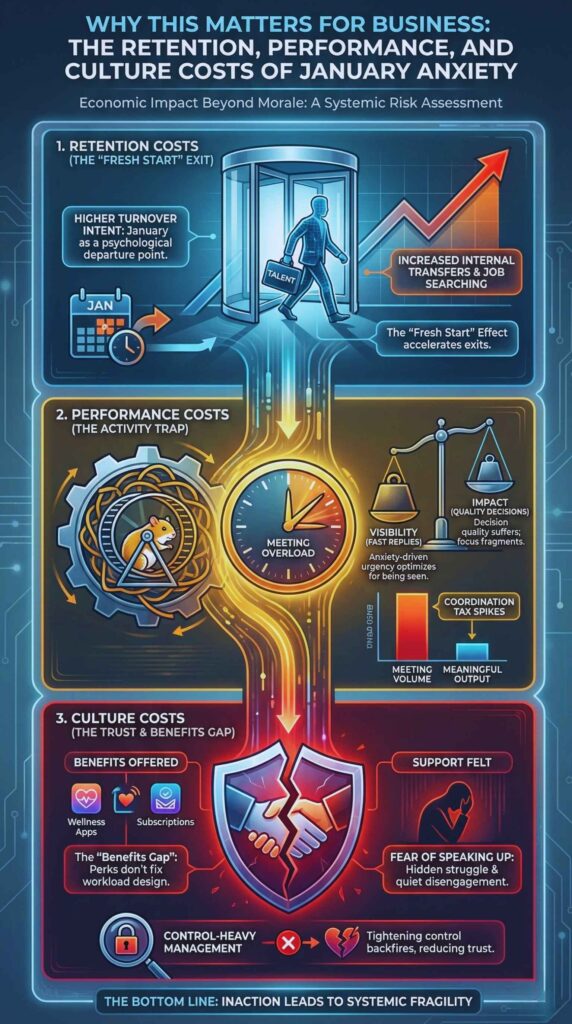
January Anxiety is not just about feelings. It affects labor economics inside the company: retention risk, performance variability, and the trust employees place in leadership.
Several workforce studies show that a large share of employees report significant levels of burnout, depression, or anxiety symptoms, and many worry about career consequences if they speak openly about mental health. That fear matters in remote teams because leaders rely more on self-reporting. If employees feel unsafe to say “I’m struggling,” the organization sees problems only after they become expensive.
There is also a “benefits gap” problem. Companies have expanded mental health programs, subscriptions, and wellness tools. Yet employees often say flexibility and work-life balance matter more than additional benefits. This is crucial for January because the highest-impact intervention is often not another resource. It is workload design and boundary clarity.
Remote teams also face a measurement trap. Some leaders respond to anxiety by tightening control: more check-ins, more monitoring, stricter response expectations. That can backfire. When employees already feel behind, control-heavy approaches increase stress and reduce trust. The organization then spends more effort managing symptoms rather than fixing causes.
Here is the business side of the equation in practical indicators leaders can monitor in Q1.
| Indicator Leaders Can Track | What It Often Signals | Why It Predicts January Anxiety |
| Rising after-hours messaging and weekend activity | Boundary erosion and workload overflow | Recovery time shrinks right when pressure rises |
| Meeting volume increases while output slows | Coordination tax and unclear priorities | Teams spend time talking about work, not doing it |
| Faster response times but lower quality decisions | Anxiety-driven urgency | People optimize for visibility instead of impact |
| Higher sick days or “quiet disengagement” | Burnout progression | January stress becomes physical fatigue |
| Higher internal transfers or job searching | Retention risk | January is a psychological “fresh start” month for exits |
| More manager overwhelm and inconsistent feedback | Leadership capacity gap | Teams feel unsafe when guidance is unstable |
It also matters for competitiveness. In 2026, many firms are still negotiating work models, from fully remote to stricter hybrid. Anxiety patterns can influence that debate. If executives interpret remote burnout as proof remote work “doesn’t work,” they may mandate office returns that solve some issues but create others, including commute burden, reduced flexibility, and talent loss.
A more accurate interpretation is this: the companies that win will not pick a location. They will build a coherent operating system. January Anxiety becomes a diagnostic tool. It reveals whether the organization’s system can handle resets without breaking people.
What Comes Next In 2026: Boundary Design, Manager Capability, And The Next Phase Of Remote Work
If January Anxiety in Remote Teams is rising, what comes next is not just a wellness trend. It is a governance trend.
Across markets, policymakers and institutions are paying more attention to the “always-on” culture enabled by digital work. “Right to disconnect” frameworks have expanded in some jurisdictions, and discussions continue in others. Even when laws do not apply to a company’s geography, the cultural signal travels: employees increasingly expect clear boundaries and fair norms around off-hours contact.
In 2026, companies will likely face three pressure points at once.
First, employees will keep demanding clarity, not slogans. “We value work-life balance” will not land if the system still rewards instant replies and late-night meetings. The organizations that reduce anxiety will write policies that define response expectations by role, urgency, and time zone, then enforce them consistently.
Second, manager capability will become the choke point. Remote teams depend on managers who can set priorities, reduce meeting load, coach performance without surveillance, and create psychological safety in a digital environment. Many managers were promoted for individual performance, not for leading distributed systems. When managers struggle, anxiety spreads downward.
Third, AI and automation will become both a risk and an opportunity. AI can reduce “work about work” by summarizing meetings, drafting updates, and helping teams manage information overload. But if AI increases the volume of content and expectations, it can intensify digital intensity. The winning approach will treat AI as a capacity tool with guardrails, not as a productivity weapon.
A practical 2026 playbook to reduce January Anxiety in Remote Teams usually includes:
- A two-week “re-entry runway” in early January where teams limit meetings, focus on priorities, and rebuild rhythms before heavy execution.
- Organization-wide rules for ad hoc meetings, including agenda requirements and default time limits.
- Protected focus blocks, with leadership modeling compliance.
- Clear escalation pathways so “urgent” has a shared definition.
- Structured social connection that is not forced fun, like optional co-working sessions, small-group mentoring, or time-zone-friendly community rituals.
- PTO buffers that protect the first day back from meetings and protect the last day before PTO from last-minute fire drills.
Predictions should stay humble, but the indicators are clear. Analysts suggest 2026 will reward firms that redesign work as a system. Remote work will remain, hybrid will remain, and office work will remain. The differentiator will be whether leaders can prevent the infinite workday from turning January into a predictable mental health dip.
January Anxiety in Remote Teams is rising because the future of work has matured into a high-intensity digital operating environment without matching guardrails. The fix is not to shame employees for feeling anxious, and it is not to flood them with wellness content. Leaders need to redesign time, boundaries, and coordination so that recovery is possible and focus becomes normal again. In 2026, that redesign will separate resilient organizations from those that mistake burnout for a temporary mood.